1993 Edition
CIA World Factbook 1993 (Project Gutenberg)
Geography
Area
total area: 450 km2 land area: 450 km2 comparative area: slightly more than 2.5 times the size of Washington, DC
Climate
temperate; snowy, cold winters and cool, dry summers
Coastline
0 km (landlocked)
Environment
deforestation, overgrazing
International disputes
none
Irrigated land
NA km2
Land boundaries
total 125 km, France 60 km, Spain 65 km
Land use
arable land: 2% permanent crops: 0% meadows and pastures: 56% forest and woodland: 22% other: 20%
Location
Western Europe, between France and Spain
Map references
Europe, Standard Time Zones of the World
Maritime claims
none; landlocked
Natural resources
hydropower, mineral water, timber, iron ore, lead
Note
landlocked
Terrain
rugged mountains dissected by narrow valleys
People and Society
Birth rate
13.78 births/1,000 population (1993 est.)
Death rate
6.99 deaths/1,000 population (1993 est.)
Ethnic divisions
Spanish 61%, Andorran 30%, French 6%, other 3%
Infant mortality rate
8.1 deaths/1,000 live births (1993 est.)
Labor force
NA
Languages
Catalan (official), French, Castilian
Life expectancy at birth
total population: 78.22 years male: 75.35 years female: 81.34 years (1993 est.)
Literacy
total population: NA% male: NA% female: NA%
Nationality
noun: Andorran(s) adjective: Andorran
Net migration rate
25.92 migrant(s)/1,000 population (1993 est.)
Population
61,962 (July 1993 est.)
Population growth rate
3.27% (1993 est.)
Religions
Roman Catholic (predominant)
Total fertility rate
1.73 children born/woman (1993 est.)
Government
Administrative divisions
7 parishes (parroquies, singular - parroquia); Andorra, Canillo, Encamp, La Massana, Les Escaldes, Ordino, Sant Julia de Loria
Capital
Andorra la Vella
Chiefs of State
French Co-Prince Francois MITTERRAND (since 21 May 1981), represented by Veguer de Franca Jean Pierre COURTOIS (since NA); Spanish Episcopal Co-Prince Mgr. Juan MARTI Alanis (since 31 January 1971), represented by Veguer Episcopal Francesc BADIA Bata
Constitution
Andorra's first written constitution was drafted in 1991; adopted 14 March 1993; to take effect within 15 days
Digraph
AN
Diplomatic representation in US
Andorra has no mission in the US
Executive branch
two co-princes (president of France, bishop of Seo de Urgel in Spain), two designated representatives (French veguer, Episcopal veguer), two permanent delegates (French prefect for the department of Pyrenees-Orientales, Spanish vicar general for the Seo de Urgel diocese), president of government, Executive Council
Flag
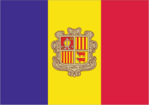
three equal vertical bands of blue (hoist side), yellow, and red with the national coat of arms centered in the yellow band; the coat of arms features a quartered shield; similar to the flags of Chad and Romania that do not have a national coat of arms in the center
General Council of the Valleys
last held 12 April 1992 (next to be held April 1996); results - percent of vote by party NA; seats - (28 total) number of seats by party NA
Head of Government
Executive Council President Oscar RIBAS Reig (since 10 Decmber 1989)
Independence
1278
Judicial branch
Supreme Court of Andorra at Perpignan (France) for civil cases, the Ecclesiastical Court of the bishop of Seo de Urgel (Spain) for civil cases, Tribunal of the Courts (Tribunal des Cortes) for criminal cases
Legal system
based on French and Spanish civil codes; no judicial review of legislative acts; has not accepted compulsory ICJ jurisdiction
Legislative branch
unicameral General Council of the Valleys (Consell General de las Valls)
Member of
INTERPOL, IOC
Names
conventional long form: Principality of Andorra conventional short form: Andorra local long form: Principat d'Andorra local short form: Andorra
National holiday
Mare de Deu de Meritxell, 8 September
Political parties and leaders
political parties not yet legally recognized; traditionally no political parties but partisans for particular independent candidates for the General Council on the basis of competence, personality, and orientation toward Spain or France; various small pressure groups developed in 1972; first formal political party, Andorran Democratic Association, was formed in 1976 and reorganized in 1979 as Andorran Democratic Party
Suffrage
18 years of age, universal
Type
parliamentary coprincipality under formal sovereignty of president of France and Spanish bishop of Seo de Urgel, who are represented locally by officials called veguers; to be changed to a parliamentary form of government
US diplomatic representation
Andorra is included within the Barcelona (Spain) Consular District, and the US Consul General visits Andorra periodically
Economy
Agriculture
sheep raising; small quantities of tobacco, rye, wheat, barley, oats, and some vegetables
Budget
revenues $119.4 million; expenditures $190 million, including capital expenditures of $NA (1990)
Currency
the French and Spanish currencies are used
Economic aid
none
Electricity
35,000 kW capacity; 140 million kWh produced, 2,570 kWh per capita (1992)
Exchange rates
French francs (F) per US$1 - 5.4812 (January 1993), 5.2938 (1992), 5.6421 (1991), 5.4453 (1990), 6.3801 (1989), 5.9569 (1988); Spanish pesetas (Ptas) per US$1 - 114.59 (January 1993), 102.38 (1992), 103.91 (1991), 101.93 (1990), 118.38 (1989), 116.49 (1988)
Exports
$23 million (f.o.b., 1989) commodities: electricity, tobacco products, furniture partners: France, Spain
External debt
$NA
Fiscal year
calendar year
Imports
$888.7 million (f.o.b., 1989) commodities: consumer goods, food partners: France, Spain
Industrial production
growth rate NA%
Industries
tourism (particularly skiing), sheep, timber, tobacco, banking
Inflation rate (consumer prices)
NA%
National product
GDP - purchasing power equivalent - $760 million (1992 est.)
National product per capita
$14,000 (1992 est.)
National product real growth rate
NA% (1992 est.)
Overview
The mainstay of Andorra's economy is tourism. An estimated 13 million tourists visit annually, attracted by Andorra's duty-free status and by its summer and winter resorts. The banking sector, with its "tax haven" status, also contributes significantly to the economy. Agricultural production is limited by a scarcity of arable land, and most food has to be imported. The principal livestock activity is sheep raising. Manufacturing consists mainly of cigarettes, cigars, and furniture. Although it is a member of the EC customs union, it is unclear what effect the European Single Market will have on the advantages Andorra obtains from its duty-free status.
Unemployment rate
0%
Communications
Highways
96 km
Telecommunications
international digital microwave network; international landline circuits to France and Spain; broadcast stations - 1 AM, no FM, no TV; 17,700 telephones
Military and Security
Note
defense is the responsibility of France and Spain