2009 Edition
CIA World Factbook 2009 (Project Gutenberg)
Introduction
Background
After more than a century of rule by France, Algerians fought through much of the 1950s to achieve independence in 1962. Algeria's primary political party, the National Liberation Front (FLN), has dominated politics ever since. Many Algerians in the subsequent generation were not satisfied, however, and moved to counter the FLN's centrality in Algerian politics. The surprising first round success of the Islamic Salvation Front (FIS) in the December 1991 balloting spurred the Algerian army to intervene and postpone the second round of elections to prevent what the secular elite feared would be an extremist-led government from assuming power. The army began a crackdown on the FIS that spurred FIS supporters to begin attacking government targets. The government later allowed elections featuring pro-government and moderate religious-based parties, but did not appease the activists who progressively widened their attacks. The fighting escalated into an insurgency, which saw intense fighting between 1992-98 and which resulted in over 100,000 deaths - many attributed to indiscriminate massacres of villagers by extremists. The government gained the upper hand by the late-1990s and FIS's armed wing, the Islamic Salvation Army, disbanded in January 2000. However, small numbers of armed militants persist in confronting government forces and conducting ambushes and occasional attacks on villages. The army placed Abdelaziz BOUTEFLIKA in the presidency in 1999 in a fraudulent election but claimed neutrality in his 2004 landslide reelection victory. Longstanding problems continue to face BOUTEFLIKA in his second term, including large-scale unemployment, a shortage of housing, unreliable electrical and water supplies, government inefficiencies and corruption, and the continuing activities of extremist militants. The Salafist Group for Preaching and Combat (GSPC) in 2006 merged with al-Qaida to form al-Qaida in the Lands of the Islamic Maghreb, which since has launched an ongoing series of kidnappings and bombings - including high-profile, mass-casualty suicide attacks targeted against the Algerian government and Western interests. Algeria must also diversify its petroleum-based economy, which has yielded a large cash reserve but which has not been used to redress Algeria's many social and infrastructure problems.
Geography
Area
total: 2,381,741 sq km country comparison to the world: 11 land: 2,381,741 sq km water: 0 sq km
Area - comparative
slightly less than 3.5 times the size of Texas
Climate
arid to semiarid; mild, wet winters with hot, dry summers along coast; drier with cold winters and hot summers on high plateau; sirocco is a hot, dust/sand-laden wind especially common in summer
Coastline
998 km
Elevation extremes
lowest point: Chott Melrhir -40 m highest point: Tahat 3,003 m
Environment - current issues
soil erosion from overgrazing and other poor farming practices; desertification; dumping of raw sewage, petroleum refining wastes, and other industrial effluents is leading to the pollution of rivers and coastal waters; Mediterranean Sea, in particular, becoming polluted from oil wastes, soil erosion, and fertilizer runoff; inadequate supplies of potable water
Environment - international agreements
party to: Biodiversity, Climate Change, Climate Change-Kyoto Protocol, Desertification, Endangered Species, Environmental Modification, Hazardous Wastes, Law of the Sea, Ozone Layer Protection, Ship Pollution, Wetlands signed, but not ratified: none of the selected agreements
Freshwater withdrawal (domestic/industrial/agricultural)
total: 6.07 cu km/yr (22%/13%/65%) per capita: 185 cu m/yr (2000)
Geographic coordinates
28 00 N, 3 00 E
Geography - note
second-largest country in Africa (after Sudan)
Irrigated land
5,690 sq km (2003)
Land boundaries
total: 6,343 km border countries: Libya 982 km, Mali 1,376 km, Mauritania 463 km, Morocco 1,559 km, Niger 956 km, Tunisia 965 km, Western Sahara 42 km
Land use
arable land: 3.17% permanent crops: 0.28% other: 96.55% (2005)
Location
Northern Africa, bordering the Mediterranean Sea, between Morocco and Tunisia
Map references
Africa
Maritime claims
territorial sea: 12 nm exclusive fishing zone: 32-52 nm
Natural hazards
mountainous areas subject to severe earthquakes; mudslides and floods in rainy season
Natural resources
petroleum, natural gas, iron ore, phosphates, uranium, lead, zinc
Terrain
mostly high plateau and desert; some mountains; narrow, discontinuous coastal plain
Total renewable water resources
14.3 cu km (1997)
People and Society
Age structure
0-14 years: 25.4% (male 4,436,591/female 4,259,729) 15-64 years: 69.5% (male 11,976,965/female 11,777,618) 65 years and over: 5.1% (male 798,576/female 928,709) (2009 est.)
Birth rate
16.9 births/1,000 population (2009 est.) country comparison to the world: 124
Death rate
4.64 deaths/1,000 population (July 2009 est.) country comparison to the world: 197
Education expenditures
5.1% of GDP (1999) country comparison to the world: 64
Ethnic groups
Arab-Berber 99%, European less than 1% note: almost all Algerians are Berber in origin, not Arab; the minority who identify themselves as Berber live mostly in the mountainous region of Kabylie east of Algiers; the Berbers are also Muslim but identify with their Berber rather than Arab cultural heritage; Berbers have long agitated, sometimes violently, for autonomy; the government is unlikely to grant autonomy but has offered to begin sponsoring teaching Berber language in schools
HIV/AIDS - adult prevalence rate
0.1%; note - no country specific models provided (2007 est.) country comparison to the world: 113
HIV/AIDS - deaths
fewer than 1,000 (2007 est.) country comparison to the world: 73
HIV/AIDS - people living with HIV/AIDS
21,000 (2007 est.) country comparison to the world: 76
Infant mortality rate
total: 27.73 deaths/1,000 live births country comparison to the world: 80 male: 30.86 deaths/1,000 live births female: 24.45 deaths/1,000 live births (2009 est.)
Languages
Arabic (official), French, Berber dialects
Life expectancy at birth
total population: 74.02 years country comparison to the world: 92 male: 72.35 years female: 75.77 years (2009 est.)
Literacy
definition: age 15 and over can read and write total population: 69.9% male: 79.6% female: 60.1% (2002 est.)
Median age
total: 26.6 years male: 26.3 years female: 26.8 years (2009 est.)
Nationality
noun: Algerian(s) adjective: Algerian
Net migration rate
-0.29 migrant(s)/1,000 population (2009 est.) country comparison to the world: 100
Population
34,178,188 (July 2009 est.) country comparison to the world: 36
Population growth rate
1.196% (2009 est.) country comparison to the world: 111
Religions
Sunni Muslim (state religion) 99%, Christian and Jewish 1%
School life expectancy (primary to tertiary education)
total: 13 years male: 13 years female: 13 years (2005)
Sex ratio
at birth: 1.05 male(s)/female under 15 years: 1.04 male(s)/female 15-64 years: 1.02 male(s)/female 65 years and over: 0.86 male(s)/female total population: 1.01 male(s)/female (2009 est.)
Total fertility rate
1.79 children born/woman (2009 est.) country comparison to the world: 157
Urbanization
urban population: 65% of total population (2008) rate of urbanization: 2.5% annual rate of change (2005-10 est.)
Government
Administrative divisions
48 provinces (wilayat, singular - wilaya); Adrar, Ain Defla, Ain Temouchent, Alger, Annaba, Batna, Bechar, Bejaia, Biskra, Blida, Bordj Bou Arreridj, Bouira, Boumerdes, Chlef, Constantine, Djelfa, El Bayadh, El Oued, El Tarf, Ghardaia, Guelma, Illizi, Jijel, Khenchela, Laghouat, Mascara, Medea, Mila, Mostaganem, M'Sila, Naama, Oran, Ouargla, Oum el Bouaghi, Relizane, Saida, Setif, Sidi Bel Abbes, Skikda, Souk Ahras, Tamanghasset, Tebessa, Tiaret, Tindouf, Tipaza, Tissemsilt, Tizi Ouzou, Tlemcen
Capital
name: Algiers geographic coordinates: 36 45 N, 3 03 E time difference: UTC+1 (6 hours ahead of Washington, DC during Standard Time)
Constitution
8 September 1963; revised 19 November 1976; effective 22 November 1976; revised 3 November 1988, 23 February 1989, 28 November 1996, 10 April 2002, and 12 November 2008
Country name
conventional long form: People's Democratic Republic of Algeria conventional short form: Algeria local long form: Al Jumhuriyah al Jaza'iriyah ad Dimuqratiyah ash Sha'biyah local short form: Al Jaza'ir
Diplomatic representation from the US
chief of mission: Ambassador David D. PEARCE embassy: 05 Chemin Cheikh Bachir, El-Ibrahimi, El-Biar 16000 Algiers mailing address: B. P. 408, Alger-Gare, 16030 Algiers telephone: [213] 770-08-2000
Diplomatic representation in the US
chief of mission: Ambassador Abdallah BAALI chancery: 2118 Kalorama Road NW, Washington, DC 20008 telephone: [1] (202) 265-2800
Executive branch
chief of state: President Abdelaziz BOUTEFLIKA (since 28 April 1999) head of government: Prime Minister Ahmed OUYAHIA (since 23 June 2008) cabinet: Cabinet of Ministers appointed by the president elections: president elected by popular vote for a five-year term; note - a November 2008 constitutional amendment abolished presidential term limits; election last held 9 April 2009 (next to be held in April 2014); prime minister appointed by the president election results: Abdelaziz BOUTEFLIKA reelected president for third term; percent of vote - Abdelaziz BOUTEFLIKA 90.2%, Louisa HANOUNE 4.2%, Moussa TOUATI 2.3%, Djahid YOUNSI 1.4%, Ali Fawzi REBIANE less than 1%, Mohamed SAID less than 1%
FAX
- [1] (202) 667-2174
- [213] 21-60-7355
Flag description
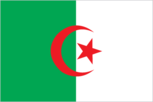
two equal vertical bands of green (hoist side) and white; a red, five-pointed star within a red crescent centered over the two-color boundary; the colors represent Islam (green), purity and peace (white), and liberty (red); the crescent and star are also Islamic symbols, but the crescent is more closed than those of other Muslim countries because the Algerians believe the long crescent horns bring happiness
Government type
republic
Independence
5 July 1962 (from France)
International organization participation
ABEDA, AfDB, AFESD, AMF, AMU, AU, BIS, FAO, G-15, G-24, G-77, IAEA, IBRD, ICAO, ICC, ICCt (signatory), ICRM, IDA, IDB, IFAD, IFC, IFRCS, IHO, ILO, IMF, IMO, IMSO, Interpol, IOC, IOM, IPU, ISO, ITSO, ITU, ITUC, LAS, MIGA, MONUC, NAM, OAPEC, OAS (observer), OIC, OPCW, OPEC, OSCE (partner), UN, UNCTAD, UNESCO, UNHCR, UNIDO, UNITAR, UNWTO, UPU, WCO, WFTU, WHO, WIPO, WMO, WTO (observer)
Judicial branch
Supreme Court
Legal system
socialist, based on French and Islamic law; judicial review of legislative acts in ad hoc Constitutional Council composed of various public officials including several Supreme Court justices; has not accepted compulsory ICJ jurisdiction
Legislative branch
bicameral Parliament consists of the Council of Nations (Senate) (144 seats; one-third of the members appointed by the president, two-thirds elected by indirect vote to serve six-year terms; the constitution requires half the council to be renewed every three years) and the National People's Assembly or Al-Majlis Al-Shabi Al-Watani (389 seats; members elected by popular vote to serve five-year terms) elections: National People's Assembly - last held 17 May 2007 (next to be held in 2012); Council of Nations (Senate) - last held 28 December 2006 (next to be held in 2009) election results: National People's Assembly - percent of vote by party - NA; seats by party - FLN 136, RND 61, MSP 52, PT 26, RCD 19, FNA 13, other 49, independents 33; Council of Nations - percent of vote by party - NA; seats by party - FLN 29, RND 12, MSP 3, RCD 1, independents 3, presidential appointees (unknown affiliation) 24; note - Council seating reflects the number of replaced council members rather than the whole Council
National holiday
Revolution Day, 1 November (1954)
Political parties and leaders
Ahd 54 [Ali Fauzi REBAINE]; Algerian National Front or FNA [Moussa TOUATI]; National Democratic Rally (Rassemblement National Democratique) or RND [Ahmed OUYAHIA]; National Liberation Front or FLN [Abdelaziz BELKHADEM, secretary general]; National Reform Movement or Islah (formerly MRN) [Ahmed ABDESLAM]; Rally for Culture and Democracy or RCD [Said SADI]; Renaissance Movement or EnNahda Movement [Fatah RABEI]; Socialist Forces Front or FFS [Hocine Ait AHMED]; Society of Peace Movement or MSP [Boudjerra SOLTANI]; Workers Party or PT [Louisa HANOUNE] note: a law banning political parties based on religion was enacted in March 1997
Political pressure groups and leaders
The Algerian Human Rights League or LADDH [Hocine ZEHOUANE]; SOS Disparus [Nacera DUTOUR]
Suffrage
18 years of age; universal
Economy
Agriculture - products
wheat, barley, oats, grapes, olives, citrus, fruits; sheep, cattle
Budget
revenues: $70.06 billion expenditures: $56.04 billion (2008 est.)
Central bank discount rate
4% (31 December 2008) country comparison to the world: 123 4% (31 December 2007)
Commercial bank prime lending rate
8% (31 December 2008) country comparison to the world: 107 8% (31 December 2007)
Current account balance
$35.27 billion (2008 est.) country comparison to the world: 14 $30.6 billion (2007 est.)
Debt - external
$3.753 billion (31 December 2008 est.) country comparison to the world: 113 $3.957 billion (31 December 2007 est.)
Distribution of family income - Gini index
35.3 (1995) country comparison to the world: 86
Economy - overview
The hydrocarbons sector is the backbone of the economy, accounting for roughly 60% of budget revenues, 30% of GDP, and over 95% of export earnings. Algeria has the eighth-largest reserves of natural gas in the world and is the fourth-largest gas exporter; it ranks 15th in oil reserves. Sustained high oil prices in recent years have helped improve Algeria's financial and macroeconomic indicators. Algeria is running substantial trade surpluses and building up record foreign exchange reserves. Algeria has decreased its external debt to less than 5% of GDP after repaying its Paris Club and London Club debt in 2006. Real GDP has risen due to higher oil output and increased government spending. The government's continued efforts to diversify the economy by attracting foreign and domestic investment outside the energy sector, however, has had little success in reducing high unemployment and improving living standards. Structural reform within the economy, such as development of the banking sector and the construction of infrastructure, moves ahead slowly hampered by corruption and bureaucratic resistance.
Electricity - consumption
28.34 billion kWh (2007 est.) country comparison to the world: 60
Electricity - exports
273 million kWh (2007 est.)
Electricity - imports
279 million kWh (2007 est.)
Electricity - production
34.98 billion kWh (2007 est.) country comparison to the world: 60
Exchange rates
Algerian dinars (DZD) per US dollar - 63.25 (2008 est.), 69.9 (2007), 72.647 (2006), 73.276 (2005), 72.061 (2004)
Exports
$78.23 billion (2008 est.) country comparison to the world: 42 $60.6 billion (2007 est.)
Exports - commodities
petroleum, natural gas, and petroleum products 97%
Exports - partners
US 23.9%, Italy 15.5%, Spain 11.4%, France 8%, Netherlands 7.8%, Canada 6.8% (2008)
GDP - composition by sector
agriculture: 8.3% industry: 62.3% services: 29.4% (2008 est.)
GDP - per capita (PPP)
$6,900 (2008 est.) country comparison to the world: 126 $6,800 (2007 est.) $6,600 (2006 est.) note: data are in 2008 US dollars
GDP - real growth rate
3.5% (2008 est.) country comparison to the world: 108 3.1% (2007 est.) 2.1% (2006 est.)
GDP (official exchange rate)
$159.7 billion (2008 est.)
GDP (purchasing power parity)
$233.5 billion (2008 est.) country comparison to the world: 49 $225.6 billion (2007 est.) $218.8 billion (2006 est.) note: data are in 2008 US dollars
Household income or consumption by percentage share
lowest 10%: 2.8% highest 10%: 26.8% (1995)
Imports
$39.16 billion (2008 est.) country comparison to the world: 54 $26.4 billion (2007 est.)
Imports - commodities
capital goods, foodstuffs, consumer goods
Imports - partners
France 16.5%, Italy 11%, China 10.3%, Spain 7.4%, Germany 6.1%, US 5.5% (2008)
Industrial production growth rate
3.2% (2008 est.) country comparison to the world: 76
Industries
petroleum, natural gas, light industries, mining, electrical, petrochemical, food processing
Inflation rate (consumer prices)
4.4% (2008 est.) country comparison to the world: 73 3.5% (2007 est.)
Investment (gross fixed)
26.1% of GDP (2008 est.) country comparison to the world: 43
Labor force
9.464 million (2008 est.) country comparison to the world: 52
Labor force - by occupation
agriculture 14%, industry 13.4%, construction and public works 10%, trade 14.6%, government 32%, other 16% (2003 est.)
Market value of publicly traded shares
$NA
Natural gas - consumption
26.83 billion cu m (2008 est.) country comparison to the world: 29
Natural gas - exports
59.67 billion cu m (2008) country comparison to the world: 5
Natural gas - imports
0 cu m (2008 est.) country comparison to the world: 205
Natural gas - production
86.5 billion cu m (2008 est.) country comparison to the world: 7
Natural gas - proved reserves
4.502 trillion cu m (1 January 2009 est.) country comparison to the world: 9
Oil - consumption
299,000 bbl/day (2008 est.) country comparison to the world: 41
Oil - exports
1.891 million bbl/day (2007 est.) country comparison to the world: 12
Oil - imports
14,320 bbl/day (2007 est.) country comparison to the world: 128
Oil - production
2.18 million bbl/day (2008 est.) country comparison to the world: 15
Oil - proved reserves
12.2 billion bbl (1 January 2009 est.) country comparison to the world: 16
Population below poverty line
23% (2006 est.)
Public debt
8.4% of GDP (2008 est.) country comparison to the world: 115 37.4% of GDP (2004 est.)
Reserves of foreign exchange and gold
$143.5 billion (31 December 2008 est.) country comparison to the world: 10 $110.6 billion (31 December 2007 est.)
Stock of direct foreign investment - abroad
$1.162 billion (31 December 2008 est.) country comparison to the world: 69 $962 million (31 December 2007 est.)
Stock of direct foreign investment - at home
$13.76 billion (31 December 2008 est.) country comparison to the world: 73 $11.91 billion (31 December 2007 est.)
Stock of domestic credit
$NA (31 December 2008) $NA (31 December 2007)
Stock of money
$60.91 billion (31 December 2008) country comparison to the world: 19 $55.43 billion (31 December 2007)
Stock of quasi money
$30.36 billion (31 December 2008) country comparison to the world: 37 $28.59 billion (31 December 2007)
Unemployment rate
12.8% (2008 est.) country comparison to the world: 142 11.8% (2007 est.)
Communications
Internet country code
.dz
Internet hosts
510 (2009) country comparison to the world: 172
Internet users
4.1 million (2008) country comparison to the world: 51
Radio broadcast stations
AM 25, FM 1, shortwave 8 (1999)
Telephone system
general assessment: a weak network of fixed-main lines, which remains at roughly 10 telephones per 100 persons, is offset by the rapid increase in mobile cellular subscribership; in 2008, combined fixed-line and mobile telephone density surpassed 100 telephones per 100 persons domestic: privatization of Algeria's telecommunications sector began in 2000; three mobile cellular licenses have been issued and, in 2005, a consortium led by Egypt's Orascom Telecom won a 15-year license to build and operate a fixed-line network in Algeria; the license will allow Orascom to develop high-speed data and other specialized services and contribute to meeting the large unfulfilled demand for basic residential telephony; Internet broadband services began in 2003 international: country code - 213; landing point for the SEA-ME-WE-4 fiber-optic submarine cable system that provides links to Europe, the Middle East, and Asia; microwave radio relay to Italy, France, Spain, Morocco, and Tunisia; coaxial cable to Morocco and Tunisia; participant in Medarabtel; satellite earth stations - 51 (Intelsat, Intersputnik, and Arabsat) (2008)
Telephones - main lines in use
3.314 million (2008) country comparison to the world: 46
Telephones - mobile cellular
31.871 million (2008) country comparison to the world: 30
Television broadcast stations
46 (plus 216 repeaters) (1995)
Transportation
Airports
143 (2009) country comparison to the world: 39
Airports - with paved runways
total: 57 over 3,047 m: 11 2,438 to 3,047 m: 29 1,524 to 2,437 m: 11 914 to 1,523 m: 5 under 914 m: 1 (2009)
Airports - with unpaved runways
total: 86 2,438 to 3,047 m: 3 1,524 to 2,437 m: 19 914 to 1,523 m: 41 under 914 m: 23 (2009)
Heliports
2 (2009)
Merchant marine
total: 33 country comparison to the world: 83 by type: bulk carrier 6, cargo 8, chemical tanker 1, liquefied gas 9, passenger/cargo 3, petroleum tanker 4, roll on/roll off 2 foreign-owned: 18 (Jordan 7, UK 11) (2008)
Pipelines
condensate 1,937 km; gas 14,648 km; liquid petroleum gas 2,933 km; oil 7,579 km (2008)
Ports and terminals
Algiers, Annaba, Arzew, Bejaia, Djendjene, Jijel, Mostaganem, Oran, Skikda
Railways
total: 3,973 km country comparison to the world: 43 standard gauge: 2,888 km 1.435-m gauge (283 km electrified) narrow gauge: 1,085 km 1.055-m gauge (2008)
Roadways
total: 108,302 km country comparison to the world: 38 paved: 76,028 km (includes 645 km of expressways) unpaved: 32,274 km (2004)
Military and Security
Manpower available for military service
males age 16-49: 9,736,757 females age 16-49: 9,590,978 (2008 est.)
Manpower fit for military service
males age 16-49: 8,317,473 females age 16-49: 8,367,005 (2009 est.)
Manpower reaching militarily significant age annually
male: 375,852 female: 362,158 (2009 est.)
Military branches
People's National Army (Armee Nationale Populaire, ANP), Land Forces (Forces Terrestres, FT), Navy of the Republic of Algeria (Marine de la Republique Algerienne, MRA), Air Force (Al-Quwwat al-Jawwiya al-Jaza'eriya, QJJ), Territorial Air Defense Force (2009)
Military expenditures
3.3% of GDP (2006) country comparison to the world: 41
Military service age and obligation
19-30 years of age for compulsory military service; conscript service obligation - 18 months (6 months basic training, 12 months civil projects) (2006)
Transnational Issues
Disputes - international
Algeria, and many other states, rejects Moroccan administration of Western Sahara; the Polisario Front, exiled in Algeria, represents the Sahrawi Arab Democratic Republic; Algeria's border with Morocco remains an irritant to bilateral relations, each nation accusing the other of harboring militants and arms smuggling; Algeria remains concerned about armed bandits operating throughout the Sahel who sometimes destabilize southern Algerian towns; dormant disputes include Libyan claims of about 32,000 sq km still reflected on its maps of southeastern Algeria and the FLN's assertions of a claim to Chirac Pastures in southeastern Morocco
IDPs
undetermined (civil war during 1990s) (2007)
Refugees and internally displaced persons
refugees (country of origin): 90,000 (Western Saharan Sahrawi, mostly living in Algerian-sponsored camps in the southwestern Algerian town of Tindouf)
Trafficking in persons
current situation: Algeria is a transit country for men and women trafficked from sub-Saharan Africa to Europe for the purposes of commercial sexual exploitation and involuntary servitude; Algerian children are trafficked internally for the purpose of domestic servitude or street vending tier rating: Tier 3 - Algeria did not report any serious law enforcement actions to punish traffickers who force women into commercial sexual exploitation or men into involuntary servitude in 2007; the government again reported no investigations of trafficking of children for domestic servitude or improvements in protection services available to victims of trafficking; Algeria still lacks victim protection services, and its failure to distinguish between trafficking and illegal migration may result in the punishment of victims of trafficking (2008) page last updated on November 11, 2009