Introduction
<p>Algeria has known many empires and dynasties, including the ancient Numidians (3rd century B.C.), Phoenicians, Carthaginians, Romans, Vandals, Byzantines, over a dozen different Arab and Amazigh dynasties, Spaniards, and Ottoman Turks. Under the Turks, the Barbary pirates operated from North Africa and preyed on shipping, from about 1500 until the French captured Algiers in 1830. The French southward conquest of Algeria proceeded throughout the 19th century and was marked by many atrocities. A bloody eight-year struggle culminated in Algerian independence in 1962. <br><br>Algeria's long-dominant political party, the National Liberation Front (FLN), was established in 1954 as part of the struggle for independence and has since played a large role in politics, though it is falling out of favor with the youth and current President Abdelmadjid TEBBOUNE. The Government of Algeria in 1988 instituted a multi-party system in response to public unrest, but the surprising first-round success of the Islamic Salvation Front (FIS) in the 1991 legislative election led the Algerian military to intervene and postpone the second round of elections to prevent what the secular elite feared would be an extremist-led government from assuming power. An army crackdown on the FIS escalated into an FIS insurgency and intense violence from 1992-98 that resulted in over 100,000 deaths, many of which were attributed to extremist groups massacring villagers. The government gained the upper hand by the late 1990s, and FIS’s armed wing, the Islamic Salvation Army, disbanded in 2000. FIS membership is now illegal.</p> <p>In 1999, Abdelaziz BOUTEFLIKA won the presidency with the backing of the military, in an election that was boycotted by several candidates protesting alleged fraud. He won subsequent elections in 2004, 2009, and 2014. Widespread protests against his decision to seek a fifth term broke out in early 2019. BOUTEFLIKA resigned in April 2019, and in December 2019, Algerians elected former Prime Minister Abdelmadjid TEBBOUNE as the country’s new president. A longtime FLN member, TEBBOUNE ran for president as an independent. In 2020, Algeria held a constitutional referendum on governmental reforms, which TEBBOUNE enacted in 2021. Subsequent reforms to the national electoral law introduced open-list voting to curb corruption. The new law also eliminated gender quotas in Parliament, and the 2021 legislative elections saw female representation plummet. The referendum, parliamentary elections, and local elections saw record-low voter turnout.</p>
Geography
- Land
- 2,381,740 sq km
- Total
- 2,381,740 sq km
- Water
- 0 sq km
slightly less than 3.5 times the size of Texas
arid to semiarid; mild, wet winters with hot, dry summers along coast; drier with cold winters and hot summers on high plateau; sirocco is a hot, dust/sand-laden wind especially common in summer
998 km
Africa
- Highest point
- Tahat 2,908 m
- Lowest point
- Chott Melrhir -40 m
- Mean elevation
- 800 m
28 00 N, 3 00 E
largest country in Africa but 80% desert; canyons and caves in the southern Hoggar Mountains and in the barren Tassili n'Ajjer area in the southeast of the country contain numerous examples of prehistoric art -- rock paintings and carvings depicting human activities and wild and domestic animals (elephants, giraffes, cattle) -- that date to the African Humid Period, roughly 5,000 to 11,000 years ago, when the region was completely vegetated
13,819 sq km (2019)
- Border countries
- Libya 989 km; Mali 1,359 km; Mauritania 460 km; Morocco 1,941 km; Niger 951 km; Tunisia 1,034 km
- number of neighbors
- 7
- Total
- 6,734 km
- Agricultural land
- 17.4% (2023 est.)
- Agricultural land: arable land
- arable land: 3.2% (2023 est.)
- Agricultural land: permanent crops
- permanent crops: 0.4% (2023 est.)
- Agricultural land: permanent pasture
- permanent pasture: 13.8% (2023 est.)
- arable land
- 3.16%
- Forest
- 0.7% (2023 est.)
- Other
- 81.9% (2023 est.)
- permanent crops
- 0.42%
No
Northern Africa, bordering the Mediterranean Sea, between Morocco and Tunisia
Lullemeden-Irhazer Aquifer System, Murzuk-Djado Basin, North Western Sahara Aquifer, Taoudeni-Tanezrouft Basin
- Atlantic Ocean drainage
- Niger (2,261,741 sq km)
- Internal (endorheic basin) drainage
- Lake Chad (2,497,738 sq km)
- Google Maps
- https://goo.gl/maps/RsAyAfyaiNVb8DpW8
- OpenStreetMap
- https://www.openstreetmap.org/relation/192756
Africa
- Contiguous zone
- 24 nm
- Exclusive fishing zone
- 32-52 nm
- Territorial sea
- 12 nm
mountainous areas subject to severe earthquakes; mudslides and floods in rainy season; droughts
petroleum, natural gas, iron ore, phosphates, uranium, lead, zinc
the vast majority of the populace is found in the extreme northern part of the country along the Mediterranean Coast
Northern Africa
mostly high plateau and desert; Atlas Mountains in the far north and Hoggar Mountains in the south; narrow, discontinuous coastal plain
- UTC+01:00
- number of time zones
- 1
People and Society
- 0-14 years
- 30.8% (male 7,411,337/female 7,062,794)
- 15-64 years
- 62.3% (male 14,846,102/female 14,441,034)
- 65 years and over
- 6.9% (2024 est.) (male 1,597,382/female 1,663,824)
- Beer
- 0.31 liters of pure alcohol (2019 est.)
- Other alcohols
- 0 liters of pure alcohol (2019 est.)
- Spirits
- 0.08 liters of pure alcohol (2019 est.)
- Total
- 0.59 liters of pure alcohol (2019 est.)
- Wine
- 0.2 liters of pure alcohol (2019 est.)
19.62 births/1,000 population (2025 est.)
- Women married by age 15
- 0% (2019)
- Women married by age 18
- 3.8% (2019)
2.7% (2019 est.)
55.5% (2019 est.)
- 4.39 deaths/1,000 population (2025 est.)
- adult female
- 65 per 1,000
- adult male
- 80 per 1,000
- Elderly dependency ratio
- 11.5 (2025 est.)
- Potential support ratio
- 8.7 (2025 est.)
- Total dependency ratio
- 60.5 (2025 est.)
- Youth dependency ratio
- 48.9 (2025 est.)
- improved total
- 69.03%
- Improved: rural
- rural: 90.4% of population (2022 est.)
- Improved: total
- total: 94.7% of population (2022 est.)
- Improved: urban
- urban: 96.1% of population (2022 est.)
- Unimproved: rural
- rural: 9.6% of population (2022 est.)
- Unimproved: total
- total: 5.3% of population (2022 est.)
- Unimproved: urban
- urban: 3.9% of population (2022 est.)
- Education expenditure (% GDP)
- 5.6% of GDP (2023 est.)
- Education expenditure (% national budget)
- 15.5% national budget (2025 est.)
6 % of GDP
- Arab-Amazigh 99%, European less than 1%
- note
- <strong>note:</strong> although almost all Algerians are Amazigh in origin and not Arab, only a minority identify themselves as primarily Amazigh, about 15% of the total population; these people live mostly in the mountainous region of Kabylie east of Algiers and in several other communities; the Amazigh are also Muslim but identify with their Amazigh rather than Arab cultural heritage; some Amazigh have long agitated, sometimes violently, for autonomy; the government is unlikely to grant autonomy but has officially recognized Amazigh languages and introduced them into public schools
1.42 (2025 est.)
- 4 % of GDP
- Health expenditure (as % of GDP)
- 5.5% of GDP (2021)
- Health expenditure (as % of national budget)
- 5.4% of national budget (2022 est.)
0.1%
1.6 beds/1,000 population (2017 est.)
- Female
- 17.5 deaths/1,000 live births
- Male
- 19.8 deaths/1,000 live births
- neonatal
- 15 deaths/1,000 live births
- Total
- 18.6 deaths/1,000 live births (2025 est.)
- Languages
- Arabic (official), French (lingua franca), Tamazight (official) (dialects include Kabyle (Taqbaylit), Shawiya (Tacawit), Mzab, Tuareg (Tamahaq))
- Major-language sample(s)
- <br>كتاب حقائق العالم، المصدر الذي لا يمكن الاستغناء عنه للمعلومات الأساسية (Arabic)<br><br>The World Factbook, the indispensable source for basic information.
- number of languages
- 1
- Female
- 78.7 years
- Male
- 77.2 years
- Total population
- 77.9 years (2024 est.)
- Female
- 74.2% (2019 est.)
2.902 million ALGIERS (capital), 936,000 Oran (2022)
62 deaths/100,000 live births (2023 est.)
- Female
- 29.4 years
- Male
- 28.8 years
- Total
- 29.3 years (2025 est.)
9 births/1,000 women 15-19
- Adjective
- Algerian
- Noun
- Algerian(s)
-0.52 migrant(s)/1,000 population (2025 est.)
27.4% (2016)
1.66 physicians/1,000 population (2022)
- Female
- 23,516,017
- Male
- 24,219,668
- Total
- 47,735,685 (2025 est.)
1.47% (2025 est.)
Muslim (official; predominantly Sunni) 99%, other (includes Christian, Jewish, Ahmadi Muslim, Shia Muslim, Ibadi Muslim) <1% (2012 est.)
- improved total
- 62.49%
- Improved: rural
- rural: 91.7% of population (2022 est.)
- Improved: total
- total: 96.6% of population (2022 est.)
- Improved: urban
- urban: 98.3% of population (2022 est.)
- Unimproved: rural
- rural: 8.3% of population (2022 est.)
- Unimproved: total
- total: 3.4% of population (2022 est.)
- Unimproved: urban
- urban: 1.7% of population (2022 est.)
- Female
- 16 years (2023 est.)
- Male
- 15 years (2023 est.)
- Total
- 15 years (2023 est.)
- 0-14 years
- 1.05 male(s)/female
- 15-64 years
- 1.03 male(s)/female
- 65 years and over
- 0.96 male(s)/female
- At birth
- 1.05 male(s)/female
- Total population
- 1.03 male(s)/female (2024 est.)
- Female
- 0.6% (2025 est.)
- Male
- 41.6% (2025 est.)
- Total
- 21.4% (2025 est.)
2.91 children born/woman (2025 est.)
- Rate of urbanization
- 1.99% annual rate of change (2020-25 est.)
- Urban population
- 75.3% of total population (2023)
- measles
- 94%
Government
58 provinces (<em>wilayas</em>, singular - <em>wilaya</em>); Adrar, Ain Defla, Ain Temouchent, Alger (Algiers), Annaba, Batna, Bechar, Bejaia, Beni Abbes, Biskra, Blida, Bordj Badji Mokhtar, Bordj Bou Arreridj, Bouira, Boumerdes, Chlef, Constantine, Djanet, Djelfa, El Bayadh, El Meghaier, El Meniaa, El Oued, El Tarf, Ghardaia, Guelma, Illizi, In Guezzam, In Salah, Jijel, Khenchela, Laghouat, Mascara, Medea, Mila, Mostaganem, M'Sila, Naama, Oran, Ouargla, Ouled Djellal, Oum el Bouaghi, Relizane, Saida, Setif, Sidi Bel Abbes, Skikda, Souk Ahras, Tamanrasset, Tebessa, Tiaret, Timimoun, Tindouf, Tipaza, Tissemsilt, Tizi Ouzou, Tlemcen, Touggourt
- Etymology
- name derives from the Arabic <em>al-jazair</em>, meaning "the islands," and refers to the four islands formerly off the coast of the capital but joined to the mainland since 1525
- Geographic coordinates
- 36 45 N, 3 03 E
- Name
- Algiers
- Time difference
- UTC+1 (6 hours ahead of Washington, DC, during Standard Time)
- Citizenship by birth
- no
- Citizenship by descent only
- the mother must be a citizen of Algeria
- Dual citizenship recognized
- no
- Residency requirement for naturalization
- 7 years
- svg
- https://mainfacts.com/media/images/coats_of_arms/dz.svg
- Amendment process
- proposed by the president of the republic or through the president with the support of three fourths of the members of both houses of Parliament in joint session; passage requires approval by both houses, approval by referendum, and promulgation by the president; the president can forego a referendum if the Constitutional Council determines the proposed amendment does not conflict with basic constitutional principles; articles including the republican form of government, the integrity and unity of the country, and fundamental citizens’ liberties and rights cannot be amended
- History
- several previous; latest approved by referendum 1 November 2020
- alternative spellings
- DZ, Dzayer, Algérie
- Conventional long form
- People's Democratic Republic of Algeria
- Conventional short form
- Algeria
- Etymology
- the country name derives from the capital city of Algiers
- FIFA code
- ALG
- Local long form
- Al Jumhuriyah al Jaza'iriyah ad Dimuqratiyah ash Sha'biyah
- local long form (ara)
- الجمهورية الديمقراطية الشعبية الجزائرية
- Local short form
- Al Jaza'ir
- Chief of mission
- Ambassador Elizabeth Moore AUBIN (since 9 February 2022)
- Email address and website
- <br>algierspd@state.gov<br><br>https://dz.usembassy.gov/
- Embassy
- 05 Chemin Cheikh Bachir, Ibrahimi, El-Biar 16030, Alger
- FAX
- [213] (0) 770-08-2299
- Mailing address
- 6030 Algiers Place, Washington DC 20521-6030
- Telephone
- [213] (0) 770-08-2000
- Chancery
- 2118 Kalorama Road NW, Washington, DC 20008
- Chief of mission
- Ambassador Sabri BOUKADOUM (since 27 February 2024)
- Consulate(s) general
- New York
- Email address and website
- <br>mail@algerianembassy.org<br><br>https://www.algerianembassy.org/
- FAX
- [1] (202) 986-5906
- Telephone
- [1] (202) 265-2800
- Cabinet
- Cabinet of Ministers appointed by the president
- Chief of state
- President Abdelmadjid TEBBOUNE (since 12 December 2019)
- Election results
- <em><br>2024: </em>Abdelmadjid TEBBOUNE (NLF) 94.7%, Abdelaali Hassani CHERIF (MSP) 3.2%, Youcef AOUCHICHE (FFS) 2.2%<em><br><br>2019:</em> (FLN) 58.1%, Abdelkader BENGRINA (El-Bina) 17.4%, Ali BENFLIS (Talaie El Hurriyet) 10.6%, Azzedine MIHOUBI (RND) 7.3%, Abdelaziz BELAID (Future Front) 6.7%
- Election/appointment process
- president directly elected by absolute majority popular vote in two rounds if needed for a 5-year term (eligible for a second term); prime minister nominated by the president after consultation with the majority party in Parliament
- Expected date of next election
- 2029
- Head of government
- Prime Minister Sifi GHRIEB (since 28 August 2025)
- Most recent election date
- 7 September 2024
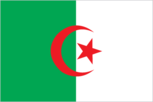
<strong>description:</strong> two equal vertical bands of green (left) and white; a red, five-pointed star inside a red crescent, centered over the two-color boundary <br><br><strong>meaning: </strong>the colors represent Islam (green), purity and peace (white), and liberty (red); the crescent and star are also Islamic symbols, but the crescent is more closed than those of other Muslim countries because Algerians believe the long crescent horns bring happiness
The flag of Algeria features two equal vertical bands of green and white. A five-pointed red star within a fly-side facing red crescent is centered over the two-color boundary.
- svg
- https://flagcdn.com/dz.svg
presidential republic
5 July 1962 (from France)
has not submitted an ICJ jurisdiction declaration; non-party state to the ICCt
ABEDA, AfDB, AFESD, AMF, AMU, AU, BIS, CAEU, CD, FAO, G-15, G-24, G-77, IAEA, IBRD, ICAO, ICC (national committees), ICRM, IDA, IDB, IFAD, IFC, IFRCS, IHO, ILO, IMF, IMO, IMSO, Interpol, IOC, IOM, IPU, ISO, ITSO, ITU, ITUC (NGOs), LAS, MIGA, MONUSCO, NAM, OAPEC, OAS (observer), OIC, OPCW, OPEC, OSCE (partner), UN, UNCTAD, UNESCO, UNHCR, UNIDO, UNITAR, UNOOSA, UNWTO, UPU, WCO, WHO, WIPO, WMO, WTO (observer)
- Highest court(s)
- Supreme Court or Le Cour Suprême, (consists of 150 judges organized into 8 chambers: Civil, Commercial and Maritime, Criminal, House of Offenses and Contraventions, House of Petitions, Land, Personal Status, and Social; Constitutional Council (consists of 12 members including the court chairman and deputy chairman)
- Judge selection and term of office
- Supreme Court judges appointed by the High Council of Magistracy, an administrative body presided over by the president of the republic, and includes the republic vice-president and several members; judges appointed for life; Constitutional Council members - 4 appointed by the president of the republic, 2 each by the 2 houses of Parliament, 2 by the Supreme Court, and 2 by the Council of State; Council president and members appointed for single 6-year terms with half the membership renewed every 3 years
- Note
- <strong>note:</strong> Algeria's judicial system does not include sharia courts
- Subordinate courts
- appellate or wilaya courts; first instance or daira tribunals
mixed system of French civil law and Islamic law; judicial review of legislative acts in ad hoc Constitutional Council composed of various public officials including several Supreme Court justices
- Legislative structure
- bicameral
- Legislature name
- Parliament (Barlaman)
- Chamber name
- National People's Assembly (Al-Majlis Al-Chaabi Al-Watani)
- Electoral system
- proportional representation
- Expected date of next election
- June 2026
- Most recent election date
- 6/12/2021
- Number of seats
- 407 (all directly elected)
- Parties elected and seats per party
- National Liberation Front (FLN) (98); Movement of Society for Peace (MSP) (65); National Democratic Rally (RND) (58); El-Moustakbel Front (Future", FM) (48); El Binaa Movement (39); Independents (84); Other (15)
- Percentage of women in chamber
- 7.9%
- Scope of elections
- full renewal
- Term in office
- 5 years
- Chamber name
- Council of the Nation (Majlis al-Oumma)
- Electoral system
- plurality/majority
- Expected date of next election
- January 2028
- Most recent election date
- 3/9/2025
- Number of seats
- 174 (116 indirectly elected; 58 appointed)
- Percentage of women in chamber
- 2.5%
- Scope of elections
- partial renewal
- Term in office
- 6 years
green, white, red
- Selected World Heritage Site locales
- Beni Hammad Fort (c); Djémila (c); Casbah of Algiers (c); M'zab Valley (c); Tassili n'Ajjer (m); Timgad (c); Tipasa (c)
- Total World Heritage Sites
- 7 (6 cultural, 1 mixed)
Independence Day, 5 July (1962); Revolution Day, 1 November (1954)
five-pointed star between the extended horns of a crescent moon; fennec fox
- Algerian National Front or FNA<br>Algerian Popular Movement or MPA<br>Algeria's Hope Rally or TAJ<br>Dignity or El Karama<br>El-Infitah<br>El Mostakbal (Future Front)<br>Ennour El Djazairi Party (Algerian Radiance Party) or PED<br>Equity and Proclamation Party or PEP<br>Islamic Renaissance Movement or Ennahda Movement<br>Justice and Development Front or FJD<br>Movement for National Reform or El Islah<br>Movement of Society for Peace or MSP<br>National Construction Movement or El-Bina (Harakat El-Binaa El-Watani)<br>National Democratic Rally (Rassemblement National Democratique) or RND<br>National Front for Social Justice or FNJS<br>National Liberation Front or FLN<br>National Militancy Front or FMN<br>National Party for Solidarity and Development or PNSD<br>National Republican Alliance or ANR<br>New Dawn Party (El-Fajr El-Jadid)<br>New Generation (Jil Jadid)<br>Oath of 1954 or Ahd 54<br>Party of Justice and Liberty or PLJ<br>Rally for Culture and Democracy or RCD<br>Socialist Forces Front or FFS<br>Union for Change and Progress or UCP<br>Union of Democratic and Social Forces or UFDS<br>Vanguard of Liberties (Talaie El Hurriyet)<br>Workers Party or PT<br>Youth Party or PJ
- note
- <strong>note:</strong> a law banning political parties based on religion was enacted in 1997
Sunday
18 years of age; universal
Yes
Economy
- potatoes, watermelons, wheat, milk, onions, tomatoes, vegetables, oranges, dates, barley (2023)
- note
- <b>note:</b> top ten agricultural products based on tonnage
- On alcohol and tobacco
- 1% of household expenditures (2023 est.)
- On food
- 37.2% of household expenditures (2023 est.)
- Expenditures
- $64.728 billion (2019 est.)
- Revenues
- $55.185 billion (2019 est.)
- code
- DZD
- name
- Algerian dinar (DZD) [د.ج]
- $-2,753,818,845
- Current account balance 2021
- -$4.513 billion (2021 est.)
- Current account balance 2022
- $19.433 billion (2022 est.)
- Current account balance 2023
- $6.359 billion (2023 est.)
- Note
- <b>note:</b> balance of payments - net trade and primary/secondary income in current dollars
- $6.9 billion
- Debt - external 2023
- $4.764 billion (2023 est.)
- Note
- <b>note:</b> present value of external debt in current US dollars
suffering oil and gas economy; lack of sector and market diversification; political instability chilling domestic consumption; poor credit access and declines in business confidence; COVID-19 austerity policies; delayed promised socio-economic reforms
- Currency
- Algerian dinars (DZD) per US dollar -
- Exchange rates 2020
- 126.777 (2020 est.)
- Exchange rates 2021
- 135.064 (2021 est.)
- Exchange rates 2022
- 141.995 (2022 est.)
- Exchange rates 2023
- 135.843 (2023 est.)
- Exchange rates 2024
- 134.053 (2024 est.)
- $53.47 billion
- Exports 2021
- $41.846 billion (2021 est.)
- Exports 2022
- $69.226 billion (2022 est.)
- Exports 2023
- $59.426 billion (2023 est.)
- Note
- <b>note:</b> balance of payments - exports of goods and services in current dollars
- natural gas, crude petroleum, refined petroleum, fertilizers, iron bars (2023)
- note
- <b>note:</b> top five export commodities based on value in dollars
- Italy 29%, France 14%, Spain 13%, USA 6%, Netherlands 4% (2023)
- note
- <b>note:</b> top five export partners based on percentage share of exports
- net inflows
- $1.23 billion
- Exports of goods and services
- 23.6% (2023 est.)
- Government consumption
- 17.9% (2023 est.)
- Household consumption
- 40.8% (2023 est.)
- Imports of goods and services
- -20.1% (2023 est.)
- Investment in fixed capital
- 32.8% (2023 est.)
- Investment in inventories
- 4.9% (2023 est.)
- Note
- <b>note:</b> figures may not total 100% due to rounding or gaps in data collection
- Agriculture
- 13.1% (2023 est.)
- Industry
- 37.8% (2023 est.)
- Note
- <b>note:</b> figures may not total 100% due to non-allocated consumption not captured in sector-reported data
- Services
- 45.6% (2023 est.)
- $263.62 billion (2024 est.)
- note
- <b>note:</b> data in current dollars at official exchange rate
$5,753
27.6 (2011)
$264.23 billion
$5,370
41 % of GDP
- $54.62 billion
- Imports 2021
- $44.287 billion (2021 est.)
- Imports 2022
- $46.613 billion (2022 est.)
- Imports 2023
- $51.131 billion (2023 est.)
- Note
- <b>note:</b> balance of payments - imports of goods and services in current dollars
- wheat, plastics, cars, milk, corn (2023)
- note
- <b>note:</b> top five import commodities based on value in dollars
- China 24%, France 12%, Italy 8%, Turkey 7%, Brazil 6% (2023)
- note
- <b>note:</b> top five import partners based on percentage share of imports
- 3.9% (2023 est.)
- note
- <b>note:</b> annual % change in industrial value added based on constant local currency
petroleum, natural gas, light industries, mining, electrical, petrochemical, food processing
- 4.05%
- Inflation rate (consumer prices) 2022
- 9.3% (2022 est.)
- Inflation rate (consumer prices) 2023
- 9.3% (2023 est.)
- Inflation rate (consumer prices) 2024
- 4% (2024 est.)
- Note
- <b>note:</b> annual % change based on consumer prices
- 13.294 million (2024 est.)
- note
- <b>note:</b> number of people ages 15 or older who are employed or seeking work
- total
- 13.56 million persons
- agriculture
- 9.48%
- industry
- 32.26%
- services
- 58.25%
- Note
- <strong>note:</strong> data cover central government debt as well as debt issued by subnational entities and intra-governmental debt
- Public debt 2017
- 27.5% of GDP (2017 est.)
- $824.9 billion
- Note
- <b>note:</b> data in 2021 dollars
- Real GDP (purchasing power parity) 2022
- $672.256 billion (2022 est.)
- Real GDP (purchasing power parity) 2023
- $699.818 billion (2023 est.)
- Real GDP (purchasing power parity) 2024
- $722.912 billion (2024 est.)
- 3.7%
- Note
- <b>note:</b> annual GDP % growth based on constant local currency
- Real GDP growth rate 2022
- 3.6% (2022 est.)
- Real GDP growth rate 2023
- 4.1% (2023 est.)
- Real GDP growth rate 2024
- 3.3% (2024 est.)
- $17,621
- Note
- <b>note:</b> data in 2021 dollars
- Real GDP per capita 2022
- $14,800 (2022 est.)
- Real GDP per capita 2023
- $15,200 (2023 est.)
- Real GDP per capita 2024
- $15,400 (2024 est.)
- $1.8 billion
- Note
- <b>note:</b> personal transfers and compensation between resident and non-resident individuals/households/entities
- Remittances 2021
- 1% of GDP (2021 est.)
- Remittances 2022
- 0.8% of GDP (2022 est.)
- Remittances 2023
- 0.8% of GDP (2023 est.)
- $83.01 billion
- Note
- <b>note:</b> holdings of gold (year-end prices)/foreign exchange/special drawing rights in current dollars
- Reserves of foreign exchange and gold 2022
- $71.852 billion (2022 est.)
- Reserves of foreign exchange and gold 2023
- $81.217 billion (2023 est.)
- Reserves of foreign exchange and gold 2024
- $83.007 billion (2024 est.)
- 11.63%
- Note
- <b>note:</b> % of labor force seeking employment
- Unemployment rate 2022
- 12.4% (2022 est.)
- Unemployment rate 2023
- 11.8% (2023 est.)
- Unemployment rate 2024
- 11.5% (2024 est.)
- Female
- 45.8% (2024 est.)
- Male
- 26.8% (2024 est.)
- Note
- <b>note:</b> % of labor force ages 15-24 seeking employment
- Total
- 29.8% (2024 est.)
Energy
- Consumption
- 3,000 metric tons (2023 est.)
- Imports
- 241,000 metric tons (2023 est.)
- Proven reserves
- 223 million metric tons (2023 est.)
- Consumption
- 85.687 billion kWh (2023 est.)
- consumption per capita
- 1,828 kWh
- Exports
- 2.753 billion kWh (2023 est.)
- Imports
- 475.8 million kWh (2023 est.)
- Installed generating capacity
- 22.591 million kW (2023 est.)
- Transmission/distribution losses
- 9.237 billion kWh (2023 est.)
- Electrification - rural areas
- 99.3%
- Electrification - total population
- 100% (2022 est.)
- Electrification - urban areas
- 100%
- Fossil fuels
- 98.1% of total installed capacity (2023 est.)
- hydroelectric
- 0.02%
- Hydroelectricity
- 0.9% of total installed capacity (2023 est.)
- nuclear
- 0%
- renewable
- 0.91%
- Solar
- 0.9% of total installed capacity (2023 est.)
- 1,503 kg of oil equivalent
- Total energy consumption per capita 2023
- 61.843 million Btu/person (2023 est.)
- Consumption
- 52.831 billion cubic meters (2023 est.)
- Exports
- 51.566 billion cubic meters (2023 est.)
- Production
- 104.896 billion cubic meters (2023 est.)
- Proven reserves
- 4.504 trillion cubic meters (2021 est.)
- Crude oil estimated reserves
- 12.2 billion barrels (2021 est.)
- Refined petroleum consumption
- 446,000 bbl/day (2023 est.)
- Total petroleum production
- 1.443 million bbl/day (2023 est.)
0.1%
Communications
- per 100 inhabitants
- 12 per 100
- Subscriptions per 100 inhabitants
- 12 (2023 est.)
- Total
- 5.54 million (2023 est.)
Radio Algérienne is the state-run radio broadcast; the National Company of Television (Entreprise Nationale de Télévision (ENTV)) is the primary state-run public TV station (2024)
.dz
- Percent of population
- 77% (2023 est.)
#####
+213
- Subscriptions per 100 inhabitants
- 15 (2024 est.)
- Total subscriptions
- 6.93 million (2024 est.)
- subscriptions per 100
- 112 per 100
- Subscriptions per 100 inhabitants
- 115 (2024 est.)
- Total subscriptions
- 54.1 million (2024 est.)
Transportation
- passengers carried
- 7.16 million passengers
- registered carrier departures
- 72,631 departures
95 (2025)
7T
Right
11 (2025)
- By type
- bulk carrier 1, container ship 4, general cargo 11, oil tanker 14, other 89
- Total
- 119 (2022)
- Key ports
- Alger, Annaba, Arzew, Arzew El Djedid, Bejaia, Mers El Kebir, Oran, Port Methanier, Skikda
- Large
- 2
- Medium
- 1
- Ports with oil terminals
- 3
- Small
- 6
- Total ports
- 17 (2024)
- Very small
- 8
- Total
- 4,020 km (2019)
DZ
Military and Security
- armored vehicles
- tanks
the ANP is responsible for external defense but also has some internal security responsibilities; key areas of concern include border and maritime security, terrorism, regional instability, and tensions with Morocco; Algeria supports the pro-independence Polisario Front in Western Sahara and accuses Morocco of supporting the Algerian separatist Movement for the Autonomy of Kabylie (MAK); border security and counterterrorism have received additional focus since the Arab Spring events of 2011 and the rise of terrorist threats emanating from Libya and the Sahel; the Army and Ministry of Defense (MND) paramilitary forces of the Gendarmerie and the border guards have beefed up their presence along the frontiers with Tunisia, Libya, Niger, and Mali to interdict and deter cross-border attacks by Islamist militant groups; the ANP and MND paramilitary forces have also increased counterterrorism cooperation with some neighboring countries, particularly Tunisia, including joint operations<br><br>the ANP has also played a large role in the country’s politics since independence in 1962, including coups in 1965 and 1991; it was a key backer of BOUTEFLIKA’s election in 1999 and remained a center of power during his 20-year rule; the military was instrumental in BOUTEFLIKA’s resignation in 2019, when it withdrew support and called for him to be removed from office (2024)
- Algerian People's National Army (ANP): Land Forces, Naval Forces (includes Coast Guard), Air Forces, Territorial Air Defense Forces, Republican Guard, National Gendarmerie<br><br>Ministry of Interior: General Directorate of National Security (national police) (2025)
- active duty personnel
- 326,000
- note
- <strong>note: </strong>the Republican Guard is subordinate to the ANP, but responsible to the President; the National Gendarmerie performs police functions outside urban areas under the auspices of the Ministry of National Defense and shares responsibility with the General Directorate of National Security for maintaining law and order; it is comprised of territorial, intervention/mobile, border guard, railway, riot control, and air support units
- percent of total labor force
- 2.81 %
information varies; estimated 200,000 active ANP, including the National Gendarmerie (2025)
the Algerian military has traditionally been armed mostly with Russian and Soviet-era weapons systems and equipment; over the past decade, it has made investments in acquiring more modern armored vehicles, air defense systems, fighter aircraft, missiles, unmanned aerial vehicles, and warships, largely from Russia, its traditional supplier, but also China and Western European suppliers such as Germany (2025)
- 8 % of GDP
- current USD
- $21,811,242,555
- Military Expenditures 2020
- 6.7% of GDP (2020 est.)
- Military Expenditures 2021
- 5.6% of GDP (2021 est.)
- Military Expenditures 2022
- 4.8% of GDP (2022 est.)
- Military Expenditures 2023
- 8% of GDP (2023 est.)
- Military Expenditures 2024
- 8% of GDP (2024 est.)
- percent of central government expenditure
- 21.38 %
- percent of GDP
- 7.97 % of GDP
18 years of age for voluntary military service for men and women; 19 years of age for mandatory national service for men (all Algerian men must register at age 17); 12 months national service obligation (2025)
- PowerIndex score
- 0.4849
Transnational Issues
- IDPs
- 25 (2024 est.)
- Refugees
- 188,206 (2024 est.)
- Tier rating
- Tier 2 Watch List — Algeria did not demonstrate overall increasing efforts to eliminate trafficking compared with the previous reporting period, therefore Algeria remained on Tier 2 Watch List for the second consecutive year; for more details, go to: https://www.state.gov/reports/2025-trafficking-in-persons-report/algeria/
Space
2002 - first remote sensing (RS) satellite (Alsat-1A) built jointly with the UK and launched by Russia<br><br>2006 - announced a national space program<br><br>2010 and 2016 - first Algerian-designed and -built RS satellites (Alsat-2A and 2B) launched by India<br><br>2017 - first communications satellite (Alcomsat-1) built jointly with and launched by China; announced a 2040 national space plan<br><br>2026 - RS satellite (AlSat-3A) launched by China
Algerian Space Agency (Agence Spatiale Algérienne, ASAL; established 2002) (2025)
none; note - in 1947, Algeria began hosting a French military rocket test site known as the Centre Interarmées d’Essais d’Engins Spéciaux (CIEES or Interarmy Special Vehicles Test Center); it was the continent of Africa's first rocket launch site and was in service until 1967
has a national space policy and space research program with stated goals of supporting internal development, managing resources, mastering space technology, and reinforcing national sovereignty; builds and operates communications and remote sensing (RS) satellites; researching and developing a range of space-related capabilities, including satellites and satellite payloads, communications, RS, instrumentation, image processing, and geo-spatial information; works with a variety of foreign space agencies and industries, including Argentina, China, France, Germany, India, Russia, Slovenia, Ukraine, the UK, and other African countries; member of the African Space Agency and the Arab Space Coordination Group (2025)
Terrorism
- al-Qa'ida in the Islamic Maghreb (AQIM); Islamic State of Iraq and ash-Sham (ISIS) – Algeria; al-Mulathamun Battalion (al-Mourabitoun)
- note
- <strong>note:</strong> details about the history, aims, leadership, organization, areas of operation, tactics, targets, weapons, size, and sources of support of the group(s) appear(s) in the Terrorism reference guide
Environment
- From coal and metallurgical coke
- 741,000 metric tonnes of CO2 (2023 est.)
- From consumed natural gas
- 105.125 million metric tonnes of CO2 (2023 est.)
- From petroleum and other liquids
- 57.795 million metric tonnes of CO2 (2023 est.)
- Total emissions
- 163.661 million metric tonnes of CO2 (2023 est.)
air pollution in major cities; soil erosion from overgrazing and other poor farming practices; desertification; river and coastal pollution from dumping of raw sewage, petroleum refining wastes, and other industrial effluents; pollution in Mediterranean Sea from oil wastes, soil erosion, and fertilizer runoff; inadequate potable water
- Party to
- Biodiversity, Climate Change, Climate Change-Kyoto Protocol, Climate Change-Paris Agreement, Comprehensive Nuclear Test Ban, Desertification, Endangered Species, Environmental Modification, Hazardous Wastes, Law of the Sea, Ozone Layer Protection, Ship Pollution, Wetlands
- Signed, but not ratified
- Nuclear Test Ban
- Agriculture
- 256 kt (2019-2021 est.)
- Energy
- 2,561.1 kt (2022-2024 est.)
- Other
- 7.6 kt (2019-2021 est.)
- Waste
- 486.4 kt (2019-2021 est.)
22.4 micrograms per cubic meter (2019 est.)
4 % of total land area
1 % of total
11.667 billion cubic meters (2022 est.)
- 92 % of internal resources
- Agricultural
- 7.391 billion cubic meters (2022)
- Industrial
- 181 million cubic meters (2022)
- Municipal
- 3.389 billion cubic meters (2022)
- Municipal solid waste generated annually
- 12.379 million tons (2024 est.)
- Percent of municipal solid waste recycled
- 11% (2022 est.)