2002 Edition
CIA World Factbook 2002 (Project Gutenberg)
Introduction
Background
After a century of rule by France, Algeria became independent in 1962. The surprising first round success of the fundamentalist FIS (Islamic Salvation Front) party in the December 1991 balloting caused the army to intervene, crack down on the FIS, and postpone the subsequent elections. The FIS response has resulted in a continuous low-grade civil conflict with the secular state apparatus, which nonetheless has allowed elections featuring pro-government and moderate religious-based parties. FIS's armed wing, the Islamic Salvation Army, disbanded itself in January 2000 and many armed militants surrendered under an amnesty program designed to promote national reconciliation. Nevertheless, residual fighting continues. Other concerns include Berber unrest, large-scale unemployment, a shortage of housing, and the need to diversify the petroleum-based economy.
Geography
Area
total: 2,381,740 sq km water: 0 sq km land: 2,381,740 sq km
Area - comparative
slightly less than 3.5 times the size of Texas
Climate
arid to semiarid; mild, wet winters with hot, dry summers along coast; drier with cold winters and hot summers on high plateau; sirocco is a hot, dust/sand-laden wind especially common in summer
Coastline
998 km
Elevation extremes
lowest point: Chott Melrhir -40 m highest point: Tahat 3,003 m
Environment - current issues
soil erosion from overgrazing and other poor farming practices; desertification; dumping of raw sewage, petroleum refining wastes, and other industrial effluents is leading to the pollution of rivers and coastal waters; Mediterranean Sea, in particular, becoming polluted from oil wastes, soil erosion, and fertilizer runoff; inadequate supplies of potable water
Environment - international agreements
party to: Biodiversity, Climate Change, Desertification, Endangered Species, Environmental Modification, Hazardous Wastes, Law of the Sea, Ozone Layer Protection, Ship Pollution, Wetlands signed, but not ratified: Geography - note: second-largest country in Africa (after Sudan)
Geographic coordinates
28 00 N, 3 00 E
Irrigated land
5,600 sq km (1998 est.)
Land boundaries
total: 6,343 km border countries: Libya 982 km, Mali 1,376 km, Mauritania 463 km, Morocco 1,559 km, Niger 956 km, Tunisia 965 km, Western Sahara 42 km
Land use
arable land: 3% permanent crops: 0% other: 97% (1998 est.)
Location
Northern Africa, bordering the Mediterranean Sea, between Morocco and Tunisia
Map references
Africa
Maritime claims
exclusive fishing zone: 32-52 NM territorial sea: 12 NM
Natural hazards
mountainous areas subject to severe earthquakes; mudslides and floods in rainy season
Natural resources
petroleum, natural gas, iron ore, phosphates, uranium, lead, zinc
Terrain
mostly high plateau and desert; some mountains; narrow, discontinuous coastal plain
People and Society
Age structure
0-14 years: 33.5% (male 5,512,369; female 5,311,914) 15-64 years: 62.4% (male 10,175,135; female 9,950,315) 65 years and over: 4.1% (male 610,643; female 717,566) (2002 est.)
Birth rate
22.34 births/1,000 population (2002 est.)
Death rate
5.15 deaths/1,000 population (2002 est.)
Ethnic groups
Arab-Berber 99%, European less than 1%
HIV/AIDS - adult prevalence rate
0.07% (1999 est.)
HIV/AIDS - deaths
NA
HIV/AIDS - people living with HIV/AIDS
NA
Infant mortality rate
39.15 deaths/1,000 live births (2002 est.)
Languages
Arabic (official), French, Berber dialects
Life expectancy at birth
71.67 years (2002 est.) male: Total fertility rate: 2.63 children born/woman (2002 est.)
Literacy
definition: age 15 and over can read and write total population: 61.6% male: 73.9% female: 49% (1995 est.)
Nationality
noun: Algerian(s) adjective: Algerian
Net migration rate
-0.42 migrant(s)/1,000 population (2002 est.)
Population
32,277,942 (July 2002 est.)
Population growth rate
1.68% (2002 est.)
Religions
Sunni Muslim (state religion) 99%, Christian and Jewish 1%
Sex ratio
at birth: 1.04 male(s)/female under 15 years: 1.04 male(s)/female 15-64 years: 1.02 male(s)/female 65 years and over: 0.85 male(s)/female total population: 1.02 male(s)/female (2002 est.)
Government
Administrative divisions
48 provinces (wilayas, singular - wilaya); Adrar, Ain Defla, Ain Temouchent, Alger, Annaba, Batna, Bechar, Bejaia, Biskra, Blida, Bordj Bou Arreridj, Bouira, Boumerdes, Chlef, Constantine, Djelfa, El Bayadh, El Oued, El Tarf, Ghardaia, Guelma, Illizi, Jijel, Khenchela, Laghouat, Mascara, Medea, Mila, Mostaganem, M'Sila, Naama, Oran, Ouargla, Oum el Bouaghi, Relizane, Saida, Setif, Sidi Bel Abbes, Skikda, Souk Ahras, Tamanghasset, Tebessa, Tiaret, Tindouf, Tipaza, Tissemsilt, Tizi Ouzou, Tlemcen
Cabinet of Ministers appointed by the president elections
15 April 1999 (next to be held NA April 2004); prime minister appointed by the president election results: Abdelaziz BOUTEFLIKA elected president; percent of vote - Abdelaziz BOUTEFLIKA over 70%; note - his six opposing candidates withdrew on the eve of the election citing electoral fraud
Capital
Algiers
Constitution
19 November 1976, effective 22 November 1976; revised 3 November 1988, 23 February 1989, and 28 November 1996
Country name
conventional long form: People's Democratic Republic of Algeria conventional short form: Algeria local short form: Al Jaza'ir local long form: Al Jumhuriyah al Jaza'iriyah ad Dimuqratiyah ash Sha'biyah
Diplomatic representation from the US
chief of mission: Ambassador Janet A. SANDERSON embassy: 4 Chemin Cheikh Bachir El-Ibrahimi, Algiers mailing address: B. P. Box 549, Alger-Gare, 16000 Algiers telephone: [213] (21) 69-11-86, 69-12-55, 69-18-54, 69-38-75 FAX: [213] (21) 69-39-79
Diplomatic representation in the US
chief of mission: Ambassador Idriss JAZAIRY chancery: 2118 Kalorama Road NW, Washington, DC 20008 FAX: [1] (202) 667-2174 telephone: [1] (202) 265-2800
Executive branch
chief of state: President Abdelaziz BOUTEFLIKA (since 28 April 1999) head of government: Prime Minister Ali BENFLIS (since 26 August 2000)
Flag description
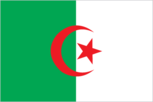
two equal vertical bands of green (hoist side) and white; a red, five-pointed star within a red crescent centered over the two-color boundary; the crescent, star, and color green are traditional symbols of Islam (the state religion)
Government type
republic
Independence
5 July 1962 (from France)
International organization participation
ABEDA, AfDB, AFESD, AL, AMF, AMU, CCC, ECA, FAO, G-15, G-19, G-24, G-77, IAEA, IBRD, ICAO, ICC, ICFTU, ICRM, IDA, IDB, IFAD, IFC, IFRCS, IHO, ILO, IMF, IMO, Interpol, IOC, IOM, ISO, ITU, MONUC, NAM, OAPEC, OAS (observer), OAU, OIC, OPCW, OPEC, OSCE (partner), UN, UNCTAD, UNESCO, UNHCR, UNIDO, UNMEE, UPU, WHO, WIPO, WMO, WToO, WTrO (observer)
Judicial branch
Supreme Court or Cour Supreme
Legal system
socialist, based on French and Islamic law; judicial review of legislative acts in ad hoc Constitutional Council composed of various public officials, including several Supreme Court justices; has not accepted compulsory ICJ jurisdiction
Legislative branch
bicameral Parliament consists of the National People's Assembly or Al-Majlis Ech-Chaabi Al-Watani (389 seats - changed from 380 seats in the 2002 elections; members elected by popular vote to serve five-year terms) and the Council of Nations (144 seats; one-third of the members appointed by the president, two-thirds elected by indirect vote; members serve six-year terms; the constitution requires half the council to be renewed every three years) elections: National People's Assembly - last held 30 May 2002 (next to be held NA 2007); Council of Nations - last held 30 December 2000 (next to be held NA 2003) election results: party - FLN 199, RND 48, MRN 43, MSP 38, PT 21, FNA 8, Nahda 1, PRA 1, MEN 1, independents 29; Council of Nations - percent of vote by party - NA%; seats by party - RND 79, FLN 12, FFS 4, MSP 1 (remaining 48 seats appointed by the president, party breakdown NA)
National holiday
Revolution Day, 1 November (1954)
Political parties and leaders
Algerian National Front or FNA [Moussa TOUATI]; Democratic National Rally or RND [Ahmed OUYAHIA, chairman]; Islamic Salvation Front or FIS (outlawed April 1992) [Ali BELHADJ and Dr. Abassi MADANI (imprisoned), Rabeh KEBIR (self-exile in Germany)]; Movement of a Peaceful Society or MSP [Mahfoud NAHNAH, chairman]; National Entente Movement or MEN [Ali BOUKHAZNA]; National Liberation Front or FLN [Boualem BENHAMOUDA, secretary general]; National Reform Movement or MRN [Abdellah DJABALLAH]; National Renewal Party or PRA [leader NA]; Progressive Republican Party [Khadir DRISS]; Rally for Culture and Democracy or RCD [Said SAADI, secretary general]; Renaissance Movement or EnNahda Movement [Lahbib ADAMI]; Social Liberal Party or PSL [Ahmed KHELIL]; Socialist Forces Front or FFS [Hocine Ait AHMED, secretary general (self-exile in Switzerland)]; Union for Democracy and Liberty [Mouley BOUKHALAFA]; Workers Party or PT [Louisa HANOUN] note: a law banning political parties based on religion was enacted in March 1997
Political pressure groups and leaders
NA
Suffrage
18 years of age; universal
Economy
Agriculture - products
wheat, barley, oats, grapes, olives, citrus, fruits; sheep, cattle
Budget
revenues: $20.3 billion expenditures: $18.8 billion, including capital expenditures of $5.8 billion (2001 est.)
Currency
Algerian dinar (DZD)
Currency code
DZD
Debt - external
$24.7 billion (2001 est.)
Distribution of family income - Gini index
35.3 (1995)
Economic aid - recipient
$100 million (1999 est.)
Economy - overview
The hydrocarbons sector is the backbone of the economy, accounting for roughly 60% of budget revenues, 30% of GDP, and over 95% of export earnings. Algeria has the fifth-largest reserves of natural gas in the world and is the second largest gas exporter; it ranks 14th in oil reserves. Algeria's financial and economic indicators improved during the mid-1990s, in part because of policy reforms supported by the IMF and debt rescheduling from the Paris Club. Algeria's finances in 2000 and 2001 benefited from the temporary spike in oil prices and the government's tight fiscal policy, leading to a large increase in the trade surplus, record highs in foreign exchange reserves, and reduction in foreign debt. The government's continued efforts to diversify the economy by attracting foreign and domestic investment outside the energy sector has had little success in reducing high unemployment and improving living standards. In 2001, the government signed an Association Treaty with the European Union that will eventually lower tariffs and increase trade.
Electricity - consumption
21.847 billion kWh (2000)
Electricity - exports
210 million kWh (2000)
Electricity - imports
150 million kWh (2000)
Electricity - production
23.556 billion kWh (2000)
Electricity - production by source
fossil fuel: 99.58% hydro: 0.42% other: 0% (2000) nuclear: 0%
Exchange rates
Algerian dinars per US dollar - 77.889 (January 2002), 77.215 (2001), 75.260 (2000), 66.574 (1999), 58.739 (1998), 57.707 (1997)
Exports
$20 billion (f.o.b., 2001 est.)
Exports - commodities
petroleum, natural gas, and petroleum products 97%
Exports - partners
Italy 23%, Spain 13%, US 13%, France 11%, Brazil 7%, (2000)
Fiscal year
calendar year
GDP
purchasing power parity - $177 billion (2001 est.)
GDP - composition by sector
agriculture: 17% industry: 33% services: 50% (2000 est.)
GDP - per capita
purchasing power parity - $5,600 (2001 est.)
GDP - real growth rate
3.8% (2001 est.)
Household income or consumption by percentage share
lowest 10%: 4.4% highest 10%: 25% (1995)
Imports
$1 billion (f.o.b., 2001 est.)
Imports - commodities
capital goods, food and beverages, consumer goods
Imports - partners
France 29%, US 9%, Italy 8%, Germany 6%, Spain 5% (2000)
Industrial production growth rate
6% (2001 est.)
Industries
petroleum, natural gas, light industries, mining, electrical, petrochemical, food processing
Inflation rate (consumer prices)
3% (2001 est.)
Labor force
9.4 million (2001 est.)
Labor force - by occupation
government 29%, agriculture 25%, construction and public works 15%, industry 11%, other 20% (1996 est.)
Population below poverty line
23% (1999 est.)
Unemployment rate
34% (2001 est.)
Communications
Internet country code
.dz
Internet Service Providers (ISPs)
2 (2000)
Internet users
180,000 (2001)
Radio broadcast stations
AM 25, FM 1, shortwave 8 (1999)
Radios
7.1 million (1997)
Telephone system
general assessment: telephone density in Algeria is very low, not exceeding five telephones per 100 persons; the number of fixed main lines increased in the last few years to a little more than 2,000,000, but only about two-thirds of these have subscribers; much of the infrastructure is outdated and inefficient domestic: good service in north but sparse in south; domestic satellite system with 12 earth stations (20 additional domestic earth stations are planned) international: 5 submarine cables; microwave radio relay to Italy, France, Spain, Morocco, and Tunisia; coaxial cable to Morocco and Tunisia; participant in Medarabtel; satellite earth stations - 2 Intelsat (1 Atlantic Ocean and 1 Indian Ocean), 1 Intersputnik, and 1 Arabsat (1998)
Telephones - main lines in use
2.3 million (1998)
Telephones - mobile cellular
33,500 (1999)
Television broadcast stations
46 (plus 216 repeaters) (1995)
Televisions
3.1 million (1997)
Transportation
Airports
136 (2001)
Airports - with paved runways
total: 52 over 3,047 m: 9 2,438 to 3,047 m: 26 914 to 1,523 m: 5 under 914 m: 1 (2001) 1,524 to 2,437 m: 11
Airports - with unpaved runways
total: 84 2,438 to 3,047 m: 3 1,524 to 2,437 m: 23 under 914 m: 18 (2001) 914 to 1,523 m: 40
Heliports
1 (2001)
Highways
total: 104,000 km paved: 71,656 km (including 640 km of expressways) unpaved: 32,344 km (1996 est.)
Merchant marine
total: 73 ships (1,000 GRT or over) totaling 903,944 GRT/1,051,433 DWT ships by type: bulk 9, cargo 25, chemical tanker 7, liquefied gas 10, petroleum tanker 5, roll on/roll off 12, short-sea passenger 4, specialized tanker 1, includes some foreign-owned ships registered here as a flag of convenience: United Arab Emirates 2 (2002 est.)
Pipelines
crude oil 6,612 km; petroleum products 298 km; natural gas 2,948 km
Ports and harbors
Algiers, Annaba, Arzew, Bejaia, Beni Saf, Dellys, Djendjene, Ghazaouet, Jijel, Mostaganem, Oran, Skikda, Tenes
Railways
total: 4,820 km standard gauge: 3,664 km 1.435-m gauge (301 km electrified; 215 km double-track) narrow gauge: 1,156 km 1.055-m gauge (1999 est.)
Waterways
none
Military and Security
Military expenditures - dollar figure
$1.87 billion (FY99)
Military expenditures - percent of GDP
4.1% (FY99)
Military manpower - availability
males age 15-49: 9,016,048 (2002 est.)
Military manpower - fit for military service
males age 15-49: 5,513,317 (2002 est.)
Military manpower - military age
19 years of age (2002 est.)
Military manpower - reaching military age annually
males: 388,939 (2002 est.)
Transnational Issues
Disputes - international
part of southeastern region claimed by Libya; Algeria supports exiled West Saharan Polisario Front and rejects Moroccan administration of Western Sahara This page was last updated on 1 January 2002 Azerbaijan