1992 Edition
CIA World Factbook 1992 (Project Gutenberg)
Geography
Climate
arid to semiarid; mild, wet winters with hot, dry summers along coast; drier with cold winters and hot summers on high plateau; sirocco is a hot, dust/sand-laden wind especially common in summer
Coastline
998 km
Comparative area
slightly less than 3.5 times the size of Texas
Disputes
Libya claims about 19,400 km2 in southeastern Algeria; land boundary disputes with Tunisia under discussion
Environment
mountainous areas subject to severe earthquakes; desertification
Land area
2,381,740 km2
Land boundaries
6,343 km total; Libya 982 km, Mali 1,376 km, Mauritania 463 km, Morocco 1,559 km, Niger 956 km, Tunisia 965 km, Western Sahara 42 km
Land use
arable land 3%; permanent crops NEGL%; meadows and pastures 13%; forest and woodland 2%; other 82%; includes irrigated NEGL%
Natural resources
crude oil, natural gas, iron ore, phosphates, uranium, lead, zinc
Note
second-largest country in Africa (after Sudan)
Terrain
mostly high plateau and desert; some mountains; narrow, discontinuous coastal plain
Territorial sea
12 nm
Total area
2,381,740 km2
People and Society
Birth rate
31 births/1,000 population (1992)
Death rate
7 deaths/1,000 population (1992)
Ethnic divisions
Arab-Berber 99%, European less than 1%
Infant mortality rate
56 deaths/1,000 live births (1992)
Labor force
3,700,000; industry and commerce 40%, agriculture 24%, government 17%, services 10% (1984)
Languages
Arabic (official), French, Berber dialects
Life expectancy at birth
66 years male, 68 years female (1992)
Literacy
50% (male 63%, female 36%) age 15 and over can read and write (1987)
Nationality
noun - Algerian(s); adjective - Algerian
Net migration rate
0 migrants/1,000 population (1992)
Organized labor
16-19% of labor force claimed; General Union of Algerian Workers (UGTA) is the only labor organization and is subordinate to the National Liberation Front
Population
26,666,921 (July 1992), growth rate 2.5% (1992)
Religions
Sunni Muslim (state religion) 99%, Christian and Jewish 1%
Total fertility rate
4.1 children born/woman (1992)
Government
Administrative divisions
48 provinces (wilayast, singular - wilaya); Adrar, Ain Defla, Ain Temouchent, Alger, Annaba, Batna, Bechar, Bejaia, Biskra, Blida, Bordj Bou Arreridj, Bouira, Boumerdes, Chlef, Constantine, Djelfa, El Bayadh, El Oued, El Tarf, Ghardaia, Guelma, Illizi, Jijel, Khenchela, Laghouat, Mascara, Medea, Mila, Mostaganem, M'Sila, Naama, Oran, Ouargla, Oum el Bouaghi, Relizane, Saida, Setif, Sidi Bel Abbes, Skikda, Souk Ahras, Tamanghasset, Tebessa, Tiaret, Tindouf, Tipaza, Tissemsilt, Tizi Ouzou, Tlemcen
Capital
Algiers
Chief of State
President Mohamed BOUDIAF; assassinated 29 June 1992
Communists
400 (est.); Communist party banned 1962
Constitution
19 November 1976, effective 22 November 1976; revised February 1989
Diplomatic representation
Ambassador Abderrahmane BENSID; Chancery at 2118 Kalorama Road NW, Washington, DC 20008; telephone (202) 265-2800 US: Ambassador Mary Ann CASEY; Embassy at 4 Chemin Cheich Bachir El-Ibrahimi, Algiers (mailing address is B. P. Box 549, Alger-Gare, 16000 Algiers); telephone [213] (2) 601-425 or 255, 186; FAX [213] (2) 603979; there is a US Consulate in Oran
Executive branch
president, prime minister, Council of Ministers (cabinet)
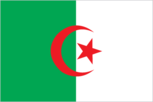
Flag
two equal vertical bands of green (hoist side) and white with a red five-pointed star within a red crescent; the crescent, star, and color green are traditional symbols of Islam (the state religion)
Head of Government
Interim Prime Minister Sid Ahmed GHOZALI (since 6 June 1991)
Independence
5 July 1962 (from France)
Judicial branch
Supreme Court (Cour Supreme)
Legal system
socialist, based on French and Islamic law; judicial review of legislative acts in ad hoc Constitutional Council composed of various public officials, including several Supreme Court justices; has not accepted compulsory ICJ jurisdiction
Legislative branch
unicameral National People's Assembly (Al-Majlis Ech-Chaabi Al-Watani)
Long-form name
Democratic and Popular Republic of Algeria
Member of
ABEDA, AfDB, AFESD, AL, AMF, AMU, CCC, ECA, FAO, G-15, G-24, G-77, IAEA, IBRD, ICAO, IDA, IDB, IFAD, ILO, IMF, IMO, INMARSAT, INTELSAT, INTERPOL, IOC, ISO, ITU, LORCS, NAM, OAPEC, OAS (observer), OAU, OIC, OPEC, UN, UNAVEM, UNCTAD, UNESCO, UNHCR, UNIDO, UPU, WCL, WHO, WIPO, WMO, WTO
National holiday
Anniversary of the Revolution, 1 November (1954)
National People's Assembly
first round held on 26 December 1991 (second round canceled by the military after President BENJEDID resigned 11 January 1992); results - percent of vote by party NA; seats - (281 total); the fundamentalist FIS won 188 of the 231 seats contested in the first round; note - elections (municipal and wilaya) were held in June 1990, the first in Algerian history; results - FIS 55%, FLN 27.5%, other 17.5%, with 65% of the voters participating
Political parties and leaders
National Liberation Front (FLN); Socialist Forces Front (FFS), Hocine Ait AHMED, Secretary General; the government established a multiparty system in September 1989, and, as of 31 December 1990, over 30 legal parties existed
President
next election to be held December 1993
Suffrage
universal at age 18
Type
republic
Economy
Agriculture
accounts for 11% of GDP and employs 24% of labor force; net importer of food - grain, vegetable oil, and sugar; farm production includes wheat, barley, oats, grapes, olives, citrus, fruits, sheep, and cattle
Budget
revenues $16.7 billion; expenditures $17.3 billion, including capital expenditures of $6.6 billion (1990 est.)
Currency
Algerian dinar (plural - dinars); 1 Algerian dinar (DA) = 100 centimes
Economic aid
US commitments, including Ex-Im (FY70-85), $1.4 billion; Western (non-US) countries, ODA and OOF bilateral commitments (1970-89), $925 million; OPEC bilateral aid (1979-89), $1.8 billion; Communist countries (1970-89), $2.7 billion; net official disbursements (1985-89), --$375 million
Electricity
6,380,000 kW capacity; 16,700 million kWh produced, 640 kWh per capita (1991)
Exchange rates
Algerian dinars (DA) per US$1 - 21.862 (January 1992), 18.473 (1991), 8.958 (1990), 7.6086 (1989), 5.9148 (1988), 4.8497 (1987)
Exports
$11.7 billion (f.o.b., 1991 est.) commodities: petroleum and natural gas 97% partners: Netherlands, Czechoslovakia, Romania, Italy, France, US
External debt
$26.4 billion
Fiscal year
calendar year
GDP
exchange rate conversion - $54 billion, per capita $2,130; real growth rate 2.5% (1990 est.)
Imports
$9 billion (f.o.b., 1991 est.) commodities: capital goods 29%, consumer goods 30% partners: France 25%, Italy 8%, FRG 8%, US 6-7%
Industrial production
growth rate --3% (1989 est.); accounts for 30% of GDP, including petroleum
Industries
petroleum, light industries, natural gas, mining, electrical, petrochemical, food processing
Inflation rate (consumer prices)
30% (1991 est.)
Overview
The oil and natural gas sector forms the backbone of the economy. Algeria depends on hydrocarbons for nearly all of its export receipts, about 30% of government revenues, and nearly 25% of GDP. In 1973-74 the sharp increase in oil prices led to a booming economy and helped to finance an ambitious program of industrialization. Plunging oil and gas prices, combined with the mismanagement of Algeria's highly centralized economy, has brought the nation to its most serious social and economic crisis since independence in 1988. The government has promised far-reaching reforms, including privatization of some public- sector companies, encouraging private-sector activity, boosting gas and nonhydrocarbon exports, and proposing a major overhaul of the banking and financial systems, but to date it has made only limited progress.
Unemployment rate
30% (1991 est.)
Communications
Airports
141 total, 124 usable; 53 with permanent-surface runways; 2 with runways over 3,659 m; 32 with runways 2,440-3,659 m; 65 with runways 1,220-2,439 m
Civil air
42 major transport aircraft
Highways
80,000 km total; 60,000 km concrete or bituminous, 20,000 km gravel, crushed stone, unimproved earth
Merchant marine
75 ships (1,000 GRT or over) totaling 903,179 GRT/1,064,246 DWT; includes 5 short-sea passenger, 27 cargo, 12 roll-on/roll-off cargo, 5 petroleum tanker, 9 liquefied gas, 7 chemical tanker, 9 bulk, 1 specialized tanker
Pipelines
crude oil 6,612 km; petroleum products 298 km; natural gas 2,948 km
Ports
Algiers, Annaba, Arzew, Bejaia, Djendjene, Ghazaouet, Jijel, Mers el Kebir, Mostaganem, Oran, Skikda
Railroads
4,060 km total; 2,616 km standard gauge (1.435 m), 1,188 km 1.055-meter gauge, 256 km 1.000-meter gauge; 300 km electrified; 215 km double track
Telecommunications
excellent domestic and international service in the north, sparse in the south; 822,000 telephones; broadcast stations - 26 AM, no FM, 18 TV; 1,600,000 TV sets; 5,200,000 radios; 5 submarine cables; radio relay to Italy, France, Spain, Morocco, and Tunisia; coaxial cable to Morocco and Tunisia; satellite earth stations - 1 Atlantic Ocean INTELSAT, 1 Indian Ocean INTELSAT, 1 Intersputnik, l ARABSAT, and 15 domestic
Military and Security
Branches
National Popular Army, Navy, Air Force, Territorial Air Defense, National Gendarmerie
Defense expenditures
exchange rate conversion - $867 million, approximately 1.8% of GDP (1992)
Manpower availability
males 15-49, 6,386,157; 3,928,029 fit for military service; 283,068 reach military age (19) annually