2020 Edition
factbook.json (GitHub)
Introduction
Background
The hunter-gatherer San people first inhabited the area that eventually became Zimbabwe. Farming communities migrated to the area around A.D. 500 during the Bantu expansion, and Shona-speaking societies began to develop in the Limpopo valley and Zimbabwean highlands around the 9th century. These societies traded with Arab merchants on the Indian Ocean coast and organized under the Kingdom of Mapungubwe in the 11th century. A series of powerful trade-oriented Shona states succeeded Mapungubwe, including the Kingdom of Zimbabwe (ca. 1220-1450), Kingdom of Mutapa (ca. 1450-1760), and the Rozwi Empire. The Rozwi Empire expelled Portuguese colonists from the Zimbabwean plateau, but the Ndebele clan of Zulu King MZILIKAZI eventually conquered the area in 1838 during the era of conflict and population displacement known as the Mfecane. In the 1880s, colonists arrived with the British South Africa Company (BSAC) and obtained a written concession for mining rights from Ndebele King LOBENGULA. The king later disavowed the concession and accused the BSAC agents of deceit. The BSAC annexed Mashonaland and then conquered Matabeleland during the First Matabele War of 1893-1894, establishing company rule over the territory. In 1923, the UK annexed BSAC holdings south of the Zambezi River, which became the British colony of Southern Rhodesia. The 1930 Land Apportionment Act restricted Black land ownership and established rules that would favor the White minority for decades. A new constitution in 1961 further cemented White minority rule. In 1965, the government under White Prime Minister Ian SMITH unilaterally declared its independence from the UK. London did not recognize Rhodesia’s independence and demanded more voting rights for the Black majority in the country. International diplomacy and an uprising by Black Zimbabweans led to biracial elections in 1979 and independence (as Zimbabwe) in 1980. Robert MUGABE, who led the uprising and became the nation's first prime minister, was the country's only ruler (as president since 1987) from independence until 2017. In the mid-1980s, the government tortured and killed thousands of civilians in a crackdown on dissent known as the Gukurahundi campaign. Economic mismanagement and chaotic implementation of land redistribution policies periodically crippled the economy. General elections in 2002, 2008, and 2013 were severely flawed and widely condemned but allowed MUGABE to remain president. In 2017, Vice President Emmerson MNANGAGWA became president after a military intervention that forced MUGABE to resign, and MNANGAGWA cemented power by sidelining rival Grace MUGABE (Robert MUGABE’s wife). In 2018, MNANGAGWA won the presidential election, and he has maintained the government's longstanding practice of violently disrupting protests and politicizing institutions. Economic conditions remain dire under MNANGAGWA.
Geography
Area
- land
- 386,847 sq km
- total
- 390,757 sq km
- water
- 3,910 sq km
Area - comparative
about four times the size of Indiana; slightly larger than Montana
Climate
tropical; moderated by altitude; rainy season (November to March)
Coastline
0 km (landlocked)
Elevation
- highest point
- Inyangani 2,592 m
- lowest point
- junction of the Runde and Save Rivers 162 m
- mean elevation
- 961 m
Geographic coordinates
20 00 S, 30 00 E
Geography - note
landlocked; the Zambezi forms a natural river boundary with Zambia; in full flood (February-April), the massive Victoria Falls on the river forms the world's largest curtain of falling water; Lake Kariba on the Zambia-Zimbabwe border forms the world's largest reservoir by volume (180 cu km; 43 cu mi)
Irrigated land
1,740 sq km (2012)
Land boundaries
- border countries
- Botswana 834 km; Mozambique 1,402 km; South Africa 230 km; Zambia 763 km
- total
- 3,229 km
Land use
- agricultural land
- 41.8% (2023 est.)
- agricultural land: arable land
- arable land: 10.4% (2023 est.)
- agricultural land: permanent crops
- permanent crops: 0.1% (2023 est.)
- agricultural land: permanent pasture
- permanent pasture: 31.3% (2023 est.)
- forest
- 35.9% (2023 est.)
- other
- 22.3% (2023 est.)
Location
Southern Africa, between South Africa and Zambia
Major aquifers
Upper Kalahari-Cuvelai-Upper Zambezi Basin
Major rivers (by length in km)
Zambezi (shared with Zambia [s]), Angola, Namibia, Botswana, and Mozambique [m]) - 2,740 km; Limpopo (shared with South Africa [s], Botswana, and Mozambique [m]) - 1,800 km note: [s] after country name indicates river source; [m] after country name indicates river mouth
Major watersheds (area sq km)
- Indian Ocean drainage
- Zambezi (1,332,412 sq km)
- Internal (endorheic basin) drainage
- Okavango Basin (863,866 sq km)
Map references
Africa
Maritime claims
none (landlocked)
Natural hazards
recurring droughts; floods and severe storms are rare
Natural resources
coal, chromium ore, asbestos, gold, nickel, copper, iron ore, vanadium, lithium, tin, platinum group metals
Population distribution
aside from major urban agglomerations in Harare and Bulawayo, population distribution is fairly even, with slightly greater overall numbers in the eastern half, as shown in this population distribution map
Terrain
mostly high plateau with higher central plateau (high veld); mountains in east
People and Society
Age structure
- 0-14 years
- 38.3% (male 3,315,075/female 3,254,643)
- 15-64 years
- 57.8% (male 4,758,120/female 5,152,773)
- 65 years and over
- 3.9% (2024 est.) (male 270,595/female 399,146)
Alcohol consumption per capita
- beer
- 1.2 liters of pure alcohol (2019 est.)
- other alcohols
- 1.47 liters of pure alcohol (2019 est.)
- spirits
- 0.39 liters of pure alcohol (2019 est.)
- total
- 3.11 liters of pure alcohol (2019 est.)
- wine
- 0.05 liters of pure alcohol (2019 est.)
Birth rate
28.18 births/1,000 population (2025 est.)
Child marriage
- men married by age 18
- 1.9% (2019)
- women married by age 15
- 5.4% (2019)
- women married by age 18
- 33.7% (2019)
Children under the age of 5 years underweight
9.6% (2024 est.)
Currently married women (ages 15-49)
62.2% (2022 est.)
Death rate
6.4 deaths/1,000 population (2025 est.)
Dependency ratios
- elderly dependency ratio
- 6.8 (2025 est.)
- potential support ratio
- 14.7 (2025 est.)
- total dependency ratio
- 72.3 (2025 est.)
- youth dependency ratio
- 65.5 (2025 est.)
Drinking water source
- improved: rural
- rural: 47.7% of population (2022 est.)
- improved: total
- total: 62.3% of population (2022 est.)
- improved: urban
- urban: 92.8% of population (2022 est.)
- unimproved: rural
- rural: 52.3% of population (2022 est.)
- unimproved: total
- total: 37.7% of population (2022 est.)
- unimproved: urban
- urban: 7.2% of population (2022 est.)
Education expenditure
- Education expenditure (% GDP)
- 0.4% of GDP (2023 est.)
- Education expenditure (% national budget)
- 17.9% national budget (2025 est.)
Ethnic groups
African 99.6% (predominantly Shona; Ndebele is the second largest ethnic group), other (includes Caucasian, Asiatic, mixed race) 0.4% (2022 est.)
Gross reproduction rate
1.68 (2025 est.)
Health expenditure
- Health expenditure (as % of GDP)
- 2.8% of GDP (2021)
- Health expenditure (as % of national budget)
- 5.2% of national budget (2022 est.)
Infant mortality rate
- female
- 29.6 deaths/1,000 live births
- male
- 37 deaths/1,000 live births
- total
- 32.8 deaths/1,000 live births (2025 est.)
Languages
Shona (official, most widely spoken) 80.9%, Ndebele (official, second most widely spoken) 11.5%, English (official, traditionally used for official business) 0.3%, 13 minority languages (official; includes Chewa, Chibarwe, Kalanga, Koisan, Nambya, Ndau, Shangani, sign language, Sotho, Tonga, Tswana, Venda, and Xhosa) 7%, other 0.3% (2022 est.)
Life expectancy at birth
- female
- 68.8 years
- male
- 65.6 years
- total population
- 67.2 years (2024 est.)
Literacy
- female
- 93.4% (2019 est.)
- male
- 93.1% (2019 est.)
- total population
- 93.2% (2019 est.)
Major urban areas - population
1.578 million HARARE (capital) (2023)
Maternal mortality ratio
358 deaths/100,000 live births (2023 est.)
Median age
- female
- 22 years
- male
- 20.3 years
- total
- 21.3 years (2025 est.)
Mother's mean age at first birth
20.3 years (2015 est.)
Nationality
- adjective
- Zimbabwean
- noun
- Zimbabwean(s)
Net migration rate
-3.58 migrant(s)/1,000 population (2025 est.)
Obesity - adult prevalence rate
15.5% (2016)
Physician density
0.14 physicians/1,000 population (2023)
Population
- female
- 8,969,644
- male
- 8,503,108
- total
- 17,472,752 (2025 est.)
Population growth rate
1.82% (2025 est.)
Religions
Apostolic Sect 40.3%, Pentecostal 17%, Protestant 13.8%, other Christian 7.8%, Roman Catholic 6.4%, African traditionalist 5%, other 1.5% (includes Muslim, Jewish, Hindu), none 8.3% (2022 est.)
Sanitation facility access
- improved: rural
- rural: 50.3% of population (2022 est.)
- improved: total
- total: 65.6% of population (2022 est.)
- improved: urban
- urban: 97.5% of population (2022 est.)
- unimproved: rural
- rural: 49.7% of population (2022 est.)
- unimproved: total
- total: 34.4% of population (2022 est.)
- unimproved: urban
- urban: 2.5% of population (2022 est.)
Sex ratio
- 0-14 years
- 1.02 male(s)/female
- 15-64 years
- 0.92 male(s)/female
- 65 years and over
- 0.68 male(s)/female
- at birth
- 1.03 male(s)/female
- total population
- 0.95 male(s)/female (2024 est.)
Tobacco use
- female
- 0.7% (2025 est.)
- male
- 17.6% (2025 est.)
- total
- 8.4% (2025 est.)
Total fertility rate
3.42 children born/woman (2025 est.)
Urbanization
- rate of urbanization
- 2.41% annual rate of change (2020-25 est.)
- urban population
- 32.5% of total population (2023)
Government
Administrative divisions
8 provinces and 2 cities* with provincial status; Bulawayo*, Harare*, Manicaland, Mashonaland Central, Mashonaland East, Mashonaland West, Masvingo, Matabeleland North, Matabeleland South, Midlands
Capital
- etymology
- named after a village of Harare at the site of the present capital; the village name derived from a Shona chieftain, NE-HARAWA, whose name meant "he who does not sleep"
- geographic coordinates
- 17 49 S, 31 02 E
- name
- Harare
- time difference
- UTC+2 (7 hours ahead of Washington, DC, during Standard Time)
Citizenship
- citizenship by birth
- no
- citizenship by descent only
- the father must be a citizen of Zimbabwe; in the case of a child born out of wedlock, the mother must be a citizen
- dual citizenship recognized
- no
- residency requirement for naturalization
- 5 years
Constitution
- amendment process
- proposed by the Senate or by the National Assembly; passage requires two-thirds majority vote by the membership of both houses of Parliament and assent of the president of the republic; amendments to constitutional chapters on fundamental human rights and freedoms and on agricultural lands also require approval by a majority of votes cast in a referendum
- history
- previous 1965 (at Rhodesian independence), 1979 (Lancaster House Agreement), 1980 (at Zimbabwean independence); latest final draft completed January 2013, approved by referendum 16 March 2013, approved by Parliament 9 May 2013, effective 22 May 2013
Country name
- conventional long form
- Republic of Zimbabwe
- conventional short form
- Zimbabwe
- etymology
- takes its name from the Kingdom of Zimbabwe (13th-15th century) and its capital of Great Zimbabwe, which was built of stone; the name Zimbabwe comes from the Bantu phrase zimba we bahwe, meaning "houses of stones;" the former name, Rhodesia, was derived from the name of British colonial administrator Cecil RHODES
- former
- Southern Rhodesia, Rhodesia, Zimbabwe-Rhodesia
Diplomatic representation from the US
- chief of mission
- Ambassador Pamela M. TREMONT (since August 2024)
- email address and website
- consularharare@state.gov https://zw.usembassy.gov/
- embassy
- 2 Lorraine Drive, Bluffhill, Harare
- FAX
- [263] 24-233-4320
- mailing address
- 2180 Harare Place, Washington DC 20521-2180
- telephone
- [263] 867-701-1000
Diplomatic representation in the US
- chancery
- 1608 New Hampshire Avenue NW, Washington, DC 20009
- chief of mission
- Ambassador (vacant); Chargé d'Affaires Sarah BHOROMA (since 12 November 2024)
- email address and website
- general@zimembassydc.org https://zimembassydc.org/
- FAX
- [1] (202) 483-9326
- telephone
- [1] (202) 332-7100
Executive branch
- cabinet
- Cabinet appointed by president, responsible to National Assembly
- chief of state
- President Emmerson Dambudzo MNANGAGWA (since 4 September 2023)
- election results
- 2023: Emmerson MNANGAGWA reelected president in first round; percent of vote - Emmerson MNANGAGWA (ZANU-PF) 52.6%, Nelson CHAMISA (MDC-T) 44%, Wilbert MUBAIWA (NPC) 1.2%, other 2.2% 2018: Emmerson MNANGAGWA elected president in first round; percent of vote - Emmerson MNANGAGWA (ZANU-PF) 50.7%, Nelson CHAMISA (MDC-T) 44.4%, Thokozani KHUPE (MDC-N) 0.9%, other 4%
- election/appointment process
- each presidential candidate nominated with a nomination paper signed by at least 10 registered voters (at least 1 candidate from each province) and directly elected by absolute-majority popular vote in 2 rounds, if needed, for a 5-year term (no term limits); co-vice presidents drawn from party leadership
- expected date of next election
- 2028
- head of government
- Vice President Constantino CHIWENGA (since 11 September 2023)
- most recent election date
- 23 August 2023
Flag
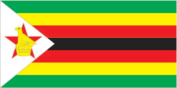
description: seven equal horizontal bands of green (top), yellow, red, black, red, yellow, and green, with a white isosceles triangle edged in black based on the left side; in the middle of the triangle, a yellow bird is on top of a five-pointed red star meaning: the bird represents the long history of the country; white stands for peace, green for agriculture, yellow for mineral wealth, red for the blood shed to achieve independence, and black for the people
Government type
presidential republic
Independence
18 April 1980 (from the UK)
International law organization participation
has not submitted an ICJ jurisdiction declaration; non-party state to the ICCt
International organization participation
ACP, AfDB, ATMIS, AU, COMESA, FAO, G-15, G-77, IAEA, IBRD, ICAO, ICRM, IDA, IFAD, IFC, IFRCS, ILO, IMF, IMO, Interpol, IOC, IOM, IPU, ISO, ITSO, ITU, ITUC (NGOs), MIGA, NAM, OPCW, PCA, SADC, UN, UNAMID, UNCTAD, UNESCO, UNIDO, UNISFA, UNMIL, UNMISS, UNOCI, UNSOM, UNWTO, UPU, WCO, WFTU (NGOs), WHO, WIPO, WMO, WTO
Judicial branch
- highest court(s)
- Supreme Court (consists of the chief justice and 4 judges); Constitutional Court (consists of the chief and deputy chief justices and 9 judges)
- judge selection and term of office
- Supreme Court judges appointed by the president on recommendation of the Judicial Service Commission, an independent body consisting of the chief justice, Public Service Commission chairman, attorney general, and 2-3 members appointed by the president; judges normally serve until age 65 but can elect to serve until age 70; Constitutional Court judge appointment NA; judges serve nonrenewable 15-year terms
- subordinate courts
- High Court; Labor Court; Administrative Court; regional magistrate courts; customary law courts; special courts
Legal system
mixed system of English common law, Roman-Dutch civil law, and customary law
Legislative branch
- legislative structure
- bicameral
- legislature name
- Parliament
Legislative branch - lower chamber
- chamber name
- National Assembly
- electoral system
- mixed system
- expected date of next election
- August 2028
- most recent election date
- 45161
- number of seats
- 280 (all directly elected)
- parties elected and seats per party
- ZANU-PF (175); Citizens Coalition for Change (CCC) (104)
- percentage of women in chamber
- 30.1%
- scope of elections
- full renewal
- term in office
- 5 years
Legislative branch - upper chamber
- chamber name
- Senate
- electoral system
- proportional representation
- expected date of next election
- August 2028
- most recent election date
- 45161
- number of seats
- 80 (60 directly elected; 20 indirectly elected)
- parties elected and seats per party
- ZANU-PF (33); Citizens Coalition for Change (CCC) (27)
- percentage of women in chamber
- 44.3%
- scope of elections
- full renewal
- term in office
- 5 years
National anthem(s)
- history
- adopted 1994; lyrics in the country's three main languages were written by Zimbabwean poet and academic MUTSWAIRO
- lyrics/music
- Solomon MUTSWAIRO/Fred Lecture CHANGUNDEGA
- title
- "Kalibusiswe Ilizwe leZimbabwe" [Ndebele] "Simudzai Mureza WeZimbabwe" [Shona] (Blessed Be the Land of Zimbabwe)
National color(s)
green, yellow, red, black, white
National heritage
- selected World Heritage Site locales
- Mana Pools National Park, Sapi, and Chewore Safari Areas (n); Great Zimbabwe National Monument (c); Khami Ruins National Monument (c); Mosi-oa-Tunya/Victoria Falls (n); Matobo Hills (c)
- total World Heritage Sites
- 5 (3 cultural, 2 natural)
National holiday
Independence Day, 18 April (1980)
National symbol(s)
Zimbabwe bird symbol, African fish eagle, flame lily
Political parties
Citizens Coalition for Change Movement for Democratic Change or MDC-T National People's Congress or NPC Zimbabwe African National Union-Patriotic Front or ZANU-PF Zimbabwe African Peoples Union or ZAPU
Suffrage
18 years of age; universal
Economy
Agricultural products
sugarcane, beef, maize, cabbages, potatoes, tomatoes, milk, onions, bananas, wheat (2023)
Budget
- expenditures
- $23 million (2018 est.)
- revenues
- $17 million (2018 est.)
Current account balance
- Current account balance 2021
- $348.215 million (2021 est.)
- Current account balance 2022
- $304.966 million (2022 est.)
- Current account balance 2023
- $133.877 million (2023 est.)
Debt - external
- Debt - external 2023
- $6.671 billion (2023 est.)
Economic overview
low income Sub-Saharan economy; political instability and endemic corruption have prevented reforms and stalled debt restructuring; new Zimbabwe Gold (ZiG) currency latest effort to combat ongoing hyperinflation; reliant on natural resource extraction, agriculture and remittances
Exchange rates
- Currency
- Zimbabwean dollars (ZWD) per US dollar -
- Exchange rates 2020
- 51.329 (2020 est.)
- Exchange rates 2021
- 88.552 (2021 est.)
- Exchange rates 2022
- 374.954 (2022 est.)
- Exchange rates 2023
- 3,509.172 (2023 est.)
- Exchange rates 2024
- 3,266.332 (2024 est.)
Exports
- Exports 2021
- $6.575 billion (2021 est.)
- Exports 2022
- $7.453 billion (2022 est.)
- Exports 2023
- $7.603 billion (2023 est.)
Exports - commodities
gold, tobacco, nickel, minerals, diamonds (2023)
Exports - partners
UAE 45%, China 18%, South Africa 15%, Mozambique 4%, Hong Kong 2% (2023)
GDP - composition, by end use
- exports of goods and services
- 22.1% (2024 est.)
- government consumption
- 12.5% (2024 est.)
- household consumption
- 91.5% (2024 est.)
- imports of goods and services
- -30.6% (2024 est.)
- investment in fixed capital
- 3.6% (2024 est.)
- investment in inventories
- 0.9% (2024 est.)
GDP - composition, by sector of origin
- agriculture
- 5.4% (2024 est.)
- industry
- 31.8% (2024 est.)
- services
- 55.8% (2024 est.)
GDP (official exchange rate)
$44.188 billion (2024 est.)
Gini Index coefficient - distribution of family income
- Gini Index coefficient - distribution of family income 2020
- 50.3 (2020 est.)
Household income or consumption by percentage share
- highest 10%
- 34.8% (2017 est.)
- lowest 10%
- 2.5% (2017 est.)
Imports
- Imports 2021
- $8.104 billion (2021 est.)
- Imports 2022
- $9.569 billion (2022 est.)
- Imports 2023
- $10.293 billion (2023 est.)
Imports - commodities
refined petroleum, fertilizers, trucks, soybean oil, stone processing machines (2023)
Imports - partners
South Africa 37%, China 15%, Bahamas, The 5%, Singapore 5%, UAE 4% (2023)
Industrial production growth rate
2.7% (2024 est.)
Industries
mining (coal, gold, platinum, copper, nickel, tin, diamonds, clay, numerous metallic and nonmetallic ores), steel, wood products, cement, chemicals, fertilizer, clothing and footwear, foodstuffs, beverages
Inflation rate (consumer prices)
- Inflation rate (consumer prices) 2020
- 557.2% (2020 est.)
- Inflation rate (consumer prices) 2021
- 98.5% (2021 est.)
- Inflation rate (consumer prices) 2022
- 104.7% (2022 est.)
Labor force
6.386 million (2024 est.)
Population below poverty line
38.3% (2019 est.)
Public debt
- Public debt 2016
- 69.9% of GDP (2016 est.)
Real GDP (purchasing power parity)
- Real GDP (purchasing power parity) 2022
- $53.399 billion (2022 est.)
- Real GDP (purchasing power parity) 2023
- $56.249 billion (2023 est.)
- Real GDP (purchasing power parity) 2024
- $57.391 billion (2024 est.)
Real GDP growth rate
- Real GDP growth rate 2022
- 6.1% (2022 est.)
- Real GDP growth rate 2023
- 5.3% (2023 est.)
- Real GDP growth rate 2024
- 2% (2024 est.)
Real GDP per capita
- Real GDP per capita 2022
- $3,300 (2022 est.)
- Real GDP per capita 2023
- $3,400 (2023 est.)
- Real GDP per capita 2024
- $3,500 (2024 est.)
Remittances
- Remittances 2021
- 9.4% of GDP (2021 est.)
- Remittances 2022
- 9.4% of GDP (2022 est.)
- Remittances 2023
- 9.4% of GDP (2023 est.)
Reserves of foreign exchange and gold
- Reserves of foreign exchange and gold 2022
- $598.622 million (2022 est.)
- Reserves of foreign exchange and gold 2023
- $115.53 million (2023 est.)
- Reserves of foreign exchange and gold 2024
- $484.973 million (2024 est.)
Taxes and other revenues
7.2% (of GDP) (2018 est.)
Unemployment rate
- Unemployment rate 2022
- 10.1% (2022 est.)
- Unemployment rate 2023
- 8.8% (2023 est.)
- Unemployment rate 2024
- 8.6% (2024 est.)
Youth unemployment rate (ages 15-24)
- female
- 15.4% (2024 est.)
- male
- 12.9% (2024 est.)
- total
- 14% (2024 est.)
Energy
Coal
- consumption
- 6.705 million metric tons (2023 est.)
- exports
- 984,000 metric tons (2023 est.)
- imports
- 71,000 metric tons (2023 est.)
- production
- 7.968 million metric tons (2023 est.)
- proven reserves
- 502 million metric tons (2023 est.)
Electricity
- consumption
- 8.346 billion kWh (2023 est.)
- exports
- 395 million kWh (2023 est.)
- imports
- 2.297 billion kWh (2023 est.)
- installed generating capacity
- 2.491 million kW (2023 est.)
- transmission/distribution losses
- 1.864 billion kWh (2023 est.)
Electricity access
- electrification - rural areas
- 33.7%
- electrification - total population
- 50.1% (2022 est.)
- electrification - urban areas
- 89%
Electricity generation sources
- biomass and waste
- 1.5% of total installed capacity (2023 est.)
- fossil fuels
- 32.5% of total installed capacity (2023 est.)
- hydroelectricity
- 65.7% of total installed capacity (2023 est.)
- solar
- 0.4% of total installed capacity (2023 est.)
Energy consumption per capita
- Total energy consumption per capita 2023
- 10.855 million Btu/person (2023 est.)
Petroleum
- refined petroleum consumption
- 34,000 bbl/day (2023 est.)
- total petroleum production
- 800 bbl/day (2023 est.)
Communications
Broadband - fixed subscriptions
- subscriptions per 100 inhabitants
- 2 (2023 est.)
- total
- 269,000 (2023 est.)
Broadcast media
government owns all local radio and TV stations; foreign shortwave broadcasts and satellite TV available; in rural areas, access to TV broadcasts is extremely limited; analog TV only, no digital service (2017)
Internet country code
.zw
Internet users
- percent of population
- 38% (2023 est.)
Telephones - fixed lines
- subscriptions per 100 inhabitants
- 2 (2023 est.)
- total subscriptions
- 310,000 (2023 est.)
Telephones - mobile cellular
- subscriptions per 100 inhabitants
- 94 (2024 est.)
- total subscriptions
- 15.7 million (2024 est.)
Transportation
Airports
144 (2025)
Civil aircraft registration country code prefix
Z
Heliports
5 (2025)
Railways
- narrow gauge
- 3,427 km (2014) 1.067-m gauge (313 km electrified)
- total
- 3,427 km (2014)
Military and Security
Military - note
the primary responsibilities of the Zimbabwe Defense Forces (ZDF) are protecting the country’s sovereignty and territory and securing its borders; it also has a role in domestic security and socio-economic development projects and has continued to be active in the country’s politics since the 2017 military-assisted political transition; the ZDF is part of the Southern Africa Development Community (SADC) Standby Force and provided troops for the SADC military deployment to Mozambique from 2021-2024; Zimbabwe has defense ties with China and Russia the ZDF was formed after independence from the former Rhodesian Army and the two guerrilla forces that opposed it during the Rhodesian Civil War (aka "Bush War") of the 1970s, the Zimbabwe African National Liberation Army (ZANLA) and the Zimbabwe People's Revolutionary Army (ZIPRA); the ZDF intervened in the Mozambique Civil War (1983-1992), the Democratic Republic of Congo during the Second Congo War (1998-2003), and the Angolan Civil War (1975-2002) during the late 1990s (2025)
Military and security forces
Zimbabwe Defense Forces (ZDF): Zimbabwe National Army (ZNA), Air Force of Zimbabwe (AFZ) Ministry of Home Affairs: Zimbabwe Republic Police (2025)
Military and security service personnel strengths
approximately 30,000 active Zimbabwe Defense Forces (2025)
Military equipment inventories and acquisitions
the ZDF inventory is comprised mostly of Russian/Soviet-era and Chinese armaments with smaller quantities of older or obsolescent material from countries such as Brazil, France, Italy, South Africa, the UK, and the US (2025)
Military expenditures
- Military Expenditures 2020
- 1% of GDP (2020 est.)
- Military Expenditures 2021
- 1.4% of GDP (2021 est.)
- Military Expenditures 2022
- 0.9% of GDP (2022 est.)
- Military Expenditures 2023
- 0.3% of GDP (2023 est.)
- Military Expenditures 2024
- 0.4% of GDP (2024 est.)
Military service age and obligation
18-22 years of age for voluntary military service for men and women (enlisted personnel); 18-24 for officer cadets; 18-30 for technical/specialist personnel; no conscription (2025)
Transnational Issues
Refugees and internally displaced persons
- IDPs
- 32,675 (2024 est.)
- refugees
- 22,432 (2024 est.)
Trafficking in persons
- tier rating
- Tier 2 Watch List — the government did not demonstrate overall increasing efforts to eliminate trafficking compared with the previous reporting period, therefore Zimbabwe remained on Tier 2 Watch List for the second consecutive year; for more details, go to: https://www.state.gov/reports/2025-trafficking-in-persons-report/zimbabwe/
Space
Key space-program milestones
2020 - began a program (BIRDS-5) sponsored by Japan to promote the development of a domestic space program by designing, building, testing, launching, and operating the first satellites for participating countries 2021 - established satellite ground communications station and completed national wetlands mapping project 2022 - first nano-sized remote sensing/educational satellite (ZIMSAT-1) built with Japan’s assistance and launched by Japan under the BIRDs-5 program 2024 - second RS satellite (ZIMSAT-2) built with Russian assistance and launched by Russia
Space agency/agencies
Zimbabwe National Geospatial and Space Agency (ZINGSA; established in 2019 and officially launched in 2021) (2025)
Space program overview
has a nascent program with the goal of using space technologies in economic development, including remote sensing capabilities to assist with monitoring or managing agriculture, food security, climate change, disease outbreaks, environmental hazards and disasters, and natural resources, as well as weather forecasting; has cooperated with Japan and Russia (2025)
Environment
Carbon dioxide emissions
- from coal and metallurgical coke
- 7.629 million metric tonnes of CO2 (2023 est.)
- from petroleum and other liquids
- 4.949 million metric tonnes of CO2 (2023 est.)
- total emissions
- 12.578 million metric tonnes of CO2 (2023 est.)
Environmental issues
deforestation; soil erosion; land degradation; air and water pollution; poaching; toxic waste and heavy metal pollution from mining
International environmental agreements
- party to
- Biodiversity, Climate Change, Climate Change-Kyoto Protocol, Climate Change-Paris Agreement, Comprehensive Nuclear Test Ban, Desertification, Endangered Species, Hazardous Wastes, Law of the Sea, Ozone Layer Protection, Wetlands
- signed, but not ratified
- none of the selected agreements
Particulate matter emissions
14.5 micrograms per cubic meter (2019 est.)
Total renewable water resources
20 billion cubic meters (2022 est.)
Total water withdrawal
- agricultural
- 4.281 billion cubic meters (2022 est.)
- industrial
- 81.352 million cubic meters (2022 est.)
- municipal
- 547.078 million cubic meters (2022 est.)
Waste and recycling
- municipal solid waste generated annually
- 1.45 million tons (2024 est.)
- percent of municipal solid waste recycled
- 21.8% (2022 est.)