1999 Edition
CIA World Factbook 1999 (Internet Archive)
Geography
Area
total: 390,580 sq km land: 386,670 sq km water: 3,910 sq km
Area--comparative
slightly larger than Montana
Climate
tropical; moderated by altitude; rainy season (November to March)
Coastline
0 km (landlocked)
Elevation extremes
lowest point: junction of the Runde and Save rivers 162 m highest point: Inyangani 2,592 m
Environment--current issues
deforestation; soil erosion; land degradation; air and water pollution; the black rhinoceros herd--once the largest concentration of the species in the world--has been significantly reduced by poaching
Environment--international agreements
party to: Biodiversity, Climate Change, Desertification, Endangered Species, Law of the Sea, Ozone Layer Protection signed, but not ratified: none of the selected agreements
Geographic coordinates
20 00 S, 30 00 E
Geography--note
landlocked
Irrigated land
1,930 sq km (1993 est.)
Land boundaries
total: 3,066 km border countries: Botswana 813 km, Mozambique 1,231 km, South Africa 225 km, Zambia 797 km
Land use
arable land: 7% permanent crops: 0% permanent pastures: 13% forests and woodland: 23% other: 57% (1993 est.)
Location
Southern Africa, northeast of Botswana
Map references
Africa
Maritime claims
none (landlocked)
Natural hazards
recurring droughts; floods and severe storms are rare
Natural resources
coal, chromium ore, asbestos, gold, nickel, copper, iron ore, vanadium, lithium, tin, platinum group metals
Terrain
mostly high plateau with higher central plateau (high veld); mountains in east
People and Society
Age structure
0-14 years: 43% (male 2,432,785; female 2,389,029) 15-64 years: 54% (male 2,986,531; female 3,059,186) 65 years and over: 3% (male 132,532; female 163,097) (1999 est.)
Birth rate
30.64 births/1,000 population (1999 est.)
Death rate
20.43 deaths/1,000 population (1999 est.)
Ethnic groups
African 98% (Shona 71%, Ndebele 16%, other 11%), white 1%, mixed and Asian 1%
Infant mortality rate
61.21 deaths/1,000 live births (1999 est.)
Languages
English (official), Shona, Sindebele (the language of the Ndebele, sometimes called Ndebele), numerous but minor tribal dialects
Life expectancy at birth
total population: 38.86 years male: 38.77 years female: 38.94 years (1999 est.)
Literacy
definition: age 15 and over can read and write English total population: 85% male: 90% female: 80% (1995 est.)
Nationality
noun: Zimbabwean(s) adjective: Zimbabwean
Net migration rate
NA migrant(s)/1,000 population note: there is a small but steady flow of Zimbabweans into South Africa in search of better paid employment
Population
11,163,160 (July 1999 est.)
Population growth rate
1.02% (1999 est.)
Religions
syncretic (part Christian, part indigenous beliefs) 50%, Christian 25%, indigenous beliefs 24%, Muslim and other 1%
Sex ratio
at birth: 1.03 male(s)/female under 15 years: 1.02 male(s)/female 15-64 years: 0.98 male(s)/female 65 years and over: 0.81 male(s)/female total population: 0.99 male(s)/female (1999 est.)
Total fertility rate
3.71 children born/woman (1999 est.)
Government
Administrative divisions
8 provinces and 2 cities* with provincial status; Bulawayo*, Harare*, Manicaland, Mashonaland Central, Mashonaland East, Mashonaland West, Masvingo, Matabeleland North, Matabeleland South, Midlands
Capital
Harare
Constitution
21 December 1979
Country name
conventional long form: Republic of Zimbabwe conventional short form: Zimbabwe former: Southern Rhodesia
Data code
ZI
Executive branch
chief of state: Executive President Robert Gabriel MUGABE (since 31 December 1987); Co-Vice Presidents Simon Vengai MUZENDA (since 31 December 1987) and Joshua M. NKOMO (since 6 August 1990); note--the president is both the chief of state and head of government head of government: Executive President Robert Gabriel MUGABE (since 31 December 1987); Co-Vice Presidents Simon Vengai MUZENDA (since 31 December 1987) and Joshua M. NKOMO (since 6 August 1990); note--the president is both the chief of state and head of government cabinet: Cabinet appointed by the president; responsible to the House of Assembly elections: president nominated by the House of Assembly for a six-year term (if more than one nomination, an electoral college consisting of members of the House of Assembly elects the president); election last held 26-27 March 1996 (next to be held NA March 2002); co-vice presidents appointed by the president election results: Robert Gabriel MUGABE reelected president; percent of electoral college vote--Robert Gabriel MUGABE 92.7%, Abel MUZOREWA 4.8%; Ndabaningi SITHOLE 2.4%
Flag description
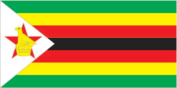
seven equal horizontal bands of green, yellow, red, black, red, yellow, and green with a white equilateral triangle edged in black based on the hoist side; a yellow Zimbabwe bird is superimposed on a red five-pointed star in the center of the triangle
Government type
parliamentary democracy
Independence
18 April 1980 (from UK)
International organization participation
ACP, AfDB, C, CCC, ECA, FAO, G-15, G-77, IAEA, IBRD, ICAO, ICFTU, ICRM, IDA, IFAD, IFC, IFRCS, ILO, IMF, Intelsat, Interpol, IOC, IOM (observer), ISO, ITU, MONUA, NAM, OAU, OPCW, PCA, SADC, UN, UNCTAD, UNESCO, UNIDO, UPU, WCL, WFTU, WHO, WIPO, WMO, WToO, WTrO Diplomatic representation in the US: chief of mission: Ambassador Amos Bernard Muvengwa MIDZI chancery: 1608 New Hampshire Avenue NW, Washington, DC 20009 Diplomatic representation from the US: chief of mission: Ambassador Thomas McDONALD embassy: 172 Herbert Chitepo Avenue, Harare mailing address: P. O. Box 3340, Harare
Judicial branch
Supreme Court Political parties and leaders: Zimbabwe African National
Legal system
mixture of Roman-Dutch and English common law
Legislative branch
unicameral parliament, called House of Assembly (150 seats--120 elected by popular vote for six-year terms, 12 nominated by the president, 10 occupied by traditional chiefs chosen by their peers, and 8 occupied by provincial governors) elections: last held 8-9 April 1995 (next to be held NA April 2001) election results: percent of vote by party--NA; seats by party--ZANU-PF 117, ZANU-Ndonga 2, independent 1
National holiday
Independence Day, 18 April (1980)
Suffrage
18 years of age; universal
Economy
Agriculture--products
corn, cotton, tobacco, wheat, coffee, sugarcane, peanuts; cattle, sheep, goats, pigs
Budget
revenues: $2.5 billion expenditures: $2.9 billion, including capital expenditures of $279 million (FY96/97 est.)
Currency
1 Zimbabwean dollar (Z$) = 100 cents
Debt--external
$5 billion (1998)
Economic aid--recipient
$437.6 million (1995)
Economy--overview
The government of Zimbabwe faces a wide variety of difficult economic problems as it struggles to consolidate earlier progress in developing a market-oriented economy. Its involvement in the war in the Democratic Republic of the Congo, for example, has already drained hundreds of millions of dollars from the economy. Badly needed support from the IMF suffers delays in part because of the country's failure to meet budgetary goals. Inflation rose from an annual rate of 25% in January 1998 to 47% in December and will almost certainly continue to increase in 1999. The economy is being steadily weakened by AIDS; Zimbabwe has one of the highest rates of infection in the world. Per capita GDP, which is twice the average of the poorer sub-Saharan nations, will increase little if any in the near-term, and Zimbabwe will suffer continued frustrations in developing its agricultural and mineral resources.
Electricity--consumption
10.769 billion kWh (1996)
Electricity--exports
1 million kWh (1996)
Electricity--imports
2.27 billion kWh (1996)
Electricity--production
8.5 billion kWh (1996)
Electricity--production by source
fossil fuel: 71.76% hydro: 28.24% nuclear: 0% other: 0% (1996)
Exchange rates
Zimbabwean dollars (Z$) per US$1--39.3701 (January 1999), 21.4133 (1998), 11.8906 (1997), 9.9206 (1996), 8.6580 (1995), 8.1500 (1994)
Exports
$1.7 billion (f.o.b., 1998 est.)
Exports--commodities
tobacco, gold, ferroalloys, cotton (1997)
Exports--partners
South Africa 12%, UK 11%, Germany 8%, Japan 6%, US 6% (1997 est.)
Fiscal year
1 July--30 June
GDP
purchasing power parity--$26.2 billion (1998 est.)
GDP--composition by sector
agriculture: 28% industry: 32% services: 40% (1997 est.)
GDP--per capita
purchasing power parity?$2,400 (1998 est.)
GDP--real growth rate
1.5% (1998 est.)
Household income or consumption by percentage share
lowest 10%: 1.8% highest 10%: 46.9% (1990)
Imports
$2 billion (f.o.b., 1998 est.)
Imports--commodities
machinery and transport equipment 39%, other manufactures 18%, chemicals 15%, fuels 10% (1997 est.)
Imports--partners
South Africa 37%, UK 7%, US 6%, Japan 6% (1997 est.)
Industrial production growth rate
10% (1994)
Industries
mining (coal, clay, numerous metallic and nonmetallic ores), copper, steel, nickel, tin, wood products, cement, chemicals, fertilizer, clothing and footwear, foodstuffs, beverages
Inflation rate (consumer prices)
32% (1998 est.)
Labor force
5 million (1997 est.)
Labor force--by occupation
NA
Population below poverty line
25.5% (1990-91 est.)
Unemployment rate
at least 45% (1994 est.)
Communications
Radio broadcast stations
AM 8, FM 18, shortwave 0
Radios
890,000 (1992 est.)
Telephone system
system was once one of the best in Africa, but now suffers from poor maintenance domestic: consists of microwave radio relay links, open-wire lines, and radiotelephone communication stations international: satellite earth station--1 Intelsat (Atlantic Ocean)
Telephones
301,000 (1990 est.)
Television broadcast stations
16 (1997)
Televisions
280,000 (1992 est.)
Transportation
Airports
467 (1998 est.) Airports--with paved runways: total: 18 over 3,047 m: 3 2,438 to 3,047 m: 2 1,524 to 2,437 m: 4 914 to 1,523 m: 9 (1998 est.) Airports--with unpaved runways: total: 449 1,524 to 2,437 m: 4 914 to 1,523 m: 220 under 914 m: 225 (1998 est.)
Highways
total: 18,338 km paved: 8,692 km unpaved: 9,646 km (1996 est.)
Pipelines
petroleum products 212 km Ports and harbors: Binga, Kariba
Railways
total: 2,759 km (1995) narrow gauge: 2,759 km 1.067-m gauge (313 km electrified; 42 km double track) (1995 est.)
Waterways
the Mazoe and Zambezi rivers are used for transporting chrome ore from Harare to Mozambique
Military and Security
Military branches
Zimbabwe National Army, Air Force of Zimbabwe, Zimbabwe Republic Police (includes Police Support Unit, Paramilitary Police)
Military expenditures--dollar figure
$427 million (FY97/98)
Military expenditures--percent of GDP
4.6% (FY97/98)
Military manpower--availability
males age 15-49: 2,738,963 (1999 est.) Military manpower--fit for military service: males age 15-49: 1,707,348 (1999 est.)
Transnational Issues
Disputes--international
quadripoint with Botswana, Namibia, and Zambia is in disagreement
Illicit drugs
significant transit point for African cannabis and South Asian heroin, mandrax, and methamphetamines destined for the South African and European markets