1991 Edition
CIA World Factbook 1991 (Project Gutenberg)
Geography
Climate
tropical; moderated by altitude; rainy season (November to March)
Coastline
none--landlocked
Comparative area
slightly larger than Montana
Disputes
quadripoint with Botswana, Namibia, and Zambia is in disagreement
Environment
recurring droughts; floods and severe storms are rare; deforestation; soil erosion; air and water pollution
Land boundaries
3,066 km total; Botswana 813 km, Mozambique 1,231 km, South Africa 225 km, Zambia 797 km
Land use
arable land 7%; permanent crops NEGL%; meadows and pastures 12%; forest and woodland 62%; other 19%; includes irrigated NEGL%
Maritime claims
none--landlocked
Natural resources
coal, chromium ore, asbestos, gold, nickel, copper, iron ore, vanadium, lithium, tin, platinum group metals
Note
landlocked
Terrain
mostly high plateau with higher central plateau (high veld); mountains in east
Total area
390,580 km2; land area: 386,670 km2
People and Society
Birth rate
41 births/1,000 population (1991)
Death rate
8 deaths/1,000 population (1991)
Ethnic divisions
African 98% (Shona 71%, Ndebele 16%, other 11%); white 1%, mixed and Asian 1%
Infant mortality rate
61 deaths/1,000 live births (1991)
Labor force
3,100,000; agriculture 74%, transport and services 16%, mining, manufacturing, construction 10% (1987)
Language
English (official); Shona, Sindebele
Life expectancy at birth
60 years male, 64 years female (1991)
Literacy
67% (male 74%, female 60%) age 15 and over can read and write (1990 est.)
Nationality
noun--Zimbabwean(s); adjective--Zimbabwean
Net migration rate
- 3 migrants/1,000 population (1991)
Organized labor
17% of wage and salary earners have union membership
Population
10,720,459 (July 1991), growth rate 2.9% (1991)
Religion
syncretic (part Christian, part indigenous beliefs) 50%, Christian 25%, indigenous beliefs 24%, a few Muslim
Total fertility rate
5.6 children born/woman (1991)
Government
Administrative divisions
8 provinces; Manicaland, Mashonaland Central, Mashonaland East, Mashonaland West, Masvingo (Victoria), Matabeleland North, Matabeleland South, Midlands
Capital
Harare
Communists
no Communist party
Constitution
21 December 1979
Diplomatic representation
Counselor (Political Affairs), Head of Chancery, Ambassador Stanislaus Garikai CHIGWEDERE; Chancery at 2852 McGill Terrace NW, Washington DC 20008; telephone (202) 332-7100; US--Ambassador (vacant); Embassy at 172 Herbert Chitapo Avenue, Harare (mailing address is P. O. Box 3340, Harare); telephone [263] (4) 794-521
Elections
Executive President--last held 28-30 March 1990 (next to be held NA March 1995); results--Robert MUGABE 78.3%; Edgar TEKERE 21.7%; Parliament--last held 28-30 March 1990 (next to be held NA March 1995); results--percent of vote by party NA; seats--(150 total, 120 elected) ZANU 117, ZUM 2, ZANU-S 1
Executive branch
executive president, 2 vice presidents, Cabinet
Flag
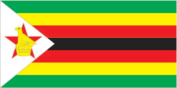
seven equal horizontal bands of green, yellow, red, black, red, yellow, and green with a white equilateral triangle edged in black based on the hoist side; a yellow Zimbabwe bird is superimposed on a red five-pointed star in the center of the triangle
Independence
18 April 1980 (from UK; formerly Southern Rhodesia)
Judicial branch
Supreme Court
Leaders
Chief of State and Head of Government--Executive President Robert Gabriel MUGABE (since 31 December 1987); Co-Vice President Simon Vengai MUZENDA (since 31 December 1987); Co-Vice President Joshua M. NKOMO (since 6 August 1990)
Legal system
mixture of Roman-Dutch and English common law
Legislative branch
unicameral Parliament
Long-form name
Republic of Zimbabwe
Member of
ACP, AfDB, C, CCC, ECA, FAO, FLS, G-77, GATT, IAEA, IBRD, ICAO, IDA, IFAD, IFC, ILO, IMF, INTELSAT, INTERPOL, IOC, IOM (observer), ITU, LORCS, NAM, OAU, PCA, SADCC, UN, UNCTAD, UNESCO, UNIDO, UPU, WCL, WHO, WIPO, WMO, WTO
National holiday
Independence Day, 18 April (1980)
Political parties and leaders
Zimbabwe African National Union-Patriotic Front (ZANU-PF), Robert MUGABE; Zimbabwe African National Union-Sithole (ZANU-S), Ndabaningi SITHOLE; Zimbabwe Unity Movement (ZUM), Edgar TEKERE
Suffrage
universal at age 18
Type
parliamentary democracy
Economy
Agriculture
accounts for about 15% of GDP and employs 74% of population; 40% of land area divided into 4,500 large commercial farms and 42% in communal lands; crops--corn (food staple), cotton, tobacco, wheat, coffee, sugarcane, peanuts; livestock--cattle, sheep, goats, pigs; self-sufficient in food
Budget
revenues $2.7 billion; expenditures $3.3 billion, including capital expenditures of $330 million (FY91)
Currency
Zimbabwean dollar (plural--dollars); 1 Zimbabwean dollar (Z$) = 100 cents
Economic aid
US commitments, including Ex-Im (FY80-89), $389 million; Western (non-US) countries, ODA and OOF bilateral commitments (1970-88), $2.3 billion; OPEC bilateral aid (1979-89), $36 million; Communist countries (1970-89), $134 million
Electricity
2,036,000 kW capacity; 5,460 million kWh produced, 540 kWh per capita (1989)
Exchange rates
Zimbabwean dollars (Z$) per US$1--2.6724 (January 1991), 2.4480 (1990), 2.1133 (1989), 1.8018 (1988), 1.6611 (1987), 1.6650 (1986), 1.6119 (1985)
Exports
$1.7 billion (f.o.b., 1989); commodities--agricultural 35% (tobacco 20%, other 15%), manufactures 20%, gold 10%, ferrochrome 10%, cotton 5%; partners--Europe 55% (EC 40%, Netherlands 5%, other 10%), Africa 20% (South Africa 10%, other 10%), US 5%
External debt
$2.96 billion (December 1989 est.)
Fiscal year
1 July-30 June
GDP
$5.6 billion, per capita $540; real growth rate 4.2% (1990 est.)
Imports
$1.4 billion (c.i.f., 1989); commodities--machinery and transportation equipment 37%, other manufactures 22%, chemicals 16%, fuels 15%; partners--EC 31%, Africa 29% (South Africa 21%, other 8%), US 8%, Japan 4%
Industrial production
growth rate 4.7% (1988 est.); accounts for 35% of GDP
Industries
mining, steel, clothing and footwear, chemicals, foodstuffs, fertilizer, beverage, transportation equipment, wood products
Inflation rate (consumer prices)
13% (1989)
Overview
Agriculture employs three-fourths of the labor force and supplies almost 40% of exports. The manufacturing sector, based on agriculture and mining, produces a variety of goods and contributes 35% to GDP. Mining accounts for only 5% of both GDP and employment, but supplies of minerals and metals account for about 40% of exports. Wide year-to-year fluctuations in agricultural production over the past six years have resulted in an uneven growth rate, one that on average matched the 3% annual increase in population.
Unemployment rate
at least 20% (1990 est.)
Communications
Airports
499 total, 415 usable; 23 with permanent-surface runways; 2 with runways over 3,659 m; 3 with runways 2,440-3,659 m; 35 with runways 1,220-2,439 m
Civil air
12 major transport aircraft
Highways
85,237 km total; 15,800 km paved, 39,090 km crushed stone, gravel, stabilized soil: 23,097 km improved earth; 7,250 km unimproved earth
Inland waterways
Lake Kariba is a potential line of communication
Pipelines
8 km, refined products
Railroads
2,745 km 1.067-meter gauge; 42 km double track; 355 km electrified
Telecommunications
system was once one of the best in Africa, but now suffers from poor maintenance; consists of radio relay links, open-wire lines, and radio communications stations; 247,000 telephones; stations--8 AM, 18 FM, 8 TV; 1 Atlantic Ocean INTELSAT earth station
Military and Security
Branches
Zimbabwe National Army, Air Force of Zimbabwe, Police Support Unit, Paramilitary Police, People's Militia
Defense expenditures
$412.4 million, NA% of GDP (FY91 est.) _%_
Manpower availability
males 15-49, 2,263,724; 1,399,354 fit for military service