1989 Edition
CIA World Factbook 1989 (Internet Archive)
Geography
Climate
- tropical; moderated by altitude; rainy season (November to March)
- tropical; marine; rainy season during southwest monsoon (June to August); cloudiness is persistent and extensive all year
Coastline
- none — landlocked
- 1,448 km
Comparative area
- slightly larger than Montana
- slightly less than three times the size of Connecticut
Disputes
- quadripoint with Botswana, Namibia, and Zambia is in disagreement
- involved in complex dispute over the Spratly Islands with China, Malaysia, Philippines, and Vietnam; Paracel Islands occupied by China, but claimed by Vietnam and Taiwan; Japanese-administered Senkaku-shotO (Senkaku Islands) claimed by China and Taiwan
Environment
- recurring droughts; floods and severe storms are rare; deforestation; soil erosion; air and water pollution; desertification
- subject to earthquakes and typhoons
Extended economic zone
200 nm
Land boundaries
- 3,066 km total; Botswana 813 km, Mozambique 1,231 km, South Africa 225 km, Zambia 797 km
- none
Land use
- 7% arable land; NEGL% permanent crops; 1 2% meadows and pastures; 62% forest and woodland; 1 9% other; includes NEGL% irrigated
- 24% arable land; 1% permanent crops; 5% meadows and pastures; 55% forest and woodland; 1 5% other; 1 4% irrigated
Maritime claims
none — landlocked
Natural resources
- coal, chromium ore, asbestos, gold, nickel, copper, iron ore, vanadium, lithium, tin
- small deposits of coal, natural gas, limestone, marble, and asbestos
Note
landlocked
Terrain
- mostly high plateau with higher central plateau (high veld); mountains in east
- eastern two-thirds mostly rugged mountains; flat to gently rolling plains in west
Territorial sea
1 2 nm
Total area
- 390,580 km2; land area: 386,670 km2
- 35,980 km2; land area: 32,260 km2; includes the Pescadores, Matsu, and Quemoy
Total area
200km
People and Society
Administrative divisions
1 6 counties (hsien, singular and plural), 5 municipalities* (shih, singular and plural), 2 special municipalities** (chuan-shih, singular and plural); Chang-hua, Chia-i, Chia-i*, Chi-lung*, Hsin-chu, Hsin-chu*, Hua-lien, Man, Kao-hsiung, Kao-hsiung**, Miao-li, Nan-t'ou, P'enghu, P'ing-tung, T'ai-chung, T'ai-chung*, T'ai-nan, T'ai-nan*, T'ai-pei, T'ai-pei**, T'ai-tung, T'ao-yiian, Yiin-lin; note — the Wade-Giles system is used for romanization
Birth rate
- 42 births/ 1,000 population (1990)
- 16 births/ 1,000 population (1990)
Capital
Taipei
Constitution
25 December 1947
Death rate
- 9 deaths/ 1 ,000 population (1990)
- 5 deaths/ 1 ,000 population (1990)
Diplomatic representation
none; unofficial commercial and cultural relations with the people of the US are maintained through a private instrumentality, the Coordination Council for North American Affairs (CCNAA) with headquarters in Taipei and field offices in Washington and 10 other US cities with all addresses and telephone numbers NA; US — unofficial commercial and cultural relations with the people of Taiwan are maintained through a private institution, the American Institute in Taiwan (AIT), which has offices in Taipei at 7 Lane 134, Hsin Yi Road, Section 3 with telephone 002 [886] (2) 7092000 and in Kao-hsiung at 88 Wu Fu 3rd Road with telephone NA
Elections
President — last held 21 March 1990 (next to be held March 1996); results— President Li Teng-hui was elected by the National Assembly; Vice President— last held 22 March 1990 (next to be held March 1996); results — Li Yuan-tzu was elected by the National Assembly; Legislative Yuan — last held 2 December 1989 (next to be held December 1992); results— KMT 65%, DPP 33%, independents 2%; seats— (304 total, 102 elected) KMT 78, DPP 21, independents 3
Ethnic divisions
- 98% African (71% Shona, 16% Ndebele, 11% other); 1% white, 1% mixed and Asian
- 84% Taiwanese, 14% mainland Chinese, 2% aborigine
Executive branch
president, vice president, premier of the Executive Yuan, vice premier of the Executive Yuan, Executive Y(ian
Flag
red with a dark blue rectangle in the upper hoist-side corner bearing a white sun with 12 triangular rays
Infant mortality rate
- 65 deaths/ 1,000 live births (1990)
- 17 deaths/ 1,000 live births (1990)
Judicial branch
Judicial Yuan
Labor force
- 3,100,000; 74% agriculture, 16% transport and services, 10% mining, manufacturing, construction (1987)
- 7,880,000; 41% industry and commerce, 32% services, 20% agriculture, 7% civil administration (1986)
Language
- English (official); Shona and Ndebele
- Mandarin Chinese (official); Taiwanese and Hakka dialects also used
Leaders
Chief of State— President LI Teng-hui (since 13 January 1988); Vice President LI Yuan-tzu (will take office 20 May 1990); Head of Government — Premier (President of the Executive Yuan) HAO Po-ts'un (since May 2 1990); Vice Premier (Vice President of the Executive Yuan) SHIH Ch'i-yang (since NA July 1988) Political parties and leaders: Kuomintang (Nationalist Party), LI Teng-hui, chairman; Democratic Socialist Party and Young China Party controlled by Kuomintang; Democratic Progressive Party (DPP); Labor Party; 27 other minor parties
Legal system
based on civil law system; accepts compulsory ICJ jurisdiction, with reservations
Legislative branch
unicameral Legislative Yuan
Life expectancy at birth
- 59 years male, 63 years female (1990)
- 72 years male, 77 years female (1990)
Literacy
- 74%
- 94%
Long-form name
none
Member of
expelled from UN General Assembly and Security Council on 25 October 1971 and withdrew on same date from other charter-designated subsidiary organs; expelled from IMF/ World Bank group April/May 1980; member of ADB and PECC, seeking to join GATT and/or MFA; attempting to retain membership in ICAC, ISO, INTELSAT, INTERPOL, IWC — International Wheat Council; suspended from IAEA in 1972, but still allows IAEA controls over extensive atomic development
National holiday
National Day (Anniversary of the Revolution), 10 October (1911)
Nationality
- noun — Zimbabwean(s); adjective— Zimbabwean
- noun — Chinese (sing., pi.); adjective — Chinese
Net migration rate
- 0 migrants/ 1 ,000 population (1990)
- NEGL migrants/ 1,000 population (1990)
Organized labor
- 1 7% of wage and salary earners have union membership
- 1,300,000 or about 18.4% (government controlled) (1983) Administration
Population
- 10,392,161 (July 1990), growth rate 3.3% (1990)
- 20,546,664 (July 1990), growth rate 1.1% (1990)
Religion
- 50% syncretic (part Christian, part indigenous beliefs), 25% Christian, 24% indigenous beliefs, a few Muslim
- 93% mixture of Buddhist, Confucian, and Taoist; 4.5% Christian; 2.5% other
Suffrage
universal at age 20
Total fertility rate
- 5.8 children born/ woman (1990)
- 1 .7 children born/ woman (1990)
Type
one-party presidential regime; opposition political parties legalized in March,
Government
Administrative divisions
8 provinces; Manicaland, Mashonaland Central, Mashonaland East, Mashonaland West, Matabeleland North, Matabeleland South, Midlands, Victoria (commonly called Masvingo)
Capital
Harare
Communists
no Communist party
Constitution
21 December 1979
Diplomatic representation
Counselor (Political Affairs), Head of Chancery, Ambassador Stanislaus Garikai CHIGWEDERE; Chancery at 2852 McGill Terrace NW, Washington DC 20008; telephone (202) 332-7100; US— Ambassadordesignate Steven RHODES; Embassy at 172 Rhodes Avenue, Harare (mailing address is P. O. Box 3340, Harare); telephone [263] (14) 794-521
Elections
President— last held 28-30 March 1990 (next to be held March 1995); results — President Robert Mugabe 78.3%; Edgar Tekere 21.7%; Parliament— last held 28-30 March 1990 (next to be held March 1993); results — percent of vote by party NA; seats — (150 total, 120 elected) ZANU 1 16, ZUM 2, ZANU-S 1, to be determined 1
Executive branch
president, vice president, Cabinet
Flag
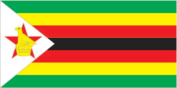
seven equal horizontal bands of green, yellow, red, black, red, yellow, and green with a white equilateral triangle edged in black based on the hoist side; a yellow Zimbabwe bird is superimposed on a red five-pointed star in the center of the triangle
Independence
18 April 1980 (from UK; formerly Southern Rhodesia)
Judicial branch
Supreme Court
Leaders
Chief of State and Head of Government— Executive President Robert Gabriel MUGABE (since 3 1 December 1987); Vice President Simon Vengai MUZENDA (since 31 December 1987) Political parties and leaders: Zimbabwe African National Union-Patriotic Front (ZANU-PF), Robert Mugabe; Zimbabwe African National Union-Sithole (ZANUS), Ndabaningi Sithole; Zimbabwe Unity Movement (ZUM), Edgar Tekere
Legal system
mixture of Roman-Dutch and English common law
Legislative branch
unicameral Parliament
Long-form name
Republic of Zimbabwe
Member of
ACP, AfDB, CCC, Commonwealth, FAO, G-77, GATT, IAEA, IBRD, ICAO, IDA, IFAD, IFC, ILO, IMF, INTERPOL, NAM, OAU, SADCC, UN, UNESCO, UPU, WFTU, WHO, WMO
National holiday
Independence Day, 18 April (1980)
Suffrage
universal at age 18
Type
parliamentary democracy
Economy
Agriculture
- accounts for about 1 5% of GDP and employs over 70% of population; 40% of land area divided into 6,000 large commercial farms and 42% in communal lands; crops — corn (food staple), cotton, tobacco, wheat, coffee, sugarcane, peanuts; livestock — cattle, sheep, goats, pigs; self-sufficient in food
- accounts for 6% of GNP and 20% of labor force (includes part-time farmers); heavily subsidized sector; major crops — rice, sugarcane, sweet potatoes, fruits, vegetables; livestock — hogs, poultry, beef, milk, cattle; not self-sufficient in wheat, soybeans, corn; fish catch expanding, 1.1 million metric tons in (1987)
Aid
- US commitments, including Ex-Im (FY80-88), $359 million; Western (nonUS) countries, ODA and OOF bilateral commitments (1970-87), $2.0 billion; OPEC bilateral aid (1979-89), $36 million; Communist countries (1970-88), $134 million
- US, including Ex-Im (FY46-82), $4.6 billion; Western (non-US) countries, ODA and OOF bilateral commitments (197087), $439 million
Budget
- revenues $2.4 billion; expenditures $3.0 billion, including capital expenditures of $290 million (FY90)
- revenues $25.9 billion; expenditures $33.2 billion, including capital expenditures of $NA (FY89)
Currency
- Zimbabwean dollar (plural — dollars); 1 Zimbabwean dollar (Z$) = 100 cents
- new Taiwan dollar (plural — dollars); 1 new Taiwan dollar (NT$) = 100 cents
Electricity
- 2,036,000 kW capacity; 5,460 million kWh produced, 540 kWh per capita (1989) Zimbabwe (continued) Taiwan
- 17,000,000 kW capacity; 68,000 million kWh produced, 3,360 kWh per capita (1989)
Exchange rates
- Zimbabwean dollars (Z$) per US$1— 2.2873 (January 1990), 2.1133 (1989), 1.8018 (1988), 1.6611 (1987), 1.6650(1986), 1.6119(1985) Fiscal year 1 July30 June
- new Taiwan dollars per US$1— 26.3 (March 1990), 26.156 (December 1989), 28.589 (1988), 31.845 (1987), 37.838 (1986), 39.849 (1985)
Exports
- $1.6 billion (f.o.b., 1988); commodities— agricultural 34% (tobacco 21%, other 13%), manufactures 19%, gold 11%, ferrochrome 1 1 %, cotton 6%; partners — Europe 55% (EC 41%, Netherlands 6%, other 8%), Africa 22% (South Africa 12%, other 10%), US 6%
- $66.2 billion (f.o.b., 1989); commodities— textiles 9.7%, electrical machinery 19.0%, general machinery and equipment 14%, telecommunications equipment 9%, basic metals and metal products 7.4%, foodstuffs 0.9%, plywood and wood products 1 .3%; partners — US 36.2%, Japan 13.7%
External debt
- $2.96 billion (December 1989 est.)
- $1.0 billion (December 1989 est.)
Fiscal year
1 July-30 June
GDP
$4.6 billion, per capita $470; real growth rate 5.3% (1988 est.)
GNP
$121.4 billion, per capita $6,000; real growth rate 7.2% (1989)
Imports
- $1.1 billion (c.i.f., 1988); commodities— machinery and transportation equipment 37%, other manufactures 22%, chemicals 16%, fuels 1 5%; partners — EC 31%, Africa 29% (South Africa 21%, other 8%), US 8%, Japan 4%
- $52.2 billion (c.i.f., 1989); commodities— machinery and equipment 15.9%, crude oil 5%, chemical and chemical products 11.1%, basic metals 7.4%, foodstuffs 2.0%; partners— Japan 31%, US 23%, Saudi Arabia 8.6%
Industrial production
- growth rate 4.7% (1988 est.)
- growth rate 4.1% (1988)
Industries
- mining, steel, clothing and footwear, chemicals, foodstuffs, fertilizer, beverage, transportation equipment, wood products
- textiles, clothing, chemicals, electronics, food processing, plywood, sugar milling, cement, shipbuilding, petroleum
Inflation rate (consumer prices)
- 7.4% (1988)
- 5.0% (1989)
Overview
- Agriculture employs a majority of the labor force and supplies almost 40% of exports. The agro-based manufacturing sector produces a variety of goods and contributes about 25% to GDP. Mining accounts for only 5% of both GDP and employment, but supplies of minerals and metals account for about 40% of exports. Wide year-to-year fluctuations in agricultural production over the past six years resulted in not only an uneven growth rate, but one that did not equal the 3% annual increase in population.
- Taiwan has a dynamic capitalist economy with considerable government guidance of investment and foreign trade and partial government ownership of some large banks and industrial firms. Real growth in GNP has averaged about 9% a year during the past three decades. Export growth has been even faster and has provided the impetus for industrialization. Agriculture contributes about 6% to GNP, down from 35% in 1952. Taiwan currently ranks as number 13 among major trading countries. Traditional labor-intensive industries are steadily being replaced with more capitaland technology-intensive industries.
Unemployment rate
- at least 20% (1988 est.)
- 1.7% (1989)
Communications
Airports
- 506 total, 420 usable; 23 with permanent-surface runways; 2 with runways over 3,659 m; 3 with runways 2,4403,659 m; 37 with runways 1,220-2,439 m
- 38 total, 37 usable; 32 with permanent-surface runways; 3 with runways over 3,659 m; 16 with runways 2,440-3,659 m; 8 with runways 1, 220-2,439 m
Branches
- Zimbabwe National Army, Air Force of Zimbabwe, Police Support Unit, People's Militia
- Army, Navy (including Marines), Air Force, Garrison Command
Civil air
1 2 major transport aircraft
Defense expenditures
- $446.7 million (FY89 est.) 10O km Pescadores Chi lung • Ma-kung Taiwan I Phi/lppin Sea Quemoy and Matsu islands are not shown Set regional map VIM
- 6.8% of GNP, or $8.2 billion (FY90 est.)
- 6.8% of GNP, or $8.2 billion (FY90 est.)
Highways
- 85,237 km total; 15,800 km paved, 39,090 km crushed stone, gravel, stabilized soil: 23,097 km improved earth; 7,250 km unimproved earth
- 18,800 km total; 15,800 km bituminous or concrete, 2,500 km crushed stone or gravel, 500 km graded earth
Inland waterways
Lake Kariba is a potential line of communication
Merchant marine
218 ships (1,000 GRT or over) totaling 5,061,960 GRT/ 7,634,074 DWT; includes 1 short-sea passenger, 61 cargo, 13 refrigerated cargo, 71 container, 14 petroleum, oils, and lubricants (POL) tanker, 3 combination ore/oil, 1 specialized tanker, 54 bulk
Military manpower
- males 15-49, 2,173,448; 1,342,920 fit for military service
- males 1 5-49, 5,809,354; 4,534,950 fit for military service; about 185,235 currently reach military age (19) annually
Pipelines
- 8 km, refined products
- 615 km refined products, 97 km natural gas
Ports
Kao-hsiung, Chi-lung, Hua-lien, Su-ao, T'ai-tung
Railroads
- 2,745 km 1 .067-meter gauge; 42 km double track; 355 km electrified
- about 1,075 km common carrier lines and over 3,800 km industrial lines; common carrier lines consist of the 1.067-meter gauge 708 km West Line and the 367 km East Line; a 98.25 km South Link Line connection is under construction; common carrier lines owned by the government and operated by the Railway Administration under Ministry of Communications; industrial lines owned and operated by government enterprises
Telecommunications
- system was once one of the best in Africa, but now suffers from poor maintenance; consists of radio relay links, open-wire lines, and radio communications stations; 247,000 telephones; stations—8 AM, 18 FM, 8 TV; 1 Atlantic Ocean INTELSAT earth station Defense Forces
- best developed system in Asia outside of Japan; 6,000,000 telephones; extensive microwave transmission links on east and west coasts; stations—91 AM, 23 FM, 15 TV (13 relays); 8,000,000 radio receivers; 6,000,000 TV sets (5,300,000 color, 700,000 monochrome); satellite earth stations — 1 Pacific Ocean INTELSAT and 1 Indian Ocean INTELSAT; submarine cable links to Japan (Okinawa), the Philippines, Guam, Singapore, Hong Kong, Indonesia, Australia, Middle East, and Western Europe Defense Forces