2003 Edition
CIA World Factbook 2003 (Project Gutenberg)
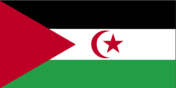
Introduction
Administrative divisions
none (under de facto control of Morocco)
Age structure
0-14 years: NA% 15-64 years: NA% 65 years and over: NA% (2003 est.)
Agriculture - products
fruits and vegetables (grown in the few oases); camels, sheep, goats (kept by nomads)
Airports
11 (2002)
Airports - with paved runways
- total
- 3 2,438 to 3,047 m: 3 (2002)
Airports - with unpaved runways
- total
- 8 1,524 to 2,437 m: 1 914 to 1,523 m: 4
- under 914 m
- 3 (2002) Military Western Sahara
Area
- land
- 266,000 sq km
- total
- 266,000 sq km
- water
- 0 sq km
Area - comparative
about the size of Colorado
Background
Morocco virtually annexed the northern two-thirds of Western Sahara (formerly Spanish Sahara) in 1976, and the rest of the territory in 1979, following Mauritania's withdrawal. A guerrilla war with the Polisario Front contesting Rabat's sovereignty ended in a 1991 UN-brokered cease-fire; a UN-organized referendum on final status has been repeatedly postponed. Geography Western Sahara
Birth rate
NA births/1,000 population (2003 est.)
Budget
- expenditures
- $NA, including capital expenditures of $NA
- revenues
- $NA
Capital
none
Climate
hot, dry desert; rain is rare; cold offshore air currents produce fog and heavy dew
Coastline
1,110 km
Country name
- conventional long form
- none
- conventional short form
- Western Sahara
- former
- Spanish Sahara
Currency
Moroccan dirham (MAD)
Currency code
MAD
Death rate
NA deaths/1,000 population (2003 est.)
Debt - external
$NA
Diplomatic representation from the US
none Economy Western Sahara
Diplomatic representation in the US
none
Disputes - international
Morocco claims and administers Western Sahara, but sovereignty remains unresolved; UN-administered cease-fire has remained in effect since September 1991, but attempts to hold a referendum have failed and parties have rejected other proposals; Mauritanian claims to Western Sahara have been dormant in recent years; Morocco allowed Spanish fishermen to fish temporarily off the coast of Western Sahara after an oil spill soiled Spanish fishing grounds This page was last updated on 18 December, 2003
Economic aid - recipient
$NA
Economy - overview
Western Sahara depends on pastoral nomadism, fishing, and phosphate mining as the principal sources of income for the population. The territory lacks sufficient rainfall for sustainable agricultural production, and most of the food for the urban population must be imported. All trade and other economic activities are controlled by the Moroccan Government. Moroccan energy interests in 2001 signed contracts to explore for oil off the coast of Western Sahara, which has angered the Polisario. Incomes and standards of living in Western Sahara are substantially below the Moroccan level.
Electricity - consumption
83.7 million kWh (2001)
Electricity - exports
0 kWh (2001)
Electricity - imports
0 kWh (2001)
Electricity - production
90 million kWh (2001)
Electricity - production by source
- fossil fuel
- 100%
- hydro
- 0%
- nuclear
- 0%
- other
- 0% (2001)
Elevation extremes
- highest point
- unnamed location 463 m
- lowest point
- Sebjet Tah -55 m
Environment - current issues
sparse water and lack of arable land
Environment - international agreements
- party to
- none of the selected agreements
- signed, but not ratified
- none of the selected agreements
Ethnic groups
Arab, Berber
Exchange rates
Moroccan dirhams per US dollar - 11.584 (2002), 11.303 (2001), 10.626 (2000), 9.804 (1999), 9.604 (1998), 9.527 (1997)
Executive branch
none
Exports
$NA
Exports - commodities
phosphates 62%
Exports - partners
Morocco claims and administers Western Sahara, so trade partners are included in overall Moroccan accounts
Fiscal year
calendar year Communications Western Sahara
GDP
purchasing power parity - $NA
GDP - composition by sector
- agriculture
- NA%
- industry
- NA%
- services
- 40% (1996 est.)
GDP - per capita
purchasing power parity - $NA
GDP - real growth rate
NA%
Geographic coordinates
24 30 N, 13 00 W
Geography - note
the waters off the coast are particularly rich fishing areas People Western Sahara
Government type
legal status of territory and issue of sovereignty unresolved; territory contested by Morocco and Polisario Front (Popular Front for the Liberation of the Saguia el Hamra and Rio de Oro), which in February 1976 formally proclaimed a government-in-exile of the Sahrawi Arab Democratic Republic (SADR),led by President Mohamed ABDELAZIZ; territory partitioned between Morocco and Mauritania in April 1976, with Morocco acquiring northern two-thirds; Mauritania, under pressure from Polisario guerrillas, abandoned all claims to its portion in August 1979; Morocco moved to occupy that sector shortly thereafter and has since asserted administrative control; the Polisario's government-in-exile was seated as an OAU member in 1984; guerrilla activities continued sporadically, until a UN-monitored cease-fire was implemented 6 September 1991
Highways
- paved
- 1,350 km
- total
- 6,200 km
- unpaved
- 4,850 km (1991 est)
HIV/AIDS - adult prevalence rate
NA%
HIV/AIDS - deaths
NA
HIV/AIDS - people living with HIV/AIDS
NA
Household income or consumption by percentage share
- highest 10%
- NA%
- lowest 10%
- NA%
Imports
$NA
Imports - commodities
fuel for fishing fleet, foodstuffs
Imports - partners
Morocco claims and administers Western Sahara, so trade partners are included in overall Moroccan accounts (2000)
Industrial production growth rate
NA%
Industries
phosphate mining, handicrafts
Infant mortality rate
- female
- NA%
- male
- NA%
- total
- NA%
Inflation rate (consumer prices)
NA%
International organization participation
none
Internet country code
.eh
Internet Service Providers (ISPs)
1 (2000)
Internet users
NA Transportation Western Sahara
Irrigated land
NA sq km
Labor force
12,000
Labor force - by occupation
animal husbandry and subsistence farming 50%
Land boundaries
- border countries
- Algeria 42 km, Mauritania 1,561 km, Morocco 443 km
- total
- 2,046 km
Land use
- arable land
- 0%
- other
- 100% (1998 est.)
- permanent crops
- 0%
Languages
Hassaniya Arabic, Moroccan Arabic
Life expectancy at birth
- female
- NA years (2003 est.)
- male
- NA years
- total population
- NA years
Literacy
- definition
- NA
- female
- NA% Government Western Sahara
- male
- NA%
- total population
- NA%
Location
Northern Africa, bordering the North Atlantic Ocean, between Mauritania and Morocco
Map references
Africa
Maritime claims
contingent upon resolution of sovereignty issue
Military expenditures - dollar figure
$NA
Military expenditures - percent of GDP
NA% Transnational Issues Western Sahara
Nationality
- adjective
- Sahrawian, Sahraouian
- noun
- Sahrawi(s), Sahraoui(s)
Natural hazards
hot, dry, dust/sand-laden sirocco wind can occur during winter and spring; widespread harmattan haze exists 60% of time, often severely restricting visibility
Natural resources
phosphates, iron ore
Oil - consumption
1,800 bbl/day (2001 est.)
Oil - exports
NA (2001)
Oil - imports
NA (2001)
Oil - production
0 bbl/day (2001 est.)
Political pressure groups and leaders
none
Population
261,794 (July 2003 est.)
Population below poverty line
NA%
Population growth rate
NA% (2003 est.)
Ports and harbors
Ad Dakhla, Cabo Bojador, Laayoune (El Aaiun)
Radio broadcast stations
AM 2, FM 0, shortwave 0 (1998)
Radios
56,000 (1997)
Railways
0 km
Religions
Muslim
Sex ratio
NA (2003 est.)
Suffrage
none; a UN-sponsored voter identification campaign not yet completed
Telephone system
- domestic
- NA
- general assessment
- sparse and limited system
- international
- tied into Morocco's system by microwave radio relay, tropospheric scatter, and satellite; satellite earth stations - 2 Intelsat (Atlantic Ocean) linked to Rabat, Morocco
Telephones - main lines in use
about 2,000 (1999 est.)
Telephones - mobile cellular
0 (1999)
Television broadcast stations
NA
Televisions
6,000 (1997)
Terrain
mostly low, flat desert with large areas of rocky or sandy surfaces rising to small mountains in south and northeast
Total fertility rate
NA children born/woman (2003 est.)
Unemployment rate
NA%
Waterways
none