1998 Edition
CIA World Factbook 1998 (Internet Archive)
Geography
Area
total: 274 sq km land: 274 sq km water: 0 sq km note: includes Ile Uvea (Wallis Island), Ile Futuna (Futuna Island), Ile Alofi, and 20 islets
Area-comparative
1.5 times the size of Washington, DC
Climate
tropical; hot, rainy season (November to April); cool, dry season (May to October); rains 2,500-3,000 mm per year (80% humidity); average temperature 26.6 degrees C
Coastline
129 km
Elevation extremes
lowest point: Pacific Ocean 0 m highest point: Mount Singavi 765 m
Environment-current issues
deforestation (only small portions of the original forests remain) largely as a result of the continued use of wood as the main fuel source; as a consequence of cutting down the forests, the mountainous terrain of Futuna is particularly prone to erosion; there are no permanent settlements on Alofi because of the lack of natural fresh water resources
Environment-international agreements
party to: NA signed, but not ratified: NA
Geographic coordinates
13 18 S, 176 12 W
Geography-note
both island groups have fringing reefs
Irrigated land
NA sq km
Land boundaries
0 km
Land use
arable land: 5% permanent crops: 20% permanent pastures: NA% forests and woodland: NA% other: 75% (1993 est.)
Location
Oceania, islands in the South Pacific Ocean, about two-thirds of the way from Hawaii to New Zealand
Map references
Oceania
Maritime claims
exclusive economic zone: 200 nm territorial sea: 12 nm
Natural hazards
NA
Natural resources
NEGL
Terrain
volcanic origin; low hills
People and Society
Age structure
0-14 years: NA 15-64 years: NA 65 years and over: NA
Birth rate
23.02 births/1,000 population (1998 est.)
Death rate
4.78 deaths/1,000 population (1998 est.)
Ethnic groups
Polynesian
Infant mortality rate
20.93 deaths/1,000 live births (1998 est.)
Languages
French, Wallisian (indigenous Polynesian language)
Life expectancy at birth
total population: 73.82 years male: 73.24 years female: 74.4 years (1998 est.)
Literacy
definition: age 15 and over can read and write total population: 50% male: 50% female: 50% (1969 est.)
Nationality
noun: Wallisian(s), Futunan(s), or Wallis and Futuna Islanders adjective: Wallisian, Futunan, or Wallis and Futuna Islander
Net migration rate
-7.61 migrant(s)/1,000 population (1998 est.)
Population
14,974 (July 1998 est.)
Population growth rate
1.06% (1998 est.)
Religions
Roman Catholic 100%
Total fertility rate
2.78 children born/woman (1998 est.)
Government
Administrative divisions
none (overseas territory of France); there are no first-order administrative divisions as defined by the US Government, but there are three kingdoms named Wallis, Sigave, Alo
Constitution
28 September 1958 (French Constitution)
Country name
conventional long form: Territory of the Wallis and Futuna Islands conventional short form: Wallis and Futuna local long form: Territoire des Iles Wallis et Futuna local short form: Wallis et Futuna
Data code
WF
Dependency status
overseas territory of France
Executive branch
chief of state: President of France Jacques CHIRAC (since 17 May 1995), represented by High Administrator Claude PIERRET (since NA) head of government: President of the Territorial Assembly Victor BRIAL (since 1 June 1997) cabinet: Council of the Territory consists of three kings and three members appointed by the high administrator on the advice of the Territorial Assembly note: there are three traditional kings with limited powers elections: high administrator appointed by the president of France on the advice of the French Ministry of the Interior; the presidents of the Territorial Government and the Territorial Assembly are elected by the members of the assembly
Flag description
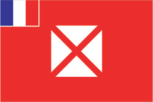
a large white modified Maltese cross centered on a red background; the flag of France outlined in white on two sides is in the upper hoist quadrant; the flag of France is used for official occasions
Government type
NA
Independence
none (overseas territory of France)
International organization participation
FZ, SPC Diplomatic representation in the US: none (overseas territory of France) Diplomatic representation from the US: none (overseas territory of France)
Judicial branch
none; justice generally administered under French law by the high administrator, but the three traditional kings administer customary law and there is a magistrate in Mata-Utu Political parties and leaders: Rally for the Republic or RPR; Union Populaire Locale or UPL; Union Pour la Democratie Francaise or UDF; Lua kae tahi (Giscardians); Mouvement des Radicaux de Gauche or MRG; Taumu'a Lelei
Legal system
French legal system
Legislative branch
unicameral Territorial Assembly or Assemblee Territoriale (20 seats; members are elected by popular vote to serve five-year terms) elections: last held 16 March 1997 (next to be held NA March 2002) election results: percent of vote by party-NA; seats by party-NA note: Wallis and Futuna elects one senator to the French Senate and one deputy to the French National Assembly; French Senate-elections last held 24 September 1989 (next to be held by NA September 1998); results-percent of vote by party-NA; seats-(1 total) RPR 1; French National Assembly-elections last held 25 May-1 June 1997 (next to be held by NA March 2002); results - percent of vote by party-NA; seats-(1 total) RPR 1
National capital
Mata-Utu (on Ile Uvea)
Suffrage
18 years of age; universal
Economy
Agriculture-products
breadfruit, yams, taro, bananas; pigs, goats
Budget
revenues: $22 million expenditures: $22 million, including capital expenditures of $NA (1997 est.)
Currency
1 CFP franc (CFPF) = 100 centimes
Debt-external
$NA
Economic aid
recipient: ODA, $NA
Economy-overview
The economy is limited to traditional subsistence agriculture, with about 80% of the labor force earning its livelihood from agriculture (coconuts and vegetables), livestock (mostly pigs), and fishing. About 4% of the population is employed in government. Revenues come from French Government subsidies, licensing of fishing rights to Japan and South Korea, import taxes, and remittances from expatriate workers in New Caledonia. Wallis and Futuna imports food - particularly flour, sugar, rice, and beef-fuel, clothing, machinery, and transport equipment, but its exports are negligible, consisting mostly of breadfruit, yams, and taro root.
Electricity-capacity
NA kW
Electricity-consumption per capita
NA kWh
Electricity-production
NA kWh
Exchange rates
Comptoirs Francais du Pacifique francs (CFPF) per US$1-110.60 (January 1998), 106.11 (1997), 93.00 (1996), 90.75 (1995), 100.94 (1994), 102.96 (1993); note-linked at the rate of 18.18 to the French franc
Exports
total value: $370,000 (f.o.b., 1995 est.) commodities: copra, handicrafts partners: NA
Fiscal year
calendar year Communications
GDP
purchasing power parity-$28.7 million (1995 est.)
GDP-composition by sector
agriculture: NA% industry: NA% services: NA%
GDP-per capita
purchasing power parity-$2,000 (1995 est.)
GDP-real growth rate
NA%
Imports
total value: $13.5 million (c.i.f., 1995 est.) commodities: foodstuffs, manufactured goods, transportation equipment, fuel, clothing partners: France, Australia, New Zealand
Industrial production growth rate
NA%
Industries
copra, handicrafts, fishing, lumber
Inflation rate-consumer price index
NA%
Labor force
NA by occupation: agriculture, livestock, and fishing 80%, government 4% (est.)
Radio broadcast stations
AM 1, FM 0, shortwave 0
Radios
NA
Telephone system
domestic: NA international: NA
Telephones
340 (1985 est.)
Television broadcast stations
0
Televisions
NA
Unemployment rate
NA%
Transportation
Airports
2 (1997 est.) Airports-with paved runways: total: 1 1,524 to 2,437 m: 1 (1997 est.) Airports-with unpaved runways: total: 1 914 to 1,523 m: 1 (1997 est.)
Highways
total: 120 km (Ile Uvea 100 km, Ile Futuna 20 km) paved: 16 km (all on Ile Uvea) unpaved: 104 km (Ile Uvea 84 km, Ile Futuna 20 km)
Merchant marine
total: 2 ships (1,000 GRT or over) totaling 44,160 GRT/41,656 DWT ships by type: oil tanker 1, passenger 1 (1997 est.)
Railways
0 km
Waterways
none Ports and harbors: Leava, Mata-Utu
Military and Security
Military-note
defense is the responsibility of France
Transnational Issues
Current issues
The Israel-PLO Declaration of Principles on Interim Self-Government Arrangements ("the DOP"), signed in Washington on 13 September 1993, provides for a transitional period not exceeding five years of Palestinian interim self-government in the Gaza Strip and the West Bank. Permanent status negotiations began on 5 May 1996, but have not resumed since the initial meeting. Under the DOP, Israel agreed to transfer certain powers and responsibilities to the Palestinian Authority, which includes a Palestinian Legislative Council elected in January 1996, as part of interim self-governing arrangements in the West Bank and Gaza Strip. A transfer of powers and responsibilities for the Gaza Strip and Jericho took place pursuant to the Israel-PLO 4 May 1994 Cairo Agreement on the Gaza Strip and the Jericho Area and in additional areas of the West Bank pursuant to the Israel-PLO 28 September 1995 Interim Agreement and the Israel-PLO 15 January 1997 Protocol Concerning Redeployment in Hebron. The DOP provides that Israel will retain responsibility during the transitional period for external security and for internal security and public order of settlements and Israelis. Permanent status is to be determined through direct negotiations.
Disputes-international
none Introduction