2010 Edition
CIA World Factbook 2010 (Project Gutenberg)
Introduction
Background
Venezuela was one of three countries that emerged from the collapse of Gran Colombia in 1830 (the others being Ecuador and New Granada, which became Colombia). For most of the first half of the 20th century, Venezuela was ruled by generally benevolent military strongmen, who promoted the oil industry and allowed for some social reforms. Democratically elected governments have held sway since 1959. Hugo CHAVEZ, president since 1999, seeks to implement his "21st Century Socialism," which purports to alleviate social ills while at the same time attacking capitalist globalization and existing democratic institutions. Current concerns include: a weakening of democratic institutions, political polarization, a politicized military, drug-related violence along the Colombian border, overdependence on the petroleum industry with its price fluctuations, and irresponsible mining operations that are endangering the rain forest and indigenous peoples.
Geography
Area
- land
- 882,050 sq km
- total
- 912,050 sq km
- water
- 30,000 sq km
Area - comparative
slightly more than twice the size of California
Climate
tropical; hot, humid; more moderate in highlands
Coastline
2,800 km
Elevation extremes
- highest point
- Pico Bolivar 5,007 m
- lowest point
- Caribbean Sea 0 m
Environment - current issues
sewage pollution of Lago de Valencia; oil and urban pollution of Lago de Maracaibo; deforestation; soil degradation; urban and industrial pollution, especially along the Caribbean coast; threat to the rainforest ecosystem from irresponsible mining operations
Environment - international agreements
- party to
- Antarctic Treaty, Biodiversity, Climate Change, Climate Change-Kyoto Protocol, Desertification, Endangered Species, Hazardous Wastes, Marine Life Conservation, Ozone Layer Protection, Ship Pollution, Tropical Timber 83, Tropical Timber 94, Wetlands
- signed but not ratified
- : none of the selected agreements
Freshwater withdrawal (domestic/industrial/agricultural)
- per capita
- 313 cu m/yr (2000)
- total
- 8.37 cu km/yr (6%/7%/47%)
Geographic coordinates
8 00 N, 66 00 W
Geography - note
on major sea and air routes linking North and South America; Angel Falls in the Guiana Highlands is the world's highest waterfall
Irrigated land
5,750 sq km (2003)
Land boundaries
- border countries
- Brazil 2,200 km, Colombia 2,050 km, Guyana 743 km
- total
- 4,993 km
Land use
- arable land
- 2.85%
- other
- 96.27% (2005)
- permanent crops
- 0.88%
Location
Northern South America, bordering the Caribbean Sea and the North Atlantic Ocean, between Colombia and Guyana
Map references
South America
Maritime claims
- contiguous zone
- 15 nm
- continental shelf
- 200 m depth or to the depth of exploitation
- exclusive economic zone
- 200 nm
- territorial sea
- 12 nm
Natural hazards
subject to floods, rockslides, mudslides; periodic droughts
Natural resources
petroleum, natural gas, iron ore, gold, bauxite, other minerals, hydropower, diamonds
Terrain
Andes Mountains and Maracaibo Lowlands in northwest; central plains (llanos); Guiana Highlands in southeast
Total renewable water resources
1,233.2 cu km (2000)
People and Society
Age structure
0-14 years: 30.5% (male 4,157,194/female 4,022,595) 15-64 years: 64.3% (male 8,480,872/female 8,754,620) 65 years and over: 5.2% (male 620,657/female 778,905) (2010 est.)
Birth rate
20.29 births/1,000 population (2010 est.)
Death rate
5.14 deaths/1,000 population (July 2010 est.)
Education expenditures
3.7% of GDP (2007)
Ethnic groups
Spanish, Italian, Portuguese, Arab, German, African, indigenous people
HIV/AIDS - adult prevalence rate
0.7%; note - no country specific models provided (2001 est.)
HIV/AIDS - deaths
4,100 (2003 est.)
HIV/AIDS - people living with HIV/AIDS
110,000 (1999 est.)
Infant mortality rate
- female
- 17.37 deaths/1,000 live births (2010 est.)
- male
- 24.6 deaths/1,000 live births
- total
- 21.07 deaths/1,000 live births
Languages
Spanish (official), numerous indigenous dialects
Life expectancy at birth
- female
- 77 years (2010 est.)
- male
- 70.69 years
- total population
- 73.77 years
Literacy
- definition: age 15 and over can read and write
- female
- 92.7% (2001 census)
- male
- 93.3%
- total population
- 93%
Major infectious diseases
- degree of risk
- high
- food or waterborne diseases
- bacterial diarrhea
- vectorborne disease
- dengue fever and malaria (2009)
Median age
- female
- 26.5 years (2010 est.)
- male
- 25.1 years
- total
- 25.8 years
Nationality
- adjective
- Venezuelan
- noun
- Venezuelan(s)
Net migration rate
0 migrant(s)/1,000 population (2010 est.)
Population
27,223,228 (July 2010 est.)
Population growth rate
1.515% (2010 est.)
Religions
nominally Roman Catholic 96%, Protestant 2%, other 2%
School life expectancy (primary to tertiary education)
- female
- 15 years (2008)
- male
- 13 years
- total
- 14 years
Sex ratio
- at birth
- 1.05 male(s)/female under 15 years: 1.03 male(s)/female 15-64 years: 0.97 male(s)/female 65 years and over: 0.79 male(s)/female
- total population
- 0.98 male(s)/female (2010 est.)
Total fertility rate
2.45 children born/woman (2010 est.)
Urbanization
- rate of urbanization
- 2% annual rate of change (2005-10 est.)
- urban population
- 93% of total population (2008)
Government
Administrative divisions
23 states (estados, singular - estado), 1 capital district* (distrito capital), and 1 federal dependency** (dependencia federal); Amazonas, Anzoategui, Apure, Aragua, Barinas, Bolivar, Carabobo, Cojedes, Delta Amacuro, Dependencias Federales (Federal Dependencies)**, Distrito Capital (Capital District)*, Falcon, Guarico, Lara, Merida, Miranda, Monagas, Nueva Esparta, Portuguesa, Sucre, Tachira, Trujillo, Vargas, Yaracuy, Zulia note: the federal dependency consists of 11 federally controlled island groups with a total of 72 individual islands
Capital
- geographic coordinates
- 10 30 N, 66 56 W
- name
- Caracas
- time difference
- UTC-4.5 (half an hour ahead of Washington, DC during Standard Time)
Constitution
30 December 1999
Country name
- conventional long form
- Bolivarian Republic of Venezuela
- conventional short form
- Venezuela
- local long form
- Republica Bolivariana de Venezuela
- local short form
- Venezuela
Diplomatic representation from the US
- chief of mission
- Ambassador (vacant)
- embassy
- Calle F con Calle Suapure, Urbanizacion Colinas de Valle Arriba, Caracas 1080
- FAX
- [58] (212) 907-8199
- mailing address
- P. O. Box 62291, Caracas 1060-A; APO AA 34037
- telephone
- [58] (212) 975-6411, 907-8400 (after hours)
Diplomatic representation in the US
- chancery
- 1099 30th Street NW, Washington, DC 20007
- chief of mission
- Ambassador Bernardo ALVAREZ Herrera
- consulate(s) general
- Boston, Chicago, Houston, Miami, New Orleans, New York, San Francisco, San Juan (Puerto Rico)
- FAX
- [1] (202) 342-6820
- telephone
- [1] (202) 342-2214
Executive branch
- cabinet
- Council of Ministers appointed by the president (For more information visit the World Leaders website )
- chief of state
- President Hugo CHAVEZ Frias (since 3 February 1999); Executive Vice President Elias JAUA Milano (since 26 January 2010); note - the president is both the chief of state and head of government
- election results
- Hugo CHAVEZ Frias reelected president; percent of vote - Hugo CHAVEZ Frias 62.9%, Manuel ROSALES 36.9%
- elections
- president elected by popular vote for a six-year term (eligible for unlimited reelection); election last held on 3 December 2006 (next to be held in December 2012) note: in 1999, a National Constituent Assembly drafted a new constitution that increased the presidential term to six years; an election was subsequently held on 30 July 2000 under the terms of this constitution; in 2009, a national referendum approved the elimination of term limits on all elected officials, including the presidency
- head of government
- President Hugo CHAVEZ Frias (since 3 February 1999); Executive Vice President Elias JAUA Milano (since 26 January 2010)
Flag description
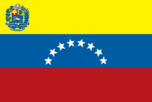
three equal horizontal bands of yellow (top), blue, and red with the coat of arms on the hoist side of the yellow band and an arc of eight white five-pointed stars centered in the blue band; the flag retains the three equal horizontal bands and three main colors of the banner of Gran Colombia, the South American republic that broke up in 1830; yellow is interpreted as standing for the riches of the land, blue for the courage of its people, and red for the blood shed in attaining independence; the seven stars on the original flag represented the seven provinces in Venezuela that united in the war of independence; in 2006, President Hugo CHAVEZ ordered an eighth star added to the star arc - a decision that sparked much controversy
Government type
federal republic
Independence
5 July 1811 (from Spain)
International organization participation
Caricom (observer), CDB, FAO, G-15, G-24, G-77, IADB, IAEA, IBRD, ICAO, ICCt, ICRM, IDA, IFAD, IFC, IFRCS, IHO, ILO, IMF, IMO, IMSO, Interpol, IOC, IOM, IPU, ITSO, ITU, ITUC, LAES, LAIA, LAS (observer), Mercosur (associate), MIGA, NAM, OAS, OPANAL, OPCW, OPEC, PCA, PetroCaribe, RG, UN, UNASUR, UNCTAD, UNESCO, UNHCR, UNIDO, Union Latina, UNWTO, UPU, WCO, WFTU, WHO, WIPO, WMO, WTO
Judicial branch
Supreme Tribunal of Justice or Tribunal Supremo de Justicia (32 magistrates are elected by the National Assembly for a single 12-year term)
Legal system
open, adversarial court system; has not accepted compulsory ICJ jurisdiction
Legislative branch
- unicameral National Assembly or Asamblea Nacional (165 seats; members elected by popular vote to serve five-year terms; three seats reserved for the indigenous peoples of Venezuela)
- election results
- percent of vote by party - pro-government 48.9%, opposition coalition 47.9%, other 3.2%; seats by party - pro-government 98, opposition 65, other 2
- elections
- last held on 26 September 2010 (next to be held in 2015)
National anthem
- lyrics/music
- Vicente SALIAS/Juan Jose LANDAETA note: adopted 1881; the lyrics were written in 1810, the music some years later; both SALIAS and LANDAETA were executed in 1814 during Venezuela's struggle for independence
- name
- "Gloria al bravo pueblo" (Glory to the Brave Nation)
National holiday
Independence Day, 5 July (1811)
Political parties and leaders
A New Time or UNT [Omar BARBOZA]; Brave People's Alliance or ABP [Oscar PEREZ]; Christian Democrats or COPEI [Luis Ignacio PLANAS]; Communist Party of Venezuela or PCV [Oscar FIGUERA]; Democratic Action or AD [Henry RAMOS Allup]; Fatherland for All or PPT [Jose ALBORNOZ]; For Social Democracy or PODEMOS [Ramon MARTINEZ]; Justice First [Julio BORGES]; Movement Toward Socialism or MAS [Felipe MUJICA]; United Socialist Party of Venezuela or PSUV [Hugo CHAVEZ]; Venezuela Project or PV [Henrique SALAS Romer]
Political pressure groups and leaders
FEDECAMARAS, a conservative business group; VECINOS groups; Venezuelan Confederation of Workers or CTV (labor organization dominated by the Democratic Action)
Suffrage
18 years of age; universal
Economy
Agriculture - products
corn, sorghum, sugarcane, rice, bananas, vegetables, coffee; beef, pork, milk, eggs; fish
Central bank discount rate
29.5% (31 December 2009) 33.5% (31 December 2008)
Commercial bank prime lending rate
19.89% (31 December 2009 est.) 22.37% (31 December 2008 est.)
Current account balance
$22.07 billion (2010 est.) $8.561 billion (2009 est.)
Debt - external
$55.61 billion (31 December 2010 est.) $53.58 billion (31 December 2009 est.)
Distribution of family income - Gini index
41 (2009) 49.5 (1998)
Economy - overview
Venezuela remains highly dependent on oil revenues, which account for roughly 95% of export earnings, about 55% of the federal budget revenues, and around 30% of GDP. A nationwide strike between December 2002 and February 2003 had far-reaching economic consequences - real GDP declined by around 9% in 2002 and 8% in 2003 - but economic output since then has recovered strongly. Fueled by high oil prices, record government spending helped to boost GDP by about 10% in 2006, 8% in 2007, and nearly 5% in 2008, before a sharp drop in oil prices caused a contraction in 2009-10. This spending, combined with recent minimum wage hikes and improved access to domestic credit, has created a consumption boom but has come at the cost of higher inflation - roughly 32% in 2008, and slowing only slightly to 30% in 2010, despite the lengthy downturn. Imports also jumped significantly before the recession of 2009. President Hugo CHAVEZ's continued efforts to increase the government's control of the economy by nationalizing firms in the agribusiness, financial, construction, oil, and steel sectors have hurt the private investment environment, reduced productive capacity, and slowed non-petroleum exports. In the first half of 2010 Venezuela faced the prospect of lengthy nationwide blackouts when its main hydroelectric power plant - which provides more than 35% of the country's electricity - nearly shut down. In January, 2010, CHAVEZ announced a dual exchange rate system for the bolivar and closed the unofficial foreign exchange market - the "parallel" market - in an effort to stem inflation and slow the currency's depreciation. The foreign exchange system offers a 2.6 bolivar per dollar rate for imports of essentials, including food, medicine, and industrial machinery, and a 4.3 bolivar per dollar rate for imports of other products, including cars and telephones.
Electricity - consumption
83.02 billion kWh (2007 est.)
Electricity - exports
540 million kWh (2007 est.)
Electricity - imports
1.651 billion kWh (2007 est.)
Electricity - production
113.3 billion kWh (2007 est.)
Exchange rates
bolivars (VEB) per US dollar - 4.3039 (2010), 2.1522 (2009), 2.147 (2008), 2,147 (2007), 2,147 (2006)
Exports
$64.87 billion (2010 est.) $57.6 billion (2009 est.)
Exports - commodities
petroleum, bauxite and aluminum, minerals, chemicals, agricultural products, basic manufactures
Exports - partners
US 35.18%, Netherlands Antilles 8.56% note: excludes oil exports; Venezuela last published petroleum figures by country in 2008 (2009)
GDP - composition by sector
- agriculture
- 4.1%
- industry
- 34.9%
- services
- 61.1% (2010 est.)
GDP - per capita (PPP)
$12,600 (2010 est.) $13,200 (2009 est.) $13,900 (2008 est.) note: data are in 2010 US dollars
GDP - real growth rate
-2.8% (2010 est.) -3.3% (2009 est.) 4.8% (2008 est.)
GDP (official exchange rate)
$285.2 billion (2010 est.)
GDP (purchasing power parity)
$344.2 billion (2010 est.) $354.1 billion (2009 est.) $366.2 billion (2008 est.) note: data are in 2010 US dollars
Household income or consumption by percentage share
lowest 10%: 1.7% highest 10%: 32.7% (2006)
Imports
$31.37 billion (2010 est.) $38.44 billion (2009 est.)
Imports - commodities
agricultural products, raw materials, machinery and equipment, transport equipment, construction materials
Imports - partners
US 23.66%, Colombia 14.43%, Brazil 9.13%, China 8.44%, Mexico 5.47% (2009)
Industrial production growth rate
-8% (2010 est.)
Industries
petroleum, construction materials, food processing, textiles; iron ore mining, steel, aluminum; motor vehicle assembly
Inflation rate (consumer prices)
29.8% (2010 est.) 27.1% (2009 est.)
Investment (gross fixed)
16.4% of GDP (2010 est.)
Labor force
13.3 million (2010 est.)
Labor force - by occupation
- agriculture
- 13%
- industry
- 23%
- services
- 64% (1997 est.)
Market value of publicly traded shares
$NA (31 December 2008) $NA (31 December 2007) $8.251 billion (31 December 2006)
Natural gas - consumption
24.86 billion cu m (2009 est.)
Natural gas - exports
0 cu m (2008 est.)
Natural gas - imports
1.8 billion cu m (2009 est.)
Natural gas - production
23.06 billion cu m (2009 est.)
Natural gas - proved reserves
4.983 trillion cu m (1 January 2010 est.)
Oil - consumption
740,000 bbl/day (2009 est.)
Oil - exports
2.182 million bbl/day (2007 est.)
Oil - imports
0 bbl/day (2007 est.)
Oil - production
2.472 million bbl/day (2009 est.)
Oil - proved reserves
97.77 billion bbl (1 January 2010 est.)
Population below poverty line
37.9% (yearend 2005 est.)
Public debt
25.5% of GDP (2010 est.) 18% of GDP (2009 est.)
Reserves of foreign exchange and gold
$29.49 billion (31 December 2010 est.) $35 billion (31 December 2009 est.)
Stock of broad money
$78.11 billion (31 December 2010 est.) $107 billion (31 December 2009 est.)
Stock of direct foreign investment - abroad
$20.97 billion (31 December 2010 est.) $17.67 billion (31 December 2009 est.)
Stock of direct foreign investment - at home
$37.71 billion (31 December 2010 est.) $41.21 billion (31 December 2009 est.)
Stock of domestic credit
$54.22 billion (31 December 2010 est.) $75.87 billion (31 December 2009 est.)
Stock of narrow money
$69.36 billion (31 December 2010 est) $93.19 billion (31 December 2009 est)
Unemployment rate
12.1% (2010 est.) 7.9% (2009 est.)
Communications
Broadcast media
government supervises a mixture of state-run and private broadcast media; 1 state-run television network, 4 privately-owned TV networks, and a government-backed pan-American channel; state-run radio network includes 15 stations; large number of private broadcast radio stations (2007)
Internet country code
.ve
Internet hosts
238,665 (2010)
Internet users
8.918 million (2009)
Telephone system
- domestic
- domestic satellite system with 3 earth stations; recent substantial improvement in telephone service in rural areas; substantial increase in digitalization of exchanges and trunk lines; installation of a national interurban fiber-optic network capable of digital multimedia services; combined fixed and mobile-cellular telephone subscribership 130 per 100 persons
- general assessment
- modern and expanding
- international
- country code - 58; submarine cable systems provide connectivity to the Caribbean, Central and South America, and US; satellite earth stations - 1 Intelsat (Atlantic Ocean) and 1 PanAmSat; participating with Colombia, Ecuador, Peru, and Bolivia in the construction of an international fiber-optic network (2009)
Telephones - main lines in use
6.867 million (2009)
Telephones - mobile cellular
28.124 million (2009)
Transportation
Airports
409 (2010)
Airports - with paved runways
- total
- 129 over 3,047 m: 5 2,438 to 3,047 m: 10 1,524 to 2,437 m: 34 914 to 1,523 m: 63 under 914 m: 17 (2010)
Airports - with unpaved runways
- total
- 280 2,438 to 3,047 m: 1 1,524 to 2,437 m: 16 914 to 1,523 m: 91 under 914 m: 172 (2010)
Heliports
4 (2010)
Merchant marine
- by type
- bulk carrier 5, cargo 15, chemical tanker 5, liquefied gas 5, passenger 1, passenger/cargo 12, petroleum tanker 16
- foreign-owned
- 10 (Denmark 1, Estonia 1, Germany 1, Greece 4, Mexico 1, Norway 1, Spain 1)
- registered in other countries
- 9 (Panama 8, Saint Vincent and the Grenadines 1) (2010)
- total
- 59
Pipelines
extra heavy crude 980 km; gas 5,258 km; oil 6,695 km; refined products 1,484 km; unknown 141 km (2009)
Ports and terminals
La Guaira, Maracaibo, Puerto Cabello, Punta Cardon
Railways
- standard gauge
- 806 km 1.435-m gauge (2008)
- total
- 806 km
Roadways
- paved
- 32,308 km
- total
- 96,155 km
- unpaved
- 63,847 km (2002)
Transportation - note
the International Maritime Bureau reports the territorial and offshore waters in the Caribbean Sea as a significant risk for piracy and armed robbery against ships; numerous vessels, including commercial shipping and pleasure craft, have been attacked and hijacked both at anchor and while underway; crews have been robbed and stores or cargoes stolen
Waterways
7,100 km note: Orinoco River (400 km) and Lake de Maracaibo navigable by oceangoing vessels (2010)
Military and Security
Manpower available for military service
males age 16-49: 6,891,648 females age 16-49: 7,047,565 (2010 est.)
Manpower fit for military service
males age 16-49: 5,504,152 females age 16-49: 5,976,339 (2010 est.)
Manpower reaching militarily significant age annually
- female
- 273,819 (2010 est.)
- male
- 276,612
Military branches
National Bolivarian Armed Forces (Fuerza Armada Nacional Bolivariana, FANB): Bolivarian Army (Ejercito Bolivariano, EB), Bolivarian Navy (Armada Bolivariana, AB); includes Naval Infantry, Coast Guard, Naval Aviation), Bolivarian Military Aviation (Aviacion Militar Bolivariana, AMB), Bolivarian National Guard (Guardia Nacional Bolivaria, GNB), Bolivarian Militia (Milicia Bolivariana, MB) (2010)
Military expenditures
1.2% of GDP (2005 est.)
Military service age and obligation
18-30 years of age for compulsory and voluntary military service; 30-month conscript service obligation; all citizens of military service age (18-60 years old) are obligated to register for military service (2010)
Transnational Issues
Disputes - international
claims all of the area west of the Essequibo River in Guyana, preventing any discussion of a maritime boundary; Guyana has expressed its intention to join Barbados in asserting claims before the United Nations Convention on the Law of the Sea (UNCLOS) that Trinidad and Tobago's maritime boundary with Venezuela extends into their waters; dispute with Colombia over maritime boundary and Venezuelan-administered Los Monjes islands near the Gulf of Venezuela; Colombian-organized illegal narcotics and paramilitary activities penetrate Venezuela's shared border region; in 2006, an estimated 139,000 Colombians sought protection in 150 communities along the border in Venezuela; US, France, and the Netherlands recognize Venezuela's granting full effect to Aves Island, thereby claiming a Venezuelan EEZ/continental shelf extending over a large portion of the eastern Caribbean Sea; Dominica, Saint Kitts and Nevis, Saint Lucia, and Saint Vincent and the Grenadines protest Venezuela's full effect claim
Illicit drugs
small-scale illicit producer of opium and coca for the processing of opiates and coca derivatives; however, large quantities of cocaine, heroin, and marijuana transit the country from Colombia bound for US and Europe; significant narcotics-related money-laundering activity, especially along the border with Colombia and on Margarita Island; active eradication program primarily targeting opium; increasing signs of drug-related activities by Colombian insurgents on border page last updated on January 24, 2011 ======================================================================
Trafficking in persons
- current situation
- Venezuela is a source, transit, and destination country for men, women, and children trafficked for the purposes of commercial sexual exploitation and forced labor; Venezuelan women and girls are trafficked within the country for sexual exploitation, lured from the nation's interior to urban and tourist areas; child prostitution in urban areas and child sex tourism in resort destinations appear to be growing; Venezuelan women and girls are trafficked for commercial sexual exploitation to Western Europe, Mexico, and Caribbean destinations
- tier rating
- Tier 2 Watch List - Venezuela is placed on the Tier 2 Watch List, up from Tier 3, as it showed greater resolve to address trafficking through law enforcement measures and prevention efforts in 2007, although stringent punishment of offenders and victim assistance remain lacking (2008)