2007 Edition
CIA World Factbook 2007 (Project Gutenberg)
Introduction
Age structure
0-14 years: 29.1% (male 3,860,116/female 3,620,440) 15-64 years: 65.7% (male 8,494,944/female 8,410,874) 65 years and over: 5.2% (male 609,101/female 734,960) (2006 est.)
Area
- land
- 882,050 sq km
- total
- 912,050 sq km
- water
- 30,000 sq km
Area - comparative
slightly more than twice the size of California
Background
Venezuela was one of three countries that emerged from the collapse of Gran Colombia in 1830 (the others being Ecuador and New Granada, which became Colombia). For most of the first half of the 20th century, Venezuela was ruled by generally benevolent military strongmen, who promoted the oil industry and allowed for some social reforms. Democratically elected governments have held sway since 1959. Hugo CHAVEZ, president since 1999, has promoted a controversial policy of "democratic socialism," which purports to alleviate social ills while at the same time attacking globalization and undermining regional stability. Current concerns include: a weakening of democratic institutions, political polarization, a politicized military, drug-related violence along the Colombian border, increasing internal drug consumption, overdependence on the petroleum industry with its price fluctuations, and irresponsible mining operations that are endangering the rain forest and indigenous peoples. Geography Venezuela
Birth rate
18.71 births/1,000 population (2006 est.)
Climate
tropical; hot, humid; more moderate in highlands
Coastline
2,800 km
Death rate
4.92 deaths/1,000 population (2006 est.)
Elevation extremes
- highest point
- Pico Bolivar (La Columna) 5,007 m
- lowest point
- Caribbean Sea 0 m
Environment - current issues
sewage pollution of Lago de Valencia; oil and urban pollution of Lago de Maracaibo; deforestation; soil degradation; urban and industrial pollution, especially along the Caribbean coast; threat to the rainforest ecosystem from irresponsible mining operations
Environment - international agreements
- party to
- Antarctic Treaty, Biodiversity, Climate Change, Climate Change-Kyoto Protocol, Desertification, Endangered Species, Hazardous Wastes, Marine Life Conservation, Ozone Layer Protection, Ship Pollution, Tropical Timber 83, Tropical Timber 94, Wetlands signed but not ratified:: none of the selected agreements
Ethnic groups
Spanish, Italian, Portuguese, Arab, German, African, indigenous
Geographic coordinates
8 00 N, 66 00 W
Geography - note
on major sea and air routes linking North and South America; Angel Falls in the Guiana Highlands is the world's highest waterfall People Venezuela
HIV/AIDS - adult prevalence rate
0.7% - note - no country specific models provided (2001 est.)
HIV/AIDS - deaths
4,100 (2003 est.)
HIV/AIDS - people living with HIV/AIDS
110,000 (1999 est.)
Infant mortality rate
- female
- 18.27 deaths/1,000 live births (2006 est.)
- male
- 24.58 deaths/1,000 live births
- total
- 21.54 deaths/1,000 live births
Irrigated land
5,750 sq km (2003)
Land boundaries
- border countries
- Brazil 2,200 km, Colombia 2,050 km, Guyana 743 km
- total
- 4,993 km
Land use
- arable land
- 2.85%
- other
- 96.27% (2005)
- permanent crops
- 0.88%
Life expectancy at birth
- female
- 77.81 years (2006 est.)
- male
- 71.49 years
- total population
- 74.54 years
Location
Northern South America, bordering the Caribbean Sea and the North Atlantic Ocean, between Colombia and Guyana
Map references
South America
Maritime claims
- contiguous zone
- 15 nm
- continental shelf
- 200-m depth or to the depth of exploitation
- exclusive economic zone
- 200 nm
- territorial sea
- 12 nm
Median age
- female
- 26.6 years (2006 est.)
- male
- 25.4 years
- total
- 26 years
Nationality
- adjective
- Venezuelan
- noun
- Venezuelan(s)
Natural hazards
subject to floods, rockslides, mudslides; periodic droughts
Natural resources
petroleum, natural gas, iron ore, gold, bauxite, other minerals, hydropower, diamonds
Net migration rate
0 migrant(s)/1,000 population (2006 est.)
Population
25,730,435 (July 2006 est.)
Population growth rate
1.38% (2006 est.)
Sex ratio
- at birth
- 1.08 male(s)/female
- total population
- 1.02 male(s)/female (2006 est.)
- under 15 years
- 1.07 male(s)/female 15-64 years: 1.01 male(s)/female 65 years and over: 0.83 male(s)/female
Terrain
Andes Mountains and Maracaibo Lowlands in northwest; central plains (llanos); Guiana Highlands in southeast
Total fertility rate
2.23 children born/woman (2006 est.)
People and Society
Administrative divisions
- 23 states (estados, singular - estado), 1 capital district* (distrito capital), and 1 federal dependency** (dependencia federal); Amazonas, Anzoategui, Apure, Aragua, Barinas, Bolivar, Carabobo, Cojedes, Delta Amacuro, Dependencias Federales**, Distrito Federal*, Falcon, Guarico, Lara, Merida, Miranda, Monagas, Nueva Esparta, Portuguesa, Sucre, Tachira, Trujillo, Vargas, Yaracuy, Zulia
- note
- the federal dependency consists of 11 federally controlled island groups with a total of 72 individual islands
Capital
- geographic coordinates
- 10 30 N, 66 56 W
- name
- Caracas
- time difference
- UTC-4 (1 hour ahead of Washington, DC during Standard Time)
Constitution
30 December 1999
Country name
- conventional long form
- Bolivarian Republic of Venezuela
- conventional short form
- Venezuela
- local long form
- Republica Bolivariana de Venezuela
- local short form
- Venezuela
Executive branch
- chief of state
- President Hugo CHAVEZ Frias (since 3 February 1999); Vice President Jorge RODRIGUEZ Gomez (since 3 January 2007); note - the president is both the chief of state and head of
Government type
federal republic
Independence
5 July 1811 (from Spain)
Languages
Spanish (official), numerous indigenous dialects
Legal system
open, adversarial court system
Literacy
- definition
- age 15 and over can read and write
- female
- 93.1% (2003 est.) Government Venezuela
- male
- 93.8%
- total population
- 93.4%
National holiday
Independence Day, 5 July (1811)
Religions
nominally Roman Catholic 96%, Protestant 2%, other 2%
Suffrage
18 years of age; universal
Government
Agriculture - products
corn, sorghum, sugarcane, rice, bananas, vegetables, coffee; beef, pork, milk, eggs; fish
Airports
375 (2006)
Airports - with paved runways
- over 3,047 m
- 5 2,438 to 3,047 m: 11 1,524 to 2,437 m: 34 914 to 1,523 m: 60
- total
- 129
- under 914 m
- 19 (2006)
Airports - with unpaved runways
- total
- 246 1,524 to 2,437 m: 9 914 to 1,523 m: 90
- under 914 m
- 147 (2006)
Budget
- expenditures
- $52.9 billion; including capital expenditures of $2.6 billion (2006 est.)
- revenues
- $52.24 billion
Currency (code)
bolivar (VEB)
Currency code
VEB
Current account balance
$31.82 billion (2006 est.)
Debt - external
$35.63 billion (2006 est.)
Diplomatic representation from the US
- chief of mission
- Ambassador William R. BROWNFIELD
- embassy
- Calle F con Calle Suapure, Urbanizacion Colinas de Valle Arriba, Caracas 1080
- mailing address
- P. O. Box 62291, Caracas 1060-A; APO AA 34037
- telephone
- [58] (212) 975-9234, 975-6411
Diplomatic representation in the US
- chancery
- 1099 30th Street NW, Washington, DC 20007
- chief of mission
- Ambassador Bernardo ALVAREZ Herrera
- telephone
- [1] (202) 342-2214
Disputes - international
claims all of the area west of the Essequibo River in Guyana, preventing any discussion of a maritime boundary; Guyana has expressed its intention to join Barbados in asserting claims before the United Nations Convention on the Law of the Sea (UNCLOS) that Trinidad and Tobago's maritime boundary with Venezuela extends into their waters; dispute with Colombia over maritime boundary and Venezuelan-administered Los Monjes islands near the Gulf of Venezuela; Colombian-organized illegal narcotics and paramilitary activities penetrate Venezuela's shared border region; in 2006, an estimated 139,000 Colombians seek protection in 150 communities along the border in Venezuela; US, France, and the Netherlands recognize Venezuela's granting full effect to Aves Island, thereby claiming a Venezuelan EEZ/continental shelf extending over a large portion of the eastern Caribbean Sea; Dominica, Saint Kitts and Nevis, Saint Lucia, and Saint Vincent and the Grenadines protest Venezuela's full effect claim
Distribution of family income - Gini index
49.1 (1998)
Economic aid - recipient
$74 million (2000)
Economy - overview
Venezuela remains highly dependent on oil revenues, which account for roughly 90% of export earnings, more than 50% of the federal budget revenues, and around 30% of GDP. Tax collection-Venezuela's primary source of non-oil revenue-is expected to surpass $23 billion in 2006, exceeding the yearend collection goal by more than 20%. A nationwide strike between December 2002 and February 2003 had far-reaching economic consequences - real GDP declined by around 9% in 2002 and 8% in 2003 - but economic output since then has recovered strongly. Fueled by higher oil prices, record government spending helped to boost GDP growth in 2004 and 2005 to approximately 18% and 11%, respectively. Economic growth in 2006 reached around 9%. This spending, combined with recent minimum wage hikes and improved access to domestic credit, has fueled a consumption boom - car sales in 2006 increased by around 70% - but has come at the cost of higher inflation. Despite government attempts to withdraw liquidity from the economy, Venezuela's money supply set a record in June 2006, approximately 70% higher than the previous year. Imports have also jumped significantly.
Electricity - consumption
86.52 billion kWh (2004)
Electricity - exports
0 kWh (2004)
Electricity - imports
0 kWh (2004)
Electricity - production
93.03 billion kWh (2004)
Electricity - production by source
- fossil fuel
- 31.7%
- hydro
- 68.3%
- nuclear
- 0%
- other
- 0% (2001)
Exchange rates
bolivares per US dollar - 2,147 (2006), 2,089.8 (2005), 1,891.3 (2004), 1,607 (2003), 1,161 (2002)
Exports
$69.23 billion f.o.b. (2006 est.)
Exports - commodities
petroleum, bauxite and aluminum, steel, chemicals, agricultural products, basic manufactures
Exports - partners
US 50.9%, Netherlands Antilles 7.2%, Canada 2.4% (2005)
FAX
- [1] (202) 342-6820
- [58] (212) 975-8991
- consulate(s) general
- Boston, Chicago, Houston, Miami, New Orleans, New York, San Francisco, San Juan (Puerto Rico)
Fiscal year
calendar year Communications Venezuela
Flag description
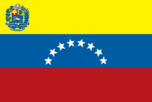
three equal horizontal bands of yellow (top), blue, and red with the coat of arms on the hoist side of the yellow band and an arc of eight white five-pointed stars centered in the blue band Economy Venezuela
GDP - composition by sector
- agriculture
- 3.7%
- industry
- 41%
- services
- 55.3% (2006 est.)
GDP - per capita (PPP)
$6,900 (2006 est.)
GDP - real growth rate
8.8% (2006 est.)
GDP (official exchange rate)
$147.9 billion (2006 est.)
GDP (purchasing power parity)
$176.4 billion (2006 est.)
Heliports
1 (2006)
Household income or consumption by percentage share
- highest 10%
- 36.5% (1998)
- lowest 10%
- 0.8%
Illicit drugs
small-scale illicit producer of opium and coca for the processing of opiates and coca derivatives; however, large quantities of cocaine, heroin, and marijuana transit the country from Colombia bound for US and Europe; significant narcotics-related money-laundering activity, especially along the border with Colombia and on Margarita Island; active eradication program primarily targeting opium; increasing signs of drug-related activities by Colombian insurgents on border This page was last updated on 8 February, 2007
Imports
$28.81 billion f.o.b. (2006 est.)
Imports - commodities
raw materials, machinery and equipment, transport equipment, construction materials
Imports - partners
US 31.6%, Colombia 11%, Brazil 9.1%, Mexico 6.9% (2005)
Industrial production growth rate
7% (2006 est.)
Industries
petroleum, construction materials, food processing, textiles; iron ore mining, steel, aluminum; motor vehicle assembly
Inflation rate (consumer prices)
15.8% (2006 est.)
International organization participation
CAN, CDB, CSN, FAO, G-3, G-15, G-24, G-77, IADB, IAEA, IBRD, ICAO, ICC, ICCt, ICRM, IFAD, IFC, IFRCS, IHO, ILO, IMF, IMO, Interpol, IOC, IOM, IPU, ISO, ITU, ITUC, LAES, LAIA, Mercosur, MIGA, NAM, OAS, OPANAL, OPCW, OPEC, PCA, RG, UN, UNCTAD, UNESCO, UNHCR, UNIDO, UNWTO, UPU, WCL, WCO, WFTU, WHO, WIPO, WMO, WTO
Internet country code
.ve
Internet hosts
51,968 (2006)
Internet Service Providers (ISPs)
16 (2000)
Internet users
3.04 million (2005) Transportation Venezuela
Investment (gross fixed)
19.8% of GDP (2006 est.)
Judicial branch
Supreme Tribunal of Justice or Tribuna Suprema de Justicia (magistrates are elected by the National Assembly for a single 12-year term)
Labor force
12.5 million (November 2006 est.)
Labor force - by occupation
- agriculture
- 13%
- industry
- 23%
- services
- 64% (1997 est.)
Legislative branch
- unicameral National Assembly or Asamblea Nacional (167 seats; members elected by popular vote to serve five-year terms; three seats reserved for the indigenous peoples of Venezuela)
- election results
- percent of vote by party - NA%; seats by party - pro-government 167 (MVR 114, PODEMOS 15, PPT 11, indigenous 2, other 25), opposition 0
- elections
- last held 4 December 2005 (next to be held in 2010)
Manpower available for military service
- females age 18-49
- 6,137,622 (2005 est.)
- males age 18-49
- 6,236,012
Manpower fit for military service
- females age 18-49
- 5,151,843 (2005 est.)
- males age 18-49
- 4,907,947
Manpower reaching military service age annually
- females age 18-49
- 237,300 (2005 est.)
- males age 18-49
- 252,396
Merchant marine
- by type
- bulk carrier 7, cargo 10, chemical tanker 2, container 1, liquefied gas 6, passenger/cargo 12, petroleum tanker 18
- foreign-owned
- 13 (Denmark 3, Greece 3, India 1, Mexico 3, Panama 1, Russia 1, Spain 1)
- registered in other countries
- 15 (Bahamas 1, Panama 14) (2006)
- total
- 56 ships (1000 GRT or over) 824,941 GRT/1,327,924 DWT
Military expenditures - dollar figure
$1.61 billion (2005 est.)
Military expenditures - percent of GDP
1.2% (2005 est.) Transnational Issues Venezuela
Military service age and obligation
18 years of age for compulsory and voluntary military service; conscript service obligation - 30 months (2004)
National Armed Forces (Fuerzas Armadas Nacionales or FAN)
Ground Forces or Army (Fuerzas Terrestres or Ejercito), Naval Forces (Fuerzas Navales or Armada; includes Marines, Coast Guard), Air Force (Fuerzas Aereas or Aviacion), Armed Forces of Cooperation or National Guard (Fuerzas Armadas de Cooperacion or Guardia Nacional)
Natural gas - consumption
27.2 billion cu m (2004 est.)
Natural gas - exports
0 cu m (2004 est.)
Natural gas - imports
0 cu m (2004 est.)
Natural gas - production
27.2 billion cu m (2004 est.)
Natural gas - proved reserves
4.276 trillion cu m (1 January 2005 est.)
Oil - consumption
560,000 bbl/day (2004 est.)
Oil - exports
2.1 million bbl/day (2004 est.)
Oil - imports
NA bbl/day (2004 est.)
Oil - production
3.081 million bbl/day (2005 est.)
Oil - proved reserves
75.27 billion bbl (2006 est.)
Pipelines
extra heavy crude 992 km; gas 5,369 km; oil 7,607 km; refined products 1,681 km; unknown (oil/water) 141 km (2006)
Political parties and leaders
A New Time or UNT [Manuel ROSALES]; Christian Democrats or COPEI [Cesar PEREZ Vivas]; Democratic Action or AD [Henry RAMOS Allup]; Fatherland for All or PPT [Jose ALBORNOZ]; Fifth Republic Movement or MVR [Hugo CHAVEZ]; Justice First [Julio BORGES]; Movement Toward Socialism or MAS [Hector MUJICA]; Venezuela Project or PV [Henrique SALAS Romer]; We Can or PODEMOS [Ismael GARCIA]
Political pressure groups and leaders
FEDECAMARAS, a conservative business group; VECINOS groups; Venezuelan Confederation of Workers or CTV (labor organization dominated by the Democratic Action)
Population below poverty line
37.9% (End 2005 est.)
Ports and terminals
Amuay, La Guaira, Maracaibo, Puerto Cabello, Punta Cardon Military Venezuela
Public debt
28.4% of GDP (2006 est.)
Radio broadcast stations
AM 201, FM NA (20 in Caracas), shortwave 11 (1998)
Radios
10.75 million (1997)
Railways
- standard gauge
- 682 km 1.435-m gauge (2005)
- total
- 682 km
Reserves of foreign exchange and gold
$35.95 billion (2006 est.)
Roadways
- paved
- 32,308 km
- total
- 96,155 km
- unpaved
- 63,847 km (1999)
Telephone system
- domestic
- domestic satellite system with 3 earth stations; recent substantial improvement in telephone service in rural areas; substantial increase in digitalization of exchanges and trunk lines; installation of a national interurban fiber-optic network capable of digital multimedia services
- general assessment
- modern and expanding
- international
- country code - 58; 3 submarine coaxial cables; satellite earth stations - 1 Intelsat (Atlantic Ocean) and 1 PanAmSat; participating with Colombia, Ecuador, Peru, and Bolivia in the construction of an international fiber-optic network
Telephones - main lines in use
3,605,500 (2005)
Telephones - mobile cellular
12.496 million (2005)
Television broadcast stations
66 (plus 45 repeaters) (1997)
Televisions
4.1 million (1997)
Trafficking in persons
- current situation
- Venezuela is a source, transit, and destination country for women and children trafficked for the purposes of sexual exploitation and forced labor; women and children from Colombia, China, Peru, Ecuador, and the Dominican Republic are trafficked to and through Venezuela and subjected to commercial sexual exploitation or forced labor; Venezuelans are trafficked internally and to Western Europe, particularly Spain and the Netherlands, and to countries in the Caribbean region for commercial sexual exploitation; Venezuela is a transit country for illegal migrants from other countries in the region and for Asian nationals, some are believed to be trafficking victims
- tier rating
- Tier 3 - Venezuela does not fully comply with the minimum standards for the elimination of trafficking and is not making significant efforts to do so
Unemployment rate
8.9% (October 2006 est.)
Waterways
- 7,100 km
- note
- Orinoco River and Lake de Maracaibo navigable by oceangoing vessels, Orinoco for 400 km (2005)