1999 Edition
CIA World Factbook 1999 (Internet Archive)
Geography
Area
total: 912,050 sq km land: 882,050 sq km water: 30,000 sq km
Area--comparative
slightly more than twice the size of California
Climate
tropical; hot, humid; more moderate in highlands
Coastline
2,800 km
Elevation extremes
lowest point: Caribbean Sea 0 m highest point: Pico Bolivar (La Columna) 5,007 m
Environment--current issues
sewage pollution of Lago de Valencia; oil and urban pollution of Lago de Maracaibo; deforestation; soil degradation; urban and industrial pollution, especially along the Caribbean coast
Environment--international agreements
party to: Biodiversity, Climate Change, Desertification, Endangered Species, Hazardous Wastes, Marine Life Conservation, Nuclear Test Ban, Ozone Layer Protection, Ship Pollution, Tropical Timber 83, Tropical Timber 94, Wetlands, Whaling signed, but not ratified: Marine Dumping
Geographic coordinates
8 00 N, 66 00 W
Geography--note
on major sea and air routes linking North and South America
Irrigated land
1,900 sq km (1993 est.)
Land boundaries
total: 4,993 km border countries: Brazil 2,200 km, Colombia 2,050 km, Guyana 743 km
Land use
arable land: 4% permanent crops: 1% permanent pastures: 20% forests and woodland: 34% other: 41% (1993 est.)
Location
Northern South America, bordering the Caribbean Sea and the North Atlantic Ocean, between Colombia and Guyana
Map references
South America, Central America and the Caribbean
Maritime claims
contiguous zone: 15 nm continental shelf: 200-m depth or to the depth of exploitation exclusive economic zone: 200 nm territorial sea: 12 nm
Natural hazards
subject to floods, rockslides, mud slides; periodic droughts
Natural resources
petroleum, natural gas, iron ore, gold, bauxite, other minerals, hydropower, diamonds
Terrain
Andes Mountains and Maracaibo Lowlands in northwest; central plains (llanos); Guiana Highlands in southeast
People and Society
Age structure
0-14 years: 33% (male 3,988,499; female 3,741,568) 15-64 years: 62% (male 7,231,546; female 7,184,769) 65 years and over: 5% (male 484,071; female 573,013) (1999 est.)
Birth rate
22.25 births/1,000 population (1999 est.)
Death rate
4.93 deaths/1,000 population (1999 est.)
Ethnic groups
Spanish, Italian, Portuguese, Arab, German, African, indigenous people
Infant mortality rate
26.51 deaths/1,000 live births (1999 est.)
Languages
Spanish (official), numerous indigenous dialects
Life expectancy at birth
total population: 72.95 years male: 69.97 years female: 76.16 years (1999 est.)
Literacy
definition: age 15 and over can read and write total population: 91.1% male: 91.8% female: 90.3% (1995 est.)
Nationality
noun: Venezuelan(s) adjective: Venezuelan
Net migration rate
-0.23 migrant(s)/1,000 population (1999 est.)
Population
23,203,466 (July 1999 est.)
Population growth rate
1.71% (1999 est.)
Religions
nominally Roman Catholic 96%, Protestant 2%
Sex ratio
at birth: 1.08 male(s)/female under 15 years: 1.07 male(s)/female 15-64 years: 1.01 male(s)/female 65 years and over: 0.84 male(s)/female total population: 1.02 male(s)/female (1999 est.)
Total fertility rate
2.61 children born/woman (1999 est.)
Government
Administrative divisions
22 states (estados, singular--estado),1 federal district* (distrito federal), and 1 federal dependency** (dependencia federal); Amazonas, Anzoategui, Apure, Aragua, Barinas, Bolivar, Carabobo, Cojedes, Delta Amacuro, Dependencias Federales**, Distrito Federal*, Falcon, Guarico, Lara, Merida, Miranda, Monagas, Nueva Esparta, Portuguesa, Sucre, Tachira, Trujillo, Yaracuy, Zulia note: the federal dependency consists of 11 federally controlled island groups with a total of 72 individual islands
Capital
Caracas
Constitution
23 January 1961
Country name
conventional long form: Republic of Venezuela conventional short form: Venezuela local long form: Republica de Venezuela local short form: Venezuela
Data code
VE
Executive branch
chief of state: President Hugo CHAVEZ Frias (since 3 February 1999); note--the president is both the chief of state and head of government head of government: President Hugo CHAVEZ Frias (since 3 February 1999); note--the president is both the chief of state and head of government cabinet: Council of Ministers appointed by the president elections: president elected by popular vote for a five-year term; election last held 6 December 1998 (next to be held NA December 2003) election results: Hugo CHAVEZ Frias elected president; percent of vote--NA%
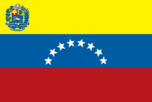
Flag description
three equal horizontal bands of yellow (top), blue, and red with the coat of arms on the hoist side of the yellow band and an arc of seven white five-pointed stars centered in the blue band
Government type
republic
Independence
5 July 1811 (from Spain)
International organization participation
CAN, Caricom (observer), CCC, CDB, ECLAC, FAO, G3, G-11, G-15, G-19, G-24, G-77, IADB, IAEA, IBRD, ICAO, ICC, ICFTU, ICRM, IFAD, IFC, IFRCS, IHO, ILO, IMF, IMO, Intelsat, Interpol, IOC, IOM, ISO, ITU, LAES, LAIA, MINURSO, NAM, OAS, OPANAL, OPCW, OPEC, PCA, RG, UN, UNCTAD, UNESCO, UNHCR, UNIDO, UNIKOM, UNU, UPU, WCL, WFTU, WHO, WIPO, WMO, WToO, WTrO Diplomatic representation in the US: chief of mission: Ambassador (vacant) chancery: 1099 30th Street NW, Washington, DC 20007 consulate(s) general: Boston, Chicago, Houston, Miami, New Orleans, New York, San Francisco, and San Juan (Puerto Rico) Diplomatic representation from the US: chief of mission: Ambassador John Francis MAISTO embassy: Calle F con Calle Suapure, Colinas de Valle Arriba, Caracas 1060 mailing address: P. O. Box 62291, Caracas 1060-A; APO AA 34037
Judicial branch
Supreme Court of Justice (Corte Suprema de Justicia), magistrates are elected by both chambers in joint session for a nine-year term, one-third are reelected every three years Political parties and leaders: National Convergence or Campins, president, and Donald RAMIREZ, secretary general]; ALFARO Ucero, secretary general]; Movement Toward Socialism or MAS Political pressure groups and leaders: FEDECAMARAS, a conservative business group; Venezuelan Confederation of Workers or CTV (labor organization dominated by the Democratic Action); VECINOS groups
Legal system
based on Napoleonic code; judicial review of legislative acts in Cassation Court only; has not accepted compulsory ICJ jurisdiction
Legislative branch
bicameral Congress of the Republic or Congreso de la Republica consists of the Senate or Senado (52 seats, two from each state and the federal district (46), one for each of the retired presidents, and others representing minorities (6); members are elected by popular vote to serve five-year terms) and Chamber of Deputies or Camara de Diputados (207 seats; members are elected by popular vote to serve five-year terms) elections: Senate--last held 6 December 1998 (next to be held NA December 2003); Chamber of Deputies--last held 6 December 1998 (next to be held NA December 2003) election results: Senate--percent of vote by party--NA; seats by party--AD 16, COPEI 14, Causa R 9, National Convergence 5, MAS 3, independents 5; note--two former presidents (1 from AD, 1 from COPEI) hold lifetime Senate seats; Chamber of Deputies--percent of vote by party--AD 25.6%, COPEI 24.6%, MAS 10.6%, National Convergence 8.7%, Causa R 19.3%; seats by party--AD 53, COPEI 51, Causa R 40, MAS 22, National Convergence 18, other 23
National holiday
Independence Day, 5 July (1811)
Suffrage
18 years of age; universal
Economy
Agriculture--products
corn, sorghum, sugarcane, rice, bananas, vegetables, coffee; beef, pork, milk, eggs; fish
Budget
revenues: $11.99 billion expenditures: $11.48 billion, including capital expenditures of $3 billion (1996 est.)
Currency
1 bolivar (Bs) = 100 centimos
Debt--external
$26.5 billion (1996)
Economic aid--recipient
$50.8 million (1995)
Economy--overview
The petroleum sector dominates the economy, accounting for roughly a third of GDP, around 80% of export earnings, and more than half of government operating revenues. As a result, the steep downturn in international oil prices has had a severe impact on the economy; fiscal cuts spurred by the loss of revenues, high interest rates, and the sharp downturn in export earnings drove the economy into recession in 1998. The recession continued into 1999 with oil prices forecast to stay relatively low, but rising. Although the government has pursued moderate austerity measures to address the downturn in revenues, Venezuela's ongoing reform program has largely stalled. Pressure on the bolivar--overvalued by as much as 40%--was also significant through much of 1998, increasing the probability of an adjustment of the currency in 1999. Newly elected President Hugo CHAVEZ will be hard pressed to address Venezuela's many economic ills. He has promised to strike a balance between reforms designed to address the structural deformities of the economy and addressing declining living standards. CHAVEZ has sought to play down the populism that marked his political campaign for the presidency in an effort to allay investor concerns. The wide range of viewpoints represented on CHAVEZ's economic team is likely to make rapid implementation of a coherent policy difficult.
Electricity--consumption
72.85 billion kWh (1996)
Electricity--exports
150 million kWh (1996)
Electricity--imports
0 kWh (1996)
Electricity--production
73 billion kWh (1996)
Electricity--production by source
fossil fuel: 20.55% hydro: 79.45% nuclear: 0% other: 0% (1996)
Exchange rates
bolivares (Bs) per US$1--570.267 (January 1999), 547.556 (1998), 488.635 (1997), 417.333 (1996), 176.843 (1995), 148.503 (1994)
Exports
$16.9 billion (f.o.b., 1998)
Exports--commodities
petroleum, bauxite and aluminum, steel, chemicals, agricultural products, basic manufactures (1998)
Exports--partners
US and Puerto Rico 57%, Colombia, Brazil (1997)
Fiscal year
calendar year
GDP
purchasing power parity--$194.5 billion (1998 est.)
GDP--composition by sector
agriculture: 4% industry: 63% services: 33% (1997 est.)
GDP--per capita
purchasing power parity?$8,500 (1998 est.)
GDP--real growth rate
-0.9% (1998 est.)
Household income or consumption by percentage share
lowest 10%: 1.5% highest 10%: 35.6% (1995)
Imports
$12.4 billion (f.o.b., 1998)
Imports--commodities
raw materials, machinery and equipment, transport equipment, construction materials (1998)
Imports--partners
US 53%, Japan, Colombia, Italy, Germany (1997)
Industrial production growth rate
0.5% (1995 est.)
Industries
petroleum, iron ore mining, construction materials, food processing, textiles, steel, aluminum, motor vehicle assembly
Inflation rate (consumer prices)
29.9% (1998)
Labor force
9.2 million
Labor force--by occupation
services 64%, industry 23%, agriculture 13% (1997 est.)
Population below poverty line
31.3% (1989 est.)
Unemployment rate
11.5% (1997 est.)
Communications
Radio broadcast stations
AM 181, FM 0, shortwave 26
Radios
9.04 million (1992 est.)
Telephone system
modern and expanding domestic: domestic satellite system with 3 earth stations international: 3 submarine coaxial cables; satellite earth station--1 Intelsat (Atlantic Ocean)
Telephones
1.44 million (1987 est.)
Television broadcast stations
66 (in addition, there are 45 repeaters) (1997)
Televisions
3.3 million (1992 est.)
Transportation
Airports
371 (1998 est.) Airports--with paved runways: total: 122 over 3,047 m: 5 2,438 to 3,047 m: 10 1,524 to 2,437 m: 32 914 to 1,523 m: 59 under 914 m: 16 (1998 est.) Airports--with unpaved runways: total: 249 1,524 to 2,437 m: 10 914 to 1,523 m: 94 under 914 m: 145 (1998 est.)
Heliports
1 (1998 est.)
Highways
total: 84,300 km paved: 33,214 km unpaved: 51,086 km (1996 est.)
Merchant marine
total: 32 ships (1,000 GRT or over) totaling 535,882 GRT/937,461 DWT ships by type: bulk 5, cargo 9, combination bulk 1, liquefied gas tanker 2, oil tanker 8, passenger-cargo 1, roll-on/roll-off cargo 5, short-sea passenger 1 (1998 est.)
Pipelines
crude oil 6,370 km; petroleum products 480 km; natural gas 4,010 km Ports and harbors: Amuay, Bajo Grande, El Tablazo, La Guaira, La Salina, Maracaibo, Matanzas, Palua, Puerto Cabello, Puerto la Cruz, Puerto Ordaz, Puerto Sucre, Punta Cardon
Railways
total: 584 km (248 km privately owned) standard gauge: 584 km 1.435-m gauge
Waterways
7,100 km; Rio Orinoco and Lago de Maracaibo accept oceangoing vessels
Military and Security
Military branches
National Armed Forces (Fuerzas Armadas Nacionales or FAN) includes Ground Forces or Army (Fuerzas Terrestres or Ejercito), Naval Forces (Fuerzas Navales or Armada), Air Force (Fuerzas Aereas or Aviacion), Armed Forces of Cooperation or National Guard (Fuerzas Armadas de Cooperacion or Guardia Nacional)
Military expenditures--dollar figure
$1.1 billion (1998)
Military expenditures--percent of GDP
1% (1998)
Military manpower--availability
males age 15-49: 6,268,982 (1999 est.) Military manpower--fit for military service: males age 15-49: 4,522,757 (1999 est.)
Military manpower--military age
18 years of age
Military manpower--reaching military age annually
males: 242,362 (1999 est.)
Transnational Issues
Disputes--international
claims all of Guyana west of the Essequibo River; maritime boundary dispute with Colombia in the Gulf of Venezuela
Illicit drugs
illicit producer of cannabis, opium, and coca leaf for the international drug trade on a small scale; however, large quantities of cocaine and heroin transit the country from Colombia bound for US and Europe; important money-laundering hub; active eradication program primarily targeting opium