1990 Edition
CIA World Factbook 1990 (Project Gutenberg)
Geography
Climate
tropical; hot, humid; more moderate in highlands
Coastline
2,800 km
Comparative area
slightly more than twice the size of California
Contiguous zone
15 nm;
Continental shelf
200 meters or to depth of exploitation;
Disputes
claims Essequibo area of Guyana; maritime boundary disputes with Colombia in the Gulf of Venezuela and with Trinidad and Tobago in the Gulf of Paria
Environment
subject to floods, rockslides, mudslides; periodic droughts; increasing industrial pollution in Caracas and Maracaibo
Extended economic zone
200 nm;
Land boundaries
4,993 km total; Brazil 2,200 km, Colombia 2,050 km, Guyana 743 km
Land use
3% arable land; 1% permanent crops; 20% meadows and pastures; 39% forest and woodland; 37% other; includes NEGL% irrigated
Natural resources
crude oil, natural gas, iron ore, gold, bauxite, other minerals, hydropower, diamonds
Note
on major sea and air routes linking North and South America
Terrain
Andes mountains and Maracaibo lowlands in northwest; central plains (llanos); Guyana highlands in southeast
Territorial sea
12 nm
Total area
912,050 km2; land area: 882,050 km2
People and Society
Birth rate
28 births/1,000 population (1990)
Death rate
4 deaths/1,000 population (1990)
Ethnic divisions
67% mestizo, 21% white, 10% black, 2% Indian
Infant mortality rate
27 deaths/1,000 live births (1990)
Labor force
5,800,000; 56% services, 28% industry, 16% agriculture (1985)
Language
Spanish (official); Indian dialects spoken by about 200,000 Amerindians in the remote interior
Life expectancy at birth
71 years male, 77 years female (1990)
Literacy
85.6%
Nationality
noun--Venezuelan(s); adjective--Venezuelan
Net migration rate
1 migrant/1,000 population (1990)
Organized labor
32% of labor force
Population
19,698,104 (July 1990), growth rate 2.5% (1990)
Religion
96% nominally Roman Catholic, 2% Protestant
Total fertility rate
3.4 children born/woman (1990)
Government
Administrative divisions
20 states (estados, singular--estado), 2 territories* (territorios, singular--territorio), 1 federal district** (distrito federal), and 1 federal dependence*** (dependencia federal); Amazonas*, Anzoategui, Apure, Aragua, Barinas, Bolivar, Carabobo, Cojedes, Delta Amacuro*, Dependencias Federales***, Distrito Federal**, Falcon, Guarico, Lara, Merida, Miranda, Monagas, Nueva Esparta, Portuguesa, Sucre, Tachira, Trujillo, Yaracuy, Zulia; note--the federal dependence consists of 11 federally controlled island groups with a total of 72 individual islands
Capital
Caracas
Communists
10,000 members (est.)
Constitution
23 January 1961
Diplomatic representation
Ambassador Simon Alberto CONSALVI Bottaro; Chancery at 2445 Massachusetts Avenue NW, Washington DC 20008; telephone (202) 797-3800; there are Venezuelan Consulates General in Baltimore, Boston, Chicago, Houston, Miami, New Orleans, New York, Philadelphia, San Francisco, and San Juan (Puerto Rico); US--Ambassador-designate Eric JAVITS; Embassy at Avenida Francisco de Miranda and Avenida Principal de la Floresta, Caracas (mailing address is P. O. Box 62291, Caracas 1060-A, or APO Miami 34037); telephone [58] (2) 284-6111 or 7111; there is a US Consulate in Maracaibo
Elections
President--last held 4 December 1988 (next to be held December 1993); results--Carlos Andres Perez (AD) 53%, Eduardo Fernandez (COPEI) 40%, others 7%; Senate--last held 4 December 1988 (next to be held December 1993); results--percent of vote by party NA; seats--(49 total) AD 23, COPEI 22, others 4; Chamber of Deputies--last held 4 December 1988 (next to be held December 1993); results--AD 43.7%, COPEI 31.4%, MAS 10.3%, others 14.6%; seats--(201 total) AD 97, COPEI 67, MAS 18, others 19
Executive branch
president, Council of Ministers (cabinet)
Flag
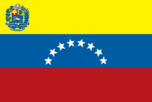
three equal horizontal bands of yellow (top), blue, and red with the coat of arms on the hoist side of the yellow band and an arc of seven white five-pointed stars centered in the blue band
Independence
5 July 1811 (from Spain)
Judicial branch
Supreme Court of Justice (Corte Suprema de Justica)
Leaders
Chief of State and Head of Government--President Carlos Andres PEREZ (since 2 February 1989)
Legal system
based on Napoleonic code; judicial review of legislative acts in Cassation Court only; has not accepted compulsory ICJ jurisdiction
Legislative branch
bicameral National Congress (Congreso Nacional) consists of an upper chamber or Senate (Senado) and a lower chamber or Chamber of Deputies (Camara de Diputados)
Long-form name
Republic of Venezuela
Member of
Andean Pact, AIOEC, FAO, G-77, Group of Eight, IADB, IAEA, IBRD, ICAO, ICO, IDB--Inter-American Development Bank, IFAD, IFC, IHO, ILO, IMF, IMO, INTELSAT, INTERPOL, IPU, IRC, ITU, IWC--International Wheat Council, LAIA, NAM, OAS, OPEC, PAHO, SELA, WFTU, UN, UNESCO, UPU, WHO, WMO, WTO
National holiday
Independence Day, 5 July (1811)
Other political or pressure groups
FEDECAMARAS, a conservative business group; Venezuelan Confederation of Workers, the Democratic Action-dominated labor organization
Political parties and leaders
Social Christian Party (COPEI), Eduardo Fernandez, secretary general; Democratic Action (AD), Gonzalo Barrios, president, and Humberto Celli, secretary general; Movement Toward Socialism (MAS), Teodoro Petkoff, president, and Freddy Munoz, secretary general
Suffrage
universal and compulsory at age 18, though poorly enforced
Type
republic
Economy
Agriculture
accounts for 6% of GDP and 15% of labor force; products--corn, sorghum, sugarcane, rice, bananas, vegetables, coffee, beef, pork, milk, eggs, fish; not self-sufficient in food other than meat
Aid
US commitments, including Ex-Im (FY70-86), $488 million; Communist countries (1970-88), $10 million
Budget
revenues $8.4 billion; expenditures $8.6 billion, including capital expenditures of $5.9 billion (1989)
Currency
bolivar (plural--bolivares); 1 bolivar (Bs) = 100 centimos
Electricity
19,110,000 kW capacity; 54,516 million kWh produced, 2,830 kWh per capita (1989)
Exchange rates
bolivares (Bs) per US$1--43.42 (January 1990), 34.6815 (1989), 14.5000 (fixed rate 1987-88), 8.0833 (1986), 7.5000 (1985)
Exports
$10.4 billion (f.o.b., 1988); commodities--petroleum 81%, bauxite and aluminum, iron ore, agricultural products, basic manufactures; partners--US 50.3%, FRG 5.3%, Japan 4.1% (1988)
External debt
$33.6 billion (1988)
Fiscal year
calendar year
GDP
$52.0 billion, per capita $2,700; real growth rate - 8.1%
Illicit drugs
illicit producer of cannabis and coca for the international drug trade on a small scale; however, large quantities of cocaine and marijuana do transit the country
Imports
$10.9 billion (f.o.b., 1988); commodities--foodstuffs, chemicals, manufactures, machinery and transport equipment; partners--US 44%, FRG 8.5%, Japan 6%, Italy 5%, Brazil 4.4% (1987)
Industrial production
growth rate 3.7%, excluding oil (1988)
Industries
petroleum, iron-ore mining, construction materials, food processing, textiles, steel, aluminum, motor vehicle assembly
Inflation rate (consumer prices)
80.7% (1989)
Overview
Petroleum is the cornerstone of the economy and accounted for 17% of GDP, 52% of central government revenues, and 81% of export earnings in 1988. President Perez introduced an economic readjustment program when he assumed office in February 1989. Lower tariffs and price supports, a free market exchange rate, and market-linked interest rates have thrown the economy into confusion, causing about an 8% decline in GDP.
Unemployment rate
7.0% (1988)
Communications
Airports
306 total, 278 usable; 134 with permanent-surface runways; none with runways over 3,659 m; 12 with runways 2,440-3,659 m; 92 with runways 1,220-2,439 m
Civil air
58 major transport aircraft
Highways
77,785 km total; 22,780 km paved, 24,720 km gravel, 14,450 km earth roads, and 15,835 km unimproved earth
Inland waterways
7,100 km; Rio Orinoco and Lago de Maracaibo accept oceangoing vessels
Merchant marine
70 ships (1,000 GRT or over) totaling 997,458 GRT/1,615,155 DWT; includes 1 short-sea passenger, 1 passenger cargo, 28 cargo, 2 container, 3 roll-on/roll-off cargo, 17 petroleum, oils, and lubricants (POL) tanker, 2 chemical tanker, 2 liquefied gas, 11 bulk, 1 vehicle carrier, 1 combination bulk, 1 combination ore/oil
Pipelines
6,370 km crude oil; 480 km refined products; 4,010 km natural gas
Ports
Amuay Bay, Bajo Grande, El Tablazo, La Guaira, Puerto Cabello, Puerto Ordaz
Railroads
542 km total; 363 km 1.435-meter standard gauge all single track, government owned; 179 km 1.435-meter gauge, privately owned
Telecommunications
modern and expanding; 1,440,000 telephones; stations--181 AM, no FM, 59 TV, 26 shortwave; 3 submarine coaxial cables; satellite earth stations--1 Atlantic Ocean INTELSAT and 3 domestic
Military and Security
Branches
Ground Forces (Army), Naval Forces (Navy, Marines, Coast Guard), Air Forces, Armed Forces of Cooperation (National Guard)
Defense expenditures
1.1% of GDP, or $570 million (1990 est.)
Military manpower
males 15-49, 5,073,913; 3,680,176 fit for military service; 211,269 reach military age (18) annually