2022 Edition
CIA World Factbook 2022 (factbook.json @ 61dadec0c9c9)
Introduction
Background
Popes in their secular role ruled portions of the Italian peninsula for more than a thousand years until the mid-19th century, when many of the Papal States were seized by the newly united Kingdom of Italy. In 1870, the pope's holdings were further circumscribed when Rome itself was annexed. Disputes between a series of "prisoner" popes and Italy were resolved in 1929 by three Lateran Treaties, which established the independent state of Vatican City and granted Roman Catholicism special status in Italy. In 1984, a concordat between the Holy See and Italy modified certain of the earlier treaty provisions, including the primacy of Roman Catholicism as the Italian state religion. Present concerns of the Holy See include religious freedom, threats against minority Christian communities in Africa and the Middle East, the plight of refugees and migrants, sexual misconduct by clergy, international development, interreligious dialogue and reconciliation, and the application of church doctrine in an era of rapid change and globalization. About 1.3 billion people worldwide profess Catholicism - the world's largest Christian faith.
Geography
Area
- land
- 0.44 sq km
- total
- 0 sq km
- water
- 0 sq km
Area - comparative
about 0.7 times the size of the National Mall in Washington, DC
Climate
temperate; mild, rainy winters (September to May) with hot, dry summers (May to September)
Coastline
0 km (landlocked)
Elevation
- highest point
- Vatican Gardens (Vatican Hill) 78 m
- lowest point
- Saint Peter's Square 19 m
Geographic coordinates
41 54 N, 12 27 E
Geography - note
landlocked; an enclave in Rome, Italy; world's smallest state; beyond the territorial boundary of Vatican City, the Lateran Treaty of 1929 grants the Holy See extraterritorial authority over 23 sites in Rome and five outside of Rome, including the Pontifical Palace at Castel Gandolfo (the Pope's summer residence)
Land boundaries
- border countries
- Italy 3.4 km
- total
- 3.4 km
Land use
- agricultural land
- 0% (2018 est.)
- other
- 100% (2018 est.)
Location
Southern Europe, an enclave of Rome (Italy)
Map references
Europe
Maritime claims
none (landlocked)
Natural hazards
occasional earthquakes
Natural resources
none
Terrain
urban; low hill
People and Society
Age structure
- 0-14 years
- NA
- 15-24 years
- NA
- 25-54 years
- NA
- 55-64 years
- NA
- 65 years and over
- NA
Birth rate
NA
Children under the age of 5 years underweight
NA
Contraceptive prevalence rate
NA
Current health expenditure
NA
Death rate
NA
Dependency ratios
- elderly dependency ratio
- NA
- potential support ratio
- NA
- total dependency ratio
- NA
- youth dependency ratio
- NA
Drinking water source
- improved: total
- total: 100% of population
- unimproved: total
- total: 0% of population (2017 est.)
Education expenditures
NA
Ethnic groups
Italian, Swiss, Argentinian, and other nationalities from around the world (2017)
HIV/AIDS - adult prevalence rate
NA
Languages
- Languages
- Italian, Latin, French, various other languages
- major-language sample(s)
- L'Almanacco dei fatti del mondo, l'indispensabile fonte per le informazioni di base. (Italian)The World Factbook, the indispensable source for basic information.
Literacy
- female
- NA
- male
- NA
- total population
- NA
Major urban areas - population
1,000 VATICAN CITY (capital) (2018)
Nationality
- adjective
- none
- noun
- none
Population
1,000 (2022 est.)
Population growth rate
0% (2014 est.)
Religions
Roman Catholic
Sanitation facility access
- improved: rural
- rural: NA
- improved: total
- total: NA
- improved: urban
- urban: NA
- unimproved: rural
- rural: NA
- unimproved: total
- total: NA
- unimproved: urban
- urban: NA
Urbanization
- rate of urbanization
- 0% annual rate of change (2020-25 est.)
- urban population
- 100% of total population (2023)
Government
Administrative divisions
none
Capital
- daylight saving time
- +1hr, begins last Sunday in March; ends last Sunday in October
- etymology
- the term "Vatican" derives from the hill Mons Vaticanus on which the Vatican is located and which comes from the Latin "vaticinari" (to prophesy), referring to the fortune tellers and soothsayers who frequented the area in Roman times
- geographic coordinates
- 41 54 N, 12 27 E
- name
- Vatican City
- time difference
- UTC+1 (6 hours ahead of Washington, DC, during Standard Time)
Citizenship
- citizenship by birth
- no
- citizenship by descent only
- no
- dual citizenship recognized
- no
- note
- note: in the Holy See, citizenship is acquired by law, ex iure, or by adminstrative decision; in the first instance, citizenship is a function of holding office within the Holy See as in the case of cardinals resident in Vatican City or diplomats of the Holy See; in the second instance, citizenship may be requested in a limited set of circumstances for those who reside within Vatican City under papal authorization, as a function of their office or service, or as the spouses and children of current citizens; citizenship is lost once an individual no longer permanently resides in Vatican City, normally reverting to the citizenship previously held
- residency requirement for naturalization
- not applicable
Constitution
- amendments
- note - although the Fundamental Law of Vatican City State makes no mention of amendments, Article Four (drafting laws), states that this legislative responsibility resides with the Pontifical Commission for Vatican City State; draft legislation is submitted through the Secretariat of State and considered by the pope
- history
- previous 1929, 1963; latest promulgated November 2000, effective 22 February 2001 (Fundamental Law of Vatican City State, the main governing document of the Vatican's civil entities); the Roman Curia is the administrative apparatus – the departments and ministries – used by the pontiff in governing the church; note - Pope Francis in October 2013, instituted a 9-member Council of Cardinal Advisers to reform the Roman Curia to include writing a new constitution; in June 2018, Pope Francis approved the Council of Cardinals' first draft of the new constitution, Predicatae Evangelium (Preach the Gospel); it became effective 5 June 2022, replacing Pastor Bonus, the previous governing document of the Roman Curia
Country name
- conventional long form
- The Holy See (Vatican City State)
- conventional short form
- Holy See (Vatican City)
- etymology
- "holy" comes from the Greek word "hera" meaning "sacred"; "see" comes from the Latin word "sedes" meaning "seat," and refers to the episcopal chair; the term "Vatican" derives from the hill Mons Vaticanus on which the Vatican is located and which comes from the Latin "vaticinari" (to prophesy), referring to the fortune tellers and soothsayers who frequented the area in Roman times
- local long form
- La Santa Sede (Stato della Citta del Vaticano)
- local short form
- Santa Sede (Citta del Vaticano)
Diplomatic representation from the US
- chief of mission
- Ambassador Joe DONNELLY (since 11 April 2022)
- email address and website
- https://va.usembassy.gov/
- embassy
- Via Sallustiana, 49, 00187 Rome
- FAX
- [39] (06) 4674-3411
- mailing address
- 5660 Holy See Place, Washington DC 20521-5660
- telephone
- [39] (06) 4674-1
Diplomatic representation in the US
- chancery
- 3339 Massachusetts Avenue NW, Washington, DC 20008
- chief of mission
- Apostolic Nuncio Archbishop Christophe PIERRE (since 27 June 2016)
- email address and website
- nuntiususa@nuntiususa.orghttp://www.nuntiususa.org/
- FAX
- [1] (202) 337-4036
- telephone
- [1] (202) 333-7121
Executive branch
- cabinet
- Pontifical Commission for the State of Vatican City appointed by the pope
- chief of state
- Pope FRANCIS (since 13 March 2013)
- election results
- 2013: Jorge Mario BERGOGLIO, former Archbishop of Buenos Aires, elected Pope FRANCIS
- elections/appointments
- pope elected by the College of Cardinals, usually for life or until voluntary resignation; election last held on 13 March 2013 (next to be held after the death or resignation of the current pope); Secretary of State appointed by the pope
- head of government
- President of the Pontifical Commission for the State of Vatican City and President of the Governorate of the Vatican City State is Fernando VERGEZ ALZAGA (since 1 October 2021)
Flag description
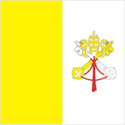
two vertical bands of yellow (hoist side) and white with the arms of the Holy See, consisting of the crossed keys of Saint Peter surmounted by the three-tiered papal tiara, centered in the white band; the yellow color represents the pope's spiritual power, the white his worldly power
Government type
ecclesiastical elective monarchy; self-described as an "absolute monarchy"
Independence
11 February 1929; note - the three treaties signed with Italy on 11 February 1929 acknowledged, among other things, the full sovereignty of the Holy See and established its territorial extent; however, the origin of the Papal States, which over centuries varied considerably in extent, may be traced back to A.D. 754
International law organization participation
has not submitted an ICJ jurisdiction declaration; non-party state to the ICCt
International organization participation
CE (observer), IAEA, Interpol, IOM, ITSO, ITU, ITUC (NGOs), OAS (observer), OPCW, OSCE, Schengen Convention (de facto member), SICA (observer), UN (observer), UNCTAD, UNHCR, Union Latina (observer), UNWTO (observer), UPU, WIPO, WTO (observer)
Judicial branch
- highest court(s)
- Supreme Court or Supreme Tribunal of the Apostolic Signatura (consists of the cardinal prefect, who serves as ex-officio president of the court, and 2 other cardinals of the Prefect Signatura); note - judicial duties were established by the Motu Proprio, papal directive, of Pope PIUS XII on 1 May 1946; most Vatican City criminal matters are handled by the Republic of Italy courts
- judge selection and term of office
- cardinal prefect appointed by the pope; the other 2 cardinals of the court appointed by the cardinal prefect on a yearly basis
- subordinate courts
- Appellate Court of Vatican City; Tribunal of Vatican City
Legal system
religious legal system based on canon (religious) law
Legislative branch
- description
- unicameral Pontifical Commission for the State of Vatican City or Pontificia Commissione per lo Stato della Citta del Vaticano (7 seats; the president of the Governorate of Vatican City State and 6 cardinals appointed by the pope to serve 5-year terms)
- election results
- composition - men 7, women 0
- elections
- last held on 11 July 2018
National anthem
- lyrics/music
- Raffaello LAVAGNA/Charles-Francois GOUNOD
- name
- "Inno e Marcia Pontificale" (Hymn and Pontifical March); often called The Pontifical Hymn
- note
- note: adopted 1950
National heritage
- selected World Heritage Site locales
- Historic Center of Rome, the Properties of the Holy See in that City Enjoying Extraterritorial Rights and San Paolo Fuori le Mura; Vatican City
- total World Heritage Sites
- 2 (both cultural)
National holiday
Election Day of Pope FRANCIS, 13 March (2013)
National symbol(s)
crossed keys beneath a papal tiara; national colors: yellow, white
Political parties and leaders
none
Suffrage
election of the pope is limited to cardinals less than 80 years old
Economy
Budget
- expenditures
- 348 million (2013)
- revenues
- 315 million (2013)
Budget surplus (+) or deficit (-)
NA
Economic overview
The Holy See is supported financially by a variety of sources, including investments, real estate income, and donations from Catholic individuals, dioceses, and institutions; these help fund the Roman Curia (Vatican bureaucracy), diplomatic missions, and media outlets. Moreover, an annual collection taken up in dioceses and from direct donations go to a non-budgetary fund, known as Peter's Pence, which is used directly by the pope for charity, disaster relief, and aid to churches in developing nations. The separate Vatican City State budget includes the Vatican museums and post office and is supported financially by the sale of stamps, coins, medals, and tourist mementos as well as fees for admission to museums and publication sales. Revenues increased between 2010 and 2011 because of expanded operating hours and a growing number of visitors. However, the Holy See did not escape the financial difficulties experienced by other European countries; in 2012, it started a spending review to determine where to cut costs to reverse its 2011 budget deficit of $20 million. The Holy See generated a modest surplus in 2012 before recording a $32 million deficit in 2013, driven primarily by the decreasing value of gold. The incomes and living standards of lay workers are comparable to those of counterparts who work in the city of Rome so most public expenditures go to wages and other personnel costs;. In February 2014, Pope FRANCIS created the Secretariat of the Economy to oversee financial and administrative operations of the Holy See, part of a broader campaign to reform the Holy See’s finances.
Exchange rates
- Currency
- euros (EUR) per US dollar -
- Exchange rates 2013
- 0.7634 (2013 est.)
- Exchange rates 2014
- 0.885 (2014 est.)
- Exchange rates 2015
- 0.9214 (2015 est.)
- Exchange rates 2016
- 0.903 (2016 est.)
- Exchange rates 2017
- 0.885 (2017 est.)
Fiscal year
calendar year
Industries
printing; production of coins, medals, postage stamps; mosaics, staff uniforms; worldwide banking and financial activities
Labor force
4,822 (2016)
Labor force - by occupation
note: essentially services with a small amount of industry; nearly all dignitaries, priests, nuns, guards, and the approximately 3,000 lay workers live outside the Vatican
Population below poverty line
NA
Real GDP (purchasing power parity)
NA
Taxes and other revenues
NA
Energy
Electricity access
- electrification - total population
- 100% (2020)
Communications
Broadcast media
the Vatican Television Center (CTV) transmits live broadcasts of the Pope's Sunday and Wednesday audiences, as well as the Pope's public celebrations; CTV also produces documentaries; Vatican Radio is the Holy See's official broadcasting service broadcasting via shortwave, AM and FM frequencies, and via satellite and Internet connections; Vatican News website partners with Vatican Radio and provides Catholic news provided by the Vatican (2021)
Communications - note
the Vatican Apostolic Library is one of the world's oldest libraries, formally established in 1475, but actually much older; it holds a significant collection of historic texts including 1.1 million printed books and 75,000 codices (manuscript books with handwritten contents); it serves as a research library for history, law, philosophy, science, and theology; the library's collections have been described as "the world's greatest treasure house of the writings at the core of Western tradition"
Internet country code
.va
Telecommunication systems
- domestic
- the telephone system operates through an automatic digital exchange (2020)
- general assessment
- the Vatican’s interior telecommunication system is composed of two strongly integrated sub-system: fixed infrastructure and mobile infrastructure; it is important to note that the mobile communication system has been designed to be capable of using satellite connections so that it is possible to ensure the telecommunication services whenever needed, following the Pastoral travels of the Pope; the telephone system operates through an automatic digital exchange (2020)
- international
- country code - 39; uses Italian system
- note
- note: the COVID-19 pandemic continues to have a significant impact on production and supply chains globally; since 2020, some aspects of the telecom sector have experienced a downturn, particularly in mobile device production; progress toward 5G implementation has resumed, as well as upgrades to infrastructure; consumer spending on telecom services has increased due to the surge in demand for capacity and bandwidth; the crucial nature of telecom services as a tool for work and school from home is still evident, and the spike in this area has seen growth opportunities for development of new tools and increased services
Military and Security
Military - note
defense is the responsibility of Italy
Military and security forces
- the Pontifical Swiss Guard Corps (Corpo della Guardia Svizzera Pontificia) serves as the de facto military force of Vatican City; the Gendarmerie Corps of Vatican City (Corpo della Gendarmeriais) is a police force that helps augment the Pontifical Swiss Guard Corps during the Pope’s appearances, as well as providing general security, traffic direction, and investigative duties for the Vatican City State (2022)
- note
- note: the Swiss Guard Corps has protected the Pope and his residence since 1506
Military service age and obligation
Pontifical Swiss Guard Corps: 19-30 years of age for voluntary military service; no conscription; must be a single Roman Catholic male with Swiss citizenship who has completed basic training with the Swiss military and can obtain a certificate of good conduct; qualified candidates must apply to serve; the service contract is between 2 and 25 years (2022)
Transnational Issues
Disputes - international
none
Illicit drugs
NA
Environment
Air pollutants
- methane emissions
- 0 megatons (2020 est.)
Climate
temperate; mild, rainy winters (September to May) with hot, dry summers (May to September)
Environment - current issues
some air pollution from the surrounding city of Rome
Environment - international agreements
- party to
- Comprehensive Nuclear Test Ban, Ozone Layer Protection
- signed, but not ratified
- Air Pollution, Environmental Modification
Land use
- agricultural land
- 0% (2018 est.)
- other
- 100% (2018 est.)
Total renewable water resources
0 cubic meters (2017 est.)
Urbanization
- rate of urbanization
- 0% annual rate of change (2020-25 est.)
- urban population
- 100% of total population (2023)