2011 Edition
CIA World Factbook 2011 Archive (HTML)
Introduction
Background
Popes in their secular role ruled portions of the Italian peninsula for more than a thousand years until the mid 19th century, when many of the Papal States were seized by the newly united Kingdom of Italy. In 1870, the pope's holdings were further circumscribed when Rome itself was annexed. Disputes between a series of "prisoner" popes and Italy were resolved in 1929 by three Lateran Treaties, which established the independent state of Vatican City and granted Roman Catholicism special status in Italy. In 1984, a concordat between the Holy See and Italy modified certain of the earlier treaty provisions, including the primacy of Roman Catholicism as the Italian state religion. Present concerns of the Holy See include religious freedom, international development, the environment, the Middle East, China, the decline of religion in Europe, terrorism, interreligious dialogue and reconciliation, and the application of church doctrine in an era of rapid change and globalization. About 1 billion people worldwide profess the Catholic faith.
Geography
Area
- 0.44 sq km 0.44 sq km 0 sq km
- total
- 0.44 sq km
- water
- 0 sq km
Area - comparative
about 0.7 times the size of The National Mall in Washington, DC
Climate
temperate; mild, rainy winters (September to May) with hot, dry summers (May to September)
Coastline
0 km (landlocked)
Elevation extremes
- unnamed location 19 m unnamed elevation 75 m
- highest point
- unnamed elevation 75 m
- lowest point
- unnamed location 19 m
Environment - current issues
NA
Environment - international agreements
- Ozone Layer Protection Air Pollution, Environmental Modification
- party to
- Ozone Layer Protection
- signed, but not ratified
- Air Pollution, Environmental Modification
Geographic coordinates
41 54 N, 12 27 E
Geography - note
landlocked; enclave in Rome, Italy; world's smallest state; beyond the territorial boundary of Vatican City, the Lateran Treaty of 1929 grants the Holy See extraterritorial authority over 23 sites in Rome and five outside of Rome, including the Pontifical Palace at Castel Gandolfo (the Pope's summer residence)
Irrigated land
0 sq km
Land boundaries
- 3.2 km Italy 3.2 km
- border countries
- Italy 3.2 km
- total
- 3.2 km
Land use
- 0% 0% 100% (urban area) (2005)
- arable land
- 0%
- other
- 100% (urban area) (2005)
- permanent crops
- 0%
Location
Southern Europe, an enclave of Rome (Italy)
Map references
Europe
Maritime claims
none (landlocked)
Natural hazards
NA
Natural resources
none
Terrain
urban; low hill
People and Society
Ethnic groups
Italians, Swiss, other
HIV/AIDS - adult prevalence rate
NA
HIV/AIDS - deaths
NA
HIV/AIDS - people living with HIV/AIDS
NA
Languages
Italian, Latin, French, various other languages
Literacy
- age 15 and over can read and write 100% 100% 100%
- [definition
- age 15 and over can read and write
- female
- 100%
- male
- 100%
- total population
- 100%
Nationality
- none none
- adjective
- none
- noun
- none
Population
832 (July 2011 est.)
Population growth rate
0.004% (2011 est.)
Religions
Roman Catholic
Urbanization
- 100% of total population (2010) 0.1% annual rate of change (2010-15 est.)
- rate of urbanization
- 0.1% annual rate of change (2010-15 est.)
- urban population
- 100% of total population (2010)
Government
Administrative divisions
none
Capital
- Vatican City 41 54 N, 12 27 E UTC+1 (6 hours ahead of Washington, DC during Standard Time) +1hr, begins last Sunday in March; ends last Sunday in October
- daylight saving time
- +1hr, begins last Sunday in March; ends last Sunday in October
- geographic coordinates
- 41 54 N, 12 27 E
- name
- Vatican City
- time difference
- UTC+1 (6 hours ahead of Washington, DC during Standard Time)
Constitution
Fundamental Law promulgated by Pope JOHN PAUL II 26 November 2000, effective 22 February 2001 (replaced the first Fundamental Law of 1929)
Country name
- The Holy See (State of the Vatican City) Holy See (Vatican City) Santa Sede (Stato della Citta del Vaticano) Santa Sede (Citta del Vaticano)
- conventional long form
- The Holy See (State of the Vatican City)
- conventional short form
- Holy See (Vatican City)
- local long form
- Santa Sede (Stato della Citta del Vaticano)
- local short form
- Santa Sede (Citta del Vaticano)
Diplomatic representation from the US
- Ambassador Miguel Humberto DIAZ Villa Domiziana, Via delle Terme Deciane 26, 00153 Rome PSC 833, Box 66, APO AE 09624 [39] (06) 4674-3428 [39] (06) 575-3411
- chief of mission
- Ambassador Miguel Humberto DIAZ
- embassy
- Villa Domiziana, Via delle Terme Deciane 26, 00153 Rome
- FAX
- [39] (06) 575-3411
- mailing address
- PSC 833, Box 66, APO AE 09624
- telephone
- [39] (06) 4674-3428
Diplomatic representation in the US
- Apostolic Nuncio (vacant); Charge d'Affaires Monsignor Jean-Francois LANTHEAUME 3339 Massachusetts Avenue NW, Washington, DC 20008 [1] (202) 333-7121 [1] (202) 337-4036
- chancery
- 3339 Massachusetts Avenue NW, Washington, DC 20008
- chief of mission
- Apostolic Nuncio (vacant); Charge d'Affaires Monsignor Jean-Francois LANTHEAUME
- FAX
- [1] (202) 337-4036
- telephone
- [1] (202) 333-7121
Executive branch
- Pope BENEDICT XVI (since 19 April 2005) Secretary of State Cardinal Tarcisio BERTONE (since 15 September 2006) Pontifical Commission for the State of Vatican City appointed by the pope pope elected for life by the College of Cardinals; election last held on 19 April 2005 (next to be held after the death of the current pope); secretary of state appointed by the pope Joseph RATZINGER elected Pope BENEDICT XVI
- cabinet
- Pontifical Commission for the State of Vatican City appointed by the pope
- chief of state
- Pope BENEDICT XVI (since 19 April 2005)
- election results
- Joseph RATZINGER elected Pope BENEDICT XVI
- elections
- pope elected for life by the College of Cardinals; election last held on 19 April 2005 (next to be held after the death of the current pope); secretary of state appointed by the pope
- head of government
- Secretary of State Cardinal Tarcisio BERTONE (since 15 September 2006)
Flag description
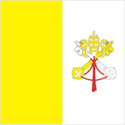
two vertical bands of yellow (hoist side) and white with the arms of the Holy See, consisting of the crossed keys of Saint Peter surmounted by the three-tiered papal tiara, centered in the white band; the yellow color represents the pope's spiritual power, the white his worldly power
Government type
ecclesiastical
Independence
11 February 1929 (from Italy); note - the three treaties signed with Italy on 11 February 1929 acknowledged, among other things, the full sovereignty of the Vatican and established its territorial extent; however, the origin of the Papal States, which over centuries varied considerably in extent, may be traced back to 754
International law organization participation
has not submitted an ICJ jurisdiction declaration; non-party state to the ICCt
International organization participation
CE (observer), IAEA, Interpol, IOM (observer), ITSO, ITU, ITUC, OAS (observer), OPCW, OSCE, Schengen Convention (de facto member), UN (observer), UNCTAD, UNHCR, Union Latina (observer), UNWTO (observer), UPU, WIPO, WTO (observer)
Judicial branch
there are three tribunals responsible for civil and criminal matters within Vatican City; three other tribunals rule on issues pertaining to the Holy See judicial duties were established by the Motu Proprio, papal directive, of Pope PIUS XII on 1 May 1946
Legal system
religious legal system based on canon (religious) law
Legislative branch
unicameral Pontifical Commission for Vatican City State
National anthem
- "Inno e Marcia Pontificale" (Hymn and Pontifical March) Raffaello LAVAGNA/Charles-Francois GOUNOD adopted 1950; although used as such, "Inno e Marcia Pontificale" is not officially a national anthem but rather a hymn meant to appeal to Roman Catholics throughout the world
- lyrics/music
- Raffaello LAVAGNA/Charles-Francois GOUNOD
- name
- "Inno e Marcia Pontificale" (Hymn and Pontifical March)
National holiday
Election Day of Pope BENEDICT XVI, 19 April (2005)
National symbol(s)
crossed keys
Political parties and leaders
none
Political pressure groups and leaders
none (exclusive of influence exercised by church officers)
Suffrage
limited to cardinals less than 80 years old
Economy
Budget
- $355.5 million $356.8 million (2008)
- expenditures
- $356.8 million (2008)
- revenues
- $355.5 million
Economy - overview
The Holy See is supported financially by a variety of sources, including investments, real estate income, and donations from Catholic individuals, dioceses, and institutions; these help fund the Roman Curia (Vatican bureaucracy), diplomatic missions, and media outlets. The separate Vatican City State budget includes the Vatican museums and post office and is supported financially by the sale of stamps, coins, medals, and tourist mementos; by fees for admission to museums; and by publications sales. Moreover, an annual collection taken up in dioceses and direct donations go to a non-budgetary fund known as Peter's Pence, which is used directly by the Pope for charity, disaster relief, and aid to churches in developing nations. The incomes and living standards of lay workers are comparable to those of counterparts who work in the city of Rome.
Electricity - consumption
NA kWh
Electricity - imports
NA kWh; note - electricity supplied by Italy; a small portion of electricity is self-produced from solar panels
Electricity - production
NA kWh
Exchange rates
euros (EUR) per US dollar - 0.755 (2010) 0.7198 (2009) 0.6827 (2008) 0.7345 (2007) 0.7964 (2006)
GDP (purchasing power parity)
$NA
Industries
printing; production of coins, medals, postage stamps; mosaics and staff uniforms; worldwide banking and financial activities
Labor force
NA
Labor force - by occupation
- essentially services with a small amount of industry; nearly all dignitaries, priests, nuns, guards, and the approximately 3,000 lay workers live outside the Vatican
- note
- essentially services with a small amount of industry; nearly all dignitaries, priests, nuns, guards, and the approximately 3,000 lay workers live outside the Vatican
Population below poverty line
NA%
Communications
Broadcast media
the Vatican Television Center (CTV) transmits live broadcasts of the Pope's Sunday and Wednesday audiences, as well as the Pope's public celebrations; CTV also produces documentaries; Vatican Radio is the Holy See's official broadcasting service broadcasting via shortwave, AM and FM frequencies, and via satellite and Internet connections (2008)
Internet country code
.va
Internet hosts
68 (2010)
Telephone system
- automatic digital exchange connected via fiber optic cable to Telecom Italia network country code - 39; uses Italian system
- domestic
- connected via fiber optic cable to Telecom Italia network
- general assessment
- automatic digital exchange
- international
- country code - 39; uses Italian system
Telephones - main lines in use
5,120 (2005)
Military and Security
Military - note
defense is the responsibility of Italy; ceremonial and limited security duties performed by Pontifical Swiss Guard
Military branches
Pontifical Swiss Guard Corps (Corpo della Guardia Svizzera Pontificia) (2010)
Transnational Issues
Disputes - international
none