1991 Edition
CIA World Factbook 1991 (Project Gutenberg)
Geography
Climate
temperate; mild, rainy winters (September to mid-May) with hot, dry summers (May to September)
Coastline
none--landlocked
Comparative area
about 0.7 times the size of The Mall in Washington, DC
Environment
urban
Land boundary
3.2 km with Italy
Land use
arable land 0%; permanent crops 0%; meadows and pastures 0%; forest and woodland 0%; other 100%
Maritime claims
none--landlocked
Natural resources
none
Note
landlocked; enclave of Rome, Italy; world's smallest state; outside the Vatican City, 13 buildings in Rome and Castel Gandolfo (the pope's summer residence) enjoy extraterritorial rights
Terrain
low hill
Total area
0.438 km2; land area: 0.438 km2
People and Society
Ethnic divisions
primarily Italians but also Swiss and other nationalities
Labor force
high dignitaries, priests, nuns, guards, and 3,000 lay workers who live outside the Vatican
Language
Italian, Latin, and various other languages
Literacy
100% (male NA%, female NA%)
Nationality
no noun or adjectival forms
Organized labor
Association of Vatican Lay Workers, 1,800 members (1987)
Population
778 (July 1991), growth rate NEGL% (1991)
Religion
Roman Catholic
Government
Capital
Vatican City
Communists
NA
Constitution
Apostolic Constitution of 1967 (effective 1 March 1968)
Diplomatic representation
Apostolic Pro-Nuncio Archbishop Agostino CACCIAVILLAN; 3339 Massachusetts Avenue NW, Washington DC 20008; telephone (202) 333-7121; US--Ambassador Thomas P. MELADY; Embassy at Villino Pacelli, Via Aurelia 294, 00165 Rome (mailing address is APO New York 09794); telephone [396] 639-0558
Elections
Pope--last held 16 October 1978 (next to be held after the death of the current pope); results--Karol WOJTYlA was elected for life by the College of Cardinals
Executive branch
pope
Flag
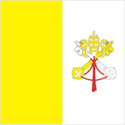
two vertical bands of yellow (hoist side) and white with the crossed keys of Saint Peter and the papal tiara centered in the white band
Independence
11 February 1929 (from Italy)
Judicial branch
none; normally handled by Italy
Leaders
Chief of State--Pope JOHN PAUL II (Karol WOJTYLA; since 16 October 1978); Head of Government--Secretary of State Archbishop Angelo SODANO
Legislative branch
unicameral Pontifical Commission
Long-form name
State of the Vatican City; note--the Vatican City is the physical seat of the Holy See, which is the central government of the Roman Catholic Church
Member of
CSCE, IAEA, ICFTU, IMF (observer), INTELSAT, IOM (observer), ITU, OAS (observer), UN (observer), UNCTAD, UNHCR, UPU, WIPO, WTO (observer)
National holiday
Installation Day of the Pope (John Paul II), 22 October (1978); note--Pope John Paul II was elected on 16 October 1978
Other political or pressure groups
none (exclusive of influence exercised by church officers)
Political parties and leaders
none
Suffrage
limited to cardinals less than 80 years old
Type
monarchical-sacerdotal state
Economy
Budget
revenues $76.6 million; expenditures $168 million, including capital expenditures of $NA (1991)
Currency
Vatican lira (plural--lire); 1 Vatican lira (VLit) = 100 centesimi
Electricity
5,000 kW standby capacity (1990); power supplied by Italy
Exchange rates
Vatican lire (VLit) per US$1--1,134.4 (January 1991), 1,198.1 (1990), 1,372.1 (1989), 1,301.6 (1988), 1,296.1 (1987), 1,490.8 (1986), 1,909.4 (1985); note--the Vatican lira is at par with the Italian lira which circulates freely
Fiscal year
calendar year
Industries
printing and production of a small amount of mosaics and staff uniforms; worldwide banking and financial activities
Overview
This unique, noncommercial economy is supported financially by contributions (known as Peter's Pence) from Roman Catholics throughout the world, the sale of postage stamps, tourist mementos, fees for admission to museums, and the sale of publications. The incomes and living standards of lay workers are comparable to, or somewhat better than, those of counterparts who work in the city of Rome.
Communications
Highways
none; all city streets
Railroads
850 m, 750 mm gauge (links with Italian network near the Rome station of Saint Peter's)
Telecommunications
stations--3 AM, 4 FM, no TV; 2,000-line automatic telephone exchange; no communications satellite systems
Military and Security
Note
defense is the responsibility of Italy; Swiss Papal Guards are posted at entrances to the Vatican City _%_