2020 Edition
factbook.json (GitHub)
Introduction
Background
Austronesian speakers from the Solomon Islands first settled Vanuatu around 2000 B.C. By around 1000, localized chieftain systems began to develop on the islands. Around 1600, Melanesian Chief ROI MATA united some of the islands of modern-day Vanuatu under his rule. In 1606, a Portuguese explorer was the first European to see Vanuatu's Banks Islands and Espiritu Santo, setting up a short-lived settlement on the latter. The next European explorers arrived in the 1760s, and the islands -- then known as the New Hebrides -- were frequented by whalers in the 1800s. European interest in harvesting the islands’ sandalwood trees caused conflict with the inhabitants. In the 1860s, European planters in Australia, Fiji, New Caledonia, and Samoa needed labor and kidnapped almost half the adult males on the islands to work as indentured servants. With growing and overlapping interests in the islands, France and the UK agreed that the New Hebrides would be neutral in 1878 and established a joint naval commission in 1887. In 1906, the two countries created the UK-France condominium to jointly administer the islands, with separate laws, police forces, currencies, and education and health systems. The condominium arrangement was dysfunctional, and the UK used France’s initial defeat in World War II to assert greater control over the islands. During the war, the US stationed up to 50,000 soldiers in Vanuatu. In 1945, they withdrew and sold their equipment, leading to the rise of political and religious movements known as "cargo cults," such as the John Frum movement. The UK-France condominium was reestablished after World War II. The UK was interested in moving the condominium toward independence in the 1960s, but France was hesitant. Political parties agitating for independence began to form, largely divided along linguistic lines. France eventually relented, and elections were held in 1974, with independence granted to the newly named Vanuatu in 1980 under English-speaking Prime Minister Walter LINI. The Nagriamel Movement, with support from French-speaking landowners, then declared the island of Espiritu Santo independent from Vanuatu, but the short-lived state was dissolved 12 weeks later. Linguistic divisions have lessened over time, but highly fractious political parties have led to weak coalition governments that require support from both Anglophone and Francophone parties. Since 2008, prime ministers have been ousted more than a dozen times through no-confidence motions or temporary procedural issues.
Geography
Area
- land
- 12,189 sq km
- total
- 12,189 sq km
- water
- 0 sq km
Area - comparative
slightly larger than Connecticut
Climate
tropical; moderated by southeast trade winds from May to October; moderate rainfall from November to April; may be affected by cyclones from December to April
Coastline
2,528 km
Elevation
- highest point
- Tabwemasana 1,877 m
- lowest point
- Pacific Ocean 0 m
Geographic coordinates
16 00 S, 167 00 E
Geography - note
a Y-shaped chain of four main islands and 80 smaller islands; several of the islands have active volcanoes, including several underwater volcanoes
Irrigated land
0 sq km (2022)
Land boundaries
- total
- 0 km
Land use
- agricultural land
- 15.3% (2023 est.)
- agricultural land: arable land
- arable land: 1.6% (2023 est.)
- agricultural land: permanent crops
- permanent crops: 10.3% (2023 est.)
- agricultural land: permanent pasture
- permanent pasture: 3.4% (2023 est.)
- forest
- 74.8% (2023 est.)
- other
- 9.8% (2023 est.)
Location
Oceania, group of islands in the South Pacific Ocean, about three-quarters of the way from Hawaii to Australia
Map references
Oceania
Maritime claims
- contiguous zone
- 24 nm
- continental shelf
- 200 nm or to the edge of the continental margin
- exclusive economic zone
- 200 nm
- territorial sea
- 12 nm
Natural hazards
tropical cyclones (January to April); volcanic activity; volcanism also causes minor earthquakes; tsunamis volcanism: significant volcanic activity with multiple eruptions in recent years; Yasur (361 m), one of the world's most active volcanoes, has experienced continuous activity in recent centuries; other historically active volcanoes include Aoba, Ambrym, Epi, Gaua, Kuwae, Lopevi, Suretamatai, and Traitor's Head
Natural resources
manganese, hardwood forests, fish
Population distribution
three quarters of the population lives in rural areas; the urban populace lives primarily in two cities, Port-Vila and Lugenville; the three largest islands -- Espiritu Santo, Malakula, and Efate -- accommodate over half of the populace
Terrain
mostly mountainous islands of volcanic origin; narrow coastal plains
People and Society
Age structure
- 0-14 years
- 31.1% (male 50,584/female 48,475)
- 15-64 years
- 63.8% (male 99,496/female 103,425)
- 65 years and over
- 5% (2024 est.) (male 7,852/female 8,175)
Alcohol consumption per capita
- beer
- 0.34 liters of pure alcohol (2019 est.)
- other alcohols
- 0 liters of pure alcohol (2019 est.)
- spirits
- 0.87 liters of pure alcohol (2019 est.)
- total
- 1.6 liters of pure alcohol (2019 est.)
- wine
- 0.39 liters of pure alcohol (2019 est.)
Birth rate
20.36 births/1,000 population (2025 est.)
Currently married women (ages 15-49)
68.6% (2020 est.)
Death rate
4.02 deaths/1,000 population (2025 est.)
Dependency ratios
- elderly dependency ratio
- 7.9 (2024 est.)
- potential support ratio
- 12.7 (2024 est.)
- total dependency ratio
- 56.7 (2024 est.)
- youth dependency ratio
- 48.8 (2024 est.)
Drinking water source
- improved: rural
- rural: 88.6% of population (2022 est.)
- improved: total
- total: 91.3% of population (2022 est.)
- improved: urban
- urban: 99.2% of population (2022 est.)
- unimproved: rural
- rural: 11.4% of population (2022 est.)
- unimproved: total
- total: 8.7% of population (2022 est.)
- unimproved: urban
- urban: 0.8% of population (2022 est.)
Education expenditure
- Education expenditure (% GDP)
- 7.6% of GDP (2023 est.)
- Education expenditure (% national budget)
- 20.1% national budget (2024 est.)
Ethnic groups
Ni-Vanuatu 99%, other 1% (European, Asian, other Melanesian, Polynesian, Micronesian, other) (2020 est.)
Gross reproduction rate
1.2 (2025 est.)
Health expenditure
- Health expenditure (as % of GDP)
- 4.4% of GDP (2021)
- Health expenditure (as % of national budget)
- 3.9% of national budget (2022 est.)
Infant mortality rate
- female
- 12.3 deaths/1,000 live births
- male
- 15 deaths/1,000 live births
- total
- 13.4 deaths/1,000 live births (2025 est.)
Languages
indigenous languages (more than 100) 82.6%, Bislama (official; creole) 14.5%, English (official) 2.1%, French (official) 0.8% (2020 est.)
Life expectancy at birth
- female
- 77.4 years
- male
- 74 years
- total population
- 75.7 years (2024 est.)
Literacy
- female
- 88.2% (2023 est.)
- male
- 87.7% (2023 est.)
- total population
- 88% (2023 est.)
Major urban areas - population
53,000 PORT-VILA (capital) (2018)
Maternal mortality ratio
100 deaths/100,000 live births (2023 est.)
Median age
- female
- 25 years
- male
- 24.1 years
- total
- 24.9 years (2025 est.)
Nationality
- adjective
- Ni-Vanuatu
- noun
- Ni-Vanuatu (singular and plural)
Net migration rate
-1.24 migrant(s)/1,000 population (2025 est.)
Obesity - adult prevalence rate
25.2% (2016)
Physician density
0.16 physicians/1,000 population (2019)
Population
- female
- 160,075
- male
- 157,932
- total
- 318,007 (2024 est.)
Population growth rate
1.51% (2025 est.)
Religions
Protestant 39.9% (Presbyterian 27.2%, Seventh Day Adventist 14.8%, Anglican 12%, Churches of Christ 5%, Assemblies of God 4.9%, Neil Thomas Ministry/Inner Life Ministry 3.2%), Roman Catholic 12.1%, Apostolic 2.3%, Church of Jesus Christ 1.8%, customary beliefs (including Jon Frum cargo cult) 3.1%, other 12%, none 1.4%, unspecified 0.1% (2020 est.)
Sanitation facility access
- improved: rural
- rural: 66.9% of population (2022 est.)
- improved: total
- total: 73.9% of population (2022 est.)
- improved: urban
- urban: 94% of population (2022 est.)
- unimproved: rural
- rural: 33.1% of population (2022 est.)
- unimproved: total
- total: 26.1% of population (2022 est.)
- unimproved: urban
- urban: 6% of population (2022 est.)
Sex ratio
- 0-14 years
- 1.04 male(s)/female
- 15-64 years
- 0.96 male(s)/female
- 65 years and over
- 0.96 male(s)/female
- at birth
- 1.05 male(s)/female
- total population
- 0.99 male(s)/female (2024 est.)
Tobacco use
- female
- 2.6% (2020 est.)
- male
- 33% (2020 est.)
- total
- 17.8% (2020 est.)
Total fertility rate
2.46 children born/woman (2025 est.)
Urbanization
- rate of urbanization
- 2.55% annual rate of change (2020-25 est.)
- urban population
- 26% of total population (2023)
Government
Administrative divisions
6 provinces; Malampa, Penama, Sanma, Shefa, Tafea, Torba
Capital
- etymology
- the local name of Vila is sometimes used alone for the the port town; its meaning is unknown
- geographic coordinates
- 17 44 S, 168 19 E
- name
- Port-Vila (on Efate)
- time difference
- UTC+11 (16 hours ahead of Washington, DC, during Standard Time)
Citizenship
- citizenship by birth
- no
- citizenship by descent only
- both parents must be citizens of Vanuatu; in the case of only one parent, it must be the father who is a citizen
- dual citizenship recognized
- no
- residency requirement for naturalization
- 10 years
Constitution
- amendment process
- proposed by the prime minister or by the Parliament membership; passage requires at least two-thirds majority vote by Parliament in special session with at least three fourths of the membership; passage of amendments affecting the national and official languages, or the electoral and parliamentary system also requires approval in a referendum
- history
- draft completed August 1979, finalized by constitution conference 19 September 1979, ratified by French and British Governments 23 October 1979, effective 30 July 1980 at independence
Country name
- conventional long form
- Republic of Vanuatu
- conventional short form
- Vanuatu
- etymology
- the name means "Our land forever" in several of the Austronesian languages spoken on the islands; the former name, New Hebrides, was given by Captain James COOK in 1774 because he thought they looked similar to the Hebrides islands off the coast of Scotland
- former
- New Hebrides
- local long form
- Ripablik blong Vanuatu
- local short form
- Vanuatu
Diplomatic representation from the US
- chief of mission
- Ambassador Ann Marie YASTISHOCK (since 16 April 2024); note - also accredited to the Papua New Guinea and the Solomon Islands, based in Port Moresby, Papua New Guinea
- email address and website
- https://vt.usembassy.gov/
- embassy
- Port Vila
Diplomatic representation in the US
- chancery
- 800 Second Avenue, Suite 400B, New York, NY 10017
- chief of mission
- Ambassador Odo TEVI (since 8 September 2017) note - also Permanent Representative to the UN
- email address and website
- vanunmis@aol.com https://www.un.int/vanuatu/
- FAX
- [1] (212) 422-3427
- telephone
- [1] (212) 661-4303
Executive branch
- cabinet
- Council of Ministers appointed by the prime minister, responsible to Parliament
- chief of state
- President Nikenike VUROBARAVU (since 23 July 2022)
- election results
- 2022: Nikenike VUROBARAVU elected president in eighth round; electoral college vote - Nikenike VUROBARAVU (VP) 48 votes, Solas MOLISA (VP) 4 votes
- election/appointment process
- president indirectly elected by an electoral college consisting of Parliament and presidents of the 6 provinces; national president serves a 5-year term; following legislative elections, the Parliament usually elects the leader of the majority party or majority coalition (who must also be a member of Parliament) as prime minister
- expected date of next election
- 2027
- head of government
- Prime Minister Jotham NAPAT (since 11 February 2025)
- most recent election date
- 23 July 2022
Flag
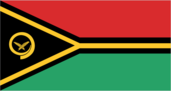
description: two equal horizontal bands of red (top) and green with a black isosceles triangle (based on the left side); a black-edged yellow stripe in the shape of a horizontal "Y" faces the left side and encloses the triangle; a boar's tusk in the triangle circles two crossed namele fern fronds, all in yellow meaning: red stands for unity and the blood of men and boars, green for the richness of the islands, and black for the ni-Vanuatu people; the yellow "Y" reflects the islands' layout in the Pacific Ocean and symbolizes the light of the Gospel; the boar's tusk is a symbol of prosperity; the ferns represent peace
Government type
parliamentary republic
Independence
30 July 1980 (from France and the UK)
International law organization participation
has not submitted an ICJ jurisdiction declaration; accepts ICCt jurisdiction
International organization participation
ACP, ADB, AOSIS, C, FAO, G-77, IBRD, ICAO, ICRM, IDA, IFC, IFRCS, ILO, IMF, IMO, IMSO, IOC, IOM, ITU, ITUC (NGOs), MIGA, NAM, OAS (observer), OIF, OPCW, PIF, Sparteca, SPC, UN, UNCTAD, UNESCO, UNIDO, UNWTO, UPU, WCO, WFTU (NGOs), WHO, WIPO, WMO, WTO
Judicial branch
- highest court(s)
- Court of Appeal (consists of 2 or more judges of the Supreme Court designated by the chief justice); Supreme Court (consists of the chief justice and 6 puisne judges -- 3 local and 3 expatriate)
- judge selection and term of office
- Supreme Court chief justice appointed by the president after consultation with the prime minister and the leader of the opposition; other judges appointed by the president on the advice of the Judicial Service Commission, a 4-member advisory body; judges serve until the age of retirement
- subordinate courts
- Magistrates Courts; Island Courts
Legal system
mixed system of English common law, French law, and customary law
Legislative branch
- electoral system
- proportional representation
- expected date of next election
- January 2029
- legislative structure
- unicameral
- legislature name
- Parliament
- most recent election date
- 1/16/2025
- number of seats
- 52 (all directly elected)
- parties elected and seats per party
- Leaders Party of Vanuatu (LPV) (9); Vanua'aku Pati (VP) (7); Iauko Group (IG) (6); Union of Moderate Parties (UMP) (6); Rural Development Party (RDP) (6); Graon mo Jastis Pati (Land and Justice Party, GJP) (5); Reunification Movement for Change (RMC) (5); Other (8)
- percentage of women in chamber
- 1.9%
- scope of elections
- full renewal
- term in office
- 4 years
National anthem(s)
- history
- adopted 1980; the anthem is written in the native Bislama
- lyrics/music
- Francois Vincent AYSSAV
- title
- "Yumi, Yumi, Yumi" (We, We, We)
National color(s)
red, black, green, yellow
National heritage
- selected World Heritage Site locales
- Chief Roi Mata’s Domain
- total World Heritage Sites
- 1 (cultural)
National holiday
Independence Day, 30 July (1980)
National symbol(s)
boar's tusk with crossed fern fronds
Political parties
Iauko Group (Eagle Party) or IG Land and Justice Party (Graon mo Jastis Pati or GJP) Leaders Party of Vanuatu or LPV Rural Development Party or RDP Reunification of Movement for Change or RMC Union of Moderate Parties or UMP Vanua'aku Pati (Our Land Party) or VP
Suffrage
18 years of age; universal
Economy
Agricultural products
coconuts, oranges, yams, cabbages, taro, bananas, chillies/peppers, chestnuts, sweet potatoes, cassava (2023)
Budget
- expenditures
- $378.659 million (2023 est.)
- revenues
- $386.577 million (2023 est.)
Current account balance
- Current account balance 2020
- -$57.858 million (2020 est.)
- Current account balance 2021
- -$75.451 million (2021 est.)
- Current account balance 2022
- -$127.432 million (2022 est.)
Debt - external
- Debt - external 2023
- $299.746 million (2023 est.)
Economic overview
lower-middle income Pacific island economy; extremely reliant on subsistence agriculture and tourism; environmentally fragile; struggling post-pandemic and Tropical Cyclone Harold rebound; sizeable inflation; road infrastructure aid from Australia
Exchange rates
- Currency
- vatu (VUV) per US dollar -
- Exchange rates 2020
- 115.38 (2020 est.)
- Exchange rates 2021
- 109.452 (2021 est.)
- Exchange rates 2022
- 115.354 (2022 est.)
- Exchange rates 2023
- 119.112 (2023 est.)
- Exchange rates 2024
- 119.167 (2024 est.)
Exports
- Exports 2020
- $132.943 million (2020 est.)
- Exports 2021
- $82.08 million (2021 est.)
- Exports 2022
- $152.087 million (2022 est.)
Exports - commodities
fish, ships, perfume plants, wood, copra (2023)
Exports - partners
Thailand 49%, Japan 19%, Cote d'Ivoire 10%, China 7%, USA 3% (2023)
GDP - composition, by end use
- exports of goods and services
- 9.6% (2022 est.)
- government consumption
- 23.9% (2022 est.)
- household consumption
- 77.2% (2022 est.)
- imports of goods and services
- -55.5% (2022 est.)
- investment in fixed capital
- 38.8% (2022 est.)
- investment in inventories
- 0.4% (2022 est.)
GDP - composition, by sector of origin
- agriculture
- 24.9% (2022 est.)
- industry
- 7.5% (2022 est.)
- services
- 60.4% (2022 est.)
GDP (official exchange rate)
$1.161 billion (2024 est.)
Gini Index coefficient - distribution of family income
- Gini Index coefficient - distribution of family income 2019
- 32.3 (2019 est.)
Household income or consumption by percentage share
- highest 10%
- 24.7% (2019 est.)
- lowest 10%
- 3% (2019 est.)
Imports
- Imports 2020
- $438.373 million (2020 est.)
- Imports 2021
- $520.391 million (2021 est.)
- Imports 2022
- $579.347 million (2022 est.)
Imports - commodities
refined petroleum, ships, plastic products, poultry, trucks (2023)
Imports - partners
China 26%, Australia 15%, Angola 11%, Fiji 9%, NZ 8% (2023)
Industrial production growth rate
-19.7% (2022 est.)
Industries
food and fish freezing, wood processing, meat canning
Inflation rate (consumer prices)
- Inflation rate (consumer prices) 2021
- 2.3% (2021 est.)
- Inflation rate (consumer prices) 2022
- 6.7% (2022 est.)
- Inflation rate (consumer prices) 2023
- 11.2% (2023 est.)
Labor force
118,100 (2024 est.)
Population below poverty line
15.9% (2019 est.)
Public debt
- Public debt 2023
- 71.7% of GDP (2023 est.)
Real GDP (purchasing power parity)
- Real GDP (purchasing power parity) 2022
- $1.009 billion (2022 est.)
- Real GDP (purchasing power parity) 2023
- $999.162 million (2023 est.)
- Real GDP (purchasing power parity) 2024
- $1.039 billion (2024 est.)
Real GDP growth rate
- Real GDP growth rate 2022
- 5.2% (2022 est.)
- Real GDP growth rate 2023
- -1% (2023 est.)
- Real GDP growth rate 2024
- 4% (2024 est.)
Real GDP per capita
- Real GDP per capita 2022
- $3,200 (2022 est.)
- Real GDP per capita 2023
- $3,100 (2023 est.)
- Real GDP per capita 2024
- $3,200 (2024 est.)
Remittances
- Remittances 2021
- 20.3% of GDP (2021 est.)
- Remittances 2022
- 19.2% of GDP (2022 est.)
- Remittances 2023
- 12.9% of GDP (2023 est.)
Reserves of foreign exchange and gold
- Reserves of foreign exchange and gold 2022
- $638.537 million (2022 est.)
- Reserves of foreign exchange and gold 2023
- $643.768 million (2023 est.)
- Reserves of foreign exchange and gold 2024
- $614.65 million (2024 est.)
Taxes and other revenues
17.4% (of GDP) (2023 est.)
Unemployment rate
- Unemployment rate 2022
- 5.2% (2022 est.)
- Unemployment rate 2023
- 5.1% (2023 est.)
- Unemployment rate 2024
- 5.1% (2024 est.)
Youth unemployment rate (ages 15-24)
- female
- 14% (2024 est.)
- male
- 9.6% (2024 est.)
- total
- 11.6% (2024 est.)
Energy
Electricity
- consumption
- 74.766 million kWh (2023 est.)
- installed generating capacity
- 39,000 kW (2023 est.)
- transmission/distribution losses
- 5.264 million kWh (2023 est.)
Electricity access
- electrification - rural areas
- 60.7%
- electrification - total population
- 70% (2022 est.)
- electrification - urban areas
- 97%
Electricity generation sources
- biomass and waste
- 0.1% of total installed capacity (2023 est.)
- fossil fuels
- 74.9% of total installed capacity (2023 est.)
- hydroelectricity
- 11.2% of total installed capacity (2023 est.)
- solar
- 8.7% of total installed capacity (2023 est.)
- wind
- 5% of total installed capacity (2023 est.)
Energy consumption per capita
- Total energy consumption per capita 2023
- 12.934 million Btu/person (2023 est.)
Petroleum
- refined petroleum consumption
- 2,000 bbl/day (2023 est.)
Communications
Broadband - fixed subscriptions
- subscriptions per 100 inhabitants
- 1 (2022 est.)
- total
- 4,000 (2022 est.)
Broadcast media
1 state-owned TV station; multi-channel pay TV available; state-owned Radio Vanuatu has 2 radio stations; 2 privately owned radio broadcasters; multiple international broadcasts available (2023)
Internet country code
.vu
Internet users
- percent of population
- 46% (2023 est.)
Telephones - fixed lines
- subscriptions per 100 inhabitants
- 1 (2022 est.)
- total subscriptions
- 3,000 (2022 est.)
Telephones - mobile cellular
- subscriptions per 100 inhabitants
- 78 (2022 est.)
- total subscriptions
- 256,000 (2022 est.)
Transportation
Airports
31 (2025)
Civil aircraft registration country code prefix
YJ
Merchant marine
- by type
- bulk carrier 11, container ship 3, general cargo 101, other 223
- total
- 338 (2023)
Ports
- key ports
- Forari Bay, Luganville, Port Vila
- large
- 0
- medium
- 0
- ports with oil terminals
- 2
- small
- 1
- total ports
- 3 (2024)
- very small
- 2
Military and Security
Military - note
the separate British and French police forces were unified in 1980 as the New Hebrides Constabulary, which was commanded by Ni-Vanuatu officers while retaining some British and French officers as advisors; the Constabulary was subsequently renamed the Vanuatu Police Force later in 1980 the Vanuatu Mobile Force has received training and other support from Australia, China, France, New Zealand, and the US Vanuatu has a "shiprider" agreement with the US, which allows local maritime law enforcement officers to embark on US Coast Guard (USCG) and US Navy (USN) vessels, including to board and search vessels suspected of violating laws or regulations within Vanuatu's designated exclusive economic zone (EEZ) or on the high seas; "shiprider" agreements also enable USCG personnel and USN vessels with embarked USCG law enforcement personnel to work with host nations to protect critical regional resources (2025)
Military and security forces
no regular military forces; Vanuatu Police Force (VPF)
Transnational Issues
Refugees and internally displaced persons
- IDPs
- 2,336 (2024 est.)
Trafficking in persons
- tier rating
- Tier 2 Watch List — Vanuatu does not fully meet the minimum standards for the elimination of trafficking, but the government has devoted sufficient resources to a written plan that, if implemented, would constitute significant efforts to meet the minimum standards; therefore, Vanuatu was granted a waiver per the Trafficking Victims Protection Act from an otherwise required downgrade to Tier 3 and remained on Tier 2 Watch List for the third consecutive year; for more details, go to: https://www.state.gov/reports/2025-trafficking-in-persons-report/vanuatu/
Environment
Carbon dioxide emissions
- from petroleum and other liquids
- 292,000 metric tonnes of CO2 (2023 est.)
- total emissions
- 292,000 metric tonnes of CO2 (2023 est.)
Environmental issues
water pollution; limited potable water; inadequate sanitation; deforestation
International environmental agreements
- party to
- Antarctic-Marine Living Resources, Biodiversity, Climate Change, Climate Change-Kyoto Protocol, Climate Change-Paris Agreement, Comprehensive Nuclear Test Ban, Desertification, Endangered Species, Hazardous Wastes, Law of the Sea, Marine Dumping-London Convention, Marine Dumping-London Protocol, Ozone Layer Protection, Ship Pollution, Wetlands
- signed, but not ratified
- none of the selected agreements
Particulate matter emissions
9.1 micrograms per cubic meter (2019 est.)
Total renewable water resources
10 billion cubic meters (2022 est.)
Waste and recycling
- municipal solid waste generated annually
- 70,200 tons (2024 est.)
- percent of municipal solid waste recycled
- 52.9% (2022 est.)