2008 Edition
CIA World Factbook 2008 (Project Gutenberg)
Introduction
Background
Multiple waves of colonizers, each speaking a distinct language, migrated to the New Hebrides in the millennia preceding European exploration in the 18th century. This settlement pattern accounts for the complex linguistic diversity found on the archipelago to this day. The British and French, who settled the New Hebrides in the 19th century, agreed in 1906 to an Anglo-French Condominium, which administered the islands until independence in 1980, when the new name of Vanuatu was adopted.
Geography
Area
total: 12,200 sq km land: 12,200 sq km water: 0 sq km note: includes more than 80 islands, about 65 of which are inhabited
Area - comparative
slightly larger than Connecticut
Climate
tropical; moderated by southeast trade winds from May to October; moderate rainfall from November to April; may be affected by cyclones from December to April
Coastline
2,528 km
Elevation extremes
lowest point: Pacific Ocean 0 m highest point: Tabwemasana 1,877 m
Environment - current issues
most of the population does not have access to a reliable supply of potable water; deforestation
Environment - international agreements
party to: Antarctic-Marine Living Resources, Biodiversity, Climate Change, Climate Change-Kyoto Protocol, Desertification, Endangered Species, Law of the Sea, Marine Dumping, Ozone Layer Protection, Ship Pollution, Tropical Timber 94 signed, but not ratified: none of the selected agreements
Geographic coordinates
16 00 S, 167 00 E
Geography - note
a Y-shaped chain of four main islands and 80 smaller islands; several of the islands have active volcanoes
Irrigated land
NA
Land boundaries
0 km
Land use
arable land: 1.64% permanent crops: 6.97% other: 91.39% (2005)
Location
Oceania, group of islands in the South Pacific Ocean, about three-quarters of the way from Hawaii to Australia
Map references
Oceania
Maritime claims
measured from claimed archipelagic baselines territorial sea: 12 nm contiguous zone: 24 nm exclusive economic zone: 200 nm continental shelf: 200 nm or to the edge of the continental margin
Natural hazards
tropical cyclones or typhoons (January to April); volcanic eruption on Aoba (Ambae) island began 27 November 2005, volcanism also causes minor earthquakes; tsunamis
Natural resources
manganese, hardwood forests, fish
Terrain
mostly mountainous islands of volcanic origin; narrow coastal plains
People and Society
Age structure
0-14 years: 31.3% (male 34,441/female 33,000) 15-64 years: 64.8% (male 71,159/female 68,435) 65 years and over: 3.9% (male 4,352/female 4,059) (2008 est.)
Birth rate
21.95 births/1,000 population (2008 est.)
Death rate
7.61 deaths/1,000 population (2008 est.)
Education expenditures
9.5% of GDP (2003)
Ethnic groups
Ni-Vanuatu 98.5%, other 1.5% (1999 Census)
HIV/AIDS - adult prevalence rate
NA
HIV/AIDS - deaths
NA
HIV/AIDS - people living with HIV/AIDS
NA
Infant mortality rate
total: 50.77 deaths/1,000 live births male: 53.32 deaths/1,000 live births female: 48.09 deaths/1,000 live births (2008 est.)
Languages
local languages (more than 100) 72.6%, pidgin (known as Bislama or Bichelama) 23.1%, English 1.9%, French 1.4%, other 0.3%, unspecified 0.7% (1999 Census)
Life expectancy at birth
total population: 63.61 years male: 62.04 years female: 65.27 years (2008 est.)
Literacy
definition: age 15 and over can read and write total population: 74% male: NA female: NA (1999 census)
Median age
total: 23.8 years male: 23.8 years female: 23.8 years (2008 est.)
Nationality
noun: Ni-Vanuatu (singular and plural) adjective: Ni-Vanuatu
Net migration rate
NA (2008 est.)
Population
215,446 (July 2008 est.)
Population growth rate
1.434% (2008 est.)
Religions
Presbyterian 31.4%, Anglican 13.4%, Roman Catholic 13.1%, Seventh-Day Adventist 10.8%, other Christian 13.8%, indigenous beliefs 5.6% (including Jon Frum cargo cult), other 9.6%, none 1%, unspecified 1.3% (1999 Census)
School life expectancy (primary to tertiary education)
total: 10 years male: 11 years female: 10 years (2004)
Sex ratio
at birth: 1.05 male(s)/female under 15 years: 1.04 male(s)/female 15-64 years: 1.04 male(s)/female 65 years and over: 1.07 male(s)/female total population: 1.04 male(s)/female (2008 est.)
Total fertility rate
2.57 children born/woman (2008 est.)
Government
Administrative divisions
6 provinces; Malampa, Penama, Sanma, Shefa, Tafea, Torba
Capital
name: Port-Vila (on Efate) geographic coordinates: 17 44 S, 168 19 E time difference: UTC+11 (16 hours ahead of Washington, DC during Standard Time)
Constitution
30 July 1980
Country name
conventional long form: Republic of Vanuatu conventional short form: Vanuatu local long form: Ripablik blong Vanuatu local short form: Vanuatu former: New Hebrides
Diplomatic representation from the US
the US does not have an embassy in Vanuatu; the ambassador to Papua New Guinea is accredited to Vanuatu
Diplomatic representation in the US
Vanuatu does not have an embassy in the US; it does, however, have a Permanent Mission to the UN
Executive branch
chief of state: President Kalkot Matas KELEKELE (since 16 August 2004) head of government: Prime Minister Edward NATAPEI (since 22 September 2008); Deputy Prime Minister Ham LINI (since 22 September 2008) cabinet: Council of Ministers appointed by the prime minister, responsible to Parliament elections: president elected for a five-year term by an electoral college consisting of Parliament and the presidents of the regional councils; election for president last held 16 August 2004 (next to be held in 2009); following legislative elections, the leader of the majority party or majority coalition is usually elected prime minister by Parliament from among its members; election for prime minister last held 22 September 2008 (next to be held following general elections in 2012) election results: Kalkot Matas KELEKELE elected president, with 49 votes out of 56, after several ballots on 16 August 2004
Flag description
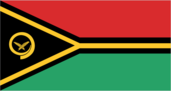
two equal horizontal bands of red (top) and green with a black isosceles triangle (based on the hoist side) all separated by a black-edged yellow stripe in the shape of a horizontal Y (the two points of the Y face the hoist side and enclose the triangle); centered in the triangle is a boar's tusk encircling two crossed namele leaves, all in yellow
Government type
parliamentary republic
Independence
30 July 1980 (from France and UK)
International organization participation
ACCT, ACP, ADB, C, FAO, G-77, IBRD, ICAO, ICRM, IDA, IFC, IFRCS, ILO, IMF, IMO, IOC, ITU, ITUC, MIGA, NAM, OAS (observer), OIF, OPCW, PIF, Sparteca, SPC, UN, UNCTAD, UNESCO, UNIDO, UPU, WHO, WMO, WTO (observer)
Judicial branch
Supreme Court (chief justice is appointed by the president after consultation with the prime minister and the leader of the opposition, three other justices are appointed by the president on the advice of the Judicial Service Commission)
Legal system
unified system being created from former dual French and British systems; has not accepted compulsory ICJ jurisdiction
Legislative branch
unicameral Parliament (52 seats; members elected by popular vote to serve four-year terms) elections: last held 2 September 2008 (next to be held 2012) election results: percent of vote by party - NA; seats by party - VP 11, NUP 8, UMP 7, VRP 7, PPP 4, GC 2, MPP 1, NA 1, NAG 1, PAP 1, Shepherds Alliance 1, VFFP 1, VLP 1, VNP 1, VPRFP 1, and independent 4; note - political party associations are fluid note: the National Council of Chiefs advises on matters of culture and language
National holiday
Independence Day, 30 July (1980)
Political parties and leaders
Greens Confederation or GC [Moana CARCASSES]; Jon Frum Movement or JF [Song KEASPAI]; Melanesian Progressive Party or MPP [Barak SOPE]; Nagriamel movement or NAG [Havo MOLI]; Namangi Aute or NA [Paul TELUKLUK]; National United Party or NUP [Ham LINI]; People's Action Party or PAP [Peter VUTA]; People's Progressive Party or PPP [Sato KILMAN]; Shepherds Alliance Party [leader NA]; Union of Moderate Parties or UMP [Serge VOHOR]; Vanuatu Family First Party or VFFP [Eta RORI]; Vanuatu Labor Party or VLP [Joshua KALSAKAU]; Vanuatu National Party or VNP [Issac HAMARILIU]; Vanua'aku Pati (Our Land Party) or VP [Edward NATAPEI]; Vanuatu Republican Party or VRP [Maxime Carlot KORMAN]; Vanuatu Republican Farmers Party or VPRFP [Jean RAVOU]
Political pressure groups and leaders
NA
Suffrage
18 years of age; universal
Economy
Agriculture - products
copra, coconuts, cocoa, coffee, taro, yams, fruits, vegetables; beef; fish
Budget
revenues: $78.7 million expenditures: $72.23 million (2005)
Central bank discount rate
6% (31 December 2007)
Commercial bank prime lending rate
8.16% (31 December 2007)
Currency (code)
vatu (VUV)
Currency code
VUV
Current account balance
-$60 million (2007 est.)
Debt - external
$81.2 million (2004)
Economic aid - recipient
$39.48 million (2005)
Economy - overview
This South Pacific island economy is based primarily on small-scale agriculture, which provides a living for 65% of the population. Fishing, offshore financial services, and tourism, with more than 60,000 visitors in 2005, are other mainstays of the economy. Mineral deposits are negligible; the country has no known petroleum deposits. A small light industry sector caters to the local market. Tax revenues come mainly from import duties. Economic development is hindered by dependence on relatively few commodity exports, vulnerability to natural disasters, and long distances from main markets and between constituent islands. In response to foreign concerns, the government has promised to tighten regulation of its offshore financial center. In mid-2002 the government stepped up efforts to boost tourism through improved air connections, resort development, and cruise ship facilities. Agriculture, especially livestock farming, is a second target for growth. Australia and New Zealand are the main suppliers of tourists and foreign aid.
Electricity - consumption
39.99 million kWh (2006 est.)
Electricity - exports
0 kWh (2007 est.)
Electricity - imports
0 kWh (2007 est.)
Electricity - production
46 million kWh (2007 est.)
Electricity - production by source
fossil fuel: 100% hydro: 0% nuclear: 0% other: 0% (2001)
Exchange rates
vatu (VUV) per US dollar - NA (2007), 111.93 (2006), NA (2005), 111.79 (2004), 122.19 (2003)
Exports
$40 million f.o.b. (2006)
Exports - commodities
copra, beef, cocoa, timber, kava, coffee
Exports - partners
Thailand 58.3%, India 18.5%, Japan 11.3% (2007)
Fiscal year
calendar year
GDP - composition by sector
agriculture: 26% industry: 12% services: 62% (2000 est.)
GDP - per capita (PPP)
$3,900 (2007 est.)
GDP - real growth rate
5% (2007 est.)
GDP (official exchange rate)
$455 million (2007 est.)
GDP (purchasing power parity)
$897 million (2007 est.)
Household income or consumption by percentage share
lowest 10%: NA% highest 10%: NA%
Imports
$156 million c.i.f. (2006)
Imports - commodities
machinery and equipment, foodstuffs, fuels
Imports - partners
Australia 20.7%, Singapore 11.8%, NZ 11.2%, Norway 8.5%, US 8.3%, Fiji 8.1%, China 7.2%, New Caledonia 4.5% (2007)
Industrial production growth rate
1% (1997 est.)
Industries
food and fish freezing, wood processing, meat canning
Inflation rate (consumer prices)
3.9% (2007 est.)
Labor force
76,410 (1999)
Labor force - by occupation
agriculture: 65% industry: 5% services: 30% (2000 est.)
Market value of publicly traded shares
$NA
Natural gas - consumption
0 cu m (2007 est.)
Natural gas - exports
0 cu m (2007 est.)
Natural gas - imports
0 cu m (2007 est.)
Natural gas - production
0 cu m (2007 est.)
Natural gas - proved reserves
0 cu m (1 January 2006 est.)
Oil - consumption
660 bbl/day (2006 est.)
Oil - exports
0 bbl/day (2005)
Oil - imports
671.1 bbl/day (2005)
Oil - production
0 bbl/day (2007 est.)
Oil - proved reserves
0 bbl (1 January 2006 est.)
Population below poverty line
NA%
Reserves of foreign exchange and gold
$40.54 million (2003)
Stock of domestic credit
$229.5 million (31 December 2007)
Stock of money
$107.1 million (31 December 2007)
Stock of quasi money
$421.8 million (31 December 2007)
Unemployment rate
1.7% (1999)
Communications
Internet country code
.vu
Internet hosts
990 (2008)
Internet Service Providers (ISPs)
1 (2000)
Internet users
17,000 (2007)
Radio broadcast stations
AM 2, FM 4, shortwave 1 (2001)
Radios
67,000 (1997)
Telephone system
general assessment: NA domestic: NA international: country code - 678; satellite earth station - 1 Intelsat (Pacific Ocean)
Telephones - main lines in use
8,800 (2007)
Telephones - mobile cellular
26,000 (2007)
Television broadcast stations
1 (2004)
Televisions
2,300 (1999)
Transportation
Airports
31 (2007)
Airports - with paved runways
total: 3 2,438 to 3,047 m: 1 1,524 to 2,437 m: 1 914 to 1,523 m: 1 (2007)
Airports - with unpaved runways
total: 28 914 to 1,523 m: 6 under 914 m: 22 (2007)
Merchant marine
total: 54 by type: bulk carrier 32, cargo 8, container 1, liquefied gas 2, passenger 1, petroleum tanker 1, refrigerated cargo 4, vehicle carrier 5 foreign-owned: 54 (Australia 2, Belgium 4, Canada 5, Estonia 1, Greece 1, Japan 29, Monaco 1, Poland 7, Russia 2, Switzerland 1, US 1) (2008)
Ports and terminals
Forari, Port-Vila, Santo (Espiritu Santo)
Roadways
total: 1,070 km paved: 256 km unpaved: 814 km (1999)
Military and Security
Manpower available for military service
males age 16-49: 58,900 (2008 est.)
Manpower fit for military service
males age 16-49: 40,577 (2008 est.)
Manpower reaching militarily significant age annually
male: 2,385 female: 2,290 (2008 est.)
Military branches
no regular military forces; Vanuatu Police Force (VPF), Vanuatu Mobile Force (VMF; includes Police Maritime Wing (PMW)) (2008)
Military expenditures
NA
Transnational Issues
Disputes - international
Matthew and Hunter Islands east of New Caledonia claimed by Vanuatu and France This page was last updated on 18 December, 2008