1991 Edition
CIA World Factbook 1991 (Project Gutenberg)
Geography
Climate
tropical; moderated by southeast trade winds
Coastline
2,528 km
Comparative area
slightly larger than Connecticut
Environment
subject to tropical cyclones or typhoons (January to April); volcanism causes minor earthquakes
Land boundary
none
Land use
arable land 1%; permanent crops 5%; meadows and pastures 2%; forest and woodland 1%; other 91%
Maritime claims
(measured from claimed archipelagic baselines); Contiguous zone: 24 nm; Continental shelf: edge of continental margin or 200 nm; Exclusive economic zone: 200 nm; Territorial sea: 12 nm
Natural resources
manganese, hardwood forests, fish
Note
located 5,750 km southwest of Honolulu in the South Pacific Ocean about three-quarters of the way between Hawaii and Australia
Terrain
mostly mountains of volcanic origin; narrow coastal plains
Total area
14,760 km2; land area: 14,760 km2; includes more than 80 islands
People and Society
Birth rate
36 births/1,000 population (1991)
Death rate
5 deaths/1,000 population (1991)
Ethnic divisions
indigenous Melanesian 94%, French 4%, remainder Vietnamese, Chinese, and various Pacific Islanders
Infant mortality rate
36 deaths/1,000 live births (1991)
Labor force
NA
Language
English and French (official); pidgin (known as Bislama or Bichelama)
Life expectancy at birth
67 years male, 72 years female (1991)
Literacy
53% (male 57%, female 48%) age 15 and over can read and write (1979)
Nationality
noun--Ni-Vanuatu (singular and plural); adjective--Ni-Vanuatu
Net migration rate
0 migrants/1,000 population (1991)
Organized labor
7 registered trade unions--largest include Oil and Gas Workers' Union, Vanuatu Airline Workers' Union
Population
170,319 (July 1991), growth rate 3.1% (1991)
Religion
Presbyterian 36.7%, Anglican 15%, Catholic 15%, indigenous beliefs 7.6%, Seventh-Day Adventist 6.2%, Church of Christ 3.8%, other 15.7%
Total fertility rate
5.4 children born/woman (1991)
Government
Administrative divisions
11 island councils; Ambrym, Aoba/Maewo, Banks/Torres, Efate, Epi, Malakula, Paama, Pentecote, Santo/Malo, Shepherd, Tafea
Capital
Port-Vila
Constitution
30 July 1980
Diplomatic representation
Vanuatu does not have a mission in Washington; US--the ambassador in Papua New Guinea is accredited to Vanuatu
Elections
Parliament--last held 30 November 1987 (next to be held by November 1991); byelections were held in December 1988 to fill vacancies resulting from the expulsion of opposition members for boycotting sessions; results--percent of vote by party NA; seats--(46 total) National Party 26, Union of Moderate Parties 19, independent 1
Executive branch
president, prime minister, Council of Ministers (cabinet)
Flag
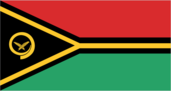
two equal horizontal bands of red (top) and green (bottom) with a black isosceles triangle (based on the hoist side) all separated by a black-edged yellow stripe in the shape of a horizontal Y (the two points of the Y face the hoist side and enclose the triangle); centered in the triangle is a boar's tusk encircling two crossed namele leaves, all in yellow
Independence
30 July 1980 (from France and UK; formerly New Hebrides)
Judicial branch
Supreme Court
Leaders
Chief of State--President Frederick TIMAKATA (since 30 January 1989); Head of Government--Prime Minister Father Walter Hadye LINI (since 30 July 1980); Deputy Prime Minister (vacant)
Legal system
unified system being created from former dual French and British systems
Legislative branch
unicameral Parliament; note--the National Council of Chiefs advises on matters of custom and land
Long-form name
Republic of Vanuatu
Member of
ACCT, ACP, AsDB, C, ESCAP, FAO, G-77, IBRD, ICAO, ICFTU, IDA, IFC, IMF, IMO, IOC, ITU, NAM, SPC, SPF, UN, UNCTAD, UNIDO, UPU, WFTU, WHO, WMO
National holiday
Independence Day, 30 July (1980)
Political parties and leaders
National Party (Vanua'aku Pati), Donald KALPOKAS; Union of Moderate Parties, Maxine CARLOT; Melanesian Progressive Party, Barak SOPE
Suffrage
universal at age 18
Type
republic
Economy
Agriculture
export crops--copra, cocoa, coffee, and fish; subsistence crops--copra, taro, yams, coconuts, fruits, and vegetables
Budget
revenues $90.0 million; expenditures $103.0 million, including capital expenditures of $45.0 million (1989 est.)
Currency
vatu (plural--vatu); 1 vatu (VT) = 100 centimes
Economic aid
Western (non-US) countries, ODA and OOF bilateral commitments (1970-88), $565 million
Electricity
17,000 kW capacity; 30 million kWh produced, 180 kWh per capita (1990)
Exchange rates
vatu (VT) per US$1--109.62 (January 1991), 116.57 (1990), 116.04 (1989), 104.43 (1988), 109.85 (1987), 106.08 (1986), 106.03 (1985)
Exports
$14.5 million (f.o.b., 1989 est.); commodities--copra 59%, cocoa 11%, meat 9%, fish 8%, timber 4%; partners--Netherlands 34%, France 27%, Japan 17%, Belgium 4%, New Caledonia 3%, Singapore 2% (1987)
External debt
$30 million (1990 est.)
Fiscal year
calendar year
GDP
$137 million, per capita $860; real growth rate 4.3% (1989 est.)
Imports
$58.4 million (f.o.b., 1989 est.); commodities--machines and vehicles 25%, food and beverages 23%, basic manufactures 18%, raw materials and fuels 11%, chemicals 6%; partners--Australia 36%, Japan 13%, NZ 10%, France 8%, Fiji 5% (1987)
Industrial production
growth rate NA%
Industries
food and fish freezing, forestry processing, meat canning
Inflation rate (consumer prices)
7.8% (1989 est.)
Overview
The economy is based primarily on subsistence farming that provides a living for about 80% of the population. Fishing and tourism are the other mainstays of the economy. Mineral deposits are negligible; the country has no known petroleum deposits. A small light industry sector caters to the local market. Tax revenues come mainly from import duties.
Unemployment rate
NA%
Communications
Airports
32 total, 28 usable; 2 with permanent-surface runways; none with runways over 3,659 m; 1 with runways 2,440-3,659 m; 1 with runways 1,220-2,439 m
Civil air
no major transport aircraft
Highways
1,027 km total; at least 240 km sealed or all-weather roads
Merchant marine
129 ships (1,000 GRT or over) totaling 2,242,850 GRT/3,447,671 DWT; includes 33 cargo, 13 refrigerated cargo, 8 container, 11 vehicle carrier, 1 livestock carrier, 5 petroleum, oils, and lubricants (POL) tanker, 1 chemical tanker, 1 liquefied gas, 55 bulk, 1 combination bulk; note--a flag of convenience registry; the USSR has 2 ships under the Vanuatu flag
Ports
Port-Vila, Luganville, Palikoulo, Santu
Railroads
none
Telecommunications
stations--2 AM, no FM, no TV; 3,000 telephones; satellite communications ground stations--1 Pacific Ocean INTELSAT
Military and Security
Branches
no military forces; Vanuatu Police Force, paramilitary force
Defense expenditures
$NA, NA% of GDP _%_
Manpower availability
males 15-49, 41,183; NA fit for military service