2008 Edition
CIA World Factbook 2008 (Project Gutenberg)
Introduction
Background
Russia conquered Uzbekistan in the late 19th century. Stiff resistance to the Red Army after World War I was eventually suppressed and a socialist republic set up in 1924. During the Soviet era, intensive production of "white gold" (cotton) and grain led to overuse of agrochemicals and the depletion of water supplies, which have left the land poisoned and the Aral Sea and certain rivers half dry. Independent since 1991, the country seeks to gradually lessen its dependence on agriculture while developing its mineral and petroleum reserves. Current concerns include terrorism by Islamic militants, economic stagnation, and the curtailment of human rights and democratization.
Geography
Area
total: 447,400 sq km land: 425,400 sq km water: 22,000 sq km
Area - comparative
slightly larger than California
Climate
mostly midlatitude desert, long, hot summers, mild winters; semiarid grassland in east
Coastline
0 km (doubly landlocked); note - Uzbekistan includes the southern portion of the Aral Sea with a 420 km shoreline
Elevation extremes
lowest point: Sariqarnish Kuli -12 m highest point: Adelunga Toghi 4,301 m
Environment - current issues
shrinkage of the Aral Sea is resulting in growing concentrations of chemical pesticides and natural salts; these substances are then blown from the increasingly exposed lake bed and contribute to desertification; water pollution from industrial wastes and the heavy use of fertilizers and pesticides is the cause of many human health disorders; increasing soil salination; soil contamination from buried nuclear processing and agricultural chemicals, including DDT
Environment - international agreements
party to: Biodiversity, Climate Change, Climate Change-Kyoto Protocol, Desertification, Endangered Species, Environmental Modification, Hazardous Wastes, Ozone Layer Protection, Wetlands signed, but not ratified: none of the selected agreements
Freshwater withdrawal (domestic/industrial/agricultural)
total: 58.34 cu km/yr (5%/2%/93%) per capita: 2,194 cu m/yr (2000)
Geographic coordinates
41 00 N, 64 00 E
Geography - note
along with Liechtenstein, one of the only two doubly landlocked countries in the world
Irrigated land
42,810 sq km (2003)
Land boundaries
total: 6,221 km border countries: Afghanistan 137 km, Kazakhstan 2,203 km, Kyrgyzstan 1,099 km, Tajikistan 1,161 km, Turkmenistan 1,621 km
Land use
arable land: 10.51% permanent crops: 0.76% other: 88.73% (2005)
Location
Central Asia, north of Afghanistan
Map references
Asia
Maritime claims
none (doubly landlocked)
Natural hazards
NA
Natural resources
natural gas, petroleum, coal, gold, uranium, silver, copper, lead and zinc, tungsten, molybdenum
Terrain
mostly flat-to-rolling sandy desert with dunes; broad, flat intensely irrigated river valleys along course of Amu Darya, Syr Darya (Sirdaryo), and Zarafshon; Fergana Valley in east surrounded by mountainous Tajikistan and Kyrgyzstan; shrinking Aral Sea in west
Total renewable water resources
72.2 cu km (2003)
People and Society
Age structure
0-14 years: 29% (male 4,047,918/female 3,870,346) 15-64 years: 66% (male 8,971,017/female 9,079,170) 65 years and over: 5% (male 588,498/female 788,077) (2008 est.)
Birth rate
17.99 births/1,000 population (2008 est.)
Death rate
5.3 deaths/1,000 population (2008 est.)
Education expenditures
9.4% of GDP (1991)
Ethnic groups
Uzbek 80%, Russian 5.5%, Tajik 5%, Kazakh 3%, Karakalpak 2.5%, Tatar 1.5%, other 2.5% (1996 est.)
HIV/AIDS - adult prevalence rate
less than 0.1% (2001 est.)
HIV/AIDS - deaths
fewer than 500 (2003 est.)
HIV/AIDS - people living with HIV/AIDS
11,000 (2003 est.)
Infant mortality rate
total: 24.23 deaths/1,000 live births male: 28.61 deaths/1,000 live births female: 19.58 deaths/1,000 live births (2008 est.)
Languages
Uzbek 74.3%, Russian 14.2%, Tajik 4.4%, other 7.1%
Life expectancy at birth
total population: 71.69 years male: 68.69 years female: 74.87 years (2008 est.)
Literacy
definition: age 15 and over can read and write total population: 99.3% male: 99.6% female: 99% (2003 est.)
Median age
total: 24.3 years male: 23.8 years female: 24.8 years (2008 est.)
Nationality
noun: Uzbekistani adjective: Uzbekistani
Net migration rate
-3.04 migrant(s)/1,000 population (2008 est.)
Population
27,345,026 (July 2008 est.)
Population growth rate
0.965% (2008 est.)
Religions
Muslim 88% (mostly Sunnis), Eastern Orthodox 9%, other 3%
School life expectancy (primary to tertiary education)
total: 11 years male: 12 years female: 11 years (2007)
Sex ratio
at birth: 1.05 male(s)/female under 15 years: 1.05 male(s)/female 15-64 years: 0.99 male(s)/female 65 years and over: 0.75 male(s)/female total population: 0.99 male(s)/female (2008 est.)
Total fertility rate
2.01 children born/woman (2008 est.)
Government
Administrative divisions
12 provinces (viloyatlar, singular - viloyat), 1 autonomous republic* (respublika), and 1 city** (shahar); Andijon Viloyati, Buxoro Viloyati, Farg'ona Viloyati, Jizzax Viloyati, Namangan Viloyati, Navoiy Viloyati, Qashqadaryo Viloyati (Qarshi), Qoraqalpog'iston Respublikasi [Karakalpakstan]* (Nukus), Samarqand Viloyati, Sirdaryo Viloyati (Guliston), Surxondaryo Viloyati (Termiz), Toshkent Shahri**, Toshkent Viloyati, Xorazm Viloyati (Urganch) note: administrative divisions have the same names as their administrative centers (exceptions have the administrative center name following in parentheses)
Capital
name: Tashkent (Toshkent) geographic coordinates: 41 20 N, 69 18 E time difference: UTC+5 (10 hours ahead of Washington, DC during Standard Time)
Constitution
adopted 8 December 1992
Country name
conventional long form: Republic of Uzbekistan conventional short form: Uzbekistan local long form: Ozbekiston Respublikasi local short form: Ozbekiston former: Uzbek Soviet Socialist Republic
Diplomatic representation from the US
chief of mission: Ambassador Richard B. NORLAND embassy: 3 Moyqo'rq'on, 5th Block, Yunusobod District, Tashkent 100093 mailing address: use embassy street address telephone: [998] (71) 120-5450
Diplomatic representation in the US
chief of mission: Ambassador Abdulaziz KAMILOV chancery: 1746 Massachusetts Avenue NW, Washington, DC 20036 telephone: [1] (202) 887-5300
Executive branch
chief of state: President Islom KARIMOV (since 24 March 1990, when he was elected president by the then Supreme Soviet) head of government: Prime Minister Shavkat MIRZIYOYEV (since 11 December 2003); First Deputy Prime Minister Rustam AZIMOV (since 2 January 2008) cabinet: Cabinet of Ministers appointed by the president with approval of the Supreme Assembly elections: president elected by popular vote for a seven-year term (eligible for a second term; previously was a five-year term, extended by constitutional amendment in 2002); election last held 23 December 2007 (next to be held in 2014); prime minister, ministers, and deputy ministers appointed by the president election results: Islom KARIMOV reelected president; percent of vote - Islom KARIMOV 88.1%, Aslidden RUSTAMOV 3.2%, Dilorom TASHMUKHAMEDOVA 2.9%, Akmal SAIDOV 2.6%
FAX
- [1] (202) 293-6804 consulate(s) general: New York
- [998] (71) 120-6335
Flag description
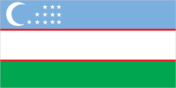
three equal horizontal bands of blue (top), white, and green separated by red fimbriations with a white crescent moon and 12 white stars in the upper hoist-side quadrant
Government type
republic; authoritarian presidential rule, with little power outside the executive branch
Independence
1 September 1991 (from Soviet Union)
International organization participation
ADB, CIS, CSTO, EAEC, EAPC, EBRD, ECO, FAO, GCTU, IAEA, IBRD, ICAO, ICCt (signatory), ICRM, IDA, IDB, IFC, IFRCS, ILO, IMF, Interpol, IOC, ISO, ITSO, ITU, MIGA, NAM, OIC, OPCW, OSCE, PFP, SCO, UN, UNCTAD, UNESCO, UNIDO, UNWTO, UPU, WCO, WFTU, WHO, WIPO, WMO, WTO (observer)
Judicial branch
Supreme Court (judges are nominated by the president and confirmed by the Supreme Assembly)
Legal system
based on civil law system; has not accepted compulsory ICJ jurisdiction
Legislative branch
bicameral Supreme Assembly or Oliy Majlis consists of an upper house or Senate (100 seats; 84 members are elected by regional governing councils and 16 appointed by the president; to serve five-year terms) and a lower house or Legislative Chamber (120 seats; members elected by popular vote to serve five-year terms) elections: last held 26 December 2004 and 9 January 2005 (next to be held December 2009) election results: Senate - percent of vote by party - NA; seats by party - NA; Legislative Chamber - percent of vote by party - NA; seats by party - LDPU 41, NDP 32, Fidokorlar 17, MTP 11, Adolat 9, unaffiliated 10 note: all parties in the Supreme Assembly support President KARIMOV
National holiday
Independence Day, 1 September (1991)
Political parties and leaders
Adolat (Justice) Social Democratic Party [Dilorom TASHMUHAMMEDOVA]; Democratic National Rebirth Party (Milly Tiklanish) or MTP [Hurshid DOSMUHAMMEDOV]; Fidokorlar National Democratic Party (Self-Sacrificers) [Ahtam TURSUNOV]; Liberal Democratic Party of Uzbekistan or LDPU [Adham SHADMANOV; People's Democratic Party or NDP (formerly Communist Party) [Asliddin RUSTAMOV]
Political pressure groups and leaders
Agrarian and Entrepreneurs' Party [Marat ZAHIDOV]; Birlik (Unity) Movement [Abdurakhim POLAT, chairman]; Committee for the Protection of Human Rights [Marat ZAHIDOV]; Erk (Freedom) Democratic Party [Muhammad SOLIH, chairman] (was banned 9 December 1992); Ezgulik Human Rights Society [Vasila INOYATOVA]; Free Farmers' Party or Ozod Dehqonlar [Nigora KHIDOYATOVA]; Human Rights Society of Uzbekistan [Talib YAKUBOV, chairman]; Independent Human Rights Organization of Uzbekistan [Mikhail ARDZINOV, chairman]; Mazlum; Sunshine Coalition [Sanjar UMAROV, chairman]
Suffrage
18 years of age; universal
Economy
Agriculture - products
cotton, vegetables, fruits, grain; livestock
Budget
revenues: $6.478 billion expenditures: $6.5 billion (2007 est.)
Currency (code)
soum (UZS)
Currency code
UZS
Current account balance
$4.615 billion (2007 est.)
Debt - external
$3.927 billion (31 December 2007 est.)
Distribution of family income - Gini index
36.8 (2003)
Economic aid - recipient
$172.3 million from the US (2005)
Economy - overview
Uzbekistan is a dry, landlocked country of which 11% consists of intensely cultivated, irrigated river valleys. More than 60% of its population lives in densely populated rural communities. Uzbekistan is now the world's second-largest cotton exporter and fifth largest producer; it relies heavily on cotton production as the major source of export earnings. Other major export earners include gold, natural gas, and oil. Following independence in September 1991, the government sought to prop up its Soviet-style command economy with subsidies and tight controls on production and prices. While aware of the need to improve the investment climate, the government still sponsors measures that often increase, not decrease, its control over business decisions. A sharp increase in the inequality of income distribution has hurt the lower ranks of society since independence. In 2003, the government accepted Article VIII obligations under the IMF, providing for full currency convertibility. However, strict currency controls and tightening of borders have lessened the effects of convertibility and have also led to some shortages that have further stifled economic activity. The Central Bank often delays or restricts convertibility, especially for consumer goods. Potential investment by Russia and China in Uzbekistan's gas and oil industry may boost growth prospects. In November 2005, Russian President Vladimir PUTIN and Uzbekistan President KARIMOV signed an "alliance," which included provisions for economic and business cooperation. Russian businesses have shown increased interest in Uzbekistan, especially in mining, telecom, and oil and gas. In 2006, Uzbekistan took steps to rejoin the Collective Security Treaty Organization (CSTO) and the Eurasian Economic Community (EurASEC), both organizations dominated by Russia. Uzbek authorities have accused US and other foreign companies operating in Uzbekistan of violating Uzbek tax laws and have frozen their assets.
Electricity - consumption
42.23 billion kWh (2006 est.)
Electricity - exports
11.52 billion kWh (2006 est.)
Electricity - imports
11.44 billion kWh (2006 est.)
Electricity - production
48.79 billion kWh (2007 est.)
Electricity - production by source
fossil fuel: 88.2% hydro: 11.8% nuclear: 0% other: 0% (2001)
Exchange rates
Uzbekistani soum (UZS) per US dollar - 1,263.8 (2007), 1,219.8 (2006), 1,020 (2005), 971.265 (2004), 771.029 (2003)
Exports
$8.05 billion f.o.b. (2007 est.)
Exports - commodities
cotton, gold, energy products, mineral fertilizers, ferrous and non-ferrous metals, textiles, food products, machinery, automobiles
Exports - partners
Russia 22.4%, Poland 10.4%, Turkey 9.4%, Kazakhstan 6.1%, Hungary 6%, China 5.6%, Ukraine 4.8%, Bangladesh 4.3% (2007)
Fiscal year
calendar year
GDP - composition by sector
agriculture: 29.4% industry: 33.1% services: 37.5% (2007 est.)
GDP - per capita (PPP)
$2,400 (2007 est.)
GDP - real growth rate
9.5% (2007 est.)
GDP (official exchange rate)
$22.31 billion (2007 est.)
GDP (purchasing power parity)
$64.4 billion (2007 est.)
Household income or consumption by percentage share
lowest 10%: 2.8% highest 10%: 29.6% (2003)
Imports
$4.48 billion f.o.b. (2007 est.)
Imports - commodities
machinery and equipment, foodstuffs, chemicals, ferrous and non-ferrous metals
Imports - partners
Russia 30.1%, China 13.3%, South Korea 13%, Germany 6.3%, Kazakhstan 6.2%, Ukraine 4% (2007)
Industrial production growth rate
12.1% (2007 est.)
Industries
textiles, food processing, machine building, metallurgy, gold, petroleum, natural gas, chemicals
Inflation rate (consumer prices)
12% officially, but 38% based on analysis of consumer prices (2007 est.)
Labor force
14.6 million (2007 est.)
Labor force - by occupation
agriculture: 44% industry: 20% services: 36% (1995)
Market value of publicly traded shares
$36.89 million (2005)
Natural gas - consumption
51.18 billion cu m (2007 est.)
Natural gas - exports
14.01 billion cu m (2007 est.)
Natural gas - imports
0 cu m (2007 est.)
Natural gas - production
65.19 billion cu m (2007 est.)
Natural gas - proved reserves
1.841 trillion cu m (1 January 2008 est.)
Oil - consumption
157,100 bbl/day (2006 est.)
Oil - exports
11,940 bbl/day (2005)
Oil - imports
31,440 bbl/day (2005)
Oil - production
99,260 bbl/day (2007 est.)
Oil - proved reserves
594 million bbl (1 January 2008 est.)
Population below poverty line
33% (2004 est.)
Public debt
18.7% of GDP (2007 est.)
Reserves of foreign exchange and gold
$6.75 billion (31 December 2007 est.)
Stock of direct foreign investment - abroad
$NA
Stock of direct foreign investment - at home
$NA
Unemployment rate
0.8% officially by the Ministry of Labor, plus another 20% underemployed (2007 est.)
Communications
Internet country code
.uz
Internet hosts
38,183 (2008)
Internet Service Providers (ISPs)
42 (2000)
Internet users
1.2 million (2007)
Radio broadcast stations
AM 4, FM 6, shortwave 3 (2006)
Radios
10.8 million (1997)
Telephone system
general assessment: antiquated and inadequate; in serious need of modernization domestic: the main line telecommunications system is dilapidated and telephone density is low; the state-owned telecommunications company, Uzbektelecom, is working on improving main line services; mobile services are growing swiftly, with the subscriber base more than doubling in 2007 to 5.8 million international: country code - 998; linked by landline or microwave radio relay with CIS member states and to other countries by leased connection via the Moscow international gateway switch; after the completion of the Uzbek link to the Trans-Asia-Europe (TAE) fiber-optic cable, Uzbekistan will be independent of Russian facilities for international communications (2007)
Telephones - main lines in use
1.793 million (2005)
Telephones - mobile cellular
5.8 million (2007)
Television broadcast stations
28 (includes 1 cable rebroadcaster in Tashkent and approximately 20 stations in regional capitals) (2006)
Televisions
6.4 million (1997)
Transportation
Airports
54 (2007)
Airports - with paved runways
total: 33 over 3,047 m: 6 2,438 to 3,047 m: 13 1,524 to 2,437 m: 5 914 to 1,523 m: 5 under 914 m: 4 (2007)
Airports - with unpaved runways
total: 21 2,438 to 3,047 m: 2 under 914 m: 19 (2007)
Pipelines
gas 9,725 km; oil 868 km (2007)
Ports and terminals
Termiz (Amu Darya)
Railways
total: 3,950 km broad gauge: 3,950 km 1.520-m gauge (620 km electrified) (2006)
Roadways
total: 86,496 km paved: 75,511 km unpaved: 10,985 km (2000)
Waterways
1,100 km (2006)
Military and Security
Manpower available for military service
males age 16-49: 7,480,484 females age 16-49: 7,542,017 (2008 est.)
Manpower fit for military service
males age 16-49: 5,684,540 females age 16-49: 6,432,976 (2008 est.)
Manpower reaching militarily significant age annually
male: 324,094 female: 323,923 (2008 est.)
Military branches
Army, Air and Air Defense Forces, National Guard
Military expenditures
2% of GDP (2005 est.)
Military service age and obligation
18 years of age for compulsory military service; 1-year conscript service obligation; moving toward a professional military, but conscription will continue; the military cannot accommodate everyone who wishes to enlist, and competition for entrance into the military is similar to the competition for admission to universities (2007)
Transnational Issues
Disputes - international
prolonged drought and cotton monoculture in Uzbekistan and Turkmenistan creates water-sharing difficulties for Amu Darya river states; field demarcation of the boundaries with Kazakhstan commenced in 2004; border delimitation of 130 km of border with Kyrgyzstan is hampered by serious disputes around enclaves and other areas
IDPs
3,400 (forced population transfers by government from villages near Tajikistan border) (2007)
Illicit drugs
transit country for Afghan narcotics bound for Russian and, to a lesser extent, Western European markets; limited illicit cultivation of cannabis and small amounts of opium poppy for domestic consumption; poppy cultivation almost wiped out by government crop eradication program; transit point for heroin precursor chemicals bound for Afghanistan This page was last updated on 18 December, 2008
Refugees and internally displaced persons
refugees (country of origin): 39,202 (Tajikistan); 1,060 (Afghanistan)
Trafficking in persons
current situation: Uzbekistan is a source country for women and girls trafficked to Kazakhstan, Russia, Middle East, and Asia for the purpose of commercial sexual exploitation; men are trafficked to Kazakhstan and Russia for purposes of forced labor in the construction, cotton, and tobacco industries; men and women are also trafficked internally for the purposes of domestic servitude, forced labor in the agricultural and construction industries, and for commercial sexual exploitation tier rating: Tier 2 Watch List - Uzbekistan is on the Tier 2 Watch List for its failure to provide evidence of increasing efforts to combat severe forms of trafficking in 2007; the government did not amend its criminal code to increase penalties for convicted traffickers; in March 2008, Uzbekistan adopted ILO Conventions on minimum age of employment and on the elimination of the worst forms of child labor and is working with the ILO on implementation; the government also demonstrated its increasing commitment to combat trafficking in March 2008 by adopting a comprehensive anti-trafficking law; Uzbekistan has not ratified the 2000 UN TIP Protocol (2008)