1995 Edition
CIA World Factbook 1995 (Project Gutenberg)
Geography
Area
total area: 447,400 sq km land area: 425,400 sq km comparative area: slightly larger than California
Climate
mostly midlatitude desert, long, hot summers, mild winters; semiarid grassland in east
Coastline
0 km note: Uzbekistan borders the Aral Sea (420 km)
Environment
current issues: drying up of the Aral Sea is resulting in growing concentrations of chemical pesticides and natural salts; these substances are then blown from the increasingly exposed lake bed and contribute to desertification; water pollution from industrial wastes and the heavy use of fertilizers and pesticides is the cause of many human health disorders; increasing soil salinization; soil contamination from agricultural chemicals, including DDT natural hazards: NA international agreements: party to - Climate Change, Environmental Modification, Ozone Layer Protection
International disputes
none
Irrigated land
41,550 sq km (1990)
Land boundaries
total 6,221 km, Afghanistan 137 km, Kazakhstan 2,203 km, Kyrgyzstan 1,099 km, Tajikistan 1,161 km, Turkmenistan 1,621 km
Land use
arable land: 10% permanent crops: 1% meadows and pastures: 47% forest and woodland: 0% other: 42%
Location
Central Asia, north of Afghanistan
Map references
Commonwealth of Independent States - Central Asian States
Maritime claims
none; landlocked
Natural resources
natural gas, petroleum, coal, gold, uranium, silver, copper, lead and zinc, tungsten, molybdenum
Note
landlocked
Terrain
mostly flat-to-rolling sandy desert with dunes; broad, flat intensely irrigated river valleys along course of Amu Darya and Sirdaryo Rivers; Fergana Valley in east surrounded by mountainous Tajikistan and Kyrgyzstan; shrinking Aral Sea in west
People and Society
Age structure
0-14 years: 40% (female 4,553,432; male 4,670,496) 15-64 years: 55% (female 6,400,578; male 6,384,862) 65 years and over: 5% (female 656,933; male 422,960) (July 1995 est.)
Birth rate
29.45 births/1,000 population (1995 est.)
Death rate
6.44 deaths/1,000 population (1995 est.)
Ethnic divisions
Uzbek 71.4%, Russian 8.3%, Tajik 4.7%, Kazakh 4.1%, Tatar 2.4%, Karakalpak 2.1%, other 7%
Infant mortality rate
52 deaths/1,000 live births (1995 est.)
Labor force
8.234 million by occupation: agriculture and forestry 43%, industry and construction 22%, other 35% (1992)
Languages
Uzbek 74.3%, Russian 14.2%, Tajik 4.4%, other 7.1%
Life expectancy at birth
total population: 68.79 years male: 65.5 years female: 72.24 years (1995 est.)
Literacy
age 15 and over can read and write (1989) total population: 97% male: 98% female: 96%
Nationality
noun: Uzbek(s) adjective: Uzbek
Net migration rate
-2.23 migrant(s)/1,000 population (1995 est.)
Population
23,089,261 (July 1995 est.)
Population growth rate
2.08% (1995 est.)
Religions
Muslim 88% (mostly Sunnis), Eastern Orthodox 9%, other 3%
Total fertility rate
3.67 children born/woman (1995 est.)
Government
Administrative divisions
12 wiloyatlar (singular - wiloyat), 1 autonomous republic* (respublikasi), and 1 city** (shahri); Andijon Wiloyati, Bukhoro Wiloyati, Jizzakh Wiloyati, Farghona Wiloyati, Qoraqalpoghiston* (Nukus), Qashqadaryo Wiloyati (Qarshi), Khorazm Wiloyati (Urganch), Namangan Wiloyati, Nawoiy Wiloyati, Samarqand Wiloyati, Sirdaryo Wiloyati (Guliston), Surkhondaryo Wiloyati (Termiz), Toshkent Shahri**, Toshkent Wiloyati note: an administrative division has the same name as its administrative center (exceptions have the administrative center name following in parentheses)
Capital
Tashkent (Toshkent)
Constitution
new constitution adopted 8 December 1992
Digraph
UZ
Diplomatic representation in US
chief of mission: Ambassador Fatikh TESHABAYEV chancery: (temporary) Suites 619 and 623, 1511 K Street NW, Washington, DC 20005 telephone: [1] (202) 638-4266, 4267
Executive branch
chief of state: President Islam KARIMOV (since NA March 1990); election last held 29 December 1991 (next to be held NA); results - Islam KARIMOV 86%, Mukhammad SOLIKH 12%, other 2%; note - a 26 March 1995 referendum extended KARIMOV's term until 2000 (99.6% approval) head of government: Prime Minister Abdulhashim MUTALOV (since 13 January 1992), First Deputy Prime Minister Ismail DJURABEKOV (since NA); Deputy Prime Ministers Viktor CHIZHEN, Bakhtiyar HAMIDOV, Kayim KHAKKULOV, Yuriy PAYGIN, Saidmukhtar SAIDKASYMOV, Utkur SULTANOV, Mirabror USMANOV, Murat SHARIFKHOJAYEV (since NA) cabinet: Cabinet of Ministers; appointed by the president with approval of the Supreme Assembly
FAX
- [1] (202) 638-4268 consulate(s) general: New York
- [7] (3712) 77-69-53
Flag
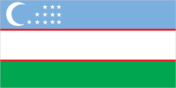
three equal horizontal bands of blue (top), white, and green separated by red fimbriations with a crescent moon and 12 stars in the upper hoist-side quadrant
Independence
31 August 1991 (from Soviet Union)
Judicial branch
Supreme Court
Legal system
evolution of Soviet civil law; still lacks independent judicial system
Legislative branch
unicameral
Member of
AsDB, CCC, CIS, EBRD, ECE, ECO, ESCAP, IAEA, IBRD, ICAO, IDA, IFC, ILO, IMF, INTERPOL, IOC, ISO, ITU, NACC, NAM, OSCE, PFP, UN, UNCTAD, UNESCO, UNIDO, UPU, WHO, WIPO, WMO, WTO
Names
conventional long form: Republic of Uzbekistan conventional short form: Uzbekistan local long form: Uzbekiston Respublikasi local short form: none former: Uzbek Soviet Socialist Republic
National holiday
Independence Day, 1 September (1991)
Other political or pressure groups
Birlik (Unity) People's Movement (BPM), Abdul Rakhim PULATOV, chairman (in exile); Islamic Rebirth Party (IRP), Abdullah UTAYEV, chairman; Adolat-94 (formed by former Vice President Shukhrat MIRSAIDOV and Ibragim BURIEV note: PULATOV (BPM) is in exile in the West; UTAYEV (IRP) is either in prison or in exile
Political parties and leaders
People's Democratic Party (PDP; formerly Communist Party), Islam A. KARIMOV, chairman; Fatherland Progress Party (FPP), Anwar YULDASHEV, chairman; Social Democratic Party, Anvar JORABAYEV, chairman; Erk (Freedom) Democratic Party (EDP), Muhammad SOLIKH, chairman (in exile); note - EDP was banned 9 December 1992
Suffrage
18 years of age; universal
Supreme Council
elections last held 25 December 1994 (next to be held NA); results - percent of vote by party NA; seats - (250 total) People's Democratic Party 207, Fatherland Progress Party 12, other 31; note - final runoffs were held 22 January 1995; seating was as follows: People's Democratic Party 69, Fatherland Progress Party 14, Social Democratic Party 47, local government 120
Type
republic
US diplomatic representation
chief of mission: Ambassador Henry L. CLARKE embassy: 82 Chilanzarskaya, Tashkent mailing address: use embassy street address telephone: [7] (3712) 77-14-07, 77-10-81
Economy
Agriculture
cotton, vegetables, fruits, grain, livestock
Budget
revenues: $NA expenditures: $NA, including capital expenditures of $NA
Currency
introduced provisional som-coupons 10 November 1993 which circulated parallel to the Russian rubles; became the sole legal currency 31 January 1994; was replaced in July 1994 by the som currency
Economic aid
recipient: the IMF has established a Systemic Transformation Facility of $74 million and the World Bank has made a rehabilitation loan of $160 million with other project loans pending; estimated annual external financing requirements for 1995-96 of $600 million to $700 million
Electricity
capacity: 11,690,000 kW production: 47.5 billion kWh consumption per capita: 2,130 kWh (1994)
Exchange rates
soms per US$1 - 25 (yearend 1994)
Exports
$943.7 million to outside the FSU countries (1994) commodities: cotton, gold, natural gas, mineral fertilizers, ferrous metals, textiles, food products partners: Russia, Ukraine, Eastern Europe, US
External debt
$NA
Fiscal year
calendar year
Illicit drugs
illicit cultivator of cannabis and opium poppy; mostly for CIS consumption; limited government eradication programs; used as transshipment point for illicit drugs to Western Europe
Imports
$1.15 billion from outside the FSU countries (1994) commodities: grain, machinery and parts, consumer durables, other foods partners: principally other FSU countries, Czech Republic
Industrial production
growth rate 1% (1994 est.)
Industries
textiles, food processing, machine building, metallurgy, natural gas
Inflation rate (consumer prices)
14% per month (1994 est.)
National product
GDP - purchasing power parity - $54.5 billion (1994 estimate as extrapolated from World Bank estimate for 1992)
National product per capita
$2,400 (1994 est.)
National product real growth rate
-4% (1994 est.)
Overview
Uzbekistan is a dry, landlocked country of which 10% consists of intensely cultivated, irrigated river valleys. It is one of the poorest states of the former USSR with 60% of its population living in overpopulated rural communities. Nevertheless, Uzbekistan is the world's third largest cotton exporter, a major producer of gold and natural gas, and a regionally significant producer of chemicals and machinery. Since independence, the government has sought to prop up the Soviet-style command economy with subsidies and tight controls on prices and production. Such policies have buffered the economy from the sharp declines in output and high inflation experienced by many other former Soviet republics. They had become increasingly unsustainable, however, as inflation moves along at 14% per month and as Russia has forced the Uzbek government to introduce its own currency. Faced with mounting economic problems, the government has begun to move on a reform agenda and cooperate with international financial institutions, announced an acceleration of privatization, and stepped up efforts to attract foreign investors. Nevertheless, the regime is likely to find it difficult to sustain its drive for economic reform.
Unemployment rate
0.3% includes only officially registered unemployed; large numbers of underemployed workers (December 1994)
Communications
Radio
broadcast stations: AM NA, FM NA, shortwave NA radios: NA
Telephone system
1,458,000 telephones; 63 telephones/1,000 persons (1995); poorly developed local: NMT-450 analog cellular network established in Tashkent intercity: NA international: linked by landline or microwave with CIS member states and by leased connection via the Moscow international gateway switch to other countries; new INTELSAT links to Tokyo and Ankara give Uzbekistan international access independent of Russian facilities; Orbita and INTELSAT earth stations
Television
broadcast stations: NA televisions: NA
Transportation
Airports
total: 261 with paved runways over 3,047 m: 6 with paved runways 2,438 to 3,047 m: 14 with paved runways 1,524 to 2,437 m: 2 with paved runways 914 to 1,523 m: 8 with paved runways under 914 m: 5 with unpaved runways 2,438 to 3,047 m: 2 with unpaved runways 1,524 to 2,438 m: 1 with unpaved runways 914 to 1,523 m: 7 with unpaved runways under 914 m: 216
Highways
total: 78,400 km paved and graveled: 67,000 km unpaved: earth 11,400 km (1990)
Pipelines
crude oil 250 km; petroleum products 40 km; natural gas 810 km (1992)
Ports
Termiz
Railroads
total: 3,460 km in common carrier service; does not include industrial lines broad gauge: 3,460 km 1.520-m gauge (1990)
Military and Security
Branches
Army, Air and Air Defense, Republic Security Forces (internal and border troops), National Guard
Defense expenditures
$NA, NA% of GDP ________________________________________________________________________ VANUATU
Manpower availability
males age 15-49 5,567,580; males fit for military service 4,537,455; males reach military age (18) annually 222,506 (1995 est.)