1993 Edition
CIA World Factbook 1993 (Project Gutenberg)
Geography
Area
total area: 447,400 km2 land area: 425,400 km2 comparative area: slightly larger than California
Climate
mostly mid latitude desert; semiarid grassland in east
Coastline
0 km note: Uzbekistan does border the Aral Sea (420 km)
Environment
drying up of the Aral Sea is resulting in growing concentrations of chemical pesticides and natural salts
International disputes
none
Irrigated land
41,550 km2 (1990)
Land boundaries
total 6,221 km, Afghanistan 137 km, Kazakhstan 2,203 km, Kyrgyzstan 1,099 km, Tajikistan 1,161 km, Turkmenistan 1,621 km
Land use
arable land: 10% permanent crops: 0% meadows and pastures: 47% forest and woodland: 0% other: 43%
Location
Central Asia, bordering the Aral Sea, between Kazakhstan and Turkmenistan
Map references
Asia, Commonwealth of Independent States - Central Asian States, Standard Time Zones of the World
Maritime claims
none; landlocked
Natural resources
natural gas, petroleum, coal, gold, uranium, silver, copper, lead and zinc, tungsten, molybdenum
Note
landlocked
Terrain
mostly flat-to-rolling sandy desert with dunes; Fergana Valley in east surrounded by mountainous Tajikistan and Kyrgyzstan; shrinking Aral Sea in west
People and Society
Birth rate
30.57 births/1,000 population (1993 est.)
Death rate
6.63 deaths/1,000 population (1993 est.)
Ethnic divisions
Uzbek 71.4%, Russian 8.3%, Tajik 4.7%, Kazakhs 4.1%, Tartars 2.4% (includes 70% of Crimean Tatars deported during World War II), Karakalpaks 2.1%, other 7%
Infant mortality rate
54.4 deaths/1,000 live births (1993 est.)
Labor force
7.941 million by occupation: agriculture and forestry 39%, industry and construction 24%, other 37% (1990)
Languages
Uzbek 85%, Russian 5%, other 10%
Life expectancy at birth
total population: 68.36 years male: 65.05 years female: 71.84 years (1993 est.)
Literacy
age 9-49 can read and write (1970) total population: 100% male: 100% female: 100%
Nationality
noun: Uzbek(s) adjective: Uzbek
Net migration rate
-2.2 migrant(s)/1,000 population (1993 est.)
Population
22,127,946 (July 1993 est.)
Population growth rate
2.17% (1993 est.)
Religions
Muslim 88% (mostly Sunnis), Eastern Orthodox 9%, other 3%
Total fertility rate
3.78 children born/woman (1993 est.)
Government
Administrative divisions
12 oblasts (oblastey, singular - oblast') and 1 autonomous republic*, (avtomnaya respublika); Andizhan, Bukhara, Dzhizak, Fergana, Karakalpakstan*, (Nukus), Kashkadar'ya (Karshi), Khorezm (Urgench), Namangan, Navoi, Samarkand, Surkhandar'ya (Termez), Syrdar'ya (Gulistan), Tashkent note: an administrative division has the same name as its administrative center (exceptions have the administrative center name following in parentheses)
Capital
Tashkent (Toshkent)
Chief of State
President Islam KARIMOV (since NA March 1990)
Constitution
new constitution adopted 8 December 1992
Digraph
UZ
Diplomatic representation in US
chief of mission: Ambassador Muhammed Babir MALIKOV chancery: 200 Pennsylvania Avenue NW, Washington, DC 20006 telephone: (202) 778-0107
Executive branch
president, prime minister, cabinet
FAX
(202) 861-0472
Flag
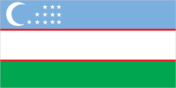
three equal horizontal bands of blue (top), white, and green separated by red fimbriations with a crescent moon and 12 stars in the upper hoist-side quadrant
Head of Government
Prime Minister Abdulkhashim MUTALOV (since 13 January 1992), First Deputy Prime Minister Ismail Hakimovitch DJURABEKOV (since NA); Supreme Soviet Chairman Shavkat Muhitdinovitch YULDASHEV (since NA June 1991)
Independence
31 August 1991 (from Soviet Union)
Judicial branch
Supreme Court
Legal system
evolution of Soviet civil law
Legislative branch
unicameral Supreme Soviet
Member of
CIS, CSCE, EBRD, ECO, ESCAP, IBRD, IDA, IMF, NACC, UN, UNCTAD, WHO
Names
conventional long form: Republic of Uzbekistan conventional short form: Uzbekistan local long form: Uzbekiston Respublikasi local short form: none former: Uzbek Soviet Socialist Republic
National holiday
Independence Day, 1 September (1991)
Other political or pressure groups
Birlik (Unity) People's Movement (BPM), Abdul Rakhman PULATOV, chairman; Islamic Rebirth Party (IRP), Abdullah UTAYEV, chairman
Political parties and leaders
People's Democratic Party (PDP; formerly Communist Party), Islam A. KARIMOV, chairman; Erk (Freedom) Democratic Party (EDP), Muhammad SOLIKH, chairman
President
last held 29 December 1991 (next to be held NA December 1996); results - Islam KARIMOV 86%, Mukhammad SOLIKH 12%, other 2%
Suffrage
18 years of age; universal
Supreme Soviet
last held 18 February 1990 (next to be held NA); results - percent of vote by party NA; seats - (500 total) Communist 450, ERK 10, other 40; note - total number of seats will be reduced to 150 in next election
Type
republic
US diplomatic representation
chief of mission: Ambassador Henry L. CLARKE embassy: 55 Chelanzanskaya, Tashkent mailing address: APO AE 09862 telephone: [7] (3712) 77-14-07
Economy
Agriculture
cotton, with much smaller production of grain, fruits, vegetables, and livestock
Budget
revenues $NA; expenditures $NA, including capital expenditures of $NA
Currency
retaining Russian ruble as currency (January 1993)
Economic aid
$950 million official aid commitments by foreign donors (1992)
Electricity
11,950,000 kW capacity; 50,900 million kWh produced, 2,300 kWh per capita (1992)
Exchange rates
rubles per US$1 - 415 (24 December 1992) but subject to wide fluctuations
Exports
$900 million to outside the successor states of the former USSR (1992) commodities: cotton, gold, textiles, chemical and mineral fertilizers, vegetable oil partners: Russia, Ukraine, Eastern Europe
External debt
$2 billion (end 1991 est.)
Fiscal year
calendar year
Illicit drugs
illicit producers of cannabis and opium; mostly for CIS consumption; limited government eradication programs; used as transshipment points for illicit drugs to Western Europe
Imports
$900 million from outside the successor states of the former USSR (1992) commodities: machinery and parts, consumer durables, grain, other foods partners: principally other former Soviet republics
Industrial production
growth rate -6%
Industries
chemical and mineral fertilizers, vegetable oil, textiles
Inflation rate (consumer prices)
at least 17% per month (first quarter 1993)
National product
GDP $NA
National product per capita
$NA
National product real growth rate
-10% (1992)
Overview
Although Uzbekistan accounted for only 3.4% of total Soviet output, it produced two-thirds of the USSR's cotton and ranks as the fourth largest global producer. Moscow's push for ever-increasing amounts of cotton had included massive irrigation projects which caused extensive environmental damage to the Aral Sea and rivers of the republic. Furthermore, the lavish use of chemical fertilizers has caused extensive pollution and widespread health problems. Recently the republic has sought to encourage food production at the expense of cotton. The small industrial sector specializes in such items as agricultural machinery, mineral fertilizers, vegetable oil, and bridge cranes. Uzbekistan also has some important natural resources including gold (about 30% of former Soviet production), uranium, and natural gas. The Uzbek Government has encouraged some land reform but has shied away from other aspects of economic reform. Output and living standards continued to fall in 1992 largely because of the cumulative impact of disruptions in supply that have followed the dismemberment of the USSR.
Unemployment rate
0.1% includes only officially registered unemployed; there are also large numbers of underemployed workers
Communications
Airports
totol: 265 useable: 74 with permanent-surface runways: 30 with runways over 3,659 m: 2 with runways 2,440-3,659 m: 20 with runways 1,220-2,439 m: 19
Highways
78,400 km total; 67,000 km hard-surfaced, 11,400 km earth (1990)
Pipelines
crude oil 250 km, petroleum products 40 km, natural gas 810 km (1992)
Ports
none; landlocked
Railroads
3,460 km; does not include industrial lines (1990)
Telecommunications
poorly developed; NMT-450 analog cellular network established in Tashkent; 1.4 million telephone lines with 7.2 lines per 100 persons (1992); linked by landline or microwave with CIS member states and by leased connection via the Moscow international gateway switch to other countries; satellite earth stations - Orbita and INTELSAT (TV receive only); new intelsat earth station provides TV receive only capability for Turkish broadcasts; new satellite ground station also installed in Tashkent for direct linkage to Tokyo.
Military and Security
Branches
Army, National Guard, Republic Security Forces (internal and border troops)
Defense expenditures
exchange rate conversion - $NA, NA% of GDP
Manpower availability
males age 15-49 5,214,075; fit for military service 4,272,398; reach military age (18) annually 218,916 (1993 est.)