2020 Edition
factbook.json (GitHub)
Introduction
Background
The Danes secured control over the southern Virgin Islands of Saint Thomas, Saint John, and Saint Croix during the 17th and early 18th centuries. Sugarcane, produced by African slave labor, drove the islands' economy during the 18th and early 19th centuries. In 1917, the US purchased the Danish holdings, which had been in economic decline since the abolition of slavery in 1848. In 2017, Hurricane Irma passed over the northern Virgin Islands of Saint Thomas and Saint John and inflicted severe damage to structures, roads, the airport on Saint Thomas, communications, and electricity. Less than two weeks later, Hurricane Maria passed over the island of Saint Croix in the southern Virgin Islands, inflicting considerable damage with heavy winds and flooding rains.
Geography
Area
- land
- 346 sq km
- total
- 1,910 sq km
- water
- 1,564 sq km
Area - comparative
twice the size of Washington, D.C.
Climate
subtropical, tempered by easterly trade winds, relatively low humidity, little seasonal temperature variation; rainy season September to November
Coastline
188 km
Elevation
- highest point
- Crown Mountain 474 m
- lowest point
- Caribbean Sea 0 m
Geographic coordinates
18 20 N, 64 50 W
Geography - note
important location along the Anegada Passage, a key shipping lane for the Panama Canal; Saint Thomas has one of the best natural deepwater harbors in the Caribbean
Irrigated land
1 sq km (2012)
Land boundaries
- total
- 0 km
Land use
- agricultural land
- 9.4% (2023 est.)
- agricultural land: arable land
- arable land: 2.6% (2023 est.)
- agricultural land: permanent crops
- permanent crops: 0.6% (2023 est.)
- agricultural land: permanent pasture
- permanent pasture: 6.3% (2023 est.)
- forest
- 58.2% (2023 est.)
- other
- 32.4% (2023 est.)
Location
Caribbean, islands between the Caribbean Sea and the North Atlantic Ocean, east of Puerto Rico
Map references
Central America and the Caribbean
Maritime claims
- exclusive economic zone
- 200 nm
- territorial sea
- 12 nm
Natural hazards
several hurricanes in recent years; frequent and severe droughts and floods; occasional earthquakes
Natural resources
pleasant climate, beaches foster tourism
Population distribution
overall population density throughout the islands is relatively low, but concentrations appear around Charlotte Amalie on St. Thomas and Christiansted on St. Croix
Terrain
mostly hilly to rugged and mountainous with little flat land
People and Society
Age structure
- 0-14 years
- 18.7% (male 9,983/female 9,547)
- 15-64 years
- 59.8% (male 29,519/female 32,899)
- 65 years and over
- 21.5% (2024 est.) (male 10,018/female 12,411)
Birth rate
10.88 births/1,000 population (2025 est.)
Death rate
9.43 deaths/1,000 population (2025 est.)
Dependency ratios
- elderly dependency ratio
- 37.1 (2025 est.)
- potential support ratio
- 2.7 (2025 est.)
- total dependency ratio
- 68 (2025 est.)
- youth dependency ratio
- 30.9 (2025 est.)
Ethnic groups
African-American or African descent 71.4%, White 13.3%, Indigenous 0.4%, Native Hawaiian and other Pacific Islander 0.1%, other 6.3%, mixed 7.5% (2020 est.)
Gross reproduction rate
0.95 (2025 est.)
Infant mortality rate
- female
- 6.3 deaths/1,000 live births
- male
- 8.3 deaths/1,000 live births
- total
- 7.2 deaths/1,000 live births (2025 est.)
Languages
English 71.6%, Spanish or Spanish Creole 17.2%, French or French Creole 8.6%, other 2.5% (2010 est.)
Life expectancy at birth
- female
- 84.1 years
- male
- 77.6 years
- total population
- 80.7 years (2024 est.)
Major urban areas - population
52,000 CHARLOTTE AMALIE (capital) (2018)
Median age
- female
- 43.9 years
- male
- 42.1 years
- total
- 43.4 years (2025 est.)
Nationality
- adjective
- Virgin Islander
- noun
- Virgin Islander(s) (US citizens)
Net migration rate
-7.27 migrant(s)/1,000 population (2025 est.)
Population
- female
- 54,597
- male
- 49,195
- total
- 103,792 (2025 est.)
Population growth rate
-0.58% (2025 est.)
Religions
Protestant 65.5%, Roman Catholic 27.1%, other Christians 2.2%, other 1.5%, none 3.7% (2010 est.)
Sanitation facility access
- improved: total
- total: 99.1% of population (2022 est.)
- unimproved: total
- total: 0.9% of population (2022 est.)
Sex ratio
- 0-14 years
- 1.05 male(s)/female
- 15-64 years
- 0.9 male(s)/female
- 65 years and over
- 0.81 male(s)/female
- at birth
- 1.06 male(s)/female
- total population
- 0.9 male(s)/female (2024 est.)
Total fertility rate
1.95 children born/woman (2025 est.)
Urbanization
- rate of urbanization
- -0.11% annual rate of change (2020-25 est.)
- urban population
- 96.2% of total population (2023)
Government
Administrative divisions
no first-order administrative divisions as defined by the US government, but 3 islands are considered second-order: Saint Croix, Saint John, Saint Thomas
Capital
- etymology
- named in honor of Danish King CHRISTIAN V’s wife, Charlotte AMALIE of Hesse-Kassel, after the colony was established in 1672
- geographic coordinates
- 18 21 N, 64 56 W
- name
- Charlotte Amalie
- time difference
- UTC-4 (1 hour ahead of Washington, DC, during Standard Time)
Citizenship
see United States
Constitution
- history
- 22 July 1954 - the Revised Organic Act of the Virgin Islands functions as a constitution for this US territory
Country name
- abbreviation
- VI
- conventional long form
- none
- conventional short form
- Virgin Islands
- etymology
- in 1493, the islets, cays, and rocks around the major islands in the chain reminded explorer Christopher COLUMBUS of Saint Ursula and her 11,000 virgin followers (Santa Ursula y las Once Mil Virgenes), which over time was shortened to the Virgins (las Virgenes)
- former
- Danish West Indies
Dependency status
unincorporated, organized territory of the US, with policy relations with the US federal government under the jurisdiction of the Office of Insular Affairs, US Department of the Interior
Diplomatic representation from the US
none (territory of the US)
Diplomatic representation in the US
none (territory of the US)
Executive branch
- cabinet
- Territorial Cabinet appointed by the governor and confirmed by the Senate
- chief of state
- President Donald J. TRUMP (since 20 January 2025)
- election results
- 2022: Albert BRYAN, Jr. reelected governor; percent of vote - Albert BRYAN, Jr. (Democratic Party) 56%, Kurt VIALET (independent) 38% 2018: Albert BRYAN, Jr. elected governor in the second round; percent of vote in first round - Albert BRYAN, Jr. (Democratic Party) 38.1%, Kenneth MAPP (independent) 33.5%, Adlah "Foncie" DONASTORG, Jr. (independent) 16.5%, other 11.9%; percent of vote in second round- Albert BRYAN, Jr. (Democratic Party) 54.5%, Kenneth MAPP (independent) 45.2%, other 0.3%
- election/appointment process
- president and vice president indirectly elected on the same ballot by an Electoral College of electors chosen from each state; president and vice president serve a 4-year term (eligible for a second term); under the US Constitution, residents of the Virgin Islands do not vote in elections for US president and vice president, but they can vote in the Democratic and Republican party presidential primary elections; governor and lieutenant governor directly elected on the same ballot by absolute majority vote in 2 rounds if needed for a 4-year term (eligible for a second term)
- expected date of next election
- November 2026
- head of government
- Governor Albert BRYAN, Jr. (since 7 January 2019)
- most recent election date
- 8 November 2022
Flag
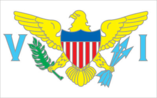
description: white field with a modified US coat of arms in the center between the large blue initials "V" and "I"; the coat of arms shows a yellow eagle holding an olive branch in its right talon and three arrows in its left, with a shield of seven red and six white vertical stripes below a blue panel meaning: white is a symbol of purity, and the letters stand for the Virgin Islands
Government type
unincorporated organized territory of the US with local self-government; republican form of territorial government with separate executive, legislative, and judicial branches
Independence
none (territory of the US)
International organization participation
AOSIS (observer), Interpol (subbureau), IOC, UPU, WFTU (NGOs)
Judicial branch
- highest court(s)
- Supreme Court of the Virgin Islands (consists of the chief justice and 2 associate justices)
- judge selection and term of office
- justices appointed by the governor and confirmed by the Virgin Islands Senate; justices serve initial 10-year terms and upon reconfirmation, during the extent of good behavior; chief justice elected to position by peers for a 3-year term
- subordinate courts
- Superior Court (Territorial Court renamed in 2004); US Court of Appeals for the Third Circuit (has appellate jurisdiction over the District Court of the Virgin Islands; it is a territorial court and is not associated with a US federal judicial district); District Court of the Virgin Islands
Legal system
US common law
National anthem(s)
- history
- official anthem, as a US territory
- lyrics/music
- Francis Scott KEY/John Stafford SMITH
- title
- "The Star-Spangled Banner"
National holiday
Transfer Day (from Denmark to the US), 31 March (1917)
Political parties
Democratic Party Independent Citizens' Movement or ICM Republican Party
Suffrage
18 years of age; universal
Economy
Agricultural products
fruit, vegetables, sorghum; Senepol cattle
Budget
- expenditures
- $1.518 billion (2016 est.)
- revenues
- $1.496 billion (2016 est.)
Economic overview
high-income, tourism-based American territorial economy; severe COVID-19 economic disruptions; major rum distillery; high public debt; sluggish reopening of large oil refinery; environmentally susceptible to hurricanes; many informal industries
Exchange rates
the US dollar is used
Exports
- Exports 2020
- $1.62 billion (2020 est.)
- Exports 2021
- $4.069 billion (2021 est.)
- Exports 2022
- $4.549 billion (2022 est.)
Exports - commodities
refined petroleum, jewelry, recreational boats, watches, rum (2019)
Exports - partners
Haiti 14%, Guadeloupe 7%, Malaysia 7%, Martinique 7%, Barbados 7%, British Virgin Islands 5% (2019)
GDP - composition, by end use
- exports of goods and services
- 97.4% (2022 est.)
- government consumption
- 34.4% (2022 est.)
- household consumption
- 68.9% (2022 est.)
- imports of goods and services
- -108.3% (2022 est.)
- investment in fixed capital
- 7.5% (2016 est.)
- investment in inventories
- 15% (2016 est.)
GDP (official exchange rate)
$4.672 billion (2022 est.)
Imports
- Imports 2020
- $3.184 billion (2020 est.)
- Imports 2021
- $4.057 billion (2021 est.)
- Imports 2022
- $5.058 billion (2022 est.)
Imports - commodities
refined petroleum, crude petroleum, rubber piping, jewelry, beer (2019)
Imports - partners
India 18%, Algeria 14%, South Korea 9%, Argentina 9%, Sweden 7%, Brazil 5% (2019)
Industries
tourism, watch assembly, rum distilling, construction, pharmaceuticals, electronics
Labor force
47,200 (2024 est.)
Public debt
- Public debt 2014
- 45.9% of GDP (2014 est.)
Real GDP (purchasing power parity)
- Real GDP (purchasing power parity) 2020
- $4.789 billion (2020 est.)
- Real GDP (purchasing power parity) 2021
- $4.965 billion (2021 est.)
- Real GDP (purchasing power parity) 2022
- $4.9 billion (2022 est.)
Real GDP growth rate
- Real GDP growth rate 2020
- -1.6% (2020 est.)
- Real GDP growth rate 2021
- 3.7% (2021 est.)
- Real GDP growth rate 2022
- -1.3% (2022 est.)
Real GDP per capita
- Real GDP per capita 2020
- $45,100 (2020 est.)
- Real GDP per capita 2021
- $46,900 (2021 est.)
- Real GDP per capita 2022
- $46,500 (2022 est.)
Unemployment rate
- Unemployment rate 2022
- 13.1% (2022 est.)
- Unemployment rate 2023
- 12.4% (2023 est.)
- Unemployment rate 2024
- 12.1% (2024 est.)
Youth unemployment rate (ages 15-24)
- female
- 28.9% (2024 est.)
- male
- 22% (2024 est.)
- total
- 25.3% (2024 est.)
Energy
Coal
- exports
- 4 metric tons (2023 est.)
Electricity
- consumption
- 618.819 million kWh (2023 est.)
- installed generating capacity
- 326,000 kW (2023 est.)
- transmission/distribution losses
- 50.181 million kWh (2023 est.)
Electricity access
- electrification - total population
- 100% (2022 est.)
Electricity generation sources
- fossil fuels
- 97.2% of total installed capacity (2023 est.)
- solar
- 2.8% of total installed capacity (2023 est.)
Petroleum
- refined petroleum consumption
- 16,000 bbl/day (2023 est.)
Communications
Broadband - fixed subscriptions
- subscriptions per 100 inhabitants
- 10 (2022 est.)
- total
- 9,000 (2022 est.)
Broadcast media
about a dozen TV stations, including 1 public TV station; multi-channel cable and satellite TV available; 24 radio stations
Internet country code
.vi
Internet users
- percent of population
- 64% (2017 est.)
Telephones - fixed lines
- subscriptions per 100 inhabitants
- 88 (2022 est.)
- total subscriptions
- 76,000 (2021 est.)
Telephones - mobile cellular
- subscriptions per 100 inhabitants
- 92 (2022 est.)
- total subscriptions
- 79,100 (2022 est.)
Transportation
Airports
2 (2025)
Heliports
4 (2025)
Merchant marine
- by type
- general cargo 1, other 1
- total
- 2 (2023)
Ports
- key ports
- Charlotte Amalie, Christiansted, Cruz Bay, Frederiksted, Limetree Bay, Port Alucroix
- large
- 0
- medium
- 0
- ports with oil terminals
- 3
- small
- 3
- total ports
- 6 (2024)
- very small
- 3
Military and Security
Military - note
defense is the responsibility of the US
Military and security forces
US Virgin Islands Police Department (VIPD); US Virgin Islands National Guard (VING)
Environment
Carbon dioxide emissions
- from petroleum and other liquids
- 2.378 million metric tonnes of CO2 (2023 est.)
- total emissions
- 2.378 million metric tonnes of CO2 (2023 est.)
Environmental issues
lack of natural freshwater resources; protection of coral reefs; solid waste management; coastal development; increased boating and overfishing
Waste and recycling
- municipal solid waste generated annually
- 146,500 tons (2024 est.)