1990 Edition
CIA World Factbook 1990 (Project Gutenberg)
Geography
Climate
subtropical, tempered by easterly tradewinds, relatively low humidity, little seasonal temperature variation; rainy season May to November
Coastline
188 km
Comparative area
slightly less than twice the size of Washington, DC
Contiguous zone
12 nm;
Continental shelf
200 m;
Environment
rarely affected by hurricanes; subject to frequent severe droughts, floods, earthquakes; lack of natural freshwater resources
Extended economic zone
200 nm;
Land boundaries
none
Land use
15% arable land; 6% permanent crops; 26% meadows and pastures; 6% forest and woodland; 47% other
Natural resources
sun, sand, sea, surf
Note
important location 1,770 km southeast of Miami and 65 km east of Puerto Rico, along the Anegada Passage--a key shipping lane for the Panama Canal; St. Thomas has one of the best natural, deepwater harbors in the Caribbean
Terrain
mostly hilly to rugged and mountainous with little level land
Territorial sea
12 nm
Total area
352 km2; land area: 349 km2
People and Society
Birth rate
22 births/1,000 population (1990)
Death rate
5 deaths/1,000 population (1990)
Ethnic divisions
74% West Indian (45% born in the Virgin Islands and 29% born elsewhere in the West Indies), 13% US mainland, 5% Puerto Rican, 8% other; 80% black, 15% white, 5% other; 14% of Hispanic origin
Infant mortality rate
19 deaths/1,000 live births (1990)
Labor force
45,000 (1987)
Language
English (official), but Spanish and Creole are widely spoken
Life expectancy at birth
70 years male, 76 years female (1990)
Literacy
90%
Nationality
noun--Virgin Islander(s); adjective--Virgin Islander
Net migration rate
- 20 migrants/1,000 population (1990)
Organized labor
90% of the government labor force
Population
99,200 (July 1990), growth rate - 0.3% (1990)
Religion
42% Baptist, 34% Roman Catholic, 17% Episcopalian, 7% other
Total fertility rate
2.7 children born/woman (1990)
Government
Administrative divisions
none (territory of the US)
Capital
Charlotte Amalie
Constitution
Revised Organic Act of 22 July 1954 serves as the constitution
Diplomatic representation
none (territory of the US)
Elections
Governor--last held NA 1986 (next to be held NA 1990); results--Alexander Farrelly (Democratic Party) defeated Adelbert Bryan (ICM); Senate--last held 8 November 1988 (next to be held NA); results--percent of vote by party NA; seats--(15 total) number of seats by party NA; US House of Representatives--last held 8 November 1988 (next to be held 6 November 1990); results--the Virgin Islands elects one nonvoting representative
Executive branch
US president, governor, lieutenant governor
Flag
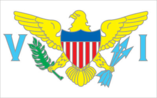
white with a modified US coat of arms in the center between the large blue initials V and I; the coat of arms shows an eagle holding an olive branch in one talon and three arrows in the other with a superimposed shield of vertical red and white stripes below a blue panel
Independence
none (territory of the US)
Judicial branch
US District Court handles civil matters over $50,000, felonies (persons 15 years of age and over), and federal cases; Territorial Court handles civil matters up to $50,000 small claims, juvenile, domestic, misdemeanors, and traffic cases
Leaders
Chief of State and Head of Government--President George BUSH (since 20 January 1989), represented by Governor Alexander FARRELLY
Legal system
based on US
Legislative branch
unicameral Senate
Long-form name
Virgin Islands of the United States
National holiday
Transfer Day (from Denmark to US), 31 March (1917)
Political parties and leaders
Democratic Party, Marilyn Stapleton; Independent Citizens' Movement (ICM), Virdin Brown; Republican Party, Charlotte-Poole Davis
Suffrage
universal at age 18; indigenous inhabitants are US citizens, but do not vote in US presidential elections
Type
organized, unincorporated territory of the US administered by the Office of Territorial and International Affairs, US Department of the Interior
Economy
Agriculture
truck gardens, food crops (small scale), fruit, sorghum, Senepol cattle
Aid
Western (non-US) countries, ODA and OOF bilateral commitments (1970-87), $33.5 million
Budget
revenues $315 million; expenditures $322 million, including capital expenditures of NA (FY88)
Currency
US currency is used
Electricity
341,000 kW capacity; 507 million kWh produced, 4,650 kWh per capita (1989)
Exchange rates
US currency is used
Exports
$3.4 billion (f.o.b., 1985); commodities--refined petroleum products; partners--US, Puerto Rico
External debt
$NA
Fiscal year
1 October-30 September
GDP
$1.03 billion, per capita $9,030; real growth rate NA% (1985)
Imports
$3.7 billion (c.i.f., 1985); commodities--crude oil, foodstuffs, consumer goods, building materials; partners--US, Puerto Rico
Industrial production
growth rate 12%
Industries
tourism, government service, petroleum refining, watch assembly, rum distilling, construction, pharmaceuticals, textiles, electronics
Inflation rate (consumer prices)
NA%
Overview
Tourism is the primary economic activity, accounting for more than 70% of GDP and 70% of employment. The manufacturing sector consists of textile, electronics, pharmaceutical, and watch assembly plants. The agricultural sector is small with most food imported. International business and financial services are a small but growing component of the economy. The world's largest petroleum refinery is at St. Croix.
Unemployment rate
3.5% (1987)
Communications
Airports
2 total, 2 usable; 2 with permanent-surface runways 1,220-2,439 m; international airports on St. Thomas and St. Croix
Highways
856 km total
Ports
St. Croix--Christiansted, Frederiksted; St. Thomas--Long Bay, Crown Bay, Red Hook; St. John--Cruz Bay
Telecommunications
44,280 telephones; stations--4 AM, 6 FM, 3 TV; modern system using fiber optic cable, submarine cable, microwave radio, and satellite facilities; 90,000 radio receivers; 56,000 television sets
Military and Security
Note
defense is the responsibility of the US