2003 Edition
CIA World Factbook 2003 (Project Gutenberg)
Introduction
Administrative divisions
50 states and 1 district*; Alabama, Alaska, Arizona, Arkansas, California, Colorado, Connecticut, Delaware, District of Columbia*, Florida, Georgia, Hawaii, Idaho, Illinois, Indiana, Iowa, Kansas, Kentucky, Louisiana, Maine, Maryland, Massachusetts, Michigan, Minnesota, Mississippi, Missouri, Montana, Nebraska, Nevada, New Hampshire, New Jersey, New Mexico, New York, North Carolina, North Dakota, Ohio, Oklahoma, Oregon, Pennsylvania, Rhode Island, South Carolina, South Dakota, Tennessee, Texas, Utah, Vermont, Virginia, Washington, West Virginia, Wisconsin, Wyoming
Age structure
0-14 years: 20.9% (male 31,098,473; female 29,675,712) 15-64 years: 66.7% (male 96,628,469; female 97,061,559) 65 years and over: 12.4% (male 14,888,185; female 20,990,156) (2003 est.)
Agriculture - products
wheat, corn, other grains, fruits, vegetables, cotton; beef, pork, poultry, dairy products; forest products; fish
Airports
14,801 (2002)
Airports - with paved runways
- over 3,047 m
- 185 2,438 to 3,047 m: 222 914 to 1,523 m: 2,390
- total
- 5,131
- under 914 m
- 969 (2002) 1,524 to 2,437 m: 1,365
Airports - with unpaved runways
- over 3,047 m
- 1 2,438 to 3,047 m: 7 914 to 1,523 m: 1,702 1,524 to 2,437 m: 158
- total
- 9,670
- under 914 m
- 7,802 (2002)
Area
- land
- 9,158,960 sq km
- note
- includes only the 50 states and District of Columbia
- total
- 9,629,091 sq km
- water
- 470,131 sq km
Area - comparative
about half the size of Russia; about three-tenths the size of Africa; about half the size of South America (or slightly larger than Brazil); slightly larger than China; about two and a half times the size of Western Europe
Background
Britain's American colonies broke with the mother country in 1776 and were recognized as the new nation of the United States of America following the Treaty of Paris in 1783. During the 19th and 20th centuries, 37 new states were added to the original 13 as the nation expanded across the North American continent and acquired a number of overseas possessions. The two most traumatic experiences in the nation's history were the Civil War (1861-65) and the Great Depression of the 1930s. Buoyed by victories in World Wars I and II and the end of the Cold War in 1991, the US remains the world's most powerful nation-state. The economy is marked by steady growth, low unemployment and inflation, and rapid advances in technology. Geography United States
Birth rate
14.14 births/1,000 population (2003 est.)
Budget
- expenditures
- $2.052 trillion, including capital expenditures of NA (2002 est.)
- revenues
- $1.946 trillion
Capital
Washington, DC
Climate
mostly temperate, but tropical in Hawaii and Florida, arctic in Alaska, semiarid in the great plains west of the Mississippi River, and arid in the Great Basin of the southwest; low winter temperatures in the northwest are ameliorated occasionally in January and February by warm chinook winds from the eastern slopes of the Rocky Mountains
Coastline
19,924 km
Constitution
17 September 1787, effective 4 March 1789
Country name
- abbreviation
- US or USA
- conventional long form
- United States of America
- conventional short form
- United States
Currency
US dollar (USD)
Currency code
USD
Death rate
8.44 deaths/1,000 population (2003 est.)
Debt - external
$862 billion (1995 est.)
Dependent areas
- American Samoa, Baker Island, Guam, Howland Island, Jarvis Island, Johnston Atoll, Kingman Reef, Midway Islands, Navassa Island, Northern Mariana Islands, Palmyra Atoll, Puerto Rico, Virgin Islands, Wake Island
- note
- from 18 July 1947 until 1 October 1994, the US administered the Trust Territory of the Pacific Islands, but recently entered into a new political relationship with all four political units: the Northern Mariana Islands is a commonwealth in political union with the US (effective 3 November 1986); Palau concluded a Compact of Free Association with the US (effective 1 October 1994); the Federated States of Micronesia signed a Compact of Free Association with the US (effective 3 November 1986); the Republic of the Marshall Islands signed a Compact of Free Association with the US (effective 21 October 1986)
Disputes - international
prolonged drought in the Mexico border region has strained water-sharing arrangements; 1990 Maritime Boundary Agreement in the Bering Sea awaits Russian Duma ratification; maritime boundary disputes with Canada at Dixon Entrance, Beaufort Sea, Strait of Juan de Fuca, and around the disputed Machias Seal Island and North Rock; The Bahamas have not been able to agree on a maritime boundary; US Naval Base at Guantanamo Bay is leased from Cuba and only mutual agreement or US abandonment of the area can terminate the lease; Haiti claims Navassa Island; US has made no territorial claim in Antarctica (but has reserved the right to do so) and does not recognize the claims of any other state; Marshall Islands claims Wake Island
Distribution of family income - Gini index
40.8 (1997)
Economic aid - donor
ODA, $6.9 billion (1997)
Economy - overview
The US has the largest and most technologically powerful economy in the world, with a per capita GDP of $37,600. In this market-oriented economy, private individuals and business firms make most of the decisions, and the federal and state governments buy needed goods and services predominantly in the private marketplace. US business firms enjoy considerably greater flexibility than their counterparts in Western Europe and Japan in decisions to expand capital plant, lay off surplus workers, and develop new products. At the same time, they face higher barriers to entry in their rivals' home markets than the barriers to entry of foreign firms in US markets. US firms are at or near the forefront in technological advances, especially in computers and in medical, aerospace, and military equipment, although their advantage has narrowed since the end of World War II. The onrush of technology largely explains the gradual development of a "two-tier labor market" in which those at the bottom lack the education and the professional/technical skills of those at the top and, more and more, fail to get comparable pay raises, health insurance coverage, and other benefits. Since 1975, practically all the gains in household income have gone to the top 20% of households. The years 1994-2000 witnessed solid increases in real output, low inflation rates, and a drop in unemployment to below 5%. The year 2001 saw the end of boom psychology and performance, with output increasing only 0.3% and unemployment and business failures rising substantially. The response to the terrorist attacks of 11 September 2001 showed the remarkable resilience of the economy. Moderate recovery took place in 2002, with the GDP growth rate rising to 2.45%. A major short-term problem in first half 2002 was a sharp decline in the stock market, fueled in part by the exposure of dubious accounting practices in some major corporations. The war in March/April 2003 between a US-led coalition and Iraq shifted resources to military industries and introduced uncertainties about investment and employment in other sectors of the economy. Long-term problems include inadequate investment in economic infrastructure, rapidly rising medical and pension costs of an aging population, sizable trade deficits, and stagnation of family income in the lower economic groups.
Electricity - consumption
3.602 trillion kWh (2001)
Electricity - exports
18.17 billion kWh (2001)
Electricity - imports
38.48 billion kWh (2001)
Electricity - production
3.719 trillion kWh (2001)
Electricity - production by source
- fossil fuel
- 71.4%
- hydro
- 5.6%
- nuclear
- 20.7%
- other
- 2.3% (2001)
Elevation extremes
- highest point
- Mount McKinley 6,194 m
- lowest point
- Death Valley -86 m
Environment - current issues
air pollution resulting in acid rain in both the US and Canada; the US is the largest single emitter of carbon dioxide from the burning of fossil fuels; water pollution from runoff of pesticides and fertilizers; very limited natural fresh water resources in much of the western part of the country require careful management; desertification
Environment - international agreements
- party to
- Air Pollution, Air Pollution-Nitrogen Oxides, Antarctic-Environmental Protocol, Antarctic-Marine Living Resources, Antarctic Seals, Antarctic Treaty, Climate Change, Desertification, Endangered Species, Environmental Modification, Marine Dumping, Marine Life Conservation, Nuclear Test Ban, Ozone Layer Protection, Ship Pollution, Tropical Timber 83, Tropical Timber 94, Wetlands, Whaling
- signed, but not ratified
- Air Pollution-Persistent Organic Pollutants, Air Pollution-Volatile Organic Compounds, Biodiversity, Climate Change-Kyoto Protocol, Hazardous Wastes
Ethnic groups
- white 77.1%, black 12.9%, Asian 4.2%, Amerindian and Alaska native 1.5%, native Hawaiian and other Pacific islander 0.3%, other 4% (2000)
- note
- a separate listing for Hispanic is not included because the US Census Bureau considers Hispanic to mean a person of Latin American descent (including persons of Cuban, Mexican, or Puerto Rican origin) living in the US who may be of any race or ethnic group (white, black, Asian, etc.)
Exchange rates
- British pounds per US dollar - 0.6661 (2002), 0.6944 (2001), 0.6596 (2000), 0.6180 (1999), 0.6037 (1998), Canadian dollars per US dollar - 1.5693 (2002), 1.5488 (2001), 1.4851 (2000), 1.4857 (1999), 1.4835 (1998), Japanese yen per US dollar - 125.39 (2002), 121.53 (2001), 107.77 (2000), 113.91 (1999), 130.91 (1998), euros per US dollar - 1.0626 (2002), 1.1175 (2001), 1.08540 (2000), 0.93863 (1999)
- note
- financial institutions in France, Italy, and Germany and eight other European countries started using the euro on 1 January 1999 with the euro replacing the local currency in consenting countries for all transactions in 2002
Executive branch
- cabinet
- Cabinet appointed by the president with Senate approval
- chief of state
- President George W. BUSH (since 20 January 2001) and Vice President Richard B. CHENEY (since 20 January 2001); note - the president is both the chief of state and head of government
- election results
- George W. BUSH elected president; percent of popular vote - George W. BUSH (Republican Party) 48%, Albert A. GORE, Jr. (Democratic Party) 48%, Ralph NADER (Green Party) 3%, other 1%
- elections
- president and vice president elected on the same ticket by a college of representatives who are elected directly from each state; president and vice president serve four-year terms; election last held 7 November 2000 (next to be held 2 November 2004)
- head of government
- President George W. BUSH (since 20 January 2001) and Vice President Richard B. CHENEY (since 20 January 2001); note - the president is both the chief of state and head of government
Exports
$687 billion f.o.b. (2002 est.)
Exports - commodities
capital goods, automobiles, industrial supplies and raw materials, consumer goods, agricultural products
Exports - partners
Canada 23.2%, Mexico 14.1%, Japan 7.4%, UK 4.8% (2002)
Fiscal year
1 October - 30 September Communications United States
Flag description
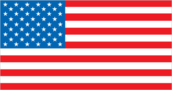
thirteen equal horizontal stripes of red (top and bottom) alternating with white; there is a blue rectangle in the upper hoist-side corner bearing 50 small, white, five-pointed stars arranged in nine offset horizontal rows of six stars (top and bottom) alternating with rows of five stars; the 50 stars represent the 50 states, the 13 stripes represent the 13 original colonies; known as Old Glory; the design and colors have been the basis for a number of other flags, including Chile, Liberia, Malaysia, and Puerto Rico Economy United States
GDP
purchasing power parity - $10.45 trillion (2002 est.)
GDP - composition by sector
- agriculture
- 2%
- industry
- 18%
- services
- 80% (2002 est.)
GDP - per capita
purchasing power parity - $36,300 (2002 est.)
GDP - real growth rate
2.4% (2002 est.)
Geographic coordinates
38 00 N, 97 00 W
Geography - note
world's third-largest country by size (after Russia and Canada) and by population (after China and India); Mt. McKinley is highest point in North America and Death Valley the lowest point on the continent People United States
Government type
Constitution-based federal republic; strong democratic tradition
Heliports
149 (2002) Military United States
Highways
- paved
- 3,737,567 km (including 89,426 km of expressways)
- total
- 6,334,859 km
- unpaved
- 2,597,292 km (2000)
HIV/AIDS - adult prevalence rate
0.6% (2001 est.)
HIV/AIDS - deaths
15,000 (2001 est.)
HIV/AIDS - people living with HIV/AIDS
900,000 (2001 est.)
Household income or consumption by percentage share
- highest 10%
- 30.5% (1997)
- lowest 10%
- 1.8%
Illicit drugs
consumer of cocaine shipped from Colombia through Mexico and the Caribbean; consumer of heroin, marijuana, and increasingly methamphetamine from Mexico; consumer of high-quality Southeast Asian heroin; illicit producer of cannabis, marijuana, depressants, stimulants, hallucinogens, and methamphetamine; money-laundering center This page was last updated on 18 December, 2003
Imports
$1.165 trillion f.o.b. (2002 est.)
Imports - commodities
crude oil and refined petroleum products, machinery, automobiles, consumer goods, industrial raw materials, food and beverages
Imports - partners
Canada 17.8%, Mexico 11.3%, China 11.1%, Japan 10.4%, Germany 5.3% (2002)
Independence
4 July 1776 (from Great Britain)
Industrial production growth rate
-0.4% (2002 est.)
Industries
leading industrial power in the world, highly diversified and technologically advanced; petroleum, steel, motor vehicles, aerospace, telecommunications, chemicals, electronics, food processing, consumer goods, lumber, mining
Infant mortality rate
- female
- 6.02 deaths/1,000 live births (2003 est.)
- male
- 7.46 deaths/1,000 live births
- total
- 6.75 deaths/1,000 live births
Inflation rate (consumer prices)
1.6% (2002)
International organization participation
AfDB, ANZUS, APEC, ARF (dialogue partner), AsDB, ASEAN (dialogue partner), Australia Group, BIS, CE (observer), CERN (observer), CP, EAPC, EBRD, ECE, ECLAC, ESCAP, FAO, G-5, G-7, G- 8, G-10, IADB, IAEA, IBRD, ICAO, ICC, ICCt (signatory), ICFTU, ICRM, IDA, IEA, IFAD, IFC, IFRCS, IHO, ILO, IMF, IMO, Interpol, IOC, IOM, ISO, ITU, MINURSO, MIPONUH, NAM (guest), NATO, NEA, NSG, OAS, OECD, OPCW, OSCE, PCA, SPC, UN, UN Security Council, UNCTAD, UNHCR, UNIKOM, UNITAR, UNMEE, UNMIBH, UNMIK, UNMISET, UNMOVIC, UNOMIG, UNRWA, UNTSO, UNU, UPU, WCL, WCO, WHO, WIPO, WMO, WTrO, ZC
Internet country code
.us
Internet Service Providers (ISPs)
7,000 (2002 est.)
Internet users
165.75 million (2002) Transportation United States
Irrigated land
214,000 sq km (1998 est.)
Judicial branch
Supreme Court (its nine justices are appointed for life by the president with confirmation by the Senate); United States Courts of Appeal; United States District Courts; State and County Courts
Labor force
141.8 million (includes unemployed) (2001)
Labor force - by occupation
- managerial and professional 31%, technical, sales and administrative support 28.9%, services 13.6%, manufacturing, mining, transportation, and crafts 24.1%, farming, forestry, and fishing 2.4%
- note
- figures exclude the unemployed (2001)
Land boundaries
- border countries
- Canada 8,893 km (including 2,477 km with Alaska), Mexico 3,141 km
- note
- US Naval Base at Guantanamo Bay, Cuba is leased by the US and thus remains part of Cuba; the base boundary is 29 km
- total
- 12,034 km
Land use
- arable land
- 19.32%
- other
- 80.46% (1998 est.)
- permanent crops
- 0.22%
Languages
English, Spanish (spoken by a sizable minority)
Legal system
based on English common law; judicial review of legislative acts; accepts compulsory ICJ jurisdiction, with reservations
Legislative branch
- bicameral Congress consists of the Senate (100 seats, one-third are renewed every two years; two members are elected from each state by popular vote to serve six-year terms) and the House of Representatives (435 seats; members are directly elected by popular vote to serve two-year terms)
- election results
- Senate - percent of vote by party - NA%; seats by party - Republican Party 51, Democratic Party 48, independent 1; House of Representatives - percent of vote by party - NA%; seats by party - Republican Party 226, Democratic Party 204, independent 1, undecided 4
- elections
- Senate - last held 5 November 2002 (next to be held NA November 2004); House of Representatives - last held 5 November 2002 (next to be held NA November 2004)
Life expectancy at birth
- female
- 80.05 years (2003 est.)
- male
- 74.37 years
- total population
- 77.14 years
Literacy
- definition
- age 15 and over can read and write
- female
- 97% (1979 est.)
- male
- 97%
- total population
- 97%
Location
North America, bordering both the North Atlantic Ocean and the North Pacific Ocean, between Canada and Mexico
Map references
North America
Maritime claims
- contiguous zone
- 24 NM
- continental shelf
- not specified
- exclusive economic zone
- 200 NM
- territorial sea
- 12 NM
Median age
- female
- 37.1 years (2002)
- male
- 34.5 years
- total
- 35.8 years
Merchant marine
- convenience
- Australia 1, Canada 4, Denmark 15, France 1, Germany 1, Netherlands 3, Norway 7, Puerto Rico 4, Singapore 11, Sweden 1, United Kingdom 3; also, the US owns 549 additional ships (1,000 GRT or over) totaling 29,616,347 DWT that operate under the registries of Antigua and Barbuda, Australia, The Bahamas, Belize, Bermuda, Cambodia, Canada, Cayman Islands, Cyprus, Finland, Gibraltar, Hong Kong (China), Indonesia, Isle of Man, Italy, Liberia, Malta, Marshall Islands, Netherlands, Norway, Norway (NIS), Panama, Peru, Philippines, Saint Vincent and the Grenadines, Singapore, Tonga, UK, Vanuatu, and Wallis and Futuna (2002 est.)
- note
- includes some foreign-owned ships registered here as a flag of
- ships by type
- barge carrier 2, bulk 71, cargo 26, chemical tanker 13, combination bulk 2, combination ore/oil 1, container 79, freighter 15, heavy lift carrier 3, passenger/cargo 1, petroleum tanker 73, refrigerated cargo 3, roll on/roll off 46, short-sea passenger 2, specialized tanker 2, vehicle carrier 9
- total
- 348 ships (1,000 GRT or over) 9,414,676 GRT/12,207,346 DWT
Military - note
- note
- 2002 estimates for military manpower are based on projections that do not take into consideration the results of the 2000 census Transnational Issues United States
Military branches
Army, Navy and Marine Corps, Air Force, and Coast Guard (Coast Guard administered in peacetime by the Department of Homeland Security but in wartime reports to the Department of the Navy)
Military expenditures - dollar figure
$276.7 billion (FY99 est.)
Military expenditures - percent of GDP
3.2% (FY99 est.)
Military manpower - availability
- males age 15-49
- 73,597,731 (2003 est.)
Military manpower - fit for military service
NA
Military manpower - military age
18 years of age (2003 est.)
Military manpower - reaching military age annually
- males
- 2,116,002 (2003 est.)
National holiday
Independence Day, 4 July (1776)
Nationality
- adjective
- American
- noun
- American(s)
Natural gas - consumption
640.9 billion cu m (2001 est.)
Natural gas - exports
11.16 billion cu m (2001 est.)
Natural gas - imports
114.1 billion cu m (2001 est.)
Natural gas - production
548.1 billion cu m (2001 est.)
Natural gas - proved reserves
5.195 trillion cu m (37257)
Natural hazards
tsunamis, volcanoes, and earthquake activity around Pacific Basin; hurricanes along the Atlantic and Gulf of Mexico coasts; tornadoes in the midwest and southeast; mud slides in California; forest fires in the west; flooding; permafrost in northern Alaska, a major impediment to development
Natural resources
coal, copper, lead, molybdenum, phosphates, uranium, bauxite, gold, iron, mercury, nickel, potash, silver, tungsten, zinc, petroleum, natural gas, timber
Net migration rate
3.52 migrant(s)/1,000 population (2003 est.)
Oil - consumption
19.65 million bbl/day (2001 est.)
Oil - exports
NA (2001)
Oil - imports
NA (2001)
Oil - production
8.054 million bbl/day (2001 est.)
Oil - proved reserves
22.45 billion bbl (37257)
People - note
data for the US are based on projections that do not take into consideration the results of the 2000 census Government United States
Pipelines
petroleum products 244,620 km; natural gas 548,665 km (2003)
Political parties and leaders
Democratic Party [Terence McAULIFFE]; Green Party [leader NA]; Libertarian Party [Steve DASBACH]; Republican Party [Governor Marc RACICOT]
Political pressure groups and leaders
NA
Population
290,342,554 (July 2003 est.)
Population below poverty line
12.7% (2001 est.)
Population growth rate
0.92% (2003 est.)
Ports and harbors
Anchorage, Baltimore, Boston, Charleston, Chicago, Duluth, Hampton Roads, Honolulu, Houston, Jacksonville, Los Angeles, New Orleans, New York, Philadelphia, Port Canaveral, Portland (Oregon), Prudhoe Bay, San Francisco, Savannah, Seattle, Tampa, Toledo
Radio broadcast stations
AM 4,762, FM 5,542, shortwave 18 (1998)
Radios
575 million (1997)
Railways
- note
- represents the aggregate length of roadway of all line-haul railroads including an estimate for class II and III railroads; excludes 135,185 km of yard tracks, sidings, and parallel lines (2000)
- standard gauge
- 194,731 km 1.435-m gauge
- total
- 194,731 km mainline routes
Religions
Protestant 56%, Roman Catholic 28%, Jewish 2%, other 4%, none 10% (1989)
Sex ratio
- at birth
- 1.05 male(s)/female
- total population
- 0.97 male(s)/female (2003 est.)
- under 15 years
- 1.05 male(s)/female 15-64 years: 1 male(s)/female 65 years and over: 0.71 male(s)/female
Suffrage
18 years of age; universal
Telephone system
- domestic
- a large system of fiber-optic cable, microwave radio relay, coaxial cable, and domestic satellites carries every form of telephone traffic; a rapidly growing cellular system carries mobile telephone traffic throughout the country
- general assessment
- a very large, technologically advanced, multipurpose communications system
- international
- 24 ocean cable systems in use; satellite earth stations - 61 Intelsat (45 Atlantic Ocean and 16 Pacific Ocean), 5 Intersputnik (Atlantic Ocean region), and 4 Inmarsat (Pacific and Atlantic Ocean regions) (2000)
Telephones - main lines in use
194 million (1997)
Telephones - mobile cellular
69.209 million (1998)
Television broadcast stations
more than 1,500 (including nearly 1,000 stations affiliated with the five major networks - NBC, ABC, CBS, FOX, and PBS; in addition, there are about 9,000 cable TV systems) (1997)
Televisions
219 million (1997)
Terrain
vast central plain, mountains in west, hills and low mountains in east; rugged mountains and broad river valleys in Alaska; rugged, volcanic topography in Hawaii
Total fertility rate
2.07 children born/woman (2003 est.)
Unemployment rate
5.8% (2002)
Waterways
- 41,009 km
- note
- navigable inland channels, exclusive of the Great Lakes