1996 Edition
CIA World Factbook 1996 (Project Gutenberg)
Introduction
Description
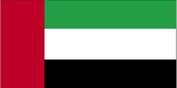
three equal horizontal bands of green (top), white, and black with a thicker vertical red band on the hoist side
Location
24 00 N, 54 00 E -- Middle East, bordering the Gulf of Oman and the Persian Gulf, between Oman and Saudi Arabia Flag ----
Geography
Area
- comparative area
- slightly smaller than Maine
- land area
- 75,581 sq km
- total area
- 75,581 sq km
Climate
desert; cooler in eastern mountains
Coastline
1,318 km
Environment
- current issues
- lack of natural freshwater resources being overcome by desalination plants; desertification; beach pollution from oil spills
- international agreements
- party to - Endangered Species, Hazardous Wastes, Marine Dumping, Ozone Layer Protection; signed, but not ratified - Biodiversity, Law of the Sea
- natural hazards
- frequent sand and dust storms
Geographic coordinates
24 00 N, 54 00 E
Geographic note
strategic location along southern approaches to Strait of Hormuz, a vital transit point for world crude oil
International disputes
location and status of boundary with Saudi Arabia is not final, defacto boundary reflects 1974 agreement; no defined boundary with most of Oman, but Administrative Line in far north; claims two islands in the Persian Gulf occupied by Iran: Lesser Tunb (called Tunb as Sughra in Arabic by UAE and Jazireh-ye Tonb-e Kuchek in Persian by Iran) and Greater Tunb (called Tunb al Kubra in Arabic by UAE and Jazireh-ye Tonb-e Bozorg in Persian by Iran); claims island in the Persian Gulf jointly administered with Iran (called Abu Musa in Arabic by UAE and Jazireh-ye Abu Musa in Persian by Iran); in 1992, the dispute over Abu Musa and the Tunb islands became more acute when Iran unilaterally tried to control the entry of third country nationals into the UAE portion of Abu Musa island, Tehran subsequently backed off in the face of significant diplomatic support for the UAE in the region
Irrigated land
50 sq km (1989 est.)
Land boundaries
- border countries
- Oman 410 km, Saudi Arabia 457 km
- total
- 867 km
Land use
- arable land
- 0%
- forest and woodland
- 0%
- meadows and pastures
- 2%
- other
- 98%
- permanent crops
- 0%
Location
Middle East, bordering the Gulf of Oman and the Persian Gulf, between Oman and Saudi Arabia
Map references
Middle East
Maritime claims
- contiguous zone
- 24 nm
- continental shelf
- 200 nm or to the edge of the continental margin
- exclusive economic zone
- 200 nm
- territorial sea
- 12 nm
Natural resources
petroleum, natural gas
Terrain
- flat, barren coastal plain merging into rolling sand dunes of vast desert wasteland; mountains in east
- highest point
- Jabal Yibir 1,527 m
- lowest point
- Persian Gulf 0 m
People and Society
Age structure
0-14 years: 35% (male 542,848; female 519,952) 15-64 years: 64% (male 1,277,829; female 683,282) 65 years and over: 1% (male 22,246; female 11,180) (July 1996 est.)
Birth rate
26.43 births/1,000 population (1996 est.)
Death rate
3.03 deaths/1,000 population (1996 est.)
Ethnic divisions
- Emiri 19%, other Arab and Iranian 23%, South Asian 50%, other expatriates (includes Westerners and East Asians) 8% (1982)
- note
- less than 20% are UAE citizens (1982)
Infant mortality rate
20.4 deaths/1,000 live births (1996 est.)
Languages
Arabic (official), Persian, English, Hindi, Urdu
Life expectancy at birth
- female
- 74.94 years (1996 est.)
- male
- 70.64 years
- total population
- 72.74 years
Literacy
- age 15 and over can read and write but definition of literacy not available (1995 est.)
- female
- 79.8%
- male
- 78.9%
- total population
- 79.2%
Nationality
- adjective
- Emiri
- noun
- Emiri(s)
Net migration rate
19.91 migrant(s)/1,000 population (1996 est.)
Population
3,057,337 (July 1996 est.)
Population growth rate
4.33% (1996 est.)
Religions
Muslim 96% (Shi'a 16%), Christian, Hindu, and other 4%
Sex ratio
- all ages
- 1.52 male(s)/female (1996 est.)
- at birth
- 1.05 male(s)/female
- under 15 years
- 1.04 male(s)/female 15-64 years: 1.87 male(s)/female 65 years and over: 1.99 male(s)/female
Total fertility rate
4.46 children born/woman (1996 est.)
Government
Administrative divisions
7 emirates (imarat, singular - imarah); Abu Zaby (Abu Dhabi), 'Ajman, Al Fujayrah, Ash Shariqah (Sharjah), Dubayy (Dubai), Ra's al Khaymah, Umm al Qaywayn
Capital
Abu Dhabi
Constitution
2 December 1971 (provisional)
Data code
TC
Diplomatic representation in US
- chancery
- Suite 600, 3000 K Street NW, Washington, DC 20007
- chief of mission
- Ambassador Muhammad bin Husayn al-SHAALI
- telephone
- [1] (202) 338-6500
Executive branch
- chief of state
- President ZAYID bin Sultan Al Nuhayyan (since 2 December 1971), ruler of Abu Zaby (Abu Dhabi) (since NA 1966) and Vice President MAKTUM bin Rashid al-Maktum (since 8 October 1990), ruler of Dubayy (Dubai) were elected by the Supreme Council of Rulers
- head of government
- Prime Minister MAKTUM bin Rashid al-Maktum (since 8 October 1990), ruler of Dubayy (Dubai) and Deputy Prime Minister SULTAN bin Zayid Al Nuhayyan (since 20 November 1990) were appointed by the president
FAX
- [971] (2) 434771
- consulate(s) general
- Dubai
Flag
three equal horizontal bands of green (top), white, and black with a thicker vertical red band on the hoist side
Independence
2 December 1971 (from UK)
International organization participation
ABEDA, AfDB, AFESD, AL, AMF, CAEU, CCC, ESCWA, FAO, G-77, GCC, IAEA, IBRD, ICAO, ICRM, IDA, IDB, IFAD, IFC, IFRCS, ILO, IMF, IMO, Intelsat, Interpol, IOC, ISO (correspondent), ITU, NAM, OAPEC, OIC, OPEC, UN, UNCTAD, UNESCO, UNIDO, UPU, WHO, WIPO, WMO, WToO
Judicial branch
Union Supreme Court, judges appointed by the president
Legal system
federal court system introduced in 1971; all emirates except Dubayy (Dubai) and Ra's al Khaymah have joined the federal system; all emirates have secular and Islamic law for civil, criminal, and high courts
Legislative branch
unicameral Federal National Council (Majlis Watani Itihad); no elections; reviews legislation, but cannot change or veto
Name of country
- abbreviation
- UAE
- conventional long form
- United Arab Emirates
- conventional short form
- none
- former
- Trucial States
- local long form
- Al Imarata al Arabiyah al Muttahidah
- local short form
- none
National holiday
National Day, 2 December (1971)
Other political or pressure groups
NA
Political parties and leaders
none
Suffrage
none
Supreme Council of Rulers
- composed of the seven emirate rulers, the council is the highest constitutional authority in the UAE; establishes general policies and sanctions federal legislation, Abu Zaby (Abu Dhabi) and Dubayy (Dubai) rulers have effective veto power; council meets four times a year
- cabinet
- Council of Ministers was appointed by the president
Type of government
federation with specified powers delegated to the UAE central government and other powers reserved to member emirates
US diplomatic representation
- chief of mission
- Ambassador David C. LITT
- embassy
- Al-Sudan Street, Abu Dhabi
- mailing address
- P. O. Box 4009, Abu Dhabi; American Embassy Abu Dhabi, Department of State, Washington, DC 20521-6010 (pouch)
- telephone
- [971] (2) 436691, 436692
Economy
Agriculture
dates, vegetables, watermelons; poultry, eggs, dairy products; fish
Budget
- expenditures
- $4.9 billion, including capital expenditures of $NA (1995 est.)
- revenues
- $4.6 billion
Currency
1 Emirian dirham (Dh) = 100 fils
Economic aid
$NA
Economic overview
The UAE has an open economy with one of the world's highest incomes per capita and with a sizable annual trade surplus. Its wealth is based on oil and gas output (about 33% of GDP), and the fortunes of the economy fluctuate with the prices of those commodities. Since 1973, the UAE has undergone a profound transformation from an impoverished region of small desert principalities to a modern state with a high standard of living. At present levels of production, crude oil reserves should last for over 100 years. Although much stronger economically than most Gulf states, the UAE faces similar problems with weak international oil prices and the pressures for cuts in OPEC oil production quotas. The UAE Government is encouraging increased privatization within the economy.
Electricity
- capacity
- 4,760,000 kW
- consumption per capita
- 5,796 kWh (1993)
- production
- 16.5 billion kWh
Exchange rates
Emirian dirhams (Dh) per US$1 - 3.6710 (fixed rate)
Exports
- $25.3 billion (f.o.b., 1994 est.)
- commodities
- crude oil 66%, natural gas, reexports, dried fish, dates
- partners
- Japan 45%, India 6%, Oman 6%, South Korea 5%, Iran 5% (1994)
External debt
$11.6 billion (1994 est.)
Fiscal year
calendar year
GDP
purchasing power parity - $70.1 billion (1995 est.)
GDP composition by sector
- agriculture
- 2%
- industry
- 55%
- services
- 43% (1994 est.)
GDP per capita
$24,000 (1995 est.)
GDP real growth rate
3.3% (1995 est.)
Illicit drugs
growing role as heroin transshipment and money-laundering center
Imports
- $21.7 billion (f.o.b., 1994)
- commodities
- manufactured goods, machinery and transport equipment, food
- partners
- Japan 11%, UK 8%, Germany 8%, US 8%, Italy 7% (1994)
Industrial production growth rate
-1.1% (1994 est.)
Industries
petroleum, fishing, petrochemicals, construction materials, some boat building, handicrafts, pearling
Inflation rate (consumer prices)
4.6% (1994 est.)
Labor force
- 794,400 (1993 est.)
- by occupation
- industry and commerce 56%, services 38%, agriculture 6% (1990 est.)
- note
- 80% of labor force is foreign (est.)
Unemployment rate
NEGL% (1988)
Communications
Branches
Army, Navy, Air Force, paramilitary (includes Federal Police Force)
Defense expenditures
exchange rate conversion - $1.59 billion, 4.3% of GDP (1994)
Manpower availability
- males age 15-49
- 1,102,080
- males fit for military service
- 599,439
- males reach military age (18) annually
- 21,250 (1996 est.)
Radio broadcast stations
AM 8, FM 3, shortwave 0
Radios
545,000 (1992 est.)
Telephone system
- modern system consisting of microwave radio relay and coaxial cable; key centers are Abu Dhabi and Dubai
- domestic
- microwave radio relay and coaxial cable
- international
- satellite earth stations - 3 Intelsat (1 Atlantic Ocean and 2 Indian Ocean) and 1 Arabsat; submarine cables to Qatar, Bahrain, India, and Pakistan; tropospheric scatter to Bahrain; microwave radio relay to Saudi Arabia
Telephones
677,793 (1993 est.)
Television broadcast stations
12
Televisions
170,000 (1993 est.) Defense
Transportation
Airports
- total
- 36
- with paved runways 1 524 to 2 437 m
- 2
- with paved runways 2 438 to 3 047 m
- 3
- with paved runways 914 to 1 523 m
- 3
- with paved runways over 3 047 m
- 9
- with paved runways under 914 m
- 10
- with unpaved runways 1 524 to 2 437 m
- 2
- with unpaved runways 914 to 1 523 m
- 7 (1995 est.)
Heliports
2 (1995 est.)
Highways
- paved
- 3,000 km
- total
- 3,000 km
- unpaved
- 0 km (1993 est.)
Merchant marine
- ships by type
- bulk 2, cargo 17, chemical tanker 2, container 7, liquefied gas tanker 1, livestock carrier 1, oil tanker 22, refrigerated cargo 2, roll-on/roll-off cargo 3 (1995 est.)
- total
- 57 ships (1,000 GRT or over) totaling 1,068,980 GRT/1,876,504 DWT
Pipelines
crude oil 830 km; natural gas, including natural gas liquids, 870 km
Ports
'Ajman, Al Fujayrah, Das Island, Khawr Fakkan, Mina' Jabal 'Ali, Mina' Khalid, Mina' Rashid, Mina' Saqr, Mina' Zayid, Umm al Qaywayn
Railways
0 km