1992 Edition
CIA World Factbook 1992 (Project Gutenberg)
Geography
Climate
temperate continental; subtropical only on the southern Crimean coast; precipitation disproportionately distributed, highest in west and north, lesser in east and southeast; winters vary from cool along the Black Sea to cold farther inland; summers are warm across the greater part of the country, hot in the south
Coastline
2,782 km
Comparative area
slightly smaller than Texas
Contiguous zone
NA nm
Continental shelf
NA meter depth
Disputes
potential border disputes with Moldova and Romania in northern Bukovina and southern Odessa oblast
Environment
air and water pollution, deforestation, radiation contamination around Chernobyl nuclear plant
Exclusive economic zone
NA nm
Exclusive fishing zone
NA nm
Land area
603,700 km2
Land boundaries
4,558 km total; Belarus 891 km, Czechoslovakia 90 km, Hungary 103 km, Moldova 939 km, Poland 428 km, Romania (southwest) 169 km, Romania (west) 362 km, Russia 1,576 km
Land use
56% arable land; 2% permanent crops; 12% meadows and pastures; NA% forest and woodland; 30% other; includes 3% irrigated
Natural resources
iron ore, coal, manganese, natural gas, oil, salt, sulphur, graphite, titanium, magnesium, kaolin, nickel, mercury, timber
Note
strategic position at the crossroads between Europe and Asia; second largest country in Europe
Terrain
most of Ukraine consists of fertile plains (steppes) and plateaux, mountains being found only in the west (the Carpathians), and in the Crimean peninsula in the extreme south
Territorial sea
NA nm
Total area
603,700 km2
People and Society
Birth rate
14 births/1,000 population (1992)
Death rate
12 deaths/1,000 population (1992)
Ethnic divisions
Ukrainian 73%, Russian 22%, Jewish 1%, other 4%
Infant mortality rate
22 deaths/1,000 live births (1992)
Labor force
25,277,000; industry and construction 41%, agriculture and forestry 19%, health, education, and culture 18%, trade and distribution 8%, transport and communication 7%, other 7% (1990)
Languages
Ukrainian, Russian, Romanian, Polish
Life expectancy at birth
65 years male, 75 years female (1992)
Literacy
NA%
Nationality
noun - Ukrainian(s); adjective - Ukrainian
Net migration rate
1 migrant/1,000 population (1992)
Organized labor
NA
Population
51,940,426 (July 1992), growth rate 0.2% (1992)
Religions
Ukrainian Autonomous Orthodox, Ukrainian Autocephalous Orthodox, Ukrainian Catholic (Uniate), Protestant, Jewish
Total fertility rate
2.0 children born/woman (1992)
Government
Administrative divisions
24 oblasts (oblastey, singular - oblast') and 1 autonomous republic* (avtomnaya respublika); Chernigov, Cherkassy, Chernovtsy, Dnepropetrovsk, Donetsk, Ivano-Frankovsk, Khar'kov, Kherson, Khmel'nitskiy, Kiev, Kirovograd, Krym (Simferopol')*, Lugansk, L'vov, Nikolayev, Odessa, Poltava, Rovno, Sumy, Ternopol', Vinnitsa, Volyn' (Lutsk), Zakarpat (Uzhgorod), Zaporozh'ye, Zhitomir; note - an oblast usually has the same name as its administrative center (exceptions have the administrative center name following in parentheses)
Capital
Kiev (Kyyiv)
Chief of State
President Leonid M. KRAVCHUK (since 5 December 1991)
Communists
Communist Party of Ukraine was banned by decree of the Supreme Council on 30 August 1991
Constitution
currently being drafted
Diplomatic representation
Ambassador Oleh H. BILORUS; Embassy at 1828 L Street, NW, Suite 711, Washington, DC 20036; telephone (202) 296-6960 US: Ambassador Roman POPADIUK; Embassy at ;10 Vul. Yuriy Kotsubinskoho, Kiev (mailing address is APO AE 09862); telephone (044) 244-7349; FAX (044) 244-7350
Executive branch
president, prime minister
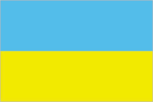
Flag
- bottom half (represents grainfields under a blue sky)
- two horizontal bars of equal size
- azure (sky blue) top half, golden yellow
Head of Government
Prime Minister Vitol'd FOKIN (since 14 November 1991); two First Deputy
Independence
24 August 1991; 1 December 1991 de facto from USSR; note - formerly the Ukrainian Soviet Socialist Republic in the Soviet Union
Judicial branch
being organized
Legal system
based on civil law system; no judicial review of legislative acts
Legislative branch
unicameral Supreme Council
Long-form name
none
Member of
CIS, CSCE, CE, ECE, IAEA, IMF, INMARSAT, IOC, ITU, NACC, PCA, UN, UNCTAD, UNESCO, UNIDO, UPU, WHO, WIPO, WMO
National holiday
Independence Day, 24 August (1991)
Other political or pressure groups
Ukraninan People's Movement for Restructuring (RUKH)
Political parties and leaders
Ukrainian Republican Party, Levko LUKYANENKO, chairman; Green Party, Yuriy SHCHERBAK, chairman; Social Democratic Party, Andriy NOSENKO, chairman; Ukrainian Democratic Party, Yuriy BADZO, chairman; Democratic Rebirth Party, Oleksandr Volodymyr GRINEV, Oleksandr FILENKO, YEMETS, Miroslav POPOVICH, Sergei LYLYK, Oleksandr BAZYLYUK, Valeriy KHMELKO, leaders; People's Party of Ukraine, Leopold TABURYANSKIY, chairman; Peasant Democratic Party, Jerhiy PLACHYNDA, chairman; Ukrainian Socialist Party, Oleksandr MOROZ, chairman
President
last held 1 December 1991 (next to be held NA 1996); results - Leonid KRAVCHUK 61.59%, Vyacheslav CHERNOVIL 23.27%, Levko LUKYANENKO 4.49%, Volodymyr GRINEV 4.17%, Iher YUKHNOVSKY 1.74%, Leopold TABURYANSKIY 0.57%
Prime Ministers
Valentyn SYMONENKO and Konstantyn MASYK (since 21 May 1991); two Deputy Prime Ministers: Oleh SLEPICHEV and Viktor SYTNYK (since 21 May 1991)
Suffrage
universal at age 18
Supreme Council
last held 4 March 1990 (next scheduled for 1995, may be held earlier in late 1992 or 1993); results - percent of vote by party NA; seats - (NA total) number of seats by party NA
Type
republic
Economy
Budget
not finalized as of May 1992
Currency
as of August 1992 using ruble and Ukrainian coupons as legal tender; Ukraine plans to withdraw the ruble from circulation and convert to a coupon-based economy on 1 October 1992; Ukrainian officials claim this will be an interim move toward introducing a Ukrainian currency - the hryvnya - possibly as early as January 1993
Exchange rates
NA
Exports
$13.5 billion (1990) commodities: coal, electric power, ferrous and nonferrous metals, chemicals, machinery and transport equipment, grain, meat partners: Russia, Belarus, Kazakhstan
Fiscal year
calendar year
GDP
$NA, per capita $NA; real growth rate -10% (1991 est.)
Imports
$16.7 billion (1990) commodities: machinery and parts, transportation equipment, chemicals, textiles partners: none
Inflation rate (consumer prices)
83% (1991 est.)
Overview
Because of its size, geographic location, Slavic population, and rich resources, the loss of Ukraine was the final and most bitter blow to the Soviet leaders wishing to preserve some semblance of the old political, military, and economic power of the USSR. After Russia, the Ukrainian republic was far and away the most important economic component of the former Soviet Union producing more than three times the output of the next-ranking republic. Its fertile black soil generated more than one fourth of Soviet agricultural output, and its farms provided substantial quantities of meat, milk, grain and vegetables to other republics. Likewise, its well-developed and diversified heavy industry supplied equipment and raw materials to industrial and mining sites in other regions of the USSR. In early 1992 the continued wholesale disruption of economic ties and the lack of an institutional structure necessary to formulate and implement economic reforms preclude a near-term recovery of output.
Unemployment rate
NA%
Communications
Airports
NA
Civil air
NA major transport aircraft
Highways
273,700 km total (1990); 236,400 km hard surfaced, 37,300 km earth
Inland waterways
NA km perennially navigable
Merchant marine
338 ships (1,000 GRT or over) totaling 4,117,595 GRT/5,403,685 DWT; includes 221 cargo, 11 container, 9 barge carriers, 59 bulk cargo, 9 petroleum tanker, 2 chemical tanker, 3 liquefied gas, 24 passenger
Pipelines
NA
Ports
maritime - Berdyansk, Il'ichevsk Kerch', Kherson, Mariupol' (formerly Zhdanov), Nikolayev, Odessa, Sevastopol', Yuzhnoye; inland - Kiev
Railroads
22,800 km all 1.500-meter gauge; does not include industrial lines (1990)
Telecommunications
inheriting part of the former USSR system, Ukraine has about 7 million telephone lines (13.5 telephones for each 100 persons); as of 31 January 1990, 3.56 million applications for telephones could not be satisfied; international calls can be made via satellite, by landline to other CIS countries, and through the Moscow international switching center; satellite earth stations employ INTELSAT, INMARSAT, and Intersputnik
Military and Security
Branches
Republic Security Forces (internal and border troops), National Guard; CIS Forces (Ground Navy, Air, and Defense)
Defense expenditures
$NA, NA% of GDP
Manpower availability
males 15-49, NA; NA fit for military service; NA reach military age (18) annually