2017 Edition
CIA World Factbook 2017 Archive (HTML)
Introduction
Background
The colonial boundaries created by Britain to delimit Uganda grouped together a wide range of ethnic groups with different political systems and cultures. These differences complicated the establishment of a working political community after independence was achieved in 1962. The dictatorial regime of Idi AMIN (1971-79) was responsible for the deaths of some 300,000 opponents; guerrilla war and human rights abuses under Milton OBOTE (1980-85) claimed at least another 100,000 lives. The rule of Yoweri MUSEVENI since 1986 has brought relative stability and economic growth to Uganda. A constitutional referendum in 2005 cancelled a 19-year ban on multi-party politics and lifted presidential term limits.
Geography
Area
- 241,038 sq km 197,100 sq km 43,938 sq km
- land
- 197,100 sq km
- total
- 241,038 sq km
- water
- 43,938 sq km
Area - comparative
slightly more than two times the size of Pennsylvania; slightly smaller than Oregon
Climate
tropical; generally rainy with two dry seasons (December to February, June to August); semiarid in northeast
Coastline
0 km (landlocked)
Elevation
- NA lowest point: Albert Nile 614 m highest point: Margherita Peak on Mount Stanley 5,110 m
- elevation extremes
- lowest point: Albert Nile 614 m
- highest point
- Margherita Peak on Mount Stanley 5,110 m
- mean elevation
- NA
Environment - current issues
draining of wetlands for agricultural use; deforestation; overgrazing; soil erosion; water hyacinth infestation in Lake Victoria; widespread poaching
Environment - international agreements
- Biodiversity, Climate Change, Climate Change-Kyoto Protocol, Desertification, Endangered Species, Hazardous Wastes, Law of the Sea, Marine Life Conservation, Ozone Layer Protection, Wetlands Environmental Modification
- party to
- Biodiversity, Climate Change, Climate Change-Kyoto Protocol, Desertification, Endangered Species, Hazardous Wastes, Law of the Sea, Marine Life Conservation, Ozone Layer Protection, Wetlands
- signed, but not ratified
- Environmental Modification
Geographic coordinates
1 00 N, 32 00 E
Geography - note
landlocked; fertile, well-watered country with many lakes and rivers
Irrigated land
140 sq km (2012)
Land boundaries
- 2,729 km Democratic Republic of the Congo 877 km, Kenya 814 km, Rwanda 172 km, South Sudan 475 km, Tanzania 391 km
- border countries (5)
- Democratic Republic of the Congo 877 km, Kenya 814 km, Rwanda 172 km, South Sudan 475 km, Tanzania 391 km
- total
- 2,729 km
Land use
- 71.2% arable land 34.3%; permanent crops 11.3%; permanent pasture 25.6% 14.5% 14.3% (2011 est.)
- agricultural land
- 71.2%
- forest
- 14.5%
- other
- 14.3% (2011 est.)
Location
East-Central Africa, west of Kenya, east of the Democratic Republic of the Congo
Map references
Africa
Maritime claims
none (landlocked)
Natural hazards
droughts; floods; earthquakes; landslides; hailstorms
Natural resources
copper, cobalt, hydropower, limestone, salt, arable land, gold
Population - distribution
population density is relatively high in comparison to other African nations; most of the population is concentrated in the central and southern parts of the country, particularly along the shores of Lake Victoria and Lake Albert; the northeast is least populated
Terrain
mostly plateau with rim of mountains
People and Society
Age structure
- 48.05% (male 9,486,324/female 9,526,713) 21.1% (male 4,130,357/female 4,217,681) 26.3% (male 5,208,817/female 5,199,556) 2.57% (male 491,397/female 525,064) 1.98% (male 343,805/female 440,411) (2017 est.)
- 0-14 years
- 48.05% (male 9,486,324/female 9,526,713)
- 15-24 years
- 21.1% (male 4,130,357/female 4,217,681)
- 25-54 years
- 26.3% (male 5,208,817/female 5,199,556)
- 55-64 years
- 2.57% (male 491,397/female 525,064)
- 65 years and over
- 1.98% (male 343,805/female 440,411) (2017 est.)
Birth rate
42.9 births/1,000 population (2017 est.)
Children under the age of 5 years underweight
12% (2012)
Contraceptive prevalence rate
36.9% (2016)
Death rate
10.2 deaths/1,000 population (2017 est.)
Demographic profile
Uganda has one of the youngest and most rapidly growing populations in the world; its total fertility rate is among the world’s highest at 5.8 children per woman. Except in urban areas, actual fertility exceeds women’s desired fertility by one or two children, which is indicative of the widespread unmet need for contraception, lack of government support for family planning, and a cultural preference for large families. High numbers of births, short birth intervals, and the early age of childbearing contribute to Uganda’s high maternal mortality rate. Gender inequities also make fertility reduction difficult; women on average are less-educated, participate less in paid employment, and often have little say in decisions over childbearing and their own reproductive health. However, even if the birth rate were significantly reduced, Uganda’s large pool of women entering reproductive age ensures rapid population growth for decades to come. Unchecked, population increase will further strain the availability of arable land and natural resources and overwhelm the country’s limited means for providing food, employment, education, health care, housing, and basic services. The country’s north and northeast lag even further behind developmentally than the rest of the country as a result of long-term conflict (the Ugandan Bush War 1981-1986 and more than 20 years of fighting between the Lord’s Resistance Army (LRA) and Ugandan Government forces), ongoing inter-communal violence, and periodic natural disasters. Uganda has been both a source of refugees and migrants and a host country for refugees. In 1972, then President Idi AMIN, in his drive to return Uganda to Ugandans, expelled the South Asian population that composed a large share of the country’s business people and bankers. Since the 1970s, thousands of Ugandans have emigrated, mainly to southern Africa or the West, for security reasons, to escape poverty, to search for jobs, and for access to natural resources. The emigration of Ugandan doctors and nurses due to low wages is a particular concern given the country’s shortage of skilled health care workers. Africans escaping conflicts in neighboring states have found refuge in Uganda since the 1950s; the country currently struggles to host tens of thousands from the Democratic Republic of the Congo, South Sudan, and other nearby countries.
Dependency ratios
- 101.6 97.2 4.4 22.8 (2015 est.)
- elderly dependency ratio
- 4.4
- potential support ratio
- 22.8 (2015 est.)
- total dependency ratio
- 101.6
- youth dependency ratio
- 97.2
Drinking water source
- urban: 95.5% of population rural: 75.8% of population total: 79% of population urban: 4.5% of population rural: 24.2% of population total: 21% of population (2015 est.)
- rural
- 24.2% of population
- total
- 21% of population (2015 est.)
- urban
- 4.5% of population
Education expenditures
1.7% of GDP (2014)
Ethnic groups
Baganda 16.5%, Banyankole 9.6%, Basoga 8.8%, Bakiga 7.1%, Iteso 7%, Langi 6.3%, Bagisu 4.9%, Acholi 4.4%, Lugbara 3.3%, other 32.1% (2014 est.)
Health expenditures
7.2% of GDP (2014)
HIV/AIDS - adult prevalence rate
6.5% (2016 est.)
HIV/AIDS - deaths
28,000 (2016 est.)
HIV/AIDS - people living with HIV/AIDS
1.4 million (2016 est.)
Hospital bed density
0.5 beds/1,000 population (2010)
Infant mortality rate
- 56.1 deaths/1,000 live births 65 deaths/1,000 live births 47 deaths/1,000 live births (2017 est.)
- female
- 47 deaths/1,000 live births (2017 est.)
- male
- 65 deaths/1,000 live births
- total
- 56.1 deaths/1,000 live births
Languages
English (official national language, taught in grade schools, used in courts of law and by most newspapers and some radio broadcasts), Ganda or Luganda (most widely used of the Niger-Congo languages, preferred for native language publications in the capital and may be taught in school), other Niger-Congo languages, Nilo-Saharan languages, Swahili, Arabic
Life expectancy at birth
- 55.9 years 54.4 years 57.3 years (2017 est.)
- female
- 57.3 years (2017 est.)
- male
- 54.4 years
- total population
- 55.9 years
Literacy
- age 15 and over can read and write 78.4% 85.3% 71.5% (2015 est.)
- definition
- age 15 and over can read and write
- female
- 71.5% (2015 est.)
- male
- 85.3%
- total population
- 78.4%
Major infectious diseases
- very high bacterial diarrhea, hepatitis A and E, and typhoid fever malaria, dengue fever, and trypanosomiasis-Gambiense (African sleeping sickness) schistosomiasis rabies (2016)
- animal contact disease
- rabies (2016)
- degree of risk
- very high
- food or waterborne diseases
- bacterial diarrhea, hepatitis A and E, and typhoid fever
- vectorborne diseases
- malaria, dengue fever, and trypanosomiasis-Gambiense (African sleeping sickness)
- water contact disease
- schistosomiasis
Major urban areas - population
KAMPALA (capital) 1.936 million (2015)
Maternal mortality ratio
343 deaths/100,000 live births (2015 est.)
Median age
- 15.8 years 15.7 years 15.9 years (2017 est.)
- female
- 15.9 years (2017 est.)
- male
- 15.7 years
- total
- 15.8 years
Mother's mean age at first birth
- 18.9 years median age at first birth among women 25-29 (2011 est.)
- note
- median age at first birth among women 25-29 (2011 est.)
Nationality
- Ugandan(s) Ugandan
- adjective
- Ugandan
- noun
- Ugandan(s)
Net migration rate
-0.7 migrant(s)/1,000 population (2017 est.)
Obesity - adult prevalence rate
5.3% (2016)
Population
- 39,570,125 estimates for this country explicitly take into account the effects of excess mortality due to AIDS; this can result in lower life expectancy, higher infant mortality, higher death rates, lower population growth rates, and changes in the distribution of population by age and sex than would otherwise be expected (July 2017 est.)
- note
- estimates for this country explicitly take into account the effects of excess mortality due to AIDS; this can result in lower life expectancy, higher infant mortality, higher death rates, lower population growth rates, and changes in the distribution of population by age and sex than would otherwise be expected (July 2017 est.)
Population distribution
population density is relatively high in comparison to other African nations; most of the population is concentrated in the central and southern parts of the country, particularly along the shores of Lake Victoria and Lake Albert; the northeast is least populated
Population growth rate
3.2% (2017 est.)
Religions
Protestant 45.1% (Anglican 32.0%, Pentecostal/Born Again/Evangelical 11.1%, Seventh Day Adventist 1.7%, Baptist .3%), Roman Catholic 39.3%, Muslim 13.7%, other 1.6%, none 0.2% (2014 est.)
Sanitation facility access
- urban: 28.5% of population rural: 17.3% of population total: 19.1% of population urban: 71.5% of population rural: 82.7% of population total: 80.9% of population (2015 est.)
- rural
- 82.7% of population
- total
- 80.9% of population (2015 est.)
- urban
- 71.5% of population
School life expectancy (primary to tertiary education)
- 10 years 10 years 10 years (2011)
- female
- 10 years (2011)
- male
- 10 years
- total
- 10 years
Sex ratio
- 1.03 male(s)/female 1 male(s)/female 0.98 male(s)/female 1 male(s)/female 0.93 male(s)/female 0.79 male(s)/female 0.99 male(s)/female (2016 est.)
- 0-14 years
- 1 male(s)/female
- 15-24 years
- 0.98 male(s)/female
- 25-54 years
- 1 male(s)/female
- 55-64 years
- 0.93 male(s)/female
- 65 years and over
- 0.79 male(s)/female
- at birth
- 1.03 male(s)/female
- total population
- 0.99 male(s)/female (2016 est.)
Total fertility rate
5.71 children born/woman (2017 est.)
Unemployment, youth ages 15-24
- 2.6% 2% 3.2% (2013 est.)
- female
- 3.2% (2013 est.)
- male
- 2%
- total
- 2.6%
Urbanization
- 16.8% of total population (2017) 5.3% annual rate of change (2015-20 est.)
- rate of urbanization
- 5.3% annual rate of change (2015-20 est.)
- urban population
- 16.8% of total population (2017)
Government
Administrative divisions
121 districts and 1 capital city*; Abim, Adjumani, Agago, Alebtong, Amolatar, Amudat, Amuria, Amuru, Apac, Arua, Budaka, Bududa, Bugiri, Buhweju, Buikwe, Bukedea, Bukomansimbi, Bukwa, Bulambuli, Buliisa, Bundibugyo, Bunyangabu, Bushenyi, Busia, Butaleja, Butambala, Butebo, Buvuma, Buyende, Dokolo, Gomba, Gulu, Hoima, Ibanda, Iganga, Isingiro, Jinja, Kaabong, Kabale, Kabarole, Kaberamaido, Kagadi, Kakumiro, Kalangala, Kaliro, Kalungu, Kampala*, Kamuli, Kamwenge, Kanungu, Kapchorwa, Kasese, Katakwi, Kayunga, Kibaale, Kiboga, Kibuku, Kiruhura, Kiryandongo, Kisoro, Kitgum, Koboko, Kole, Kotido, Kumi, Kween, Kyankwanzi, Kyegegwa, Kyenjojo, Kyotera, Lamwo, Lira, Luuka, Luwero, Lwengo, Lyantonde, Manafwa, Maracha, Masaka, Masindi, Mayuge, Mbale, Mbarara, Mitooma, Mityana, Moroto, Moyo, Mpigi, Mubende, Mukono, Nakapiripirit, Nakaseke, Nakasongola, Namayingo, Namisindwa, Namutumba, Napak, Nebbi, Ngora, Ntoroko, Ntungamo, Nwoya, Omoro, Otuke, Oyam, Pader, Pakwach, Pallisa, Rakai, Rubanda, Rubirizi, Rukiga, Rukungiri, Sembabule, Serere, Sheema, Sironko, Soroti, Tororo, Wakiso, Yumbe, Zombo
Capital
- Kampala 0 19 N, 32 33 E UTC+3 (8 hours ahead of Washington, DC, during Standard Time)
- geographic coordinates
- 0 19 N, 32 33 E
- name
- Kampala
- time difference
- UTC+3 (8 hours ahead of Washington, DC, during Standard Time)
Citizenship
- no at least one parent or grandparent must be a native-born citizen of Uganda yes an aggregate of 20 years and continuously for the last 2 years prior to applying for citizenship
- citizenship by birth
- no
- citizenship by descent only
- at least one parent or grandparent must be a native-born citizen of Uganda
- dual citizenship recognized
- yes
- residency requirement for naturalization
- an aggregate of 20 years and continuously for the last 2 years prior to applying for citizenship
Constitution
- several previous; latest adopted 27 September 1995, promulgated 8 October 1995 proposed by the National Assembly; passage requires at least two-thirds majority vote of the Assembly membership in the second and third readings; proposals affecting constitutional sections including the sovereignty of the people, supremacy of the constitution, human rights and freedoms, the democratic and multiparty form of government, presidential term of office, independence of the judiciary, and the institutions of traditional or cultural leaders also requires passage by referendum, ratification by at least two-thirds majority vote of district council members in at least two-thirds of Uganda's districts, and assent by the president of the republic; amended many times, last in 2015 (2017)
- amendments
- proposed by the National Assembly; passage requires at least two-thirds majority vote of the Assembly membership in the second and third readings; proposals affecting constitutional sections including the sovereignty of the people, supremacy of the constitution, human rights and freedoms, the democratic and multiparty form of government, presidential term of office, independence of the judiciary, and the institutions of traditional or cultural leaders also requires passage by referendum, ratification by at least two-thirds majority vote of district council members in at least two-thirds of Uganda's districts, and assent by the president of the republic; amended many times, last in 2015 (2017)
- history
- several previous; latest adopted 27 September 1995, promulgated 8 October 1995
Country name
- Republic of Uganda Uganda from the Swahili "Buganda," adopted by the British as the name for their East African colony in 1894; Buganda had been a powerful East African state during the 18th and 19th centuries
- conventional long form
- Republic of Uganda
- conventional short form
- Uganda
- etymology
- from the Swahili "Buganda," adopted by the British as the name for their East African colony in 1894; Buganda had been a powerful East African state during the 18th and 19th centuries
Diplomatic representation from the US
- Ambassador Deborah R. MALAC (since 27 February 2016) 1577 Ggaba Road, Kampala P.O. Box 7007, Kampala [256] (414) 259 791 through 93, 95 [256] (414) 259794
- chief of mission
- Ambassador Deborah R. MALAC (since 27 February 2016)
- embassy
- 1577 Ggaba Road, Kampala
- FAX
- [256] (414) 259794
- mailing address
- P.O. Box 7007, Kampala
- telephone
- [256] (414) 259 791 through 93, 95
Diplomatic representation in the US
- Ambassador Mull Sebujja KATENDE (since 8 September 2017) 5911 16th Street NW, Washington, DC 20011 [1] (202) 726-7100 through 7102, 0416 [1] (202) 726-1727
- chancery
- 5911 16th Street NW, Washington, DC 20011
- chief of mission
- Ambassador Mull Sebujja KATENDE (since 8 September 2017)
- FAX
- [1] (202) 726-1727
- telephone
- [1] (202) 726-7100 through 7102, 0416
Executive branch
- President Yoweri Kaguta MUSEVENI (since seizing power on 26 January 1986); Vice President Edward SSEKANDI (since 24 May 2011); note - the president is both chief of state and head of government President Yoweri Kaguta MUSEVENI (since seizing power on 26 January 1986); Vice President Edward SSEKANDI (since 24 May 2011); Prime Minister Ruhakana RUGUNDA (since 19 September 2014); First Deputy Prime Minister Moses ALI (since 6 June 2016); Second Deputy Prime Minister Kirunda KIVEJINJA (since 6 June 2016) Cabinet appointed by the president from among elected members of the National Assembly or persons who qualify to be elected as members of the National Assembly president directly elected by absolute majority popular vote in 2 rounds if needed for a 5-year term (no term limits); election last held on 18 February 2016 (next to be held in February 2021) Yoweri Kaguta MUSEVENI reelected president; percent of vote - Yoweri Kaguta MUSEVENI (NRM) 60.6%, Kizza BESIGYE (FDC) 35.6%, other 3.8%
- cabinet
- Cabinet appointed by the president from among elected members of the National Assembly or persons who qualify to be elected as members of the National Assembly
- chief of state
- President Yoweri Kaguta MUSEVENI (since seizing power on 26 January 1986); Vice President Edward SSEKANDI (since 24 May 2011); note - the president is both chief of state and head of government
- election results
- Yoweri Kaguta MUSEVENI reelected president; percent of vote - Yoweri Kaguta MUSEVENI (NRM) 60.6%, Kizza BESIGYE (FDC) 35.6%, other 3.8%
- elections/appointments
- president directly elected by absolute majority popular vote in 2 rounds if needed for a 5-year term (no term limits); election last held on 18 February 2016 (next to be held in February 2021)
- head of government
- President Yoweri Kaguta MUSEVENI (since seizing power on 26 January 1986); Vice President Edward SSEKANDI (since 24 May 2011); Prime Minister Ruhakana RUGUNDA (since 19 September 2014); First Deputy Prime Minister Moses ALI (since 6 June 2016); Second Deputy Prime Minister Kirunda KIVEJINJA (since 6 June 2016)
Flag description
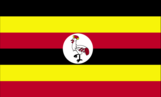
six equal horizontal bands of black (top), yellow, red, black, yellow, and red; a white disk is superimposed at the center and depicts a grey crowned crane (the national symbol) facing the hoist side; black symbolizes the African people, yellow sunshine and vitality, red African brotherhood; the crane was the military badge of Ugandan soldiers under the UK
Government type
presidential republic
Independence
9 October 1962 (from the UK)
International law organization participation
accepts compulsory ICJ jurisdiction; accepts ICCt jurisdiction
International organization participation
ACP, AfDB, AU, C, COMESA, EAC, EADB, FAO, G-77, IAEA, IBRD, ICAO, ICC (national committees), ICCt, IDA, IDB, IFAD, IFC, IFRCS, IGAD, ILO, IMF, IMO, Interpol, IOC, IOM, IPU, ISO (correspondent), ITSO, ITU, ITUC (NGOs), MIGA, NAM, OIC, OPCW, PCA, UN, UNCTAD, UNESCO, UNHCR, UNIDO, UNOCI, UNWTO, UPU, WCO, WFTU (NGOs), WHO, WIPO, WMO, WTO
Judicial branch
- Supreme Court of Uganda (consists of the chief justice and at least 10 justices) justices appointed by the president of the republic in consultation with the Judicial Service Commission (a 9-member independent advisory body) and approved by the National Assembly; justices serve until mandatory retirement at age 70 Court of Appeal (also sits as the Constitutional Court); High Court (includes 12 High Court Circuits and 8 High Court Divisions); Industrial Court; Chief Magistrate Grade One and Grade Two Courts throughout the country; qadhis courts; local council courts; family and children courts
- highest court(s)
- Supreme Court of Uganda (consists of the chief justice and at least 10 justices)
- judge selection and term of office
- justices appointed by the president of the republic in consultation with the Judicial Service Commission (a 9-member independent advisory body) and approved by the National Assembly; justices serve until mandatory retirement at age 70
- subordinate courts
- Court of Appeal (also sits as the Constitutional Court); High Court (includes 12 High Court Circuits and 8 High Court Divisions); Industrial Court; Chief Magistrate Grade One and Grade Two Courts throughout the country; qadhis courts; local council courts; family and children courts
Legal system
mixed legal system of English common law and customary law
Legislative branch
- unicameral National Assembly or Parliament (445 seats; 290 members directly elected in single-seat constituencies by simple majority vote, 112 for women directly elected in single-seat districts by simple majority vote, and 25 "representatives" reserved for special interest groups - army 10, disabled 5, youth 5, labor 5; up to 18 ex officio members appointed by the president; members serve 5-year terms) last held on 18 February 2016 (next to be held in February 2021) percent of vote by party - NA; seats by party - NRM 293, FDC 36, DP 15, Uganda People's Defense Force 10, UPC 6, independent 66 (excludes 19 ex-officio members)
- description
- unicameral National Assembly or Parliament (445 seats; 290 members directly elected in single-seat constituencies by simple majority vote, 112 for women directly elected in single-seat districts by simple majority vote, and 25 "representatives" reserved for special interest groups - army 10, disabled 5, youth 5, labor 5; up to 18 ex officio members appointed by the president; members serve 5-year terms)
- election results
- percent of vote by party - NA; seats by party - NRM 293, FDC 36, DP 15, Uganda People's Defense Force 10, UPC 6, independent 66 (excludes 19 ex-officio members)
- elections
- last held on 18 February 2016 (next to be held in February 2021)
National anthem
- "Oh Uganda, Land of Beauty!" George Wilberforce KAKOMOA adopted 1962
- lyrics/music
- George Wilberforce KAKOMOA
- name
- "Oh Uganda, Land of Beauty!"
- note
- adopted 1962
National holiday
Independence Day, 9 October (1962)
National symbol(s)
- grey crowned crane; national colors: black, yellow, red
- grey crowned crane; national colors
- black, yellow, red
Political parties and leaders
Conservative Party or CP [Ken LUKYAMUZI] Democratic Party or DP [Norbert MAO] Forum for Democratic Change or FDC [Mugisha MUNTU] Justice Forum or JEEMA [Asuman BASALIRWA] National Resistance Movement or NRM [Yoweri MUSEVENI] Uganda People's Congress or UPC [James AKENA] Uganda People's Defense Force or UPDF
Political pressure groups and leaders
National Association of Women Organizations in Uganda or NAWOU [Monica EMIRU] Parliamentary Advocacy Forum or PAFO Ugandan Coalition for Political Accountability to Women or COPAW
Suffrage
18 years of age; universal
Economy
Agriculture - products
coffee, tea, cotton, tobacco, cassava (manioc, tapioca), potatoes, corn, millet, pulses, cut flowers; beef, goat meat, milk, poultry, and fish
Budget
- $3.696 billion $4.885 billion (2016 est.)
- expenditures
- $4.885 billion (2016 est.)
- revenues
- $3.696 billion
Budget surplus (+) or deficit (-)
-4.5% of GDP (2016 est.)
Central bank discount rate
14% (December 2014) 17% (30 March 2016)
Commercial bank prime lending rate
23.89% (31 December 2016 est.) 22.6% (31 December 2015 est.)
Current account balance
$-1.09 billion (2016 est.) $-1.794 billion (2015 est.)
Debt - external
$6.408 billion (31 December 2016 est.) $5.756 billion (31 December 2015 est.)
Distribution of family income - Gini index
39.5 (2013) 45.7 (2002)
Economy - overview
Uganda has substantial natural resources, including fertile soils, regular rainfall, small deposits of copper, gold, and other minerals, and recently discovered oil. Agriculture is the most important sector of the economy, employing more than one-third of the work force. Coffee accounts for the bulk of export revenues. Uganda has a small industrial sector that is dependent on imported inputs like oil and equipment. Overall productivity is hampered by a number of supply-side constraints, including underinvestment in an agricultural sector that continues to rely on rudimentary technology. Industrial growth is impeded by high-costs due to poor infrastructure, low levels of private investment, and the depreciation of the Ugandan shilling. Since 1986, the government - with the support of foreign countries and international agencies - has acted to rehabilitate and stabilize the economy by undertaking currency reform, raising producer prices on export crops, increasing prices of petroleum products, and improving civil service wages. The policy changes were especially aimed at dampening inflation while encouraging foreign investment to boost production and export earnings. Since 1990, economic reforms ushered in an era of solid economic growth based on continued investment in infrastructure, improved incentives for production and exports, lower inflation, and better domestic security. The global economic downturn in 2008 hurt Uganda's exports; however, Uganda's GDP growth has largely recovered due to past reforms and a rapidly growing urban consumer population. Oil revenues and taxes are expected to become a larger source of government funding as production starts in the next five to 10 years. However, lower oil prices since 2014 and protracted negotiations and legal disputes between the Ugandan government and oil companies may prove a stumbling block to further exploration and development. Uganda faces many economic challenges. Instability in South Sudan has led to a sharp increase in Sudanese refugees and is disrupting Uganda's main export market. High energy costs, inadequate transportation and energy infrastructure, insufficient budgetary discipline, and corruption inhibit economic development and investor confidence. During 2015 and 2016, the Uganda shilling depreciated 50% against the dollar. The budget is dominated by energy and road infrastructure spending, while relying on donor support for long-term drivers of growth, including agriculture, health, and education. The largest infrastructure projects are externally financed through low-interest concessional loans. As a result, debt servicing for these loans is expected to rise.
Exchange rates
Ugandan shillings (UGX) per US dollar - 3,420.1 (2016 est.) 3,420.1 (2015 est.) 3,234.1 (2014 est.) 2,599.8 (2013 est.) 2,505.6 (2012 est.)
Exports
$2.921 billion (2016 est.) $2.667 billion (2015 est.)
Exports - commodities
coffee, fish and fish products, tea, cotton, flowers, horticultural products; gold
Exports - partners
Kenya 20.9%, UAE 11.2%, Rwanda 9.5%, Democratic Republic of the Congo 8.9%, Italy 4.5% (2016)
Fiscal year
1 July - 30 June
GDP - composition, by end use
- 77.4% 10.2% 24.8% -5.8% 18.8% -25.4% (2016 est.)
- exports of goods and services
- 18.8%
- government consumption
- 10.2%
- household consumption
- 77.4%
- imports of goods and services
- -25.4% (2016 est.)
- investment in fixed capital
- 24.8%
- investment in inventories
- -5.8%
GDP - composition, by sector of origin
- 25.4% 22.7% 51.9% (2016 est.)
- agriculture
- 25.4%
- industry
- 22.7%
- services
- 51.9% (2016 est.)
GDP - per capita (PPP)
- $2,300 (2016 est.) $2,300 (2015 est.) $2,200 (2014 est.) data are in 2016 dollars
- note
- data are in 2016 dollars
GDP - real growth rate
2.3% (2016 est.) 5.7% (2015 est.) 4.6% (2014 est.)
GDP (official exchange rate)
$25.31 billion (2016 est.)
GDP (purchasing power parity)
- $83.39 billion (2016 est.) $80.47 billion (2015 est.) $75.33 billion (2014 est.) data are in 2016 dollars
- note
- data are in 2016 dollars
Gross national saving
20.1% of GDP (2016 est.) 17.7% of GDP (2015 est.) 17.2% of GDP (2014 est.)
Household income or consumption by percentage share
- 2.4% 36.1% (2009 est.)
- highest 10%
- 36.1% (2009 est.)
- lowest 10%
- 2.4%
Imports
$4.326 billion (2016 est.) $4.955 billion (2015 est.)
Imports - commodities
capital equipment, vehicles, petroleum, medical supplies; cereals
Imports - partners
China 17.9%, India 17.2%, UAE 9.5%, Kenya 9.2%, Japan 5.2%, South Africa 4.5%, Saudi Arabia 4.4% (2016)
Industrial production growth rate
3.8% (2016 est.)
Industries
sugar processing, brewing, tobacco, cotton textiles; cement, steel production
Inflation rate (consumer prices)
5.5% (2016 est.) 3.9% (2015 est.)
Labor force
19.4 million (2016 est.)
Labor force - by occupation
- 71.9% 4.4% 23.7% (2013 est.)
- agriculture
- 71.9%
- industry
- 4.4%
- services
- 23.7% (2013 est.)
Market value of publicly traded shares
$7.294 billion (31 December 2012 est.) $7.727 billion (31 December 2011 est.) $1.788 billion (31 December 2011 est.)
Population below poverty line
19.7% (2013 est.)
Public debt
37.8% of GDP (2016 est.) 30.7% of GDP (2015 est.)
Reserves of foreign exchange and gold
- $3.034 billion (31 December 2016 est.) $2.843 billion (31 December 2015 est.) excludes gold
- note
- excludes gold
Stock of broad money
$3.674 billion (31 December 2016 est.) $3.458 billion (31 December 2015 est.)
Stock of direct foreign investment - abroad
$NA
Stock of direct foreign investment - at home
$NA
Stock of domestic credit
$3.989 billion (31 December 2016 est.) $3.946 billion (31 December 2015 est.)
Stock of narrow money
$2.167 billion (31 December 2016 est.) $2.029 billion (31 December 2015 est.)
Taxes and other revenues
14.1% of GDP (2016 est.)
Unemployment rate
9.4% (2013 est.)
Energy
Carbon dioxide emissions from consumption of energy
2.7 million Mt (2013 est.)
Crude oil - exports
0 bbl/day (2014 est.)
Crude oil - imports
0 bbl/day (2014 est.)
Crude oil - production
0 bbl/day (2016 est.)
Crude oil - proved reserves
2.5 billion bbl (1 January 2017)
Electricity - consumption
2.936 billion kWh (2015 est.)
Electricity - exports
121 million kWh (2015)
Electricity - from fossil fuels
14.8% of total installed capacity (2015 est.)
Electricity - from hydroelectric plants
76.6% of total installed capacity (2015 est.)
Electricity - from nuclear fuels
0% of total installed capacity (2015 est.)
Electricity - from other renewable sources
10.2% of total installed capacity (2015 est.)
Electricity - imports
48 million kWh (2015 est.)
Electricity - installed generating capacity
922,000 kW (2015 est.)
Electricity - production
3.235 billion kWh (2015 est.)
Electricity access
- 32,100,000 15% 55% 7% (2013)
- electrification - rural areas
- 7% (2013)
- electrification - total population
- 15%
- electrification - urban areas
- 55%
- population without electricity
- 32,100,000
Natural gas - consumption
0 cu m (2013 est.)
Natural gas - exports
0 cu m (2013 est.)
Natural gas - imports
0 cu m (2013 est.)
Natural gas - production
0 cu m (2013 est.)
Natural gas - proved reserves
14.16 billion cu m (1 January 2017 es)
Refined petroleum products - consumption
27,000 bbl/day (2015 est.)
Refined petroleum products - exports
0 bbl/day (2014 est.)
Refined petroleum products - imports
26,290 bbl/day (2014 est.)
Refined petroleum products - production
0 bbl/day (2014 est.)
Communications
Broadcast media
public broadcaster, Uganda Broadcasting Corporation (UBC), operates radio and TV networks; Uganda first began licensing privately owned stations in the 1990s; by 2007, there were nearly 150 radio and 35 TV stations, mostly based in and around Kampala; transmissions of multiple international broadcasters are available in Kampala (2007)
Internet country code
.ug
Internet users
- 8,382,782 21.9% (July 2016 est.)
- percent of population
- 21.9% (July 2016 est.)
- total
- 8,382,782
Telephone system
- mobile cellular service is increasing rapidly, but the number of main lines is still deficient; work underway on a national backbone information and communications technology infrastructure; international phone networks and Internet connectivity provided through satellite and fiber-optic cables through Kenya and the Indian Ocean intercity traffic by wire, microwave radio relay, and radiotelephone communication stations, fixed-line and mobile-cellular systems for short-range traffic; mobile-cellular teledensity about 60 per 100 persons country code - 256; satellite earth stations - 1 Intelsat (Atlantic Ocean) and 1 Inmarsat; analog and digital links to Kenya and Tanzania (2016)
- domestic
- intercity traffic by wire, microwave radio relay, and radiotelephone communication stations, fixed-line and mobile-cellular systems for short-range traffic; mobile-cellular teledensity about 60 per 100 persons
- general assessment
- mobile cellular service is increasing rapidly, but the number of main lines is still deficient; work underway on a national backbone information and communications technology infrastructure; international phone networks and Internet connectivity provided through satellite and fiber-optic cables through Kenya and the Indian Ocean
- international
- country code - 256; satellite earth stations - 1 Intelsat (Atlantic Ocean) and 1 Inmarsat; analog and digital links to Kenya and Tanzania (2016)
Telephones - fixed lines
- 368,243 1 (July 2016 est.)
- subscriptions per 100 inhabitants
- 1 (July 2016 est.)
- total subscriptions
- 368,243
Telephones - mobile cellular
- 22,838,486 60 (July 2016 est.)
- subscriptions per 100 inhabitants
- 60 (July 2016 est.)
- total
- 22,838,486
Transportation
Airports
47 (2013)
Airports - with paved runways
- 1 (2013)
- 1,524 to 2,437 m
- 1
- 914 to 1,523 m
- 1 (2013)
- over 3,047 m
- 3
- total
- 5
Airports - with unpaved runways
- 7 (2013)
- 1,524 to 2,437 m
- 8
- 914 to 1,523 m
- 26
- over 3,047 m
- 1
- total
- 42
- under 914 m
- 7 (2013)
Civil aircraft registration country code prefix
5X (2016)
Merchant marine
- bulk carrier 1 (2017)
- by type
- bulk carrier 1 (2017)
- total
- 1
National air transport system
- 41,812 23,472 mt-km (2015)
- annual freight traffic on registered air carriers
- 23,472 mt-km (2015)
- annual passenger traffic on registered air carriers
- 41,812
- inventory of registered aircraft operated by air carriers
- 1
- number of registered air carriers
- 1
Ports and terminals
- Entebbe, Jinja, Port Bell (Lake Victoria)
- lake port(s)
- Entebbe, Jinja, Port Bell (Lake Victoria)
Railways
- 1,244 km 1,244 km 1.000-m gauge (2014)
- narrow gauge
- 1,244 km 1.000-m gauge (2014)
- total
- 1,244 km
Roadways
- 20,000 km (excludes local roads) 3,264 km 16,736 km (2011)
- paved
- 3,264 km
- total
- 20,000 km (excludes local roads)
- unpaved
- 16,736 km (2011)
Waterways
(there are no long navigable stretches of river in Uganda; parts of the Albert Nile that flow out of Lake Albert in the northwestern part of the country are navigable; several lakes including Lake Victoria and Lake Kyoga have substantial traffic; Lake Albert is navigable along a 200-km stretch from its northern tip to its southern shores) (2011)
Military and Security
Military branches
- Uganda People's Defense Force (UPDF): Land Forces (includes Marine Unit), Uganda Air Force (2013)
- Uganda People's Defense Force (UPDF)
- Land Forces (includes Marine Unit), Uganda Air Force (2013)
Military expenditures
1.57% of GDP (2016) 1.6% of GDP (2015) 1.71% of GDP (2014) 1.74% of GDP (2013) 1.79% of GDP (2012)
Military service age and obligation
18-26 years of age for voluntary military duty; 18-30 years of age for professionals; no conscription; 9-year service obligation; the government has stated that while recruitment under 18 years of age could occur with proper consent, "no person under the apparent age of 18 years shall be enrolled in the armed forces"; Ugandan citizenship and secondary education required (2012)
Transnational Issues
Disputes - international
Uganda is subject to armed fighting among hostile ethnic groups, rebels, armed gangs, militias, and various government forces that extend across its borders; Ugandan refugees as well as members of the Lord's Resistance Army (LRA) seek shelter in southern Sudan and the Democratic Republic of the Congo's Garamba National Park; LRA forces have also attacked Kenyan villages across the border
Refugees and internally displaced persons
- 1,057,809 (South Sudan) (refugees and asylum seekers); 231,504 (Democratic Republic of the Congo) (refugees and asylum seekers); 40,313 (Burundi) (refugee and asylum seekers); 36,909 (Somalia) (refugees and asylum seekers); 15,260 (Rwanda) (refugees and asylum seekers) (2017) 53,000 (displaced in northern Uganda because of fighting between government forces and the Lord's Resistance Army; as of 2011, most of the 1.8 million people displaced to IDP camps at the height of the conflict had returned home or resettled, but many had not found durable solutions; intercommunal violence and cattle raids) (2016)
- IDPs
- 53,000 (displaced in northern Uganda because of fighting between government forces and the Lord's Resistance Army; as of 2011, most of the 1.8 million people displaced to IDP camps at the height of the conflict had returned home or resettled, but many had not found durable solutions; intercommunal violence and cattle raids) (2016)
- refugees (country of origin)
- 1,057,809 (South Sudan) (refugees and asylum seekers); 231,504 (Democratic Republic of the Congo) (refugees and asylum seekers); 40,313 (Burundi) (refugee and asylum seekers); 36,909 (Somalia) (refugees and asylum seekers); 15,260 (Rwanda) (refugees and asylum seekers) (2017)