1998 Edition
CIA World Factbook 1998 (Internet Archive)
Geography
Area
total: 236,040 sq km land: 199,710 sq km water: 36,330 sq km
Area-comparative
slightly smaller than Oregon
Climate
tropical; generally rainy with two dry seasons (December to February, June to August); semiarid in northeast
Coastline
0 km (landlocked)
Elevation extremes
lowest point: Lake Albert 621 m highest point: Margherita (Mount Stanley) 5,110 m
Environment-current issues
draining of wetlands for agricultural use; deforestation; overgrazing; soil erosion; poaching is widespread
Environment-international agreements
party to: Biodiversity, Climate Change, Desertification, Endangered Species, Law of the Sea, Marine Life Conservation, Nuclear Test Ban, Ozone Layer Protection, Wetlands signed, but not ratified: Environmental Modification
Geographic coordinates
1 00 N, 32 00 E
Geography-note
landlocked
Irrigated land
90 sq km (1993 est.)
Land boundaries
total: 2,698 km border countries: Democratic Republic of the Congo 765 km, Kenya 933 km, Rwanda 169 km, Sudan 435 km, Tanzania 396 km
Land use
arable land: 25% permanent crops: 9% permanent pastures: 9% forests and woodland: 28% other: 29% (1993 est.)
Location
Eastern Africa, west of Kenya
Map references
Africa
Maritime claims
none (landlocked)
Natural hazards
NA
Natural resources
copper, cobalt, limestone, salt
Terrain
mostly plateau with rim of mountains
People and Society
Age structure
0-14 years: 51% (male 5,682,510; female 5,643,962) 15-64 years: 47% (male 5,157,818; female 5,199,080) 65 years and over: 2% (male 236,374; female 247,451) (July 1998 est.)
Birth rate
49.21 births/1,000 population (1998 est.)
Death rate
18.95 deaths/1,000 population (1998 est.)
Ethnic groups
Baganda 17%, Karamojong 12%, Basogo 8%, Iteso 8%, Langi 6%, Rwanda 6%, Bagisu 5%, Acholi 4%, Lugbara 4%, Bunyoro 3%, Batobo 3%, non-African (European, Asian, Arab) 1%, other 23%
Infant mortality rate
92.86 deaths/1,000 live births (1998 est.)
Languages
English (official national language, taught in grade schools, used in courts of law and by most newspapers and some radio broadcasts), Ganda or Luganda (most widely used of the Niger-Congo languages, preferred for native language publications and may be taught in school), other Niger-Congo languages, Nilo-Saharan languages, Swahili, Arabic
Life expectancy at birth
total population: 42.6 years male: 41.81 years female: 43.41 years (1998 est.)
Literacy
definition: age 15 and over can read and write total population: 61.8% male: 73.7% female: 50.2% (1995 est.)
Nationality
noun: Ugandan(s) adjective: Ugandan
Net migration rate
-1.8 migrant(s)/1,000 population (1998 est.) note: Uganda is host to refugees from a number of neighboring countries, including: Sudan 175,000, Rwanda possibly 10,000, and Democratic Republic of the Congo about 5,000
Population
22,167,195 (July 1998 est.)
Population growth rate
2.85% (1998 est.)
Religions
Roman Catholic 33%, Protestant 33%, Muslim 16%, indigenous beliefs 18%
Sex ratio
at birth: 1.03 male(s)/female under 15 years: 1 male(s)/female 15-64 years: 0.99 male(s)/female 65 years and over: 0.95 male(s)/female (1998 est.)
Total fertility rate
7.09 children born/woman (1998 est.)
Government
Administrative divisions
39 districts; Apac, Arua, Bundibugyo, Bushenyi, Gulu, Hoima, Iganga, Jinja, Kabale, Kabarole, Kalangala, Kampala, Kamuli, Kapchorwa, Kasese, Kibale, Kiboga, Kisoro, Kitgum, Kotido, Kumi, Lira, Luwero, Masaka, Masindi, Mbale, Mbarara, Moroto, Moyo, Mpigi, Mubende, Mukono, Nebbi, Ntungamo, Pallisa, Rakai, Rukungiri, Soroti, Tororo
Constitution
8 October 1995; adopted by the interim, 284-member Constituent Assembly, charged with debating the draft constitution that had been proposed in May 1993; the Constituent Assembly was dissolved on promulgation of the constitution in October 1995
Country name
conventional long form: Republic of Uganda conventional short form: Uganda
Data code
UG
Executive branch
chief of state: President Lt. Gen. Yoweri Kaguta MUSEVENI (since seizing power 29 January 1986); note-the president is both chief of state and head of government head of government: President Lt. Gen. Yoweri Kaguta MUSEVENI (since seizing power 29 January 1986); Prime Minister Kintu MUSOKE (since 18 November 1994) note-the president is both chief of state and head of government; the prime minister assists the president in the supervision of the cabinet cabinet: Cabinet appointed by the president from among elected legislators elections: president elected by popular vote; election last held 9 May 1996 (next to be held by 31 May 2001); note-first popular election for president since independence in 1962; prime minister appointed by the president election results: Lt. Gen. Yoweri Kaguta MUSEVENI elected president; percent of vote - Lt. Gen. Yoweri Kaguta MUSEVENI 74%, Paul Kawanga SSEMOGERERE 24%, Muhammad MAYANJA 2%
FAX
- [1] (202) 726-1727 Diplomatic representation from the US: chief of mission: Ambassador Nancy J. POWELL embassy: Parliament Avenue, Kampala mailing address: P. O. Box 7007, Kampala telephone: [256] (41) 259792, 259793, 259795
- [256] (41) 259794
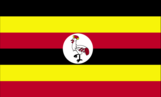
Flag description
six equal horizontal bands of black (top), yellow, red, black, yellow, and red; a white disk is superimposed at the center and depicts a red-crested crane (the national symbol) facing the hoist side
Government type
republic
Independence
9 October 1962 (from UK)
International organization participation
ACP, AfDB, C, CCC, EADB, ECA, FAO, G-77, IAEA, IBRD, ICAO, ICFTU, ICRM, IDA, IDB, IFAD, IFC, IFRCS, IGAD, ILO, IMF, Intelsat, Interpol, IOC, IOM, ISO (correspondent), ITU, NAM, OAU, OIC, PCA, UN, UNCTAD, UNESCO, UNHCR, UNIDO, UPU, WFTU, WHO, WIPO, WMO, WToO, WTrO Diplomatic representation in the US: chief of mission: Ambassador Edith Grace SSEMPALA chancery: 5911 16th Street NW, Washington, DC 20011 telephone: [1] (202) 726-7100 through 7102, 0416
Judicial branch
Court of Appeal, judges are appointed by the president; High Court, judges are appointed by the president Political parties and leaders: only one political organization, the National Resistance Movement or NRM [Dr. Samson KISEKKA, chairman] is recognized; note-this is the party of President MUSEVENI; the president maintains that the NRM is not a political party, but a movement which claims the loyalty of all Ugandans note: of the political parties that exist but are prohibited from sponsoring candidates, the most important are the Ugandan People's Congress or UPC [Milton OBOTE], Democratic Party or DP [Paul SSEMOGERERE], and Conservative Party or CP [Joshua S. MAYANJA-NKANGI]; the new constitution requires the suspension of political party activity until a referendum is held on the matter in 2000
Legal system
in 1995, the government restored the legal system to one based on English common law and customary law and reinstituted a normal judicial system; accepts compulsory ICJ jurisdiction, with reservations
Legislative branch
unicameral National Assembly (276 members serve five-year terms; 214 directly elected by universal suffrage, but 62 are nominated by legally established special interest groups and approved by the president-women 39, army 10, disabled 5, youth 5, labor 3) elections: elections to the National Assembly (formerly the National Resistance Council) took place on 27 June 1996 (next election to be held in 2001); election results: NA; note-election campaigning by party was not permitted
National capital
Kampala
National holiday
Independence Day, 9 October (1962)
Suffrage
18 years of age; universal
Economy
Agriculture-products
coffee, tea, cotton, tobacco, cassava (tapioca), potatoes, corn, millet, pulses; beef, goat meat, milk, poultry
Budget
revenues: $869 million expenditures: $985 million, including capital expenditures of $69 million (FY95/96)
Currency
1 Ugandan shilling (USh) = 100 cents
Debt-external
$3.5 billion (1996 est.)
Economic aid
recipient: ODA, $NA
Economy-overview
Uganda has substantial natural resources, including fertile soils, regular rainfall, and sizable mineral deposits of copper and cobalt. Agriculture is the most important sector of the economy, employing over 80% of the work force. Coffee is the major export crop and accounts for the bulk of export revenues. Since 1986, the government-with the support of foreign countries and international agencies-has acted to rehabilitate and stabilize the economy by undertaking currency reform, raising producer prices on export crops, increasing prices of petroleum products, and improving civil service wages. The policy changes are especially aimed at dampening inflation and boosting production and export earnings. In 1990-97, the economy turned in a solid performance based on: continued investment in the rehabilitation of infrastructure, improved incentives for production and exports, reduced inflation, gradually improved domestic security, and the return of exiled Indian-Ugandan entrepreneurs.
Electricity-capacity
162,000 kW (1998)
Electricity-consumption per capita
35 kWh (1995)
Electricity-production
807 million kWh (1995)
Exchange rates
Ugandan shillings (USh) per US$1-1,148.1 (January 1998), 1,083.0 (1997), 1,046.1 (1996), 968.9 (1995), 979.4 (1994), 1,195.0 (1993)
Exports
total value: $604 million (f.o.b., 1996) commodities: coffee, gold, cotton, tea, corn, fish partners: Spain 23%, France 14%, Germany 14%, Italy 10%, Netherlands 8% (1995)
Fiscal year
1 July-30 June Communications
GDP
purchasing power parity-$34.6 billion (1997 est.)
GDP-composition by sector
agriculture: 49% industry: 13% services: 38% (1995 est.)
GDP-per capita
purchasing power parity-$1,700 (1997 est.)
GDP-real growth rate
5% (1997 est.)
Imports
total value: $1.2 billion (c.i.f., 1996) commodities: machinery, chemicals, fuel, cotton piece goods, transportation equipment, food partners: Kenya 26%, UK 12%, Japan 8%, Germany 8%, India 5.5% (1995)
Industrial production growth rate
19.7% (FY95/96)
Industries
sugar, brewing, tobacco, cotton textiles, cement
Inflation rate-consumer price index
6% (1997)
Labor force
total: 8.361 million (1993 est.) by occupation: agriculture 86%, industry 4%, services 10% (1980 est.)
Radio broadcast stations
AM 10, FM 0, shortwave 0
Radios
2.13 million (1993 est.)
Telephone system
fair system domestic: microwave radio relay and radiotelephone communications stations, cellular system international: satellite earth station-1 Intelsat (Atlantic Ocean)
Telephones
61,600 (1990 est.)
Television broadcast stations
9 (1987 est.)
Televisions
220,000 (1993 est.)
Unemployment rate
NA%
Transportation
Airports
29 (1997 est.) Airports-with paved runways: total: 5 over 3,047 m: 3 1,524 to 2,437 m: 1 under 914 m: 1 (1997 est.) Airports-with unpaved runways: total: 24 2,438 to 3,047 m: 1 1,524 to 2,437 m: 7 914 to 1,523 m: 8 under 914 m: 8 (1997 est.)
Highways
total: 27,000 km paved: 1,800 km unpaved: 25,200 km (of which about 4,800 km are all-weather roads) (1990 est.)
Merchant marine
total: 3 roll-on/roll-off cargo ships (1,000 GRT or over) totaling 5,091 GRT/8,229 DWT (1997 est.)
Railways
total: 1,241 km narrow gauge: 1,241 km 1.000-m gauge note: a program to rehabilitate the railroad is underway (1995)
Waterways
Lake Victoria, Lake Albert, Lake Kyoga, Lake George, Lake Edward, Victoria Nile, Albert Nile Ports and harbors: Entebbe, Jinja, Port Bell
Military and Security
Military branches
Army, Navy, Air Wing
Military expenditures-dollar figure
$56 million (FY93/94)
Military expenditures-percent of GDP
1.7% (FY93/94)
Military manpower-availability
males age 15-49: 4,672,307 (1998 est.) Military manpower-fit for military service: males: 2,534,993 (1998 est.)
Transnational Issues
Disputes-international
none