1995 Edition
CIA World Factbook 1995 (Project Gutenberg)
Geography
Area
total area: 236,040 sq km land area: 199,710 sq km comparative area: slightly smaller than Oregon
Climate
tropical; generally rainy with two dry seasons (December to February, June to August); semiarid in northeast
Coastline
0 km (landlocked)
Environment
current issues: draining of wetlands for agricultural use; deforestation; overgrazing; soil erosion; poaching is widespread natural hazards: NA international agreements: party to - Biodiversity, Climate Change, Endangered Species, Law of the Sea, Marine Life Conservation, Nuclear Test Ban, Ozone Layer Protection, Wetlands; signed, but not ratified - Environmental Modification
International disputes
none
Irrigated land
90 sq km (1989 est.)
Land boundaries
total 2,698 km, Kenya 933 km, Rwanda 169 km, Sudan 435 km, Tanzania 396 km, Zaire 765 km
Land use
arable land: 23% permanent crops: 9% meadows and pastures: 25% forest and woodland: 30% other: 13%
Location
Eastern Africa, west of Kenya
Map references
Africa
Maritime claims
none; landlocked
Natural resources
copper, cobalt, limestone, salt
Note
landlocked
Terrain
mostly plateau with rim of mountains
People and Society
Age structure
0-14 years: 49% (female 4,792,164; male 4,834,757) 15-64 years: 49% (female 4,802,650; male 4,704,159) 65 years and over: 2% (female 215,648; male 223,884) (July 1995 est.)
Birth rate
48.03 births/1,000 population (1995 est.)
Death rate
24.35 deaths/1,000 population (1995 est.)
Ethnic divisions
Baganda 17%, Karamojong 12%, Basogo 8%, Iteso 8%, Langi 6%, Rwanda 6%, Bagisu 5%, Acholi 4%, Lugbara 4%, Bunyoro 3%, Batobo 3%, European, Asian, Arab 1%, other 23%
Infant mortality rate
112.2 deaths/1,000 live births (1995 est.)
Labor force
4.5 million (est.) by occupation: agriculture over 80%
Languages
English (official), Luganda, Swahili, Bantu languages, Nilotic languages
Life expectancy at birth
total population: 36.58 years male: 36.26 years female: 36.91 years (1995 est.)
Literacy
age 15 and over can read and write (1991) total population: 56% male: 68% female: 45%
Nationality
noun: Ugandan(s) adjective: Ugandan
Net migration rate
NA migrant(s)/1,000 population (1995 est.) note: Uganda is host to refugees from a number of neighboring countries, including Zaire, Sudan, and Rwanda; probably in excess of 100,000 southern Sudanese fled to Uganda during the past year; many of the 8,000 Rwandans who took refuge in Uganda have returned home
Population
19,573,262 (July 1995 est.)
Population growth rate
2.25% (1995 est.)
Religions
Roman Catholic 33%, Protestant 33%, Muslim 16%, indigenous beliefs 18%
Total fertility rate
6.7 children born/woman (1995 est.)
Government
Administrative divisions
39 districts; Apac, Arua, Bundibugyo, Bushenyi, Gulu, Hoima, Iganga, Jinja, Kabale, Kabarole, Kalangala, Kampala, Kamuli, Kapchorwa, Kasese, Kibale, Kiboga, Kisoro, Kitgum, Kotido, Kumi, Lira, Luwero, Masaka, Masindi, Mbale, Mbarara, Moroto, Moyo, Mpigi, Mubende, Mukono, Nebbi, Ntungamo, Pallisa, Rakai, Rukungiri, Sototi, Tororo
Capital
Kampala
Constitution
8 September 1967, in process of constitutional revision
Digraph
UG
Diplomatic representation in US
chief of mission: Ambassador Stephen Kapimpina KATENTA-APULI chancery: 5911 16th Street NW, Washington, DC 20011 telephone: [1] (202) 726-7100 through 7102, 0416
Executive branch
chief of state: President Lt. Gen. Yoweri Kaguta MUSEVENI (since 29 January 1986); Vice President Dr. Specioza Wandira KAZIBWE (since 18 November 1994) head of government: Prime Minister Kintu MUSOKE (since 18 November 1994) cabinet: Cabinet; appointed by the president
FAX
- [1] (202) 726-1727
- [256] (41) 259794
Flag
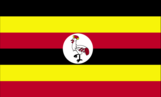
six equal horizontal bands of black (top), yellow, red, black, yellow, and red; a white disk is superimposed at the center and depicts a red-crested crane (the national symbol) facing the staff side
Independence
9 October 1962 (from UK)
Judicial branch
Court of Appeal, High Court
Legal system
government plans to restore system based on English common law and customary law and reinstitute a normal judicial system; accepts compulsory ICJ jurisdiction, with reservations
Legislative branch
unicameral
Member of
ACP, AfDB, C, CCC, EADB, ECA, FAO, G-77, GATT, IAEA, IBRD, ICAO, ICFTU, ICRM, IDA, IDB, IFAD, IFC, IFRCS, IGADD, ILO, IMF, INTELSAT, INTERPOL, IOC, IOM, ISO (correspondent), ITU, NAM, OAU, OIC, PCA, UN, UNCTAD, UNESCO, UNHCR, UNIDO, UNITAR, UPU, WFTU, WHO, WIPO, WMO, WTO
Names
conventional long form: Republic of Uganda conventional short form: Uganda
National holiday
Independence Day, 9 October (1962)
National Resistance Council
elections last held 28 March 1993 (next to be held end of 1995); results - 284 non-partisan delegates elected to an interim Constituent Assembly with the principal task of writing a final draft of a new constitution for Uganda on the basis of which a regular Constituent Assembly will be elected note: first free and fair election in 30 years is to be held by end of 1995
Other political or pressure groups
Lord's Resistance Army (LRA); Ruwenzori Movement
Political parties and leaders
only party - National Resistance Movement (NRM), Yoweri MUSEVENI note: Ugandan People's Congress (UPC), Milton OBOTE; Democratic Party (DP), Paul SSEMOGEERE; and Conservative Party (CP), Joshua S. MAYANJA-NKANGI continue to exist but are all proscribed from conducting public political activities
Suffrage
18 years of age; universal
Type
republic
US diplomatic representation
chief of mission: Ambassador E. Michael SOUTHWICK embassy: Parliament Avenue, Kampala mailing address: P. O. Box 7007, Kampala telephone: [256] (41) 259792, 259793, 259795
Economy
Agriculture
mainly subsistence; accounts for 57% of GDP and over 80% of labor force; cash crops - coffee, tea, cotton, tobacco; food crops - cassava, potatoes, corn, millet, pulses; livestock products - beef, goat meat, milk, poultry; self-sufficient in food
Budget
revenues: $365 million expenditures: $545 million, including capital expenditures of $165 million (1989 est.)
Currency
1 Ugandan shilling (USh) = 100 cents
Economic aid
recipient: US commitments, including Ex-Im (1970-89), $145 million; Western (non-US) countries, ODA and OOF bilateral commitments (1970-89), $1.4 billion; OPEC bilateral aid (1979-89), $60 million; Communist countries (1970-89), $169 million
Electricity
capacity: 160,000 kW production: 780 million kWh consumption per capita: 32 kWh (1993)
Exchange rates
Ugandan shillings (USh) per US$1 - 1,195 (December 1994), 1,195.0 (1993), 1.133.8 (1992), 734.0 (1991), 428.85 (1990), 223.1 (1989)
Exports
$237 million (f.o.b., 1993 est.) commodities: coffee 97%, cotton, tea partners: US 25%, UK 18%, France 11%, Spain 10%
External debt
$2.9 billion (1993 est.)
Fiscal year
1 July - 30 June
Imports
$696 million (c.i.f., 1993 est.) commodities: petroleum products, machinery, cotton piece goods, metals, transportation equipment, food partners: Kenya 25%, UK 14%, Italy 13%
Industrial production
growth rate 1.5% (1992); accounts for 5% of GDP
Industries
sugar, brewing, tobacco, cotton textiles, cement
Inflation rate (consumer prices)
5% (1994 est.)
National product
GDP - purchasing power parity - $16.2 billion (1994 est.)
National product per capita
$850 (1994 est.)
National product real growth rate
6% (1994 est.)
Overview
Uganda has substantial natural resources, including fertile soils, regular rainfall, and sizable mineral deposits of copper and cobalt. Agriculture is the most important sector of the economy, employing over 80% of the work force. Coffee is the major export crop and accounts for the bulk of export revenues. Since 1986 the government - with the support of foreign countries and international agencies - has acted to rehabilitate and stabilize the economy by undertaking currency reform, raising producer prices on export crops, increasing prices of petroleum products, and improving civil service wages. The policy changes are especially aimed at dampening inflation and boosting production and export earnings. In 1990-94, the economy turned in a solid performance based on continued investment in the rehabilitation of infrastructure, improved incentives for production and exports, and gradually improving domestic security. The economy again prospered in 1994 with rapid growth, low inflation, growing foreign investment, a trimmed bureaucracy, and the continued return of exiled Indian-Ugandan entrepreneurs.
Unemployment rate
NA%
Communications
Radio
broadcast stations: AM 10, FM 0, shortwave 0 radios: NA
Telephone system
NA telephones; fair system local: NA intercity: microwave and radio communications stations international: 1 INTELSAT (Atlantic Ocean) earth station
Television
broadcast stations: 9 televisions: NA
Transportation
Airports
total: 29 with paved runways over 3,047 m: 3 with paved runways 1,524 to 2,437 m: 1 with paved runways under 914 m: 9 with unpaved runways 2,438 to 3,047 m: 1 with unpaved runways 1,524 to 2,438 m: 6 with unpaved runways 914 to 1,523 m: 9
Highways
total: 26,200 km paved: 1,970 km unpaved: gravel, crushed stone 5,849 km; earth, tracks 18,381 km
Inland waterways
Lake Victoria, Lake Albert, Lake Kyoga, Lake George, Lake Edward; Victoria Nile, Albert Nile; principal inland water ports are at Jinja and Port Bell, both on Lake Victoria
Merchant marine
total: 3 roll-on/roll-off cargo ships (1,000 GRT or over) totaling 5,091 GRT/NA DWT
Ports
Entebbe, Jinja, Port Bell
Railroads
total: 1,300 km single track narrow gauge: 1,300 km 1.000-m-gauge
Military and Security
Branches
Army, Navy, Air Wing
Defense expenditures
exchange rate conversion - $55 million, 1.7% of budget (FY93/94) ________________________________________________________________________ UKRAINE
Manpower availability
males age 15-49 4,231,019; males fit for military service 2,298,654 (1995 est.)