1991 Edition
CIA World Factbook 1991 (Project Gutenberg)
Geography
Climate
tropical; generally rainy with two dry seasons (December to February, June to August); semiarid in northeast
Coastline
none--landlocked
Comparative area
slightly smaller than Oregon
Environment
straddles Equator; deforestation; overgrazing; soil erosion
Land boundaries
2,698 km total; Kenya 933 km, Rwanda 169 km, Sudan 435 km, Tanzania 396 km, Zaire 765 km
Land use
arable land 23%; permanent crops 9%; meadows and pastures 25%; forest and woodland 30%; other 13%; includes irrigated NEGL%
Maritime claims
none--landlocked
Natural resources
copper, cobalt, limestone, salt
Note
landlocked
Terrain
mostly plateau with rim of mountains
Total area
236,040 km2; land area: 199,710 km2
People and Society
Birth rate
51 births/1,000 population (1991)
Death rate
15 deaths/1,000 population (1991)
Ethnic divisions
African 99%, European, Asian, Arab 1%
Infant mortality rate
94 deaths/1,000 live births (1991)
Labor force
4,500,000 (est.); subsistence agriculture 94%, wage earners (est.) 6%; 50% of population of working age (1983)
Language
English (official); Luganda and Swahili widely used; other Bantu and Nilotic languages
Life expectancy at birth
50 years male, 52 years female (1991)
Literacy
48% (male 62%, female 35%) age 15 and over can read and write (1990 est.)
Nationality
noun--Ugandan(s); adjective--Ugandan
Net migration rate
0 migrants/1,000 population (1991)
Organized labor
125,000 union members
Population
18,690,070 (July 1991), growth rate 3.7% (1991)
Religion
Roman Catholic 33%, Protestant 33%, Muslim 16%, rest indigenous beliefs
Total fertility rate
7.3 children born/woman (1991)
Government
Administrative divisions
10 provinces; Busoga, Central, Eastern, Karamoja, Nile, North Buganda, Northern, South Buganda, Southern, Western
Capital
Kampala
Communists
possibly a few sympathizers
Constitution
8 September 1967, in process of constitutional revision
Diplomatic representation
Ambassador Stephen Kapimpina KATENTA-APULI; 5909 16th Street NW, Washington DC 20011; telephone (202) 726-7100 through 7102; US--Ambassador James CARSON; Embassy at Parliament Avenue, Kampala (mailing address is P. O. Box 7007, Kampala); telephone [256] (41) 259792, 259793, 259795
Elections
National Resistance Council--last held 11-28 February 1989 (next to be held after January 1995); results--NRM is the only party; seats--(278 total, 210 indirectly elected) 210 members elected without party affiliation
Executive branch
president, prime minister, three deputy prime ministers, Cabinet
Flag
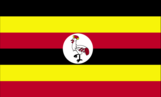
six equal horizonal bands of black (top), yellow, red, black, yellow, and red; a white disk is superimposed at the center and depicts a red-crested crane (the national symbol) facing the staff side
Independence
9 October 1962 (from UK)
Judicial branch
Court of Appeal, High Court
Leaders
Chief of State--President Lt. Gen. Yoweri Kaguta MUSEVENI (since 29 January 1986); Vice President Samson Babi Mululu KISEKKA (since NA January 1991); Head of Government--Prime Minister George Cosmas ADYEBO (since NA January 1991)
Legal system
government plans to restore system based on English common law and customary law and reinstitute a normal judicial system; accepts compulsory ICJ jurisdiction, with reservations
Legislative branch
unicameral National Resistance Council
Long-form name
Republic of Uganda
Member of
ACP, AfDB, C, CCC, EADB, ECA, FAO, G-77, GATT, IAEA, IBRD, ICAO, ICFTU, IDA, IDB, IFAD, IFC, IGADD, ILO, IMF, INTELSAT, INTERPOL, IOC, ITU, LORCS, NAM, OAU, OIC, PCA, UN, UNCTAD, UNESCO, UNHCR, UNIDO, UPU, WHO, WIPO, WMO, WTO
National holiday
Independence Day, 9 October (1962)
Other political parties or pressure groups
Uganda People's Front (UPF), Uganda People's Christian Democratic Army (UPCDA), Ruwenzori Movement
Political parties and leaders
only party--National Resistance Movement (NRM); note--the Uganda Patriotic Movement (UPM), Ugandan People's Congress (UPC), Democratic Party (DP), and Conservative Party (CP) are all proscribed from conducting public political activities
Suffrage
universal at age 18
Type
republic
Economy
Agriculture
accounts for 57% of GDP and 83% of labor force; cash crops--coffee, tea, cotton, tobacco; food crops--cassava, potatoes, corn, millet, pulses; livestock products--beef, goat meat, milk, poultry; self-sufficient in food
Budget
revenues $365 million; expenditures $545 million, including capital expenditures of $165 million (FY89 est.)
Currency
Ugandan shilling (plural--shillings); 1 Ugandan shilling (USh) = 100 cents
Economic aid
US commitments, including Ex-Im (1970-89), $145 million; Western (non-US) countries, ODA and OOF bilateral commitments (1970-88), $1.2 billion; OPEC bilateral aid (1979-89), $60 million; Communist countries (1970-89), $169 million
Electricity
173,000 kW capacity; 312 million kWh produced, 18 kWh per capita (1989)
Exchange rates
Ugandan shillings (USh) per US$1--563.18 (January 1991), 428.85 (1990), 223.09 (1989), 106.14 (1988), 42.84 (1987), 14.00 (1986), 6.72 (1985)
Exports
$273 million (f.o.b., 1989); commodities--coffee 97%, cotton, tea; partners--US 25%, UK 18%, France 11%, Spain 10%
External debt
$1.9 billion (1990 est.)
Fiscal year
1 July-30 June
GDP
$4.9 billion, per capita $290 (1988); real growth rate 6.1% (1989 est.)
Imports
$652 million (c.i.f., 1989); commodities--petroleum products, machinery, cotton piece goods, metals, transportation equipment, food; partners--Kenya 25%, UK 14%, Italy 13%
Industrial production
growth rate 15.0% (1989 est.); accounts for 5% of GDP
Industries
sugar, brewing, tobacco, cotton textiles, cement
Inflation rate (consumer prices)
30% (FY90)
Overview
Uganda has substantial natural resources, including fertile soils, regular rainfall, and sizable mineral deposits of copper and cobalt. The economy has been devastated by much political instability, mismanagement, and civil war since independence in 1962, keeping Uganda poor with a per capita income of about $300. (GDP remains below the levels of the early 1970s, as does industrial production.) Agriculture is the most important sector of the economy, employing over 80% of the work force. Coffee is the major export crop and accounts for the bulk of export revenues. Since 1986 the government has acted to rehabilitate and stabilize the economy by undertaking currency reform, raising producer prices on export crops, increasing petroleum prices, and improving civil service wages. The policy changes are especially aimed at dampening inflation, which was running at over 300% in 1987, and boosting production and export earnings.
Unemployment rate
NA%
Communications
Airports
37 total, 28 usable; 5 with permanent-surface runways; 1 with runways over 3,659 m; 3 with runways 2,440-3,659 m; 10 with runways 1,220-2,439 m
Civil air
4 major transport aircraft
Highways
26,200 km total; 1,970 km paved; 5,849 km crushed stone, gravel, and laterite; remainder earth roads and tracks
Inland waterways
Lake Victoria, Lake Albert, Lake Kyoga, Lake George, Lake Edward; Victoria Nile, Albert Nile; principal inland water ports are at Jinja and Port Bell, both on Lake Victoria
Merchant marine
1 roll-on/roll-off cargo (1,000 GRT or over) totaling 1,697 GRT
Railroads
1,300 km, 1.000-meter-gauge single track
Telecommunications
fair system with radio relay and radio communications stations; 61,600 telephones; stations--10 AM, no FM, 9 TV; satellite communications ground stations--1 Atlantic Ocean INTELSAT and 1 Indian Ocean INTELSAT
Military and Security
Branches
Army, Navy, Air Force
Defense expenditures
$68 million, 1.5% of GDP (1988) _%_
Manpower availability
males 15-49, about 3,980,637; about 2,162,241 fit for military service