1989 Edition
CIA World Factbook 1989 (Internet Archive)
Geography
Climate
- tropical; generally rainy with two dry seasons (December to February, June to August); semiarid in northeast
- desert; cooler in eastern mountains
- temperate; moderated by prevailing southwest winds over the North Atlantic Current; more than half of the days are overcast
Coastline
- none — landlocked
- 1 ,448 km
- 12,429km
Comparative area
- slightly smaller than Oregon
- slightly smaller than Maine
- slightly smaller than Oregon
Continental shelf
- defined by bilateral boundaries or equidistant line
- 200 meters or to depth of exploitation or in accordance with agreed upon boundaries
Disputes
- boundary with Qatar is in dispute; no defined boundary with Saudi Arabia; no defined boundary with most of Oman, but Administrative Line in far north; claims three islands in the Persian Gulf occupied by Iran (Jazlreh-ye Abu Musa or Abu Musa, JazTreh-ye Tonb-e Bozorg or Greater Tunb, and Jazlreh-ye Tonb-e Kuchek or Lesser Tunb)
- maritime boundary with Ireland; Northern Ireland question with Ireland; Gibraltar question with Spain; Argentina claims Falkland Islands (Islas Malvinas); Argentina claims South Georgia and the South Sandwich Islands; Mauritius claims island of Diego Garcia in British Indian Ocean Territory; Hong Kong is scheduled to become a Special Administrative Region of China in 1997; Rockall continental shelf dispute involving Denmark, Iceland, and Ireland (Ireland and the UK have signed a boundary agreement in the Rockall area); territorial claim in Antarctica (British Antarctic Territory)
Environment
- straddles Equator; deforestation; overgrazing; soil erosion
- frequent dust and sand storms; lack of natural freshwater resources being overcome by desalination plants; desertification
- pollution control measures improving air, water quality; because of
Exclusive fishing zone
200 nm
Extended economic zone
200 nm
Land boundaries
- 2,698 km total; Kenya 933 km, Rwanda 169 km, Sudan 435 km, Tanzania 396 km, Zaire 765 km
- 1,016 km total; Oman 410 km, Saudi Arabia 586 km, Qatar 20 km
Land boundary
Ireland 360 km
Land use
- 23% arable land; 9% permanent crops; 25% meadows and pastures; 30% forest and woodland; 1 3% other; includes NEGL% irrigated
- NEGL% arable land; NEGL% permanent crops; 2% meadows and pastures; NEGL% forest and woodland; 98% other; includes NEGL% irrigated
- 29% arable land; NEGL% permanent crops; 48% meadows and pastures; 9% forest and woodland; 14% other; includes 1% irrigated
Maritime claims
none — landlocked
Natural resources
- copper, cobalt, limestone, salt
- crude oil and natural gas
- coal, crude oil, natural gas, tin, limestone, iron ore, salt, clay, chalk, gypsum, lead, silica
Note
- landlocked
- strategic location along southern approaches to Strait of Hormuz, a vital transit point for world crude oil
Terrain
- mostly plateau with rim of mountains
- flat, barren coastal plain merging into rolling sand dunes of vast desert wasteland; mountains in east
- mostly rugged hills and low mountains; level to rolling plains in east and southeast
Territorial sea
- 3 nm
- 1 2 nm
Total area
- 236,040 km2; land area: 199,710km2
- 83,600 km2; land area: 83,600 km2
- 244,820 km2; land area: 241,590 km2; includes Rockall and Shetland Islands
People and Society
Birth rate
- 52 births/ 1,000 population (1990)
- 31 births/ 1,000 population (1990)
Death rate
- 17 deaths/ 1,000 population (1990)
- 3 deaths/ 1 ,000 population (1990)
Ethnic divisions
- 99% African, 1 % European, Asian, Arab
- 19% Emirian, 23% other Arab, 50% South Asian (fluctuating), 8% other expatriates (includes Westerners and East Asians); less than 20% of the population are UAE citizens (1982)
Infant mortality rate
- 107 deaths/ 1,000 live births (1990)
- 24 deaths/ 1,000 live births (1990)
Labor force
- 4,500,000 (est.); 94% subsistence activities, 6% wage earners (est.); 50% of population of working age (1983)
- 580,000 (1986 est.); 85% industry and commerce, 5% agriculture, 5% services, 5% government; 80% of labor force is foreign
Language
- English (official); Luganda and Swahili widely used; other Bantu and Nilotic languages
- Arabic (official); Farsi and English widely spoken in major cities; Hindi, Urdu
Life expectancy at birth
- 48 years male, 50 years female (1990)
- 69 years male, 73 years female (1990)
Literacy
- 57.3%
- 68%
Nationality
- noun — Ugandan(s); adjective— Ugandan
- noun — Emirian(s), adjective — Emirian
Net migration rate
- 0 migrants/ 1 ,000 population (1990)
- 33 migrants/ 1 ,000 population (1990)
Organized labor
- 125,000 union members
- trade unions are illegal
Population
- 17,960,262 (July 1990), growth rate 3.5% (1990)
- 2,253,624 (July 1990), growth rate 6.0% (1990)
Religion
- 33% Roman Catholic, 33% Protestant, 16% Muslim, rest indigenous beliefs
- 96% Muslim (16% Shi'a); 4% Christian, Hindu, and other
Total fertility rate
- 7.4 children born/ woman (1990)
- 4.9 children born/ woman (1990)
Government
Administrative divisions
- 10 provinces; Busoga, Central, Eastern, Karamoja, Nile, North Buganda, Northern, South Buganda, Southern, Western
- 7 emirates (imarSt, singular — irnarah): Abu Zaby, 'AjmSn, Al Fujayrah, Ash Shariqah, Dubayy, Ra's al Khaymah, Umm al Qaywayn
Capital
- Kampala
- Abu Dhabi
Communists
- possibly a few sympathizers
- NA
Constitution
- 8 September 1967, suspended following coup of 27 July 1985; in process of constitutional revision
- 2 December 1971 (provisional)
Diplomatic representation
- Ambassador Stephen Kapimpina KATENTA-APULI; 5909 16th Street NW, Washington DC 2001 1; telephone (202) 726-7100 through 7102; US— Ambassador John A. BURROUGHS, Jr.; Embassy at British High Commission Building, Obote Avenue, Kampala (mailing address is P. O. Box 7007, Kampala); telephone [256] (41)
- Ambassador Abdullah bin Zayed AL-NAHAYYAN; Chancery at Suite 740, 600 New Hampshire Avenue NW, Washington DC 20037; telephone (202) 338-6500; US— Ambassador Edward S. WALKER, Jr.; Embassy at Al-Sudan Street, Abu Dhabi (mailing address is P. O. Box 4009, Abu Dhabi); telephone [971] (2) 336691; there is a US Consulate General in Dubai
Elections
- National Resistance Council — last held 1 1-28 February 1989 (next to be held after January 1995); results— NRM is the only party; seats — (278 total, 210 indirectly elected) NRM 210
- none
Executive branch
- president, prime minister, three deputy prime ministers, Cabinet
- president, vice president, Supreme Council of Rulers, prime minister, Council of Ministers
Flag
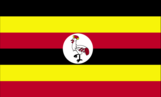
- six equal horizonal bands of black (top), yellow, red, black, yellow, and red; a white disk is superimposed at the center and depicts a red-crested crane (the national symbol) facing the staff side
- three equal horizontal bands of green (top), white, and black' with a thicker vertical red band on the hoist side
Independence
- 9 October 1962 (from UK)
- 2 December 1971 (from UK; formerly Trucial States)
Judicial branch
- Court of Appeal, High Court
- Union Supreme Court
Leaders
- Chief of State — President Lt. Gen. Yoweri Kaguta MUSEVENI (since 29 January 1986); Head of Government — Prime Minister Samson Babi Mululu KISEKKA (since 30 January 1986); First Deputy Prime Minister Eriya KATEGAYA (since NA) Political parties and leaders: only party — National Resistance Movement (NRM); note — the Uganda Patriotic Movement (UPM), Ugandan People's Congress (UPC), Democratic Party (DP), and Conservative Party (CP) are all proscribed from conducting public political activities
- Chief of State — President Shaykh Zayid bin Sultan Al NUHAYYAN of Abu Dhabi (since 2 December United Kingdom 1971); Vice President Shaykh Rashid bin Sa'id Al MAKTUM of Dubayy (since 2 December 1971; Head of Government — Prime Minister Shaykh Rashid bin Sa'id Al MAKTUM of Dubayy (Prime Minister since 30 April 1979); Deputy Prime Minister Maktum bin Rashid al MAKTUM (since 2 December 1971) Political parties and leaders: none
Legal system
- government plans to restore system based on English common law and customary law and reinstitute a normal judicial system; accepts compulsory ICJ jurisdiction, with reservations
- secular codes are being introduced by the UAE Government and in several member shaykhdoms; Islamic law remains influential
Legislative branch
- unicameral National Resistance Council
- unicameral Federal National Council
Long-form name
- Republic of Uganda
- United Arab Emirates (no short-form name); abbreviated UAE
Member of
- ACP, AfDB, CCC, Commonwealth, FAO, G-77, GATT, IAEA, IBRD, ICAC, ICAO, ICO, IDA, IDB— Islamic Development Bank, IFAD, IFC, ILO, IMF, INTELSAT, INTERPOL, ISO, ITU, NAM, OAU, QIC, UN, UNESCO, UPU, WHO, WIPO, WMO, WTO
- Arab League, CCC, FAO, G-77, GATT (de facto), GCC, IAEA, IBRD, ICAO, IDA, IDB— Islamic Development Bank, IFAD, IFC, ILO, IMF, IMO, INTELSAT, INTERPOL, ITU, NAM, OAPEC, QIC, OPEC, UN, UNESCO, UPU, WHO, WIPO, WTO
National holiday
- Independence Day, 9 October (1962)
- National Day, 2 December (1971)
Other political or pressure groups
a few small clandestine groups are active
Other political parties or pressure groups
Uganda People's Democratic Movement (UPDM), Uganda People's Front (UPF), Uganda Freedom Movement (UFM), Holy Spirit Movement (HSM)
Suffrage
- universal at age 18
- none
Type
- republic
- federation with specified powers delegated to the UAE central government and other powers reserved to member shaykhdoms
Economy
Agriculture
- accounts for 57% of GDP and 83% of labor force; cash crops — coffee, tea, cotton, tobacco; food crops — cassava, potatoes, corn, millet, pulses; livestock products — beef, goat meat, milk, poultry; self-sufficient in food
- accounts for 1% of GNP and 5% of labor force; cash crop — dates; food products — vegetables, watermelons, poultry, eggs, dairy, fish; only 25% selfsufficient in food
Aid
- US commitments, including Ex-Im (1970-88), $123 million; Western (non-US) countries, ODA and OOF bilateral commitments (1970-87), $1.0 billion; OPEC bilateral aid (1979-89), $60 million; Communist countries (1970-88), $140 million
- donor — pledged $9. 1 billion in bilateral aid to less developed countries (197989)
Budget
- revenues $365 million; expenditures $545 million, including capital expenditures of $165 million (FY89 est.)
- revenues S3. 5 billion; expenditures $4.0 billion, including capital expenditures of $N A (1989 est.)
Currency
- Ugandan shilling (plural — shillings); 1 Ugandan shilling (USh) = 100 cents
- Emirian dirham (plural — dirhams); 1 Emirian dirham (Dh) = 100 fils
Electricity
- 173,000 kW capacity; 312 million kWh produced, 18 kWh per capita (1989)
- 5,590,000 kW capacity; 15,000 million kWh produced, 7,090 kWh per capita (1989)
Exchange rates
- Ugandan shillings (USh) per US$1— 370 (December 1989), 223.09 (1989), 106.14(1988), 42.84(1987), 14.00 (1986), 6.72 (1985) Fiscal year 1 July-30 June
- Emirian dirhams (Dh) per US$1— 3.6710 (fixed rate)
Exports
- $272 million (f.o.b., 1988); commodities— coffee 97%, cotton, tea; partners—US 25%, UK 18%, France 1 1%, Spain 10%
- $10.6 billion (f.o.b., 1988 est.); commodities — crude oil 75%, natural gas, reexports, dried fish, dates; partners — US, EC, Japan
External debt
- $1.4 billion (1989 est.) Uganda (continued) United Arab Emirates
- $1 1.0 billion (December 1989 est.)
Fiscal year
calendar year
GDP
$4.9 billion, per capita $300 (1988); real growth rate 6.1% (1989 est.)
GNP
$23.3 billion, per capita $1 1,680; real growth rate -2.1% (1988)
Imports
- $626 million (c.i.f., 1988); commodities— petroleum products, machinery, cotton piece goods, metals, transportation equipment, food; partners — Kenya 25%, UK 14%, Italy 13%
- $8.5 billion (c.i.f., 1988 est.); commodities — food, consumer and capital goods; partners — EC, Japan, US
Industrial production
- growth rate 25.1% (1988)
- growth rate —9.3% (1986)
Industries
- sugar, brewing, tobacco, cotton textiles, cement
- petroleum, fishing, petrochemicals, construction materials, some boat building, handicrafts, pearling
Inflation rate (consumer prices)
- 72% (FY89)
- 5-6% (1988 est.)
Overview
- Uganda has substantial natural resources, including fertile soils, regular rainfall, and sizable mineral deposits of copper and cobalt. For most of the past 1 5 years the economy has been devastated by political instability, mismanagement, and civil war, keeping Uganda poor with a per capita income of about $300. (GDP remains below the levels of the early 1970s, as does industrial production.) Agriculture is the most important sector of the economy, employing over 80% of the work force. Coffee is the major export crop and accounted for 97% of export revenues in 1988. Since 1986 the government has acted to rehabilitate and stabilize the economy by undertaking currency reform, raising producer prices on export crops, increasing petroleum prices, and improving civil service wages. The policy changes are especially aimed at dampening inflation, which was running at over 300% in 1987, and boosting production and export earnings.
- The UAE has an open economy with one of the world's higher levels of income per capita. This wealth is based on oil and gas, and the fortunes of the economy fluctuate with the prices of those commodities. Since 1973, when petroleum prices shot up, the UAE has undergone a profound transformation from an impoverished region of small desert principalities to a modern state with a high standard of living. At present levels of production, crude oil reserves should last for over 100 years.
Unemployment rate
- NA%
- NEGL (1988)
Communications
Airports
- 39 total, 30 usable; 5 with permanent-surface runways; 1 with runways over 3,659 m; 3 with runways 2,4403,659 m; 10 with runways 1,220-2,439 m
- 40 total, 34 usable; 19 with permanent-surface runways; 8 with runways over 3,659 m; 5 with runways 2,4403,659 m; 4 with runways 1,220-2,439 m
Branches
- National Resistance Army (NRA)
- Army, Navy, Air Force, Central Military Command, Federal Police Force
Civil air
- 4 major transport aircraft
- 8 major transport aircraft
Defense expenditures
- 1.4% of GDP (1985) Persian Gulf „„-. ., Kh.vm«h Umm al Qaywayn i Sfr regional map VI
- $1.59 billion (1987) North Sea Edinburgh «\N«wca«l. ^upon Tyne Fnglish Channel Seereiionil mtp V
Highways
- 26,200 km total; 1,970 km paved; 5,849 km crushed stone, gravel, and laterite; remainder earth roads and tracks
- 2,000 km total; 1,800 km bituminous, 200 km gravel and graded earth
Inland waterways
Lake Victoria, Lake Albert, Lake Kyoga, Lake George, Lake Edward; Victoria Nile, Albert Nile; principal inland water ports are at Jinja and Port Bell, both on Lake Victoria
Merchant marine
- 1 roll-on/roll-off cargo (1,000 CRT or over) totaling 1,697 GRT
- 47 ships (1,000 CRT or over) totaling 728,332 GRT/1, 181,566 DWT; includes 14 cargo, 7 container, 2 roll-on/ro'1-off cargo, 20 petroleum, oils, and lubricants (POL) tanker, 4 bulk
Military manpower
- males 1 5-49, about 3,836,921; about 2,084,813 fit for military service
- males 15-49, 904,690; 498,082 fit for military service
Pipelines
830 km crude oil; 870 km natural gas, including natural gas liquids
Ports
Al Fujayrah, Khawr Fakkan, MTna' Jabal 'AH, Mlna' Khalid, Mlna' Rashid, Mlna' Saqr, Mlna' Zayid
Railroads
1,300km, 1 .000-meter-gauge single track
Telecommunications
- fair system with radio relay and radio communications stations; 61,600 telephones; stations — 10 AM, no FM, 9 TV; satellite earth stations— 1 Atlantic Ocean INTELSAT and 1 Indian Ocean INTELSAT Defense Forces
- adequate system of radio relay and coaxial cable; key centers are Abu Dhabi and Dubayy; 386,600 telephones; stations— 8 AM, 3 FM, 12 TV; satellite earth stations — 1 Atlantic Ocean INTELSAT, 2 Indian Ocean INTELSAT and 1 ARABSAT; submarine cables to Qatar, Bahrain, India, and Pakistan; tropospheric scatter to Bahrain; radio relay to Saudi Arabia Defense Forces