2013 Edition
CIA World Factbook 2013 Archive (HTML)
Introduction
Background
In 1974, ethnic differences within the British colony of the Gilbert and Ellice Islands caused the Polynesians of the Ellice Islands to vote for separation from the Micronesians of the Gilbert Islands. The following year, the Ellice Islands became the separate British colony of Tuvalu. Independence was granted in 1978. In 2000, Tuvalu negotiated a contract leasing its Internet domain name ".tv" for $50 million in royalties over a 12-year period.
Geography
Area
- 26 sq km 26 sq km 0 sq km
- total
- 26 sq km
- water
- 0 sq km
Area - comparative
0.1 times the size of Washington, DC
Climate
tropical; moderated by easterly trade winds (March to November); westerly gales and heavy rain (November to March)
Coastline
24 km
Elevation extremes
- Pacific Ocean 0 m unnamed location 5 m
- highest point
- unnamed location 5 m
- lowest point
- Pacific Ocean 0 m
Environment - current issues
since there are no streams or rivers and groundwater is not potable, most water needs must be met by catchment systems with storage facilities (the Japanese Government has built one desalination plant and plans to build one other); beachhead erosion because of the use of sand for building materials; excessive clearance of forest undergrowth for use as fuel; damage to coral reefs from the spread of the Crown of Thorns starfish; Tuvalu is concerned about global increases in greenhouse gas emissions and their effect on rising sea levels, which threaten the country's underground water table; in 2000, the government appealed to Australia and New Zealand to take in Tuvaluans if rising sea levels should make evacuation necessary
Environment - international agreements
- Biodiversity, Climate Change, Climate Change-Kyoto Protocol, Desertification, Law of the Sea, Ozone Layer Protection, Ship Pollution, Whaling none of the selected agreements
- party to
- Biodiversity, Climate Change, Climate Change-Kyoto Protocol, Desertification, Law of the Sea, Ozone Layer Protection, Ship Pollution, Whaling
- signed, but not ratified
- none of the selected agreements
Geographic coordinates
8 00 S, 178 00 E
Geography - note
one of the smallest and most remote countries on Earth; six of the nine coral atolls - Nanumea, Nui, Vaitupu, Nukufetau, Funafuti, and Nukulaelae - have lagoons open to the ocean; Nanumaya and Niutao have landlocked lagoons; Niulakita does not have a lagoon
Irrigated land
NA
Land boundaries
0 km
Land use
- 0% 60% 40% (2011)
- arable land
- 0%
- other
- 40% (2011)
- permanent crops
- 60%
Location
Oceania, island group consisting of nine coral atolls in the South Pacific Ocean, about one-half of the way from Hawaii to Australia
Map references
Oceania
Maritime claims
- 12 nm 24 nm 200 nm
- contiguous zone
- 24 nm
- exclusive economic zone
- 200 nm
- territorial sea
- 12 nm
Natural hazards
severe tropical storms are usually rare, but in 1997 there were three cyclones; low levels of islands make them sensitive to changes in sea level
Natural resources
fish
Terrain
low-lying and narrow coral atolls
People and Society
Age structure
- 29.8% (male 1,637/female 1,555) 20.9% (male 1,197/female 1,044) 35.8% (male 1,846/female 1,985) 8.1% (male 352/female 514) 5.3% (male 238/female 330) (2013 est.)
- 0-14 years
- 29.8% (male 1,637/female 1,555)
- 15-24 years
- 20.9% (male 1,197/female 1,044)
- 25-54 years
- 35.8% (male 1,846/female 1,985)
- 55-64 years
- 8.1% (male 352/female 514)
- 65 years and over
- 5.3% (male 238/female 330) (2013 est.)
Birth rate
23.56 births/1,000 population (2013 est.)
Children under the age of 5 years underweight
1.6% (2007)
Contraceptive prevalence rate
30.5% (2007)
Death rate
8.97 deaths/1,000 population (2013 est.)
Drinking water source
- urban: 98% of population rural: 97% of population total: 98% of population urban: 2% of population rural: 3% of population total: 2% of population (2010 est.)
- rural
- 3% of population
- total
- 2% of population (2010 est.)
- urban
- 2% of population
Education expenditures
NA
Ethnic groups
Polynesian 96%, Micronesian 4%
Health expenditures
17.3% of GDP (2011)
HIV/AIDS - adult prevalence rate
NA
HIV/AIDS - deaths
NA
HIV/AIDS - people living with HIV/AIDS
NA
Hospital bed density
5.6 beds/1,000 population (2001)
Infant mortality rate
- 32.61 deaths/1,000 live births 35.45 deaths/1,000 live births 29.63 deaths/1,000 live births (2013 est.)
- female
- 29.63 deaths/1,000 live births (2013 est.)
- total
- 32.61 deaths/1,000 live births
Languages
Tuvaluan (official), English (official), Samoan, Kiribati (on the island of Nui)
Life expectancy at birth
- 65.47 years 63.36 years 67.67 years (2013 est.)
- female
- 67.67 years (2013 est.)
- total population
- 65.47 years
Literacy
NA
Median age
- 24.6 years 23.4 years 26.3 years (2013 est.)
- female
- 26.3 years (2013 est.)
- male
- 23.4 years
- total
- 24.6 years
Nationality
- Tuvaluan(s) Tuvaluan
- adjective
- Tuvaluan
- noun
- Tuvaluan(s)
Net migration rate
-6.92 migrant(s)/1,000 population (2013 est.)
Physicians density
1.09 physicians/1,000 population (2009)
Population
10,698 (July 2013 est.)
Population growth rate
0.77% (2013 est.)
Religions
Protestant 98.4% (Church of Tuvalu (Congregationalist) 97%, Seventh-Day Adventist 1.4%), Baha'i 1%, other 0.6%
Sanitation facility access
- urban: 88% of population rural: 81% of population total: 85% of population urban: 12% of population rural: 19% of population total: 15% of population (2010 est.)
- rural
- 19% of population
- total
- 15% of population (2010 est.)
- urban
- 12% of population
School life expectancy (primary to tertiary education)
- 11 years 10 years 11 years (2001)
- female
- 11 years (2001)
- male
- 10 years
- total
- 11 years
Sex ratio
- 1.05 male(s)/female 1.06 male(s)/female 1.17 male(s)/female 0.91 male(s)/female 0.71 male(s)/female 0.73 male(s)/female 0.97 male(s)/female (2013 est.)
- 0-14 years
- 1.06 male(s)/female
- 15-24 years
- 1.17 male(s)/female
- 25-54 years
- 0.91 male(s)/female
- 55-64 years
- 0.71 male(s)/female
- 65 years and over
- 0.73 male(s)/female
- at birth
- 1.05 male(s)/female
- total population
- 0.97 male(s)/female (2013 est.)
Total fertility rate
3.06 children born/woman (2013 est.)
Urbanization
- 50% of total population (2010) 1.4% annual rate of change (2010-15 est.)
- rate of urbanization
- 1.4% annual rate of change (2010-15 est.)
- urban population
- 50% of total population (2010)
Government
Administrative divisions
7 island councils and 1 town council*; Funafuti*, Nanumaga, Nanumea, Niutao, Nui, Nukufetau, Nukulaelae, Vaitupu
Capital
- Funafuti 8 31 S, 179 13 E UTC+12 (17 hours ahead of Washington, DC during Standard Time) administrative offices are in Vaiaku Village on Fongafale Islet
- geographic coordinates
- 8 31 S, 179 13 E
- name
- Funafuti
- time difference
- UTC+12 (17 hours ahead of Washington, DC during Standard Time)
Constitution
previous 1978 (at independence); latest effective 1 October 1986; amended 2007, 2010 (2010)
Country name
- none Tuvalu none Tuvalu Ellice Islands "Tuvalu" means "group of eight" referring to the country's eight traditionally inhabited islands
- conventional long form
- none
- conventional short form
- Tuvalu
- former
- Ellice Islands
- local long form
- none
- local short form
- Tuvalu
Diplomatic representation from the US
the US does not have an embassy in Tuvalu; the US ambassador to Fiji, currently Ambassador Frankie A. REED, is accredited to Tuvalu
Diplomatic representation in the US
- Ambassador Aunese Makoi SIMATI (since 11 January 2013) Note - Tuvalu does not have an embassy in Washington, D.C.; UN office located at 800 2nd Avenue, Suite 400D, New York, NY 10017 [1] (212) 490-0534 [1] (212) 937-0692
- chancery
- Note - Tuvalu does not have an embassy in Washington, D.C.; UN office located at 800 2nd Avenue, Suite 400D, New York, NY 10017
- chief of mission
- Ambassador Aunese Makoi SIMATI (since 11 January 2013)
- FAX
- [1] (212) 937-0692
- telephone
- [1] (212) 490-0534
Executive branch
- Queen ELIZABETH II (since 6 February 1952); represented by Governor General Iakoba TAEIA Italeli (since May 2010) Prime Minister Enele SOPOAGA (since 5 August 2013) Cabinet appointed by the governor general on the recommendation of the prime minister the monarchy is hereditary; governor general appointed by the monarch on the recommendation of the prime minister; prime minister and deputy prime minister elected by and from the members of parliament following parliamentary elections Willie TELAVI removed as prime minister by the governor-general on 1 August 2013; Enele SOPOAGA elected 4 August 2013 in a 8 to 5 vote by the House of Assembly
- cabinet
- Cabinet appointed by the governor general on the recommendation of the prime minister
- chief of state
- Queen ELIZABETH II (since 6 February 1952); represented by Governor General Iakoba TAEIA Italeli (since May 2010)
- election results
- Willie TELAVI removed as prime minister by the governor-general on 1 August 2013; Enele SOPOAGA elected 4 August 2013 in a 8 to 5 vote by the House of Assembly
- elections
- the monarchy is hereditary; governor general appointed by the monarch on the recommendation of the prime minister; prime minister and deputy prime minister elected by and from the members of parliament following parliamentary elections
- head of government
- Prime Minister Enele SOPOAGA (since 5 August 2013)
Flag description
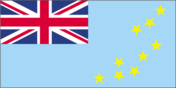
light blue with the flag of the UK in the upper hoist-side quadrant; the outer half of the flag represents a map of the country with nine yellow, five-pointed stars on a blue field symbolizing the nine atolls in the ocean
Government type
parliamentary democracy and a Commonwealth realm
Independence
1 October 1978 (from the UK)
International law organization participation
has not submitted an ICJ jurisdiction declaration; non-party state to the ICCt
International organization participation
ACP, ADB, AOSIS, C, FAO, IBRD, IDA, IFRCS (observer), ILO, IMF, IMO, IOC, ITU, OPCW, PIF, Sparteca, SPC, UN, UNCTAD, UNESCO, UNIDO, UPU, WHO
Judicial branch
- Court of Appeal is the Fiji Court of Appeal on Fiji Island (consists of the chief justice who visits twice a year); High Court, located on Fiji, consists of the chief justice of Fiji who presides over its sessions chief justice appointed by the president of Fiji on the advice of the prime minister following consultation with the parliamentary leader of the opposition; justices of the Court of Appeal, and puisne judges of the High Court are appointed by the president of Fiji, upon the nomination of the Judicial Service Commission, after consulting with the Cabinet Minister and the committee of the House of Representatives responsible for the administration of justice; the chief justice and justices of Appeal generally required to retire at age 70; puisine judges appointed for not less than 4 years nor more than 7 years with mandatory retirement at age 65 magistrates' courts; island courts; lands courts
- highest court(s)
- Court of Appeal is the Fiji Court of Appeal on Fiji Island (consists of the chief justice who visits twice a year); High Court, located on Fiji, consists of the chief justice of Fiji who presides over its sessions
- judge selection and term of office
- chief justice appointed by the president of Fiji on the advice of the prime minister following consultation with the parliamentary leader of the opposition; justices of the Court of Appeal, and puisne judges of the High Court are appointed by the president of Fiji, upon the nomination of the Judicial Service Commission, after consulting with the Cabinet Minister and the committee of the House of Representatives responsible for the administration of justice; the chief justice and justices of Appeal generally required to retire at age 70; puisine judges appointed for not less than 4 years nor more than 7 years with mandatory retirement at age 65
- subordinate courts
- magistrates' courts; island courts; lands courts
Legal system
mixed legal system of English common law and local customary law
Legislative branch
- unicameral Parliament or Fale I Fono, also called House of Assembly (15 seats; members elected by popular vote to serve four-year terms) last held on 16 September 2010 (next to be held in 2014) percent of vote - NA; seats - independents 15; 10 members reelected
- election results
- percent of vote - NA; seats - independents 15; 10 members reelected
- elections
- last held on 16 September 2010 (next to be held in 2014)
National anthem
- "Tuvalu mo te Atua" (Tuvalu for the Almighty) Afaese MANOA adopted 1978; the anthem's name is also the nation's motto
- lyrics/music
- Afaese MANOA
- name
- "Tuvalu mo te Atua" (Tuvalu for the Almighty)
National holiday
Independence Day, 1 October (1978)
Political parties and leaders
there are no political parties but members of parliament usually align themselves in informal groupings
Political pressure groups and leaders
none
Suffrage
18 years of age; universal
Economy
Agriculture - products
coconuts; fish
Budget
- $21.54 million $23.05 million (2006)
- expenditures
- $23.05 million (2006)
- revenues
- $21.54 million
Budget surplus (+) or deficit (-)
-3.8% of GDP (2006)
Current account balance
$-7.7 million (2010 est.) $-11.68 million (2003)
Debt - external
$NA
Economy - overview
Tuvalu consists of a densely populated, scattered group of nine coral atolls with poor soil. Only eight of the atolls are inhabited. The country has no known mineral resources and few exports and is almost entirely dependent upon imported food and fuel. Subsistence farming and fishing are the primary economic activities. Fewer than 1,000 tourists, on average, visit Tuvalu annually. Job opportunities are scarce and public sector workers make up most of those employed. About 15% of the adult male population work as seamen on merchant ships abroad, and remittances are a vital source of income contributing around $2 million in 2007. Substantial income is received annually from the Tuvalu Trust Fund (TTF) an international trust fund established in 1987 by Australia, NZ, and the UK and supported also by Japan and South Korea. Thanks to wise investments and conservative withdrawals, this fund grew from an initial $17 million to an estimated value of $77 million in 2006. The TTF contributed nearly $9 million towards the government budget in 2006 and is an important cushion for meeting shortfalls in the government's budget. The US Government is also a major revenue source for Tuvalu because of payments from a 1988 treaty on fisheries. In an effort to ensure financial stability and sustainability, the government is pursuing public sector reforms, including privatization of some government functions and personnel cuts. Tuvalu also derives royalties from the lease of its ".tv" Internet domain name with revenue of more than $2 million in 2006. A minor source of government revenue comes from the sale of stamps and coins. With merchandise exports only a fraction of merchandise imports, continued reliance must be placed on fishing and telecommunications license fees, remittances from overseas workers, official transfers, and income from overseas investments. Growing income disparities and the vulnerability of the country to climatic change are among leading concerns for the nation.
Exchange rates
Tuvaluan dollars or Australian dollars (AUD) per US dollar - 0.97 (2011) 1.67 (2011 est.) 1.67 (2010) 1.28 (2009) 1.21 (2008)
Exports
$600,000 (2010 est.) $1 million (2004 est.)
Exports - commodities
copra, fish
Fiscal year
calendar year
GDP - composition, by sector of origin
- 16.6% 27.2% 56.2% (2002)
- agriculture
- 16.6%
- industry
- 27.2%
- services
- 56.2% (2002)
GDP - per capita (PPP)
$3,400 (2012 est.) $3,500 (2011 est.) $3,200 (2010 est.)
GDP - real growth rate
0.2% (2012 est.) 8.5% (2011 est.) -2.7% (2010 est.)
GDP (official exchange rate)
$39.46 million (2012 est.)
GDP (purchasing power parity)
$39 million (2012 est.) $38.66 million (2011 est.) $35.27 million (2010 est.) data are in 2012 US dollars
Household income or consumption by percentage share
- NA% NA%
- highest 10%
- NA%
- lowest 10%
- NA%
Imports
$16.5 million (2010 est.) $12.91 million (2005)
Imports - commodities
food, animals, mineral fuels, machinery, manufactured goods
Industrial production growth rate
NA%
Industries
fishing, tourism, copra
Inflation rate (consumer prices)
3.8% (2006 est.)
Labor force
3,615 (2004 est.)
Labor force - by occupation
- people make a living mainly through exploitation of the sea, reefs, and atolls and from wages sent home by those abroad (mostly workers in the phosphate industry and sailors)
- note
- people make a living mainly through exploitation of the sea, reefs, and atolls and from wages sent home by those abroad (mostly workers in the phosphate industry and sailors)
Population below poverty line
NA%
Taxes and other revenues
54.6% of GDP (2006)
Unemployment rate
NA%
Communications
Broadcast media
no TV stations; many households use satellite dishes to watch foreign TV stations; 1 government-owned radio station, Radio Tuvalu, includes relays of programming from international broadcasters (2009)
Internet country code
.tv
Internet hosts
145,158 (2012)
Internet users
4,200 (2008)
Telephone system
- serves particular needs for internal communications radiotelephone communications between islands country code - 688; international calls can be made by satellite (2007)
- domestic
- radiotelephone communications between islands
- general assessment
- serves particular needs for internal communications
- international
- country code - 688; international calls can be made by satellite (2007)
Telephones - main lines in use
1,450 (2012)
Telephones - mobile cellular
2,800 (2012)
Transportation
Airports
1 (2013)
Airports - with unpaved runways
- 1 (2013)
- 1,524 to 2,437 m
- 1 (2013)
- total
- 1
Merchant marine
- bulk carrier 4, cargo 24, chemical tanker 15, container 1, passenger 2, passenger/cargo 1, petroleum tanker 10, refrigerated cargo 1 33 (China 4, Indonesia 1, Maldives 1, Singapore 19, South Korea 1, Turkey 1, Vietnam 6) (2010)
- foreign-owned
- 33 (China 4, Indonesia 1, Maldives 1, Singapore 19, South Korea 1, Turkey 1, Vietnam 6) (2010)
- total
- 58
Ports and terminals
Funafuti
Roadways
- 8 km 8 km (2011)
- total
- 8 km
Military and Security
Manpower fit for military service
- 2,021 2,026 (2010 est.)
- females age 16-49
- 2,026 (2010 est.)
- males age 16-49
- 2,021
Manpower reaching militarily significant age annually
- 111 (2010 est.)
- female
- 111 (2010 est.)
- male
- 119
Military branches
no regular military forces; Tuvalu Police Force (2012)
Military expenditures
NA
Transnational Issues
Disputes - international
none