1998 Edition
CIA World Factbook 1998 (Internet Archive)
Geography
Area
total: 26 sq km land: 26 sq km water: 0 sq km
Area-comparative
0.1 times the size of Washington, DC
Climate
tropical; moderated by easterly trade winds (March to November); westerly gales and heavy rain (November to March)
Coastline
24 km
Elevation extremes
lowest point: Pacific Ocean 0 m highest point: unnamed location 5 m
Environment-current issues
since there are no streams or rivers and groundwater is not potable, all water needs must be met by catchment systems with storage facilities; beachhead erosion because of the use of sand for building materials; excessive clearance of forest undergrowth for use as fuel; damage to coral reefs from the spread of the Crown of Thorns starfish; Tuvalu is very concerned about global increases in greenhouse gas emissions and their effect on rising sea levels, which threaten the country's underground water table
Environment-international agreements
party to: Climate Change, Endangered Species, Marine Dumping, Ozone Layer Protection, Ship Pollution, Whaling signed, but not ratified: Biodiversity, Law of the Sea
Geographic coordinates
8 00 S, 178 00 E
Irrigated land
NA sq km
Land boundaries
0 km
Land use
arable land: 0% permanent crops: 0% permanent pastures: 0% forests and woodland: 0% other: 100% (1993 est.) note: Tuvalu's nine coral atolls have enough soil to grow coconuts and support subsistence agriculture
Location
Oceania, island group consisting of nine coral atolls in the South Pacific Ocean, about one-half of the way from Hawaii to Australia
Map references
Oceania
Maritime claims
contiguous zone: 24 nm exclusive economic zone: 200 nm territorial sea: 12 nm
Natural hazards
severe tropical storms are usually rare, but, in 1997, there were three cyclones
Natural resources
fish
Terrain
very low-lying and narrow coral atolls
People and Society
Age structure
0-14 years: 35% (male 1,875; female 1,804) 15-64 years: 60% (male 2,980; female 3,290) 65 years and over: 5% (male 226; female 269) (July 1998 est.)
Birth rate
22.6 births/1,000 population (1998 est.)
Death rate
8.62 deaths/1,000 population (1998 est.)
Ethnic groups
Polynesian 96%
Infant mortality rate
26.23 deaths/1,000 live births (1998 est.)
Languages
Tuvaluan, English
Life expectancy at birth
total population: 63.88 years male: 62.72 years female: 65.09 years (1998 est.)
Literacy
NA; note-education is free and compulsory from ages 6 through 13
Nationality
noun: Tuvaluan(s) adjective: Tuvaluan
Net migration rate
0 migrant(s)/1,000 population (1998 est.)
Population
10,444 (July 1998 est.)
Population growth rate
1.4% (1998 est.)
Religions
Church of Tuvalu (Congregationalist) 97%, Seventh-Day Adventist 1.4%, Baha'i 1%, other 0.6%
Sex ratio
at birth: 1.05 male(s)/female under 15 years: 1.04 male(s)/female 15-64 years: 0.91 male(s)/female 65 years and over: 0.84 male(s)/female (1998 est.)
Total fertility rate
3.11 children born/woman (1998 est.)
Government
Administrative divisions
none
Constitution
1 October 1978
Country name
conventional long form: none conventional short form: Tuvalu former: Ellice Islands
Data code
TV
Executive branch
chief of state: Queen ELIZABETH II of the UK (since 6 February 1952), represented by Governor General Manuella TULAGA (since NA June 1994) head of government: Prime Minister Bikenibeu PAENIU (since 23 December 1996) and Deputy Prime Minister Kokeiya MALUA (since 8 April 1998); cabinet: Cabinet appointed by the governor general on the recommendation of the prime minister elections: the queen is a hereditary monarch; governor general appointed by the queen on the recommendation of the prime minister; prime minister and deputy prime minister elected by and from the members of Parliament; election last held 8 April 1998 (next to be held NA 2002) election results: Bikenibeu PAENIU reelected prime minister by a vote in Parliament of 10 to 2; Kokeiya MALUA elected deputy prime minister; percent of Parliament vote-NA
Flag description
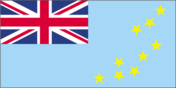
light blue with the flag of the UK in the upper hoist-side quadrant; the outer half of the flag represents a map of the country with nine yellow five-pointed stars symbolizing the nine islands
Government type
constitutional monarchy with a parliamentary democracy; began debating republic status in 1992
Independence
1 October 1978 (from UK)
International organization participation
AsDB, C (special), ESCAP, Intelsat (nonsignatory user), ITU, Sparteca, SPC, SPF, UNESCO, UPU, WHO, WTrO (applicant) Diplomatic representation in the US: Tuvalu does not have an embassy in the US Diplomatic representation from the US: the US does not have an embassy in Tuvalu; the US ambassador to Fiji is accredited to Tuvalu
Judicial branch
eight Island Courts; High Court; note-a chief justice visits twice a year to preside over sessions of the High Court Political parties and leaders: there are no political parties but members of Parliament usually align themselves in informal groupings
Legal system
NA
Legislative branch
unicameral Parliament or Fale I Fono, also called House of Assembly (12 seats-two from each island with more than 1,000 inhabitants, one from all the other inhabited islands; members elected by popular vote to serve four-year terms) elections: last held 26-27 March 1998 (next to be held by NA 2002) election results: percent of vote-NA; seats-independents 12
National capital
Funafuti
National holiday
Independence Day, 1 October (1978)
Suffrage
18 years of age; universal
Economy
Agriculture-products
coconuts; fish
Budget
revenues: $4.3 million expenditures: $4.3 million, including capital expenditures of $NA (1989 est.)
Currency
1 Tuvaluan dollar ($T) or 1 Australian dollar ($A) = 100 cents
Debt-external
$NA
Economic aid
recipient: ODA, $1.725 million from Australia (FY96/97 est.); $1.7 million from NZ (FY95/96); note: substantial annual support from an international trust fund
Economy-overview
Tuvalu consists of a densely populated, scattered group of nine coral atolls with poor soil. The country has no known mineral resources and few exports. Subsistence farming and fishing are the primary economic activities. The islands are too small and too remote for development of a large-scale tourist industry. Government revenues largely come from the sale of stamps and coins and worker remittances. About 1,000 Tuvaluans work in Nauru in the phosphate mining industry. Nauru has begun repatriating Tuvaluans, however, as phosphate resources decline, which will present additional problems for Tuvalu's already stretched economy. Substantial income is received annually from an international trust fund established in 1987 by Australia, NZ, and the UK and supported also by Japan and South Korea. In an effort to reduce its dependence on foreign aid, the government is pursuing public sector reforms, including privatization of some government functions and personnel cuts of up to 7%. Low-lying Tuvalu is particularly vulnerable to any future global warming.
Electricity-capacity
2,600 kW (1995)
Electricity-consumption per capita
NA kWh
Electricity-production
3 million kWh (1995)
Exchange rates
Tuvaluan dollars ($T) or Australian dollars ($A) per US$1-1.5281 (January 1998), 1.3439 (1997), 1.2773 (1996), 1.3486 (1995), 1.3667 (1994), 1.4704 (1993)
Exports
total value: $165,000 (f.o.b., 1989) commodities: copra partners: Fiji, Australia, NZ
Fiscal year
calendar year Communications
GDP
purchasing power parity-$7.8 million (1995 est.)
GDP-composition by sector
agriculture: NA% industry: NA% services: NA%
GDP-per capita
purchasing power parity-$800 (1995 est.)
GDP-real growth rate
8.7% (1995)
Imports
total value: $4.4 million (c.i.f., 1989) commodities: food, animals, mineral fuels, machinery, manufactured goods partners: Fiji, Australia, NZ
Industrial production growth rate
NA%
Industries
fishing, tourism, copra
Inflation rate-consumer price index
3.9% (average 1985-93)
Labor force
NA by occupation: NA note: people make a living mainly through exploitation of the sea, reefs, and atolls and from wages sent home by those working abroad (mostly workers in the phosphate industry and sailors)
Radio broadcast stations
AM 1, FM 0, shortwave 0
Radios
4,000 (1993 est.)
Telephone system
domestic: radiotelephone communications between islands international: NA
Telephones
130 (1983 est.)
Television broadcast stations
0
Televisions
NA
Unemployment rate
NA%
Transportation
Airports
1 (1997 est.) Airports-with unpaved runways: total: 1 1,524 to 2,437 m: 1 (1997 est.)
Highways
total: 8 km (1996 est.) paved: NA km unpaved: NA km Ports and harbors: Funafuti, Nukufetau
Merchant marine
total: 14 ships (1,000 GRT or over) totaling 53,220 GRT/83,118 DWT ships by type: cargo 8, chemical tanker 4, oil tanker 1, passenger-cargo 1 (1997 est.)
Railways
0 km
Military and Security
Military branches
no regular military forces; Police Force (consists of 56 fulland part-time personnel)
Military expenditures-dollar figure
$NA
Military expenditures-percent of GDP
NA%
Transnational Issues
Disputes-international
none