1994 Edition
CIA World Factbook 1994 (Project Gutenberg)
Introduction
Administrative divisions
none
Agriculture
coconuts and fish
Airports
total: 1 usable: 1 with permanent-surface runways: with runways over 3,659 m: with runways 2,440-3,659 m: with runways 1,220-2,439 m: 1
Area
total area: 26 sq km land area: 26 sq km comparative area: about 0.1 times the size of Washington, DC
Birth rate
25.73 births/1,000 population (1994 est.)
Branches
Police Force
Budget
revenues: $4.3 million expenditures: $4.3 million, including capital expenditures of $NA (1989 est.)
Capital
Funafuti
Climate
tropical; moderated by easterly trade winds (March to November); westerly gales and heavy rain (November to March)
Coastline
24 km
Constitution
1 October 1978
Currency
1 Tuvaluan dollar ($T) or 1 Australian dollar ($A) = 100 cents
Death rate
9.15 deaths/1,000 population (1994 est.)
Defense expenditures
$NA, NA% of GNP
Digraph
TV
Diplomatic representation in US
Tuvalu has no mission in the US
Economic aid
recipient: US commitments, including Ex-Im (FY70-87), $1 million; Western (non-US) countries, ODA and OOF bilateral commitments (1970-89), $101 million
Electricity
capacity: 2,600 kW production: 3 million kWh consumption per capita: 330 kWh (1990)
Environment
current issues: since there are no streams or rivers and groundwater is not potable, all water needs must be met by catchment systems with storage facilities natural hazards: severe tropical storms are rare international agreements: party to - Climate Change, Ozone Layer Protection, Ship Pollution; signed, but not ratified - Biodiversity, Law of the Sea
Ethnic divisions
Polynesian 96%
Exchange rates
Tuvaluan dollars ($T) or Australian dollars ($A) per US$1 - 1.4364 (January 1994), 1.4704 (1993), 1.3600 (1992), 1.2835 (1991), 1.2799 (1990), 1.2618 (1989)
Executive branch
chief of state: Queen ELIZABETH II (since 6 February 1952), represented by Governor General Tomu Malaefono SIONE (since NA 1993) head of government: Prime Minister Kamuta LATASI (since 10 December 1993); Deputy Prime Minister Otinielu TAUSI (since 10 December 1993) cabinet: Cabinet; appointed by the governor general on recommendation of the prime minister
Exports
$165,000 (f.o.b., 1989) commodities: copra partners: Fiji, Australia, NZ
External debt
$NA
Fiscal year
NA
Flag
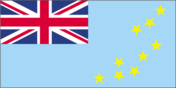
light blue with the flag of the UK in the upper hoist-side quadrant; the outer half of the flag represents a map of the country with nine yellow five-pointed stars symbolizing the nine islands
Highways
total: 8 km unpaved: gravel 8 km
Imports
$4.4 million (c.i.f., 1989) commodities: food, animals, mineral fuels, machinery, manufactured goods partners: Fiji, Australia, NZ
Independence
1 October 1978 (from UK)
Industrial production
growth rate NA%
Industries
fishing, tourism, copra
Infant mortality rate
27.3 deaths/1,000 live births (1994 est.)
Inflation rate (consumer prices)
2.9% (1989)
International disputes
none
Irrigated land
NA sq km
Judicial branch
High Court
Labor force
NA by occupation: NA
Land boundaries
0 km
Land use
arable land: 0% permanent crops: 0% meadows and pastures: 0% forest and woodland: 0% other: 100%
Languages
Tuvaluan, English
Legal system
NA
Legislative branch
unicameral
Life expectancy at birth
total population: 63.03 years male: 61.57 years female: 64.08 years (1994 est.)
Literacy
total population: NA% male: NA% female: NA%
Location
Oceania, Polynesia, 3,000 km east of Papua New Guinea in the South Pacific Ocean
Map references
Oceania, Standard Time Zones of the World
Maritime claims
contiguous zone: 24 nm exclusive economic zone: 200 nm territorial sea: 12 nm
Member of
ACP, AsDB, C (special), ESCAP, INTELSAT (nonsignatory user), ITU, SPARTECA, SPC, SPF, UNESCO, UPU, WHO
Merchant marine
7 ships (1,000 GRT or over) totaling 57,067 GRT/102,037 DWT, chemical tanker 4, oil tanker 2, passenger-cargo 1
Names
conventional long form: none conventional short form: Tuvalu former: Ellice Islands
National holiday
Independence Day, 1 October (1978)
National product
GNP - exchange rate conversion - $6.4 million (1990)
National product per capita
$700 (1990)
National product real growth rate
4% (1990 est.)
Nationality
noun: Tuvaluans(s) adjective: Tuvaluan
Natural resources
fish
Net migration rate
0 migrant(s)/1,000 population (1994 est.)
Overview
Tuvalu consists of a scattered group of nine coral atolls with poor soil. The country has no known mineral resources and few exports. Subsistence farming and fishing are the primary economic activities. The islands are too small and too remote for development of a tourist industry. Government revenues largely come from the sale of stamps and coins and worker remittances. Substantial income is received annually from an international trust fund established in 1987 by Australia, NZ, and the UK and supported also by Japan and South Korea.
Parliament (Palamene)
elections last held 25 November 1993 (next to be held by NA 1997); results - percent of vote NA; seats - (12 total)
Political parties and leaders
none
Population
9,831 (July 1994 est.)
Population growth rate
1.66% (1994 est.)
Ports
Funafuti, Nukufetau
Religions
Church of Tuvalu (Congregationalist) 97%, Seventh-Day Adventist 1.4%, Baha'i 1%, other 0.6%
Suffrage
18 years of age; universal
Telecommunications
broadcast stations - 1 AM, no FM, no TV; 300 radiotelephones; 4,000 radios; 108 telephones
Terrain
very low-lying and narrow coral atolls
Total fertility rate
3.11 children born/woman (1994 est.)
Type
democracy; began debating republic status in 1992; referendum expected in 1993
Unemployment rate
NA%
US diplomatic representation
none