2018 Edition
CIA World Factbook 2018 Archive (Wayback Machine)
Introduction
Background
Present-day Turkmenistan covers territory that has been at the crossroads of civilizations for centuries. The area was ruled in antiquity by various Persian empires, and was conquered by Alexander the Great, Muslim armies, the Mongols, Turkic warriors, and eventually the Russians. In medieval times, Merv (located in present-day Mary province) was one of the great cities of the Islamic world and an important stop on the Silk Road. Annexed by Russia in the late 1800s, Turkmenistan later figured prominently in the anti-Bolshevik movement in Central Asia. In 1924, Turkmenistan became a Soviet republic; it achieved independence upon the dissolution of the USSR in 1991. Extensive hydrocarbon/natural gas reserves, which have yet to be fully exploited, have begun to transform the country. The Government of Turkmenistan is moving to expand its extraction and delivery projects and has attempted to diversify its gas export routes beyond Russia's pipeline network. In 2010, new gas export pipelines that carry Turkmen gas to China and to northern Iran began operating, effectively ending the Russian monopoly on Turkmen gas exports. In 2016 and 2017, Turkmen sales of natural gas were halted to Russia and Iran, respectively, making China the sole major buyer of Turkmen gas. President for Life Saparmurat NYYAZOW died in December 2006, and Turkmenistan held its first multi-candidate presidential election in February 2007. Gurbanguly BERDIMUHAMEDOW, a deputy cabinet chairman under NYYAZOW, emerged as the country's new president. He was reelected in 2012 and again in 2017 with over 97% of the vote in both instances, in elections widely regarded as undemocratic.
Geography
Area
- land
- 469,930 sq km
- total
- 488,100 sq km
- water
- 18,170 sq km
Area Comparative
slightly more than three times the size of Georgia; slightly larger than California
Climate
subtropical desert
Coastline
0 km (landlocked); note - Turkmenistan borders the Caspian Sea (1,768 km)
Elevation
- elevation extremes
- -81 m lowest point: Vpadina Akchanaya (Sarygamysh Koli is a lake in northern Turkmenistan with a water level that fluctuates above and below the elevation of Vpadina Akchanaya, the lake has dropped as low as -110 m)
- mean elevation
- 230 m
- note
- 3139 highest point: Gora Ayribaba
Environment Current Issues
contamination of soil and groundwater with agricultural chemicals, pesticides; salination, water logging of soil due to poor irrigation methods; Caspian Sea pollution; diversion of a large share of the flow of the Amu Darya into irrigation contributes to that river's inability to replenish the Aral Sea; soil erosion; desertification
Environment International Agreements
- party to
- Biodiversity, Climate Change, Climate Change-Kyoto Protocol, Desertification, Hazardous Wastes, Ozone Layer Protection
- signed, but not ratified
- none of the selected agreements
Geographic Coordinates
40 00 N, 60 00 E
Geography Note
landlocked; the western and central low-lying desolate portions of the country make up the great Garagum (Kara-Kum) desert, which occupies over 80% of the country; eastern part is plateau
Irrigated Land
19,950 sq km (2012)
Land Boundaries
- border countries (4)
- Afghanistan 804 km, Iran 1148 km, Kazakhstan 413 km, Uzbekistan 1793 km
- total
- 4,158 km
Land Use
- arable land: 4.1% (2011 est.) / permanent crops: 0.1% (2011 est.) / permanent pasture: 67.8% (2011 est.)
- agricultural land
- 72% (2011 est.)
- forest
- 8.8% (2011 est.)
- other
- 19.2% (2011 est.)
Location
Central Asia, bordering the Caspian Sea, between Iran and Kazakhstan
Map References
Asia
Maritime Claims
- note
- none (landlocked)
Natural Hazards
earthquakes; mudslides; droughts; dust storms; floods
Natural Resources
petroleum, natural gas, sulfur, salt
Population Distribution
the most densely populated areas are the southern, eastern, and northeastern oases; approximately 50% of the population lives in and around the capital of Ashgabat
Terrain
flat-to-rolling sandy desert with dunes rising to mountains in the south; low mountains along border with Iran; borders Caspian Sea in west
People and Society
Age Structure
- 0-14 years
- 25.66% (male 704,067 /female 684,581)
- 15-24 years
- 17.71% (male 482,094 /female 476,080)
- 25-54 years
- 43.52% (male 1,169,965 /female 1,185,159)
- 55-64 years
- 8.17% (male 208,328 /female 233,902)
- 65 years and over
- 4.93% (male 116,218 /female 150,618) (2018 est.)
Birth Rate
18.9 births/1,000 population (2018 est.)
Children Under The Age Of 5 Years Underweight
3.2% (2015)
Contraceptive Prevalence Rate
50.2% (2015/16)
Death Rate
6.1 deaths/1,000 population (2018 est.)
Dependency Ratios
- elderly dependency ratio
- 6.2 (2015 est.)
- potential support ratio
- 16.1 (2015 est.)
- total dependency ratio
- 52.7 (2015 est.)
- youth dependency ratio
- 46.5 (2015 est.)
Drinking Water Source
- improved: urban: 89.1% of population
- rural: 53.7% of population
- total: 71.1% of population
- unimproved: urban: 10.9% of population
- rural: 46.3% of population
- total: 28.9% of population (2012 est.)
Education Expenditures
3% of GDP (2012)
Ethnic Groups
Turkmen 85%, Uzbek 5%, Russian 4%, other 6% (2003)
Health Expenditures
2.1% of GDP (2014)
Hiv Aids Adult Prevalence Rate
NA
Hiv Aids Deaths
NA
Hiv Aids People Living With Hiv Aids
NA
Hospital Bed Density
7.4 beds/1,000 population (2013)
Infant Mortality Rate
- female
- 26 deaths/1,000 live births (2018 est.)
- male
- 39.8 deaths/1,000 live births (2018 est.)
- total
- 33.1 deaths/1,000 live births (2018 est.)
Languages
Turkmen (official) 72%, Russian 12%, Uzbek 9%, other 7%
Life Expectancy At Birth
- female
- 73.9 years (2018 est.)
- male
- 67.6 years (2018 est.)
- total population
- 70.7 years (2018 est.)
Literacy
- definition
- age 15 and over can read and write (2015 est.)
- female
- 99.6% (2015 est.)
- male
- 99.8% (2015 est.)
- total population
- 99.7% (2015 est.)
Major Urban Areas Population
810,000 ASHGABAT (capital) (2018)
Maternal Mortality Rate
42 deaths/100,000 live births (2015 est.)
Median Age
- female
- 28.8 years (2018 est.)
- male
- 27.8 years
- total
- 28.3 years
Nationality
- adjective
- Turkmen
- noun
- Turkmen(s)
Net Migration Rate
-1.8 migrant(s)/1,000 population (2017 est.)
Obesity Adult Prevalence Rate
18.6% (2016)
Physicians Density
2.29 physicians/1,000 population (2014)
Population
5,411,012 (July 2018 est.)
Population Growth Rate
1.1% (2018 est.)
Religions
Muslim 89%, Eastern Orthodox 9%, unknown 2%
Sanitation Facility Access
- improved: urban: 100% of population (2012 est.)
- rural: 98.2% of population (2012 est.)
- total: 99.1% of population (2012 est.)
- unimproved: urban: 0% of population (2012 est.)
- rural: 1.8% of population (2012 est.)
- total: 0.9% of population (2012 est.)
School Life Expectancy Primary To Tertiary Education
- female
- 11 years (2014)
- male
- 11 years (2014)
- total
- 11 years (2014)
Sex Ratio
- 0-14 years
- 1.03 male(s)/female (2017 est.)
- 15-24 years
- 1.01 male(s)/female (2017 est.)
- 25-54 years
- 0.98 male(s)/female (2017 est.)
- 55-64 years
- 0.89 male(s)/female (2017 est.)
- 65 years and over
- 0.77 male(s)/female (2017 est.)
- at birth
- 1.04 male(s)/female (2017 est.)
- total population
- 0.98 male(s)/female (2017 est.)
Total Fertility Rate
2.06 children born/woman (2018 est.)
Urbanization
- rate of urbanization
- 2.46% annual rate of change (2015-20 est.)
- urban population
- 51.6% of total population (2018)
Government
Administrative Divisions
- 5 provinces (welayatlar, singular - welayat) and 1 independent city*: Ahal Welayaty (Anew), Ashgabat*, Balkan Welayaty (Balkanabat), Dasoguz Welayaty, Lebap Welayaty (Turkmenabat), Mary Welayaty
- note
- administrative divisions have the same names as their administrative centers (exceptions have the administrative center name following in parentheses)
Capital
- geographic coordinates
- 37 57 N, 58 23 E
- name
- Ashgabat (Ashkhabad)
- time difference
- UTC+5 (10 hours ahead of Washington, DC, during Standard Time)
Citizenship
- citizenship by birth
- no
- citizenship by descent only
- at least one parent must be a citizen of Turkmenistan
- dual citizenship recognized
- yes
- residency requirement for naturalization
- 7 years
Constitution
- amendments
- proposed by the National Assembly; passage requires two-thirds majority vote of the total Assembly membership or absolute majority approval in a referendum; amended several times, last in 2016; note - in mid-2014, the president established a Constitutional Commission to initiate a process for developing constitutional reforms (2017)
- history
- adopted 18 May 1992 (2017)
Country Name
- conventional long form
- none
- conventional short form
- Turkmenistan
- etymology
- the suffix "-stan" means "place of" or "country," so Turkmenistan literally means the "Land of the Turkmen [people]"
- former
- Turkmen Soviet Socialist Republic
- local long form
- none
- local short form
- Turkmenistan
Diplomatic Representation From The Us
- chief of mission
- Ambassador Allan MUSTARD (since 20 January 2015)
- embassy
- No. 9 1984 Street (formerly Pushkin Street), Ashgabat, Turkmenistan 744000
- FAX
- [993] (12) 94-26-14
- mailing address
- 7070 Ashgabat Place, Washington, DC 20521-7070
- telephone
- [993] (12) 94-00-45
Diplomatic Representation In The Us
- chancery
- 2207 Massachusetts Avenue NW, Washington, DC 20008
- chief of mission
- Ambassador Meret Bairamovich ORAZOW (since 14 February 2001)
- FAX
- [1] (202) 588-0697
- telephone
- [1] (202) 588-1500
Executive Branch
- cabinet
- Cabinet of Ministers appointed by the president
- chief of state
- President Gurbanguly BERDIMUHAMEDOW (since 14 February 2007); note - the president is both chief of state and head of government
- election results
- Gurbanguly BERDIMUHAMEDOW reelected president in the first round; percent of vote - Gurbanguly BERDIMUHAMEDOW (DPT) 97.7%, other 2.3%
- elections/appointments
- president directly elected by absolute majority popular vote in 2 rounds if needed for a 7-year term (no term limits); election last held on 12 February 2017 (next to be held in February 2024)
- head of government
- President Gurbanguly BERDIMUHAMEDOW (since 14 February 2007)
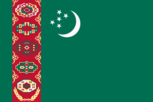
Flag Description
- green field with a vertical red stripe near the hoist side, containing five tribal guls (designs used in producing carpets) stacked above two crossed olive branches; five white stars and a white crescent moon appear in the upper corner of the field just to the fly side of the red stripe; the green color and crescent moon represent Islam; the five stars symbolize the regions or welayats of Turkmenistan; the guls reflect the national identity of Turkmenistan where carpet-making has long been a part of traditional nomadic life
- note
- the flag of Turkmenistan is the most intricate of all national flags
Government Type
presidential republic; authoritarian
Independence
27 October 1991 (from the Soviet Union)
International Law Organization Participation
has not submitted an ICJ jurisdiction declaration; non-party state to the ICCt
International Organization Participation
ADB, CIS (associate member, has not ratified the 1993 CIS charter although it participates in meetings and held the chairmanship of the CIS in 2012), EAPC, EBRD, ECO, FAO, G-77, IBRD, ICAO, ICRM, IDA, IDB, IFC, IFRCS, ILO, IMF, IMO, Interpol, IOC, IOM (observer), ISO (correspondent), ITU, MIGA, NAM, OIC, OPCW, OSCE, PFP, UN, UNCTAD, UNESCO, UNHCR, UNIDO, UNWTO, UPU, WCO, WFTU (NGOs), WHO, WIPO, WMO
Judicial Branch
- highest courts
- Supreme Court of Turkmenistan (consists of the court president and 21 associate judges and organized into civil, criminal, and military chambers)
- judge selection and term of office
- judges appointed by the president for 5-year terms
- subordinate courts
- High Commercial Court; appellate courts; provincial, district, and city courts; military courts
Legal System
civil law system with Islamic law influences
Legislative Branch
- description
- unicameral National Assembly or Mejlis (125 seats; members directly elected from single-seat constituencies by absolute majority vote; members serve 5-year terms)
- election results
- percent of vote by party - NA; seats by party - DPT 55, APT 11, PIE 11, independent 48 (individuals nominated by citizen groups); composition - men 94, women 31, percent of women 24.8%
- elections
- last held on 25 March 2018, although interim elections are held on an ad hoc basis to fill vacant sets
National Anthem
- lyrics/music
- collective/Veli MUKHATOV
- name
- "Garassyz, Bitarap Turkmenistanyn" (Independent, Neutral, Turkmenistan State Anthem)
- note
- adopted 1997, lyrics revised in 2008, to eliminate references to deceased President Saparmurat NYYAZOW
National Holiday
Independence Day, 27 October (1991)
National Symbol S
Akhal-Teke horse; national colors: green, white
Political Parties And Leaders
- Agrarian Party of Turkmenistan or APT [Bashim ANNAGURBANOW]Democratic Party of Turkmenistan or DPT [Ata SERDAROW]Organization of Trade Unions of TurkmenistanMagtymguly Youth OrganizationParty of Industrialists and Entrepreneurs or PIE [Saparmyrat OVGANOW]Women's Union of Turkmenistan
- note
- all of these parties support President BERDIMUHAMEDOW; a law authorizing the registration of political parties went into effect in January 2012; unofficial, small opposition movements exist abroad
Suffrage
18 years of age; universal
Economy
Agriculture Products
cotton, grain, melons; livestock
Budget
- expenditures
- 6.714 billion (2017 est.)
- revenues
- 5.657 billion (2017 est.)
Budget Surplus Or Deficit
-2.8% (of GDP) (2017 est.)
Central Bank Discount Rate
- 5% (31 December 2014)
- 5% (31 December 2013)
Commercial Bank Prime Lending Rate
- 19% (31 December 2017 est.)
- 16% (31 December 2016 est.)
Current Account Balance
- -$4.359 billion (2017 est.)
- -$7.207 billion (2016 est.)
Debt External
- $539.4 million (31 December 2017 est.)
- $425.3 million (31 December 2016 est.)
Distribution Of Family Income Gini Index
40.8 (1998)
Economy Overview
Turkmenistan is largely a desert country with intensive agriculture in irrigated oases and significant natural gas and oil resources. The two largest crops are cotton, most of which is produced for export, and wheat, which is domestically consumed. Although agriculture accounts for almost 8% of GDP, it continues to employ nearly half of the country's workforce. Hydrocarbon exports, the bulk of which is natural gas going to China, make up 25% of Turkmenistan’s GDP. Ashgabat has explored two initiatives to bring gas to new markets: a trans-Caspian pipeline that would carry gas to Europe and the Turkmenistan-Afghanistan-Pakistan-India gas pipeline. Both face major financing, political, and security hurdles and are unlikely to be completed soon.Turkmenistan’s autocratic governments under presidents NIYAZOW (1991-2006) and BERDIMUHAMEDOW (since 2007) have made little progress improving the business climate, privatizing state-owned industries, combatting corruption, and limiting economic development outside the energy sector. High energy prices in the mid-2000s allowed the government to undertake extensive development and social spending, including providing heavy utility subsidies.Low energy prices since mid-2014 are hampering Turkmenistan’s economic growth and reducing government revenues. The government has cut subsidies in several areas, and wage arrears have increased. In January 2014, the Central Bank of Turkmenistan devalued the manat by 19%, and downward pressure on the currency continues. There is a widening spread between the official exchange rate (3.5 TMM per US dollar) and the black market exchange rate (approximately 14 TMM per US dollar). Currency depreciation and conversion restrictions, corruption, isolationist policies, and declining spending on public services have resulted in a stagnate economy that is nearing crisis. Turkmenistan claims substantial foreign currency reserves, but non-transparent data limit international institutions’ ability to verify this information.
Exchange Rates
- Turkmen manat (TMM) per US dollar -
- 4.125 (2017 est.)
- 3.5 (2016 est.)
- 3.5 (2015 est.)
- 3.5 (2014 est.)
- 2.85 (2013 est.)
Exports
- $7.458 billion (2017 est.)
- $6.987 billion (2016 est.)
Exports Commodities
gas, crude oil, petrochemicals, textiles, cotton fiber
Exports Partners
China 83.7%, Turkey 5.1% (2017)
Fiscal Year
calendar year
Gdp Composition By End Use
- exports of goods and services
- 26.2% (2017 est.)
- government consumption
- 10% (2017 est.)
- household consumption
- 50% (2017 est.)
- imports of goods and services
- -14.3% (2017 est.)
- investment in fixed capital
- 28.2% (2017 est.)
- investment in inventories
- 0% (2017 est.)
Gdp Composition By Sector Of Origin
- agriculture
- 7.5% (2017 est.)
- industry
- 44.9% (2017 est.)
- services
- 47.7% (2017 est.)
Gdp Official Exchange Rate
$37.93 billion (2017 est.) (2017 est.)
Gdp Per Capita Ppp
- $18,200 (2017 est.)
- $17,300 (2016 est.)
- $16,500 (2015 est.)
- note
- data are in 2017 dollars
Gdp Purchasing Power Parity
- $103.7 billion (2017 est.)
- $97.41 billion (2016 est.)
- $91.72 billion (2015 est.)
- note
- data are in 2017 dollars
Gdp Real Growth Rate
- 6.5% (2017 est.)
- 6.2% (2016 est.)
- 6.5% (2015 est.)
Gross National Saving
- 23.9% of GDP (2017 est.)
- 24.3% of GDP (2016 est.)
- 18.9% of GDP (2015 est.)
Household Income Or Consumption By Percentage Share
- highest 10%
- 31.7% (1998)
- lowest 10%
- 31.7% (1998)
Imports
- $4.571 billion (2017 est.)
- $5.215 billion (2016 est.)
Imports Commodities
machinery and equipment, chemicals, foodstuffs
Imports Partners
Turkey 24.2%, Algeria 14.4%, Germany 9.8%, China 8.9%, Russia 8%, US 6.6% (2017)
Industrial Production Growth Rate
1% (2017 est.)
Industries
natural gas, oil, petroleum products, textiles, food processing
Inflation Rate Consumer Prices
- 8% (2017 est.)
- 3.6% (2016 est.)
Labor Force
2.305 million (2013 est.)
Labor Force By Occupation
- agriculture
- 48.2%
- industry
- 14%
- services
- 37.8% (2004 est.)
Market Value Of Publicly Traded Shares
- note
- NA
Population Below Poverty Line
0.2% (2012 est.)
Public Debt
- 28.8% of GDP (2017 est.)
- 24.1% of GDP (2016 est.)
Reserves Of Foreign Exchange And Gold
- $24.91 billion (31 December 2017 est.)
- $25.05 billion (31 December 2016 est.)
Stock Of Broad Money
- $12.23 billion (31 December 2015 est.)
- $5.632 billion (31 December 2014 est.)
Stock Of Direct Foreign Investment At Home
- $3.061 billion (2013 est.)
- $3.117 billion (2012 est.)
Stock Of Domestic Credit
- $28.4 billion (31 December 2015 est.)
- $13.09 billion (31 December 2014 est.)
Stock Of Narrow Money
- $1.326 billion (31 December 2015 est.)
- $1.255 billion (31 December 2014 est.)
Taxes And Other Revenues
14.9% (of GDP) (2017 est.)
Unemployment Rate
- 11% (2014 est.)
- 10.6% (2013)
Energy
Carbon Dioxide Emissions From Consumption Of Energy
100.5 million Mt (2017 est.)
Crude Oil Exports
67,790 bbl/day (2015 est.)
Crude Oil Imports
0 bbl/day (2015 est.)
Crude Oil Production
0 bbl/day (2017 est.)
Crude Oil Proved Reserves
600 million bbl (1 January 2018 est.)
Electricity Access
- electrification - total population
- 100% (2016)
Electricity Consumption
15.09 billion kWh (2016 est.)
Electricity Exports
3.201 billion kWh (2015 est.)
Electricity From Fossil Fuels
100% of total installed capacity (2016 est.)
Electricity From Hydroelectric Plants
0% of total installed capacity (2017 est.)
Electricity From Nuclear Fuels
0% of total installed capacity (2017 est.)
Electricity From Other Renewable Sources
0% of total installed capacity (2017 est.)
Electricity Imports
0 kWh (2016 est.)
Electricity Installed Generating Capacity
4.001 million kW (2016 est.)
Electricity Production
21.18 billion kWh (2016 est.)
Natural Gas Consumption
39.31 billion cu m (2017 est.)
Natural Gas Exports
38.14 billion cu m (2017 est.)
Natural Gas Imports
0 cu m (2017 est.)
Natural Gas Production
77.45 billion cu m (2017 est.)
Natural Gas Proved Reserves
7.504 trillion cu m (1 January 2018 est.)
Refined Petroleum Products Consumption
160,000 bbl/day (2016 est.)
Refined Petroleum Products Exports
53,780 bbl/day (2015 est.)
Refined Petroleum Products Imports
0 bbl/day (2015 est.)
Refined Petroleum Products Production
191,100 bbl/day (2015 est.)
Communications
Broadband Fixed Subscriptions
- subscriptions per 100 inhabitants
- less than 1 (2017 est.)
- total
- 4,000 (2017 est.)
Broadcast Media
broadcast media is government controlled and censored; 7 state-owned TV and 4 state-owned radio networks; satellite dishes and programming provide an alternative to the state-run media; officials sometimes limit access to satellite TV by removing satellite dishes (2007)
Internet Country Code
.tm
Internet Users
- percent of population
- 18% (July 2016 est.)
- total
- 951,925 (July 2016 est.)
Telephone System
- domestic
- Turkmentelekom, in cooperation with foreign partners, has installed high-speed fiber-optic lines and has upgraded most of the country's telephone exchanges and switching centers with new digital technology; combined fixed-line and mobile teledensity is about 170 per 100 persons; Russia's Mobile TeleSystems (MTS), the only foreign mobile-cellular service provider in Turkmenistan, suspended operations in September 2017 due to the state-owned telecom company cutting MTS' access to international and long-distance communication services and Internet; Turkmenistan's first telecommunication satellite was launched in 2015 and is expected to greatly improve connectivity in the country (2018)
- general assessment
- telecommunications network is gradually improving (2018)
- international
- country code - 993; linked by fiber-optic cable and microwave radio relay to other CIS republics and to other countries by leased connections to the Moscow international gateway switch; an exchange in Ashgabat switches international traffic through Turkey via Intelsat; satellite earth stations - 1 Orbita and 1 Intelsat (2018)
Telephones Fixed Lines
- subscriptions per 100 inhabitants
- 13 (July 2016 est.)
- total subscriptions
- 665,000 (July 2016 est.)
Telephones Mobile Cellular
- subscriptions per 100 inhabitants
- 160 (July 2016 est.)
- total subscriptions
- 8.575 million (July 2016 est.)
Transportation
Airports
26 (2013)
Airports With Paved Runways
- 1,524 to 2,437 m
- 9 (2013)
- 2,438 to 3,047 m
- 9 (2013)
- 914 to 1,523 m
- 2 (2013)
- over 3,047 m
- 1 (2013)
- total
- 21 (2013)
Airports With Unpaved Runways
- 1,524 to 2,437 m
- 1 (2013)
- total
- 5 (2013)
- under 914 m
- 4 (2013)
Civil Aircraft Registration Country Code Prefix
EZ (2016)
Heliports
1 (2013)
Merchant Marine
- by type
- general cargo 8, oil tanker 8, other 57 (2017)
- total
- 73 (2017)
National Air Transport System
- annual freight traffic on registered air carriers
- 0 mt-km (2015)
- annual passenger traffic on registered air carriers
- 2,138,389 (2015)
- inventory of registered aircraft operated by air carriers
- 23 (2015)
- number of registered air carriers
- 1 (2015)
Pipelines
7500 km gas, 1501 km oil (2013)
Ports And Terminals
- major seaport(s)
- Caspian Sea - Turkmenbasy
Railways
- broad gauge
- 5,113 km 1.520-m gauge (2017)
- total
- 5,113 km (2017)
Roadways
- paved
- 47,577 km (2002)
- total
- 58,592 km (2002)
- unpaved
- 11,015 km (2002)
Waterways
1,300 km (Amu Darya River and Kara Kum Canal are important inland waterways) (2011)
Military and Security
Military Branches
Turkmen Armed Forces: Ground Forces, Navy, Air and Air Defense Forces (2013)
Military Service Age And Obligation
18-27 years of age for compulsory male military service; 2-year conscript service obligation; 20 years of age for voluntary service; males may enroll in military schools from age 15 (2015)
Transnational Issues
Disputes International
cotton monoculture in Uzbekistan and Turkmenistan creates water-sharing difficulties for Amu Darya river statesfield demarcation of the boundaries with Kazakhstan commenced in 2005 and with Uzbekistan in 2017, but Caspian seabed delimitation remains stalled with Azerbaijan, Iran, Russia, and Kazakhstan due to indecision over how to allocate the sea's waters and seabedbilateral talks continue with Azerbaijan on dividing the seabed and contested oilfields in the middle of the Caspian
Illicit Drugs
transit country for Afghan narcotics bound for Russian and Western European markets; transit point for heroin precursor chemicals bound for Afghanistan
Refugees And Internally Displaced Persons
- stateless persons
- 3,851 (2017)
Trafficking In Persons
- current situation
- Turkmenistan is a source country for men, women, and children subjected to forced labor and sex trafficking; Turkmen who migrate abroad are forced to work in the textile, agriculture, construction, and domestic service industries, while women and girls may also be sex trafficked; in 2014, men surpassed women as victims; Turkey and Russia are primary trafficking destinations, followed by the Middle East, South and Central Asia, and other parts of Europe; Turkmen also experience forced labor domestically in the informal construction industry; participation in the cotton harvest is still mandatory for some public sector employees
- tier rating
- Tier 2 Watch List – Turkmenistan does not fully comply with the minimum standards for the elimination of trafficking; however, it is making significant efforts to do so; in 2014, Turkmenistan was granted a waiver from an otherwise required downgrade to Tier 3 because its government has a written plan that, if implemented, would constitute making significant efforts to bring itself into compliance with the minimum standards for the elimination of trafficking; the government made some progress in its law enforcement efforts in 2014, convicting more offenders than in 2013; authorities did not make adequate efforts to identify and protect victims and did not fund international organizations or NGOs that offered protective services; some victims were punished for crimes as a result of being trafficked (2015)