2008 Edition
CIA World Factbook 2008 (Project Gutenberg)
Introduction
Background
Eastern Turkmenistan for centuries formed part of the Persian province of Khurasan; in medieval times Merv (today known as Mary) was one of the great cities of the Islamic world and an important stop on the Silk Road. Annexed by Russia between 1865 and 1885, Turkmenistan became a Soviet republic in 1924. It achieved independence upon the dissolution of the USSR in 1991. Extensive hydrocarbon/natural gas reserves could prove a boon to this underdeveloped country if extraction and delivery projects were to be expanded. The Turkmenistan Government is actively seeking to develop alternative petroleum transportation routes to break Russia's pipeline monopoly. President for Life Saparmurat NYYAZOW died in December 2006, and Turkmenistan held its first multi-candidate presidential electoral process in February 2007. Gurbanguly BERDIMUHAMEDOW, a vice premier under NYYAZOW, emerged as the country's new president.
Geography
Area
total: 488,100 sq km land: 488,100 sq km water: NEGL
Area - comparative
slightly larger than California
Climate
subtropical desert
Coastline
0 km; note - Turkmenistan borders the Caspian Sea (1,768 km)
Elevation extremes
lowest point: Vpadina Akchanaya -81 m; note - Sarygamysh Koli is a lake in northern Turkmenistan with a water level that fluctuates above and below the elevation of Vpadina Akchanaya (the lake has dropped as low as -110 m) highest point: Gora Ayribaba 3,139 m
Environment - current issues
contamination of soil and groundwater with agricultural chemicals, pesticides; salination, water logging of soil due to poor irrigation methods; Caspian Sea pollution; diversion of a large share of the flow of the Amu Darya into irrigation contributes to that river's inability to replenish the Aral Sea; desertification
Environment - international agreements
party to: Biodiversity, Climate Change, Climate Change-Kyoto Protocol, Desertification, Hazardous Wastes, Ozone Layer Protection signed, but not ratified: none of the selected agreements
Freshwater withdrawal (domestic/industrial/agricultural)
total: 24.65 cu km/yr (2%/1%/98%) per capita: 5,104 cu m/yr (2000)
Geographic coordinates
40 00 N, 60 00 E
Geography - note
landlocked; the western and central low-lying desolate portions of the country make up the great Garagum (Kara-Kum) desert, which occupies over 80% of the country; eastern part is plateau
Irrigated land
18,000 sq km (2003)
Land boundaries
total: 3,736 km border countries: Afghanistan 744 km, Iran 992 km, Kazakhstan 379 km, Uzbekistan 1,621 km
Land use
arable land: 4.51% permanent crops: 0.14% other: 95.35% (2005)
Location
Central Asia, bordering the Caspian Sea, between Iran and Kazakhstan
Map references
Asia
Maritime claims
none (landlocked)
Natural hazards
NA
Natural resources
petroleum, natural gas, sulfur, salt
Terrain
flat-to-rolling sandy desert with dunes rising to mountains in the south; low mountains along border with Iran; borders Caspian Sea in west
Total renewable water resources
60.9 cu km (1997)
People and Society
Age structure
0-14 years: 34.2% (male 902,811/female 868,428) 15-64 years: 61.5% (male 1,577,187/female 1,607,353) 65 years and over: 4.3% (male 97,480/female 126,312) (2008 est.)
Birth rate
25.07 births/1,000 population (2008 est.)
Death rate
6.11 deaths/1,000 population (2008 est.)
Education expenditures
3.9% of GDP (1991)
Ethnic groups
Turkmen 85%, Uzbek 5%, Russian 4%, other 6% (2003)
HIV/AIDS - adult prevalence rate
less than 0.1% (2004 est.)
HIV/AIDS - deaths
fewer than 100 (2004 est.)
HIV/AIDS - people living with HIV/AIDS
fewer than 200 (2003 est.)
Infant mortality rate
total: 51.81 deaths/1,000 live births male: 56.01 deaths/1,000 live births female: 47.4 deaths/1,000 live births (2008 est.)
Languages
Turkmen 72%, Russian 12%, Uzbek 9%, other 7%
Life expectancy at birth
total population: 68.6 years male: 65.53 years female: 71.82 years (2008 est.)
Literacy
definition: age 15 and over can read and write total population: 98.8% male: 99.3% female: 98.3% (1999 est.)
Median age
total: 22.6 years male: 22 years female: 23.1 years (2008 est.)
Nationality
noun: Turkmen(s) adjective: Turkmenistani
Net migration rate
-3 migrant(s)/1,000 population (2008 est.)
Population
5,179,571 (July 2008 est.)
Population growth rate
1.596% (2008 est.)
Religions
Muslim 89%, Eastern Orthodox 9%, unknown 2%
Sex ratio
at birth: 1.05 male(s)/female under 15 years: 1.04 male(s)/female 15-64 years: 0.98 male(s)/female 65 years and over: 0.77 male(s)/female total population: 0.99 male(s)/female (2008 est.)
Total fertility rate
3.07 children born/woman (2008 est.)
Government
Administrative divisions
5 provinces (welayatlar, singular - welayat) and 1 independent city*: Ahal Welayaty (Anew), Ashgabat*, Balkan Welayaty (Balkanabat), Dashoguz Welayaty, Lebap Welayaty (Turkmenabat), Mary Welayaty note: administrative divisions have the same names as their administrative centers (exceptions have the administrative center name following in parentheses)
Capital
name: Ashgabat (Ashkhabad) geographic coordinates: 37 57 N, 58 23 E time difference: UTC+5 (10 hours ahead of Washington, DC during Standard Time)
Constitution
adopted 18 May 1992
Country name
conventional long form: none conventional short form: Turkmenistan local long form: none local short form: Turkmenistan former: Turkmen Soviet Socialist Republic
Diplomatic representation from the US
chief of mission: Ambassador (vacant); Charge d'Affaires Richard M. MILES embassy: No. 9 1984 Street (formerly Pushkin Street), Ashgabat, Turkmenistan 744000 mailing address: 7070 Ashgabat Place, Washington, DC 20521-7070 telephone: [993] (12) 35-00-45
Diplomatic representation in the US
chief of mission: Ambassador Meret Bairamovich ORAZOW chancery: 2207 Massachusetts Avenue NW, Washington, DC 20008 telephone: [1] (202) 588-1500
Executive branch
chief of state: President Gurbanguly BERDIMUHAMEDOW (since 14 February 2007); note - the president is both the chief of state and head of government head of government: President Gurbanguly BERDIMUHAMEDOW (since 14 February 2007) cabinet: Cabinet of Ministers appointed by the president elections: president elected by popular vote for a five-year term; election last held on 11 February 2007 (next to be held in 2012) election results: Gurbanguly BERDIMUHAMEDOW elected president; percent of vote - Gurbanguly BERDIMUHAMEDOW 89.2%, Amanyaz ATAJYKOW 3.2%, other candidates 7.6%
FAX
- [1] (202) 588-0697
- [993] (12) 39-26-14
Flag description
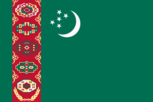
green field with a vertical red stripe near the hoist side, containing five tribal guls (designs used in producing carpets) stacked above two crossed olive branches; a white crescent moon representing Islam with five white stars representing the regions or welayats of Turkmenistan appear in the upper corner of the field just to the fly side of the red stripe
Government type
republic; authoritarian presidential rule, with little power outside the executive branch
Independence
27 October 1991 (from Soviet Union)
International organization participation
ADB, CIS, EAPC, EBRD, ECO, FAO, G-77, IBRD, ICAO, ICRM, IDA, IDB, IFC, IFRCS, ILO, IMF, IMO, Interpol, IOC, IOM (observer), ISO (correspondent), ITU, MIGA, NAM, OIC, OPCW, OSCE, PFP, SCO (guest), UN, UNCTAD, UNESCO, UNIDO, UNWTO, UPU, WCO, WFTU, WHO, WIPO, WMO
Judicial branch
Supreme Court (judges are appointed by the president)
Legal system
based on civil law system and Islamic law; has not accepted compulsory ICJ jurisdiction
Legislative branch
two parliamentary bodies, a People's Council or Halk Maslahaty (supreme legislative body of about 2,500 delegates, some elected by popular vote and some appointed; meets at least yearly) and a National Assembly or Mejlis (50 seats; members are elected by popular vote to serve five-year terms) elections: People's Council - last held in April 2003 (next to be held in December 2008); National Assembly - last held 19 December 2004 (next to be held in December 2008) election results: People's Council - percent of vote by party - DPT 100%; seats by party - DPT 2,507; National Assembly - percent of vote by party - DPT 100%; seats by party - DPT 50; note - all elected officials are members of the Democratic Party of Turkmenistan and are preapproved by the president note: in late 2003, a law was adopted reducing the powers of the National Assembly and making the People's Council the supreme legislative organ; the People's Council can now legally dissolve the National Assembly, and the president is now able to participate in the National Assembly as its supreme leader; the National Assembly can no longer adopt or amend the constitution or announce referendums or its elections; since the president is both the chairman of the People's Council and the supreme leader of the National Assembly, the 2003 law has the effect of making him the sole authority of both the executive and legislative branches of
National holiday
Independence Day, 27 October (1991)
Political parties and leaders
Democratic Party of Turkmenistan or DPT [Gurbanguly BERDIMUHAMEDOW] note: formal opposition parties are outlawed; unofficial, small opposition movements exist underground or in foreign countries; the two most prominent opposition groups-in-exile have been National Democratic Movement of Turkmenistan (NDMT) and the United Democratic Party of Turkmenistan (UDPT); NDMT was led by former Foreign Minister Boris SHIKHMURADOV until his arrest and imprisonment in the wake of the 25 November 2002 attack on President NYYAZOW's motorcade
Political pressure groups and leaders
NA
Suffrage
18 years of age; universal
Economy
Agriculture - products
cotton, grain; livestock
Budget
revenues: $1.664 billion expenditures: $1.624 billion (2007 est.)
Currency (code)
Turkmen manat (TMM)
Currency code
TMM
Current account balance
$1.705 billion (2007 est.)
Debt - external
$1.4 billion to $5 billion (2004 est.)
Distribution of family income - Gini index
40.8 (1998)
Economic aid - recipient
$28.25 million from the US (2005)
Economy - overview
Turkmenistan is a largely desert country with intensive agriculture in irrigated oases and large gas and oil resources. One-half of its irrigated land is planted in cotton; formerly it was the world's 10th-largest producer. Poor harvests in recent years have led to an almost 50% decline in cotton exports. With an authoritarian ex-Communist regime in power and a tribally based social structure, Turkmenistan has taken a cautious approach to economic reform, hoping to use gas and cotton sales to sustain its inefficient economy. Privatization goals remain limited. From 1998-2005, Turkmenistan suffered from the continued lack of adequate export routes for natural gas and from obligations on extensive short-term external debt. At the same time, however, total exports rose by an average of roughly 15% per year from 2003-07, largely because of higher international oil and gas prices. Overall prospects in the near future are discouraging because of widespread internal poverty, a poor educational system, government misuse of oil and gas revenues, and Ashgabat's reluctance to adopt market-oriented reforms. In the past, Turkmenistan's economic statistics were state secrets. The new government has established a State Agency for Statistics, but GDP numbers and other figures are subject to wide margins of error. In particular, the rate of GDP growth is uncertain. Since his election, President BERDIMUHAMEDOW has sought to improve the health and education systems, ordered unification of the country's dual currency exchange rate, begun decreasing state subsidies for gasoline, signed an agreement to build a gas line to China, and created a special tourism zone on the Caspian Sea. All of these moves hint that the new post-NYYAZOW government will work to create a friendlier foreign investment environment.
Electricity - consumption
9.584 billion kWh (2006 est.)
Electricity - exports
1.34 billion kWh (2006 est.)
Electricity - imports
0 kWh (2007 est.)
Electricity - production
12.83 billion kWh (2006 est.)
Electricity - production by source
fossil fuel: 99.9% hydro: 0.1% nuclear: 0% other: 0% (2001)
Exchange rates
Turkmen manat (TMM) per US dollar - 6,250 (2007) official rate note: the commercial rate was 19,800 Turkemen manat per US$ (2007)
Exports
$7.567 billion f.o.b. (2007 est.)
Exports - commodities
gas, crude oil, petrochemicals, textiles, cotton fiber
Exports - partners
Ukraine 51.3%, Iran 18.5%, Turkey 5% (2007)
Fiscal year
calendar year
GDP - composition by sector
agriculture: 11.5% industry: 40.8% services: 47.7% (2007 est.)
GDP - per capita (PPP)
$5,300 (2007 est.)
GDP - real growth rate
11.5% (IMF estimate) note: official government statistics are widely regarded as unreliable (2007 est.)
GDP (official exchange rate)
$26.91 billion (2007 est.)
GDP (purchasing power parity)
$26.92 billion (2007 est.)
Household income or consumption by percentage share
lowest 10%: 2.6% highest 10%: 31.7% (1998)
Imports
$4.516 billion f.o.b. (2007 est.)
Imports - commodities
machinery and equipment, chemicals, foodstuffs
Imports - partners
UAE 14.3%, Russia 11.6%, Turkey 10.3%, China 9.1%, Ukraine 8.7%, Iran 7%, Germany 6.5%, US 5.6% (2007)
Industrial production growth rate
10.3% (2007 est.)
Industries
natural gas, oil, petroleum products, textiles, food processing
Inflation rate (consumer prices)
11.3% (2007 est.)
Investment (gross fixed)
32.5% of GDP (2007 est.)
Labor force
2.089 million (2004 est.)
Labor force - by occupation
agriculture: 48.2% industry: 14% services: 37.8% (2004 est.)
Market value of publicly traded shares
$NA
Natural gas - consumption
19.48 billion cu m (2007 est.)
Natural gas - exports
49.4 billion cu m (2007 est.)
Natural gas - imports
0 cu m (2007 est.)
Natural gas - production
68.88 billion cu m (2007 est.)
Natural gas - proved reserves
2.832 trillion cu m (1 January 2008 est.)
Oil - consumption
107,400 bbl/day (2006 est.)
Oil - exports
40,000 bbl/day (2007 est.)
Oil - imports
5,283 bbl/day (2005)
Oil - production
180,400 bbl/day (2007 est.)
Oil - proved reserves
600 million bbl (1 January 2008 est.)
Population below poverty line
30% (2004 est.)
Reserves of foreign exchange and gold
$5.172 billion (31 December 2007 est.)
Unemployment rate
60% (2004 est.)
Communications
Internet country code
.tm
Internet hosts
640 (2008)
Internet Service Providers (ISPs)
1
Internet users
70,000 (2007)
Radio broadcast stations
AM 16, FM 8, shortwave 2 (1998)
Radios
1.225 million (1997)
Telephone system
general assessment: poorly developed domestic: Turkmentelekom, in cooperation with foreign investors, is planning to upgrade the country's telephone exchanges and install a new digital switching system; mobile-cellular usage remains limited international: country code - 993; linked by cable and microwave radio relay to other CIS republics and to other countries by leased connections to the Moscow international gateway switch; a new telephone link from Ashgabat to Iran has been established; a new exchange in Ashgabat switches international traffic through Turkey via Intelsat; satellite earth stations - 1 Orbita and 1 Intelsat (2006)
Telephones - main lines in use
398,100 (2005)
Telephones - mobile cellular
216,900 (2006)
Television broadcast stations
4 (government-owned and programmed) (2004)
Televisions
820,000 (1997)
Transportation
Airports
28 (2007)
Airports - with paved runways
total: 22 over 3,047 m: 1 2,438 to 3,047 m: 11 1,524 to 2,437 m: 8 914 to 1,523 m: 2 (2007)
Airports - with unpaved runways
total: 6 1,524 to 2,437 m: 2 under 914 m: 4 (2007)
Heliports
1 (2007)
Merchant marine
total: 7 by type: cargo 4, petroleum tanker 2, refrigerated cargo 1 (2008)
Pipelines
gas 6,441 km; oil 1,361 km (2007)
Ports and terminals
Turkmenbasy
Railways
total: 2,440 km broad gauge: 2,440 km 1.520-m gauge (2006)
Roadways
total: 58,592 km paved: 47,577 km unpaved: 11,015 km (2002)
Waterways
1,300 km (Amu Darya and Kara Kum canal important inland waterways) (2006)
Military and Security
Manpower available for military service
males age 16-49: 1,316,698 females age 16-49: 1,331,005 (2008 est.)
Manpower fit for military service
males age 16-49: 1,064,965 females age 16-49: 1,136,553 (2008 est.)
Manpower reaching militarily significant age annually
male: 57,615 female: 55,426 (2008 est.)
Military branches
Ground Forces, Navy, Air and Air Defense Forces (2007)
Military expenditures
3.4% of GDP (2005 est.)
Military service age and obligation
18-30 years of age for compulsory military service; 2-year conscript service obligation (2007)
Transnational Issues
Disputes - international
cotton monoculture in Uzbekistan and Turkmenistan creates water-sharing difficulties for Amu Darya river states; field demarcation of the boundaries with Kazakhstan commenced in 2005, but Caspian seabed delimitation remains stalled with Azerbaijan, Iran, and Kazakhstan due to Turkmenistan's indecision over how to allocate the sea's waters and seabed
Illicit drugs
transit country for Afghan narcotics bound for Russian and Western European markets; transit point for heroin precursor chemicals bound for Afghanistan This page was last updated on 18 December, 2008
Refugees and internally displaced persons
refugees (country of origin): 11,173 (Tajikistan); less than 1,000 (Afghanistan) (2007)