1996 Edition
CIA World Factbook 1996 (Project Gutenberg)
Introduction
Description
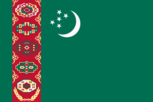
green field, including a vertical stripe on the hoist side, with a claret vertical stripe in between containing five white, black, and orange carpet guls (an asymmetrical design used in producing rugs) associated with five different tribes; a white crescent and five white stars in the upper left corner to the right of the carpet guls
Location
40 00 N, 60 00 E -- Central Asia, bordering the Caspian Sea, between Iran and Kazakstan Flag ----
Geography
Area
- comparative area
- slightly larger than California
- land area
- 488,100 sq km
- total area
- 488,100 sq km
Climate
subtropical desert
Coastline
- 0 km
- note
- Turkmenistan borders the Caspian Sea (1,768 km)
Environment
- current issues
- contamination of soil and groundwater with agricultural chemicals, pesticides; salinization, water-logging of soil due to poor irrigation methods; Caspian Sea pollution; diversion of a large share of the flow of the Amu Darya into irrigation contributes to that river's inability to replenish the Aral Sea; desertification
- international agreements
- party to - Ozone Layer Protection; signed, but not ratified - Climate Change, Desertification
- natural hazards
- NA
Geographic coordinates
40 00 N, 60 00 E
Geographic note
landlocked
International disputes
Caspian Sea boundaries are not yet determined
Irrigated land
12,450 sq km (1990)
Land boundaries
- border countries
- Afghanistan 744 km, Iran 992 km, Kazakstan 379 km, Uzbekistan 1,621 km
- total
- 3,736 km
Land use
- arable land
- 2%
- forest and woodland
- 0%
- meadows and pastures
- 69%
- other
- 29%
- permanent crops
- 0%
Location
Central Asia, bordering the Caspian Sea, between Iran and Kazakstan
Map references
Commonwealth of Independent States
Maritime claims
none (landlocked)
Natural resources
petroleum, natural gas, coal, sulfur, salt
Terrain
- flat-to-rolling sandy desert with dunes rising to mountains in the south; low mountains along border with Iran; borders Caspian Sea in west
- highest point
- Ayrybaba 3,139 m
- lowest point
- Sarygamysh Koli -110 m
People and Society
Age structure
0-14 years: 39% (male 826,637; female 804,385) 15-64 years: 56% (male 1,154,415; female 1,188,173) 65 years and over: 5% (male 65,447; female 110,226) (July 1996 est.)
Birth rate
29.12 births/1,000 population (1996 est.)
Death rate
8.89 deaths/1,000 population (1996 est.)
Ethnic divisions
Turkmen 73.3%, Russian 9.8%, Uzbek 9%, Kazak 2%, other 5.9%
Infant mortality rate
81.6 deaths/1,000 live births (1996 est.)
Languages
Turkmen 72%, Russian 12%, Uzbek 9%, other 7%
Life expectancy at birth
- female
- 66.52 years (1996 est.)
- male
- 56.68 years
- total population
- 61.48 years
Literacy
- age 15 and over can read and write (1989 est.)
- female
- 97%
- male
- 99%
- total population
- 98%
Nationality
- adjective
- Turkmen
- noun
- Turkmen(s)
Net migration rate
-2.08 migrant(s)/1,000 population (1996 est.)
Population
4,149,283 (July 1996 est.)
Population growth rate
1.82% (1996 est.)
Religions
Muslim 87%, Eastern Orthodox 11%, unknown 2%
Sex ratio
- all ages
- 0.97 male(s)/female (1996 est.)
- at birth
- 1.05 male(s)/female
- under 15 years
- 1.03 male(s)/female 15-64 years: 0.97 male(s)/female 65 years and over: 0.59 male(s)/female
Total fertility rate
3.62 children born/woman (1996 est.)
Government
Administrative divisions
- 5 welayatlar (singular - welayat): Ahal Welayaty (Ashgabat), Balkan Welayaty (Nebitdag), Dashhowuz Welayaty (formerly Tashauz), Lebap Welayaty (Charjew), Mary Welayaty
- note
- names in parentheses are administrative centers when name differs from welayat name
Assembly (Majlis)
elections last held 11 December 1994 (next to be held NA 1999); results - percent of vote by party NA; seats - (50 total) Democratic Party 45, other 5; note - all 50 preapproved by President NIYAZOV
Capital
Ashgabat
Constitution
adopted 18 May 1992
Data code
TX
Diplomatic representation in US
- chancery
- 1511 K Street NW, Suite 412, Washington, DC 20005
- chief of mission
- Ambassador Halil UGUR
- telephone
- [1] (202) 737-4800
Executive branch
- cabinet
- Council of Ministers was appointed by the president
- chief of state
- President Saparmurat NIYAZOV (since 27 October 1990, when the first direct presidential election occured) was elected to a five-year term by universal suffrage; election last held 21 June 1992 (next to be held NA 2002); results - Saparmurad NIYAZOV 99.5% (ran unopposed); note - a 15 January 1994 referendum extended NIYAZOV's term an additional five years until 2002 (99.99% approval)
- head of government
- Prime Minister (vacant); Deputy Prime Ministers Mukhamed ABALAKOV (since NA), Babamurad BAZAROV (since NA), Hekim ISHANOV (since NA), Valeriy OTCHERTSOV (since NA), Yagmur OVEZOV (since NA), Matkarim RAJAPOV (since NA), Pirkuly ODEYEV (since NA), Rejep SAPAROV (since NA), Boris SHIKHMURADOV (since NA), Batyr SARJAYEV (since NA), Amannazar ILAMANOV (since NA), Ilaman SHYKHYYEV (since NA) were appointed by the president
- note
- NIYAZOV has been asked by various local groups, most recently on 26 October 1995 at the annual elders meeting, to be "president for life," but that would require an amendment to the constitution
FAX
- [1] (202) 737-1152
- [7] (3632) 51-13-05
Flag
green field, including a vertical stripe on the hoist side, with a claret vertical stripe in between containing five white, black, and orange carpet guls (an asymmetrical design used in producing rugs) associated with five different tribes; a white crescent and five white stars in the upper left corner to the right of the carpet guls
Independence
27 October 1991 (from the Soviet Union)
International organization participation
CCC, CIS, EBRD, ECE, ECO, ESCAP, FAO, IBRD, ICAO, IDB, IFRCS, ILO, IMF, IMO, Intelsat (nonsignatory user), IOC, ISO (correspondent), ITU, NACC, OIC, OSCE, PFP, UN, UNCTAD, UNESCO, UPU, WHO, WMO, WToO, WTrO (observer)
Judicial branch
Supreme Court
Legal system
based on civil law system
Legislative branch
under the 1992 constitution, there are two parliamentary bodies, a unicameral People's Council (Halk Maslahaty - having more than 100 members and meeting infrequently) and a 50-member unicameral Assembly (Majlis)
Name of country
- conventional long form
- none
- conventional short form
- Turkmenistan
- former
- Turkmen Soviet Socialist Republic
- local long form
- none
- local short form
- Turkmenistan
National holiday
Independence Day, 27 October (1991)
Political parties and leaders
- Democratic Party of Turkmenistan, Saparmurat NIYAZOV; Party for Democratic Development, Durdymurat HOJA-MUHAMEDOV, chairman; Agzybirlik, Nurberdy NURMAMEDOV, cochairman, Hubayberdi HALLIYEV, cochairman
- note
- formal opposition parties are outlawed; unofficial, small opposition movements exist underground or in foreign countries
Suffrage
18 years of age; universal
Type of government
republic
US diplomatic representation
- chief of mission
- Ambassador Michael W. COTTER
- embassy
- 9 Pushkin Street, Ashgabat
- mailing address
- use embassy street address
- telephone
- [7] (3632) 35-00-45, 35-00-46, 35-00-42, Tie Line [8] 962-0000
Economy
Agriculture
cotton, grain; livestock
Budget
- expenditures
- $NA, including capital expenditures of $NA
- revenues
- $NA
Currency
Turkmenistan introduced its national currency, the manat, on 1 November 1993
Economic aid
- note
- commitments, $1,830 million ($375 million drawn), 1992-95
- recipient
- ODA, $10 million (1993)
Economic overview
Turkmenistan is largely desert country with nomadic cattle raising, intensive agriculture in irrigated oases, and huge gas and oil resources. One-half of its irrigated land is planted in cotton making it the world's tenth largest producer. It also has the world's fifth largest reserves of natural gas and substantial oil resources. Until the end of 1993, Turkmenistan had experienced less economic disruption than other former Soviet states because its economy received a boost from higher prices for oil and gas and a sharp increase in hard currency earnings. In 1994, Russia's refusal to export Turkmen gas to hard currency markets and mounting debts of its major customers in the former USSR for gas deliveries contributed to a sharp fall in industrial production and caused the budget to shift from a surplus to a slight deficit. The economy remained depressed through 1995 while inflation soared. Furthermore, with an authoritarian ex-communist regime in power and a tribally based social structure, Turkmenistan has taken a cautious approach to economic reform, hoping to use gas and cotton sales to sustain its inefficient economy. For 1996, Turkmenistan will face continuing constraints on its earnings because of its customers' inability to pay for their gas and a below average cotton crop in 1995. Turkmenistan is working hard to open new gas export channels through Iran and Turkey, but these will take many years to realize.
Electricity
- capacity
- 2,480,000 kW
- consumption per capita
- 2,400 kWh (1995)
- production
- 9.8 billion kWh
Exchange rates
- manats per US$1 - 2,400 (January 1996)
- note
- government established a unified rate in mid-January 1996
Exports
- $1.9 billion to states outside the FSU (1995)
- commodities
- natural gas, cotton, petroleum products, electricity, textiles, carpets
- partners
- Ukraine, Russia, Kazakstan, Uzbekistan, Georgia, Azerbaijan, Armenia, Eastern Europe, Turkey, Argentina
External debt
$400 million (of which $275 million to Russia) (1995 est.)
Fiscal year
calendar year
GDP
purchasing power parity - $11.5 billion (1995 estimate as extrapolated from World Bank estimate for 1994)
GDP composition by sector
- agriculture
- 32.5%
- industry
- 33.4%
- services
- 34.1% (1991 est.)
GDP per capita
$2,820 (1995 est.)
GDP real growth rate
-10% (1995 est.)
Illicit drugs
illicit cultivator of cannabis and opium poppy; mostly for CIS consumption; limited government eradication program; used as transshipment point for illicit drugs from Southwest Asia to Western Europe
Imports
- $777 million from states outside the FSU (1995)
- commodities
- machinery and parts, grain and food, plastics and rubber, consumer durables, textiles
- partners
- Russia, Azerbaijan, Uzbekistan, Kazakstan, Turkey
Industrial production growth rate
-7% (1995)
Industries
natural gas, oil, petroleum products, textiles, food processing
Inflation rate (consumer prices)
25% monthly average (1994 est.)
Labor force
- 1.642 million (January 1994)
- by occupation
- agriculture and forestry 44%, industry and construction 20%, other 36% (1992)
Unemployment rate
NA%
Communications
Branches
Army, Air and Air Defense, Republic Security Forces (internal and border troops), National Guard
Defense expenditures
4.5 billion manats, 3.0% of GDP (1995); note - conversion of defense expenditures into US dollars using the current exchange rate could produce misleading results
Manpower availability
- males age 15-49
- 1,024,398
- males fit for military service
- 834,803
- males reach military age (18) annually
- 41,697 (1996 est.)
Radio broadcast stations
AM NA, FM NA, shortwave NA; note - there is at least one state-owned radio broadcast station of NA type
Radios
NA
Telephone system
- poorly developed
- domestic
- NA
- international
- linked by cable and microwave radio relay to other CIS republics and to other countries by leased connections to the Moscow international gateway switch; a new telephone link from Ashgabat to Iran has been established; a new exchange in Ashgabat switches international traffic through Turkey via Intelsat; satellite earth stations - 1 Orbita and 1 Intelsat
Telephones
NA
Television broadcast stations
NA
Televisions
NA Defense
Transportation
Airports
- total
- 64
- with paved runways 1 524 to 2 437 m
- 8
- with paved runways 2 438 to 3 047 m
- 13
- with paved runways 914 to 1 523 m
- 1
- with unpaved runways 914 to 1 523 m
- 7
- with unpaved runways under 914 m
- 35 (1994 est.)
Highways
- paved
- NA km
- total
- 23,000 km
- unpaved
- NA km (1990 est.)
Pipelines
crude oil 250 km; natural gas 4,400 km
Ports
Turkmenbashi (formerly Krasnowodsk)
Railways
- broad gauge
- 2,120 km 1.520-m gauge (1990)
- total
- 2,120 km in common carrier service; does not include industrial lines
Waterways
the Amu Darya is an important inland waterway