1992 Edition
CIA World Factbook 1992 (Project Gutenberg)
Geography
Climate
subtropical desert
Coastline
0 km note: Turkmenistan does border the Caspian Sea (1,768 km)
Comparative area
slightly larger than California
Disputes
none
Environment
NA
Land area
488,100 km2
Land boundaries
3,736 km total; Afghanistan 744 km, Iran 992 km, Kazakhstan 379 km, Uzbekistan 1,621 km
Land use
NA% arable land; NA% permanent crops; NA% meadows and pastures; NA% forest and woodland; NA% other; includes NA% irrigated
Maritime claims
none - landlocked
Natural resources
petroleum, natural gas, coal, sulphur, salt, magnesium
Note
landlocked
Terrain
flat-to-rolling sandy desert with dunes; borders Caspian Sea in west
Total area
488,100 km2
People and Society
Birth rate
36 births/1,000 population (1992)
Death rate
9 deaths/1,000 population (1992)
Ethnic divisions
Turkmen 72%, Russian 9%, Uzbek 9%, other 10%
Infant mortality rate
94 deaths/1,000 live births (1992)
Labor force
1,542,000; agriculture and forestry 42%, industry and construction 21%, other 37% (1990)
Languages
Turkmen 72%, Russian 12%, Uzbek 9%, other 7%
Life expectancy at birth
59 years male, 66 years female (1992)
Literacy
NA% (male NA%, female NA) age 15 and over can read and write
Nationality
noun - Turkmen(s); adjective - Turkmen
Net migration rate
-3 migrants/1,000 population (1992)
Organized labor
NA
Population
3,838,108 (July 1992), growth rate 2.4% (1992)
Religions
Islam 85%, Eastern Orthodox 10%, unknown 5%
Total fertility rate
4.5 children born/woman (1992)
Government
Administrative divisions
4 oblasts (oblastey, singular - oblast'); Balkan (Nebit-Dag), Chardzhou, Mary, Tashauz; note - the rayons around Ashgabat are under direct republic jurisdiction; all oblasts have the same name as their administrative center except Balkan Oblast, centered at Nebit-Dag
Capital
Ashgabat (Ashkhabad)
Chief of State
President Saparmurad NIYAZOV (since 21 June 1992)
Communists
renamed Democratic Party, 16 December 1990
Constitution
adopted 18 May 1992
Diplomatic representation
NA US: Ambassador-designate Joseph HULINGS; Embassy at Yubilenaya Hotel, Ashgabat (Ashkhabad) (mailing address is APO; AE 09862); telephone [8] (011) 7-3630-24-49-08
Executive branch
president, prime minister, two deputy prime ministers, Council of Ministers
Flag
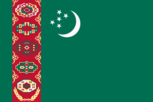
green field with five claret carpet gels (that is, a repeated carpet pattern) on the hoist side; a white crescent and five white stars in the upper left corner to the right of the carpet gels
Head of Government
Prime Minister (vacant), Deputy Prime Ministers V. G. OCHERTSOV and Atta CHARYYEV (since NA 1991)
Independence
27 October 1991 (from the Soviet Union; formerly Turkmen Soviet Socialist Republic)
Judicial branch
NA
Legal system
NA
Legislative branch
Majlis
Long-form name
none
Majlis
last held 7 January 1990 (next to be held NA 1995); results - percent of vote by party NA; seats - (175 total) elections not officially by party, but Communist Party members won nearly 90% of seats
Member of
CIS, CSCE, IBRD, IMF, NACC, UN, UNCTAD
National holiday
Independence Day, 27 October (1991)
Other political or pressure groups
Agzybirlik (Unity) Movement
Political parties and leaders
Democratic Party (formerly Communist), Saparmurad NIYAZOV, chairman opposition: Democratic Party, Durdymorad KHODZHA Mukhammed, chairman
President
last held 21 June 1992 (next to be held NA June 1997); results - Saparmurad NIYAZOV 99.5% (ran unopposed)
Suffrage
universal at age 18
Type
republic
Economy
Agriculture
cotton, fruits, vegetables
Budget
NA
Currency
As of May 1992, retaining ruble as currency
Economic aid
NA
Electricity
3,170,000 kW capacity; 14,900 million kWh produced, 4,114 kWh per capita (1990)
Exchange rates
NA
Exports
$239 million (1990) commodities: natural gas, oil, chemicals, cotton, textiles, carpets partners: Russia, Ukraine, Uzbekistan
External debt
$650 million (end of 1991 est.)
Fiscal year
calendar year
GDP
purchasing power equivalent - NA, per capita $NA; real growth rate -0.6% (1991 est.)
Illicit drugs
illicit producers of cannabis and opium; mostly for domestic consumption; status of government eradication programs unknown; used as transshipment points for illicit drugs to Western Europe
Imports
$970 million (1990) commodities: machinery and parts, plastics and rubber, consumer durables, textiles partners: NA
Industrial production
growth rate 4.1% (1991)
Industries
oil and gas, petrochemicals, fertilizers, food processing, textiles
Inflation rate (consumer prices)
85% (1991)
Overview
Like the other 15 former Soviet republics, Turkmenistan faces enormous problems of economic adjustment - to move away from Moscow-based central planning toward a system of decisionmaking by private enterpreneurs, local government authorities, and, hopefully, foreign investors. This process requires wholesale changes in supply sources, markets, property rights, and monetary arrangements. Industry - with 10% of the labor force - is heavily weighted toward the energy sector, which produced 11% of the ex-USSR's gas and 1% of its oil. Turkmenistan ranked second among the former Soviet republics in cotton production, mainly in the irrigated western region, where the huge Karakumskiy Canal taps the Amu Darya.
Unemployment rate
20-25% (1991 est.)
Communications
Airports
NA
Civil air
NA
Highways
23,000 km total (1990); 18,300 km hard surfaced, 4,700 km earth
Inland waterways
NA km
Pipelines
NA
Ports
inland - Krasnovodsk
Railroads
2,120 km all 1.520-meter gauge
Telecommunications
poorly developed; telephone density NA; linked by landline or microwave to other CIS member states and Iran, and by leased connections via the Moscow international gateway switch to other countries; satellite earth stations - Orbita and INTELSAT (TV receive only)
Military and Security
Branches
Republic Security Forces (internal and border troops), National Guard; CIS Forces (Ground, Air and Air Defense)
Defense expenditures
$NA, NA% of GDP
Manpower availability
males 15-49, NA; NA fit for military service; NA reach military age (18) annually