2008 Edition
CIA World Factbook 2008 (Project Gutenberg)
Introduction
Background
Modern Turkey was founded in 1923 from the Anatolian remnants of the defeated Ottoman Empire by national hero Mustafa KEMAL, who was later honored with the title Ataturk or "Father of the Turks." Under his authoritarian leadership, the country adopted wide-ranging social, legal, and political reforms. After a period of one-party rule, an experiment with multi-party politics led to the 1950 election victory of the opposition Democratic Party and the peaceful transfer of power. Since then, Turkish political parties have multiplied, but democracy has been fractured by periods of instability and intermittent military coups (1960, 1971, 1980), which in each case eventually resulted in a return of political power to civilians. In 1997, the military again helped engineer the ouster - popularly dubbed a "post-modern coup" - of the then Islamic-oriented government. Turkey intervened militarily on Cyprus in 1974 to prevent a Greek takeover of the island and has since acted as patron state to the "Turkish Republic of Northern Cyprus," which only Turkey recognizes. A separatist insurgency begun in 1984 by the Kurdistan Workers' Party (PKK) - now known as the People's Congress of Kurdistan or Kongra-Gel (KGK) - has dominated the Turkish military's attention and claimed more than 30,000 lives. After the capture of the group's leader in 1999, the insurgents largely withdrew from Turkey mainly to northern Iraq. In 2004, KGK announced an end to its ceasefire and attacks attributed to the KGK increased. Turkey joined the UN in 1945 and in 1952 it became a member of NATO. In 1964, Turkey became an associate member of the European Community; over the past decade, it has undertaken many reforms to strengthen its democracy and economy enabling it to begin accession membership talks with the European Union.
Geography
Area
total: 780,580 sq km land: 770,760 sq km water: 9,820 sq km
Area - comparative
slightly larger than Texas
Climate
temperate; hot, dry summers with mild, wet winters; harsher in interior
Coastline
7,200 km
Elevation extremes
lowest point: Mediterranean Sea 0 m highest point: Mount Ararat 5,166 m
Environment - current issues
water pollution from dumping of chemicals and detergents; air pollution, particularly in urban areas; deforestation; concern for oil spills from increasing Bosporus ship traffic
Environment - international agreements
party to: Air Pollution, Antarctic Treaty, Biodiversity, Climate Change, Desertification, Endangered Species, Hazardous Wastes, Ozone Layer Protection, Ship Pollution, Wetlands signed, but not ratified: Environmental Modification
Freshwater withdrawal (domestic/industrial/agricultural)
total: 39.78 cu km/yr (15%/11%/74%) per capita: 544 cu m/yr (2001)
Geographic coordinates
39 00 N, 35 00 E
Geography - note
strategic location controlling the Turkish Straits (Bosporus, Sea of Marmara, Dardanelles) that link Black and Aegean Seas; Mount Ararat, the legendary landing place of Noah's ark, is in the far eastern portion of the country
Irrigated land
52,150 sq km (2003)
Land boundaries
total: 2,648 km border countries: Armenia 268 km, Azerbaijan 9 km, Bulgaria 240 km, Georgia 252 km, Greece 206 km, Iran 499 km, Iraq 352 km, Syria 822 km
Land use
arable land: 29.81% permanent crops: 3.39% other: 66.8% (2005)
Location
Southeastern Europe and Southwestern Asia (that portion of Turkey west of the Bosporus is geographically part of Europe), bordering the Black Sea, between Bulgaria and Georgia, and bordering the Aegean Sea and the Mediterranean Sea, between Greece and Syria
Map references
Middle East
Maritime claims
territorial sea: 6 nm in the Aegean Sea; 12 nm in Black Sea and in Mediterranean Sea exclusive economic zone: in Black Sea only: to the maritime boundary agreed upon with the former USSR
Natural hazards
severe earthquakes, especially in northern Turkey, along an arc extending from the Sea of Marmara to Lake Van
Natural resources
coal, iron ore, copper, chromium, antimony, mercury, gold, barite, borate, celestite (strontium), emery, feldspar, limestone, magnesite, marble, perlite, pumice, pyrites (sulfur), clay, arable land, hydropower
Terrain
high central plateau (Anatolia); narrow coastal plain; several mountain ranges
Total renewable water resources
234 cu km (2003)
People and Society
Age structure
0-14 years: 24.4% (male 8,937,515/female 8,608,375) 15-64 years: 68.6% (male 25,030,793/female 24,253,312) 65 years and over: 7% (male 2,307,236/female 2,755,576) (2008 est.)
Birth rate
16.15 births/1,000 population (2008 est.)
Death rate
6.02 deaths/1,000 population (2008 est.)
Education expenditures
4% of GDP (2004)
Ethnic groups
Turkish 80%, Kurdish 20% (estimated)
HIV/AIDS - adult prevalence rate
less than 0.1%; note - no country specific models provided (2001 est.)
HIV/AIDS - deaths
NA
HIV/AIDS - people living with HIV/AIDS
NA
Infant mortality rate
total: 36.98 deaths/1,000 live births male: 40.44 deaths/1,000 live births female: 33.34 deaths/1,000 live births (2008 est.)
Languages
Turkish (official), Kurdish, Dimli (or Zaza), Azeri, Kabardian note: there is also a substantial Gagauz population in the European part of Turkey
Life expectancy at birth
total population: 73.14 years male: 70.67 years female: 75.73 years (2008 est.)
Literacy
definition: age 15 and over can read and write total population: 87.4% male: 95.3% female: 79.6% (2004 est.)
Median age
total: 29 years male: 28.8 years female: 29.2 years (2008 est.)
Nationality
noun: Turk(s) adjective: Turkish
Net migration rate
0 migrant(s)/1,000 population (2008 est.)
Population
71,892,808 (July 2008 est.)
Population growth rate
1.013% (2008 est.)
Religions
Muslim 99.8% (mostly Sunni), other 0.2% (mostly Christians and Jews)
School life expectancy (primary to tertiary education)
total: 11 years male: 12 years female: 11 years (2006)
Sex ratio
at birth: 1.05 male(s)/female under 15 years: 1.04 male(s)/female 15-64 years: 1.03 male(s)/female 65 years and over: 0.84 male(s)/female total population: 1.02 male(s)/female (2008 est.)
Total fertility rate
1.87 children born/woman (2008 est.)
Government
Administrative divisions
81 provinces (iller, singular - ili); Adana, Adiyaman, Afyonkarahisar, Agri, Aksaray, Amasya, Ankara, Antalya, Ardahan, Artvin, Aydin, Balikesir, Bartin, Batman, Bayburt, Bilecik, Bingol, Bitlis, Bolu, Burdur, Bursa, Canakkale, Cankiri, Corum, Denizli, Diyarbakir, Duzce, Edirne, Elazig, Erzincan, Erzurum, Eskisehir, Gaziantep, Giresun, Gumushane, Hakkari, Hatay, Icel (Mersin), Igdir, Isparta, Istanbul, Izmir (Smyrna), Kahramanmaras, Karabuk, Karaman, Kars, Kastamonu, Kayseri, Kilis, Kirikkale, Kirklareli, Kirsehir, Kocaeli, Konya, Kutahya, Malatya, Manisa, Mardin, Mugla, Mus, Nevsehir, Nigde, Ordu, Osmaniye, Rize, Sakarya, Samsun, Sanliurfa, Siirt, Sinop, Sirnak, Sivas, Tekirdag, Tokat, Trabzon (Trebizond), Tunceli, Usak, Van, Yalova, Yozgat, Zonguldak
Capital
name: Ankara geographic coordinates: 39 56 N, 32 52 E time difference: UTC+2 (7 hours ahead of Washington, DC during Standard Time) daylight saving time: +1hr, begins last Sunday in March; ends last Sunday in October
Constitution
7 November 1982
Country name
conventional long form: Republic of Turkey conventional short form: Turkey local long form: Turkiye Cumhuriyeti local short form: Turkiye
Diplomatic representation from the US
chief of mission: Ambassador Ross WILSON embassy: 110 Ataturk Boulevard, Kavaklidere, 06100 Ankara mailing address: PSC 93, Box 5000, APO AE 09823 telephone: [90] (312) 455-5555
Diplomatic representation in the US
chief of mission: Ambassador Nabi SENSOY chancery: 2525 Massachusetts Avenue NW, Washington, DC 20008 telephone: [1] (202) 612-6700
Executive branch
chief of state: President Abdullah GUL (since 28 August 2007) head of government: Prime Minister Recep Tayyip ERDOGAN (since 14 March 2003); Deputy Prime Minister Cemil CICEK (since 29 August 2007); Deputy Prime Minister Hayati YAZICI (since 29 August 2007); Deputy Prime Minister Nazim EKREN (since 29 August 2007) cabinet: Council of Ministers appointed by the president on the nomination of the prime minister elections: president elected by the National Assembly for one seven-year terms; prime minister appointed by the president from among members of parliament election results: Abdullah GUL received 339 votes in the third round of voting on 28 August 2007, after failing to garner the two thirds vote required by law in the first two rounds note: president-elect must have a two-thirds majority of the National Assembly on the first two ballots and a simple majority on the third ballot
FAX
- [1] (202) 612-6744 consulate(s) general: Chicago, Houston, Los Angeles, New York
- [90] (312) 467-0019 consulate(s) general: Istanbul consulate(s): Adana; note - there is a Consular Agent in Izmir
Flag description
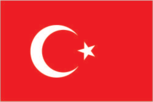
red with a vertical white crescent (the closed portion is toward the hoist side) and white five-pointed star centered just outside the crescent opening
Government type
republican parliamentary democracy
Independence
29 October 1923 (successor state to the Ottoman Empire)
International organization participation
ADB (nonregional members), Australia Group, BIS, BSEC, CE, CERN (observer), EAPC, EBRD, ECO, EU (applicant), FAO, IAEA, IBRD, ICAO, ICC, ICRM, IDA, IDB, IEA, IFAD, IFC, IFRCS, IHO, ILO, IMF, IMO, IMSO, Interpol, IOC, IOM, IPU, ISO, ITSO, ITU, ITUC, MIGA, NATO, NEA, NSG, OAS (observer), OECD, OIC, OPCW, OSCE, PCA, SECI, UN, UNCTAD, UNESCO, UNHCR, UNIDO, UNIFIL, UNMIS, UNOCI, UNOMIG, UNRWA, UNWTO, UPU, WCO, WEU (associate), WFTU, WHO, WIPO, WMO, WTO, ZC
Judicial branch
Constitutional Court; High Court of Appeals (Yargitay); Council of State (Danistay); Court of Accounts (Sayistay); Military High Court of Appeals; Military High Administrative Court
Legal system
civil law system derived from various European continental legal systems; note - member of the European Court of Human Rights (ECHR), although Turkey claims limited derogations on the ratified European Convention on Human Rights; has not accepted compulsory ICJ jurisdiction
Legislative branch
unicameral Grand National Assembly of Turkey or Turkiye Buyuk Millet Meclisi (550 seats; members are elected by popular vote to serve five-year terms) elections: last held on 22 July 2007 (next to be held on November 2012) election results: percent of vote by party - AKP 46.7%, CHP 20.8%, MHP 14.3%, independents 5.2%, and other 13.0%; seats by party - AKP 341, CHP 112, MHP 71, independents 26; note - seats by party as of 17 December 2007 - AKP 340, CHP 87, MHP 70, DTP 20, DSP 13, independents 6, other 12, vacant 2 (DTP entered parliament as independents; DSP entered parliament on CHP's party list); only parties surpassing the 10% threshold are entitled to parliamentary seats
National holiday
Republic Day, 29 October (1923)
Political parties and leaders
Anavatan Partisi (Motherland Party) or Anavatan [Erkan MUMCU]; Democratic Left Party or DSP [Mehmet Zeki SEZER]; Democratic Society Party or DTP [Nurettin DEMIRTAS]; Felicity Party or SP [Recai KUTAN] (sometimes translated as Contentment Party); Justice and Development Party or AKP [Recep Tayyip ERDOGAN]; Nationalist Action Party or MHP [Devlet BAHCELI] (sometimes translated as Nationalist Movement Party); People's Rise Party (Halkin Yukselisi Partisi) or HYP [Yasar Nuri OZTURK]; Republican People's Party or CHP [Deniz BAYKAL]; Social Democratic People's Party or SHP [Murat KARAYALCIN]; True Path Party or DYP [Mehmet AGAR] (sometimes translated as Correct Way Party); Young Party or GP [Cem Cengiz UZAN] note: the parties listed above are some of the more significant of the 49 parties that Turkey had on 1 December 2004
Political pressure groups and leaders
Confederation of Public Sector Unions or KESK [Ismail Hakki TOMBUL]; Confederation of Revolutionary Workers Unions or DISK [Suleyman CELEBI]; Independent Industrialists' and Businessmen's Association or MUSIAD [Omer BOLAT]; Moral Rights Workers Union or Hak-Is [Salim USLU]; Turkish Confederation of Employers' Unions or TISK [Tugurl KUDATGOBILIK]; Turkish Confederation of Labor or Turk-Is [Salih KILIC]; Turkish Confederation of Tradesmen and Craftsmen or TESK [Dervis GUNDAY]; Turkish Industrialists' and Businessmen's Association or TUSIAD [Omer SABANCI]; Turkish Union of Chambers of Commerce and Commodity Exchanges or TOBB [M. Rifat HISARCIKLIOGLU]
Suffrage
18 years of age; universal
Economy
Agriculture - products
tobacco, cotton, grain, olives, sugar beets, pulse, citrus; livestock
Budget
revenues: $145.5 billion expenditures: $156.1 billion (2007 est.)
Central bank discount rate
25% (31 December 2007)
Currency (code)
Turkish lira (TRY); old Turkish lira (TRL) before 1 January 2005
Currency code
TRL, YTL
Current account balance
-$37.58 billion (2007 est.)
Debt - external
$247.1 billion (31 December 2007)
Distribution of family income - Gini index
43.6 (2003)
Economic aid - recipient
ODA, $464 million (2005)
Economy - overview
Turkey's dynamic economy is a complex mix of modern industry and commerce along with a traditional agriculture sector that still accounts for more than 35% of employment. It has a strong and rapidly growing private sector, yet the state still plays a major role in basic industry, banking, transport, and communication. The largest industrial sector is textiles and clothing, which accounts for one-third of industrial employment; it faces stiff competition in international markets with the end of the global quota system. However, other sectors, notably the automotive and electronics industries, are rising in importance within Turkey's export mix. Real GNP growth has exceeded 6% in many years, but this strong expansion has been interrupted by sharp declines in output in 1994, 1999, and 2001. The economy is turning around with the implementation of economic reforms, and 2004 GDP growth reached 9%, followed by roughly 5% annual growth from 2005-07. Inflation fell to 7.7% in 2005 - a 30-year low - but climbed back to 8.5% in 2007. Despite the strong economic gains from 2002-07, which were largely due to renewed investor interest in emerging markets, IMF backing, and tighter fiscal policy, the economy is still burdened by a high current account deficit and high external debt. Further economic and judicial reforms and prospective EU membership are expected to boost foreign direct investment. The stock value of FDI currently stands at about $85 billion. Privatization sales are currently approaching $21 billion. Oil began to flow through the Baku-Tblisi-Ceyhan pipeline in May 2006, marking a major milestone that will bring up to 1 million barrels per day from the Caspian to market. In 2007, Turkish financial markets weathered significant domestic political turmoil, including turbulence sparked by controversy over the selection of former Foreign Minister Abdullah GUL as Turkey's 11th president. Economic fundamentals are sound, marked by strong economic growth and foreign direct investment. Turkey's high current account deficit leaves the economy vulnerable to destabilizing shifts in investor confidence, however.
Electricity - consumption
141.5 billion kWh (2006 est.)
Electricity - exports
2.576 billion kWh (2007 est.)
Electricity - imports
863 million kWh (2007 est.)
Electricity - production
181.6 billion kWh (2007 est.)
Electricity - production by source
fossil fuel: 79.3% hydro: 20.4% nuclear: 0% other: 0.3% (2001)
Exchange rates
Turkish liras (TRY) per US dollar - 1.319 (2007), 1.4286 (2006), 1.3436 (2005), 1.4255 (2004), 1.5009 (2003) note: on 1 January 2005 the old Turkish lira (TRL) was converted to new Turkish lira (TRY) at a rate of 1,000,000 old to 1 new Turkish lira
Exports
$115.3 billion f.o.b. (2007 est.)
Exports - commodities
apparel, foodstuffs, textiles, metal manufactures, transport equipment
Exports - partners
Germany 11.2%, UK 8.1%, Italy 7%, France 5.6%, Russia 4.4%, Spain 4.3% (2007)
Fiscal year
calendar year
GDP - composition by sector
agriculture: 8.9% industry: 28.3% services: 62.8% (2007 est.)
GDP - per capita (PPP)
$12,000 (2007 est.)
GDP - real growth rate
4.5% (2007 est.)
GDP (official exchange rate)
$663.4 billion (2007 est.)
GDP (purchasing power parity)
$853.9 billion (2007 est.)
Household income or consumption by percentage share
lowest 10%: 2% highest 10%: 34.1% (2003)
Imports
$162 billion f.o.b. (2007 est.)
Imports - commodities
machinery, chemicals, semi-finished goods, fuels, transport equipment
Imports - partners
Russia 13.8%, Germany 10.3%, China 7.8%, Italy 5.9%, US 4.8%, France 4.6% (2007)
Industrial production growth rate
5.4% (2007 est.)
Industries
textiles, food processing, autos, electronics, mining (coal, chromite, copper, boron), steel, petroleum, construction, lumber, paper
Inflation rate (consumer prices)
8.7% (2007 est.)
Investment (gross fixed)
21.5% of GDP (2007 est.)
Labor force
23.53 million note: about 1.2 million Turks work abroad (2007 est.)
Labor force - by occupation
agriculture: 35.9% industry: 22.8% services: 41.2% (3rd quarter, 2004)
Market value of publicly traded shares
$162.4 billion (2006)
Natural gas - consumption
36.6 billion cu m (2007 est.)
Natural gas - exports
31 million cu m (2007 est.)
Natural gas - imports
35.83 billion cu m (2007 est.)
Natural gas - production
893 million cu m (2007 est.)
Natural gas - proved reserves
8.495 billion cu m (1 January 2008 est.)
Oil - consumption
676,600 bbl/day (2007 est.)
Oil - exports
114,600 bbl/day (2005)
Oil - imports
714,100 bbl/day (2005)
Oil - production
42,800 bbl/day (2007 est.)
Oil - proved reserves
300 million bbl (1 January 2008 est.)
Population below poverty line
20% (2002)
Public debt
38.9% of GDP (2007 est.)
Reserves of foreign exchange and gold
$76.51 billion (31 December 2007 est.)
Stock of direct foreign investment - abroad
$11.35 billion (2007 est.)
Stock of direct foreign investment - at home
$106.4 billion (2007 est.)
Stock of domestic credit
$358.1 billion (31 December 2007)
Stock of money
$64.43 billion (31 December 2007)
Stock of quasi money
$254.3 billion (31 December 2007)
Unemployment rate
9.9% plus underemployment of 4% (2007 est.)
Communications
Internet country code
.tr
Internet hosts
2.667 million (2008)
Internet Service Providers (ISPs)
50 (2001)
Internet users
13.15 million (2006)
Radio broadcast stations
AM 16, FM 107, shortwave 6 (2001)
Radios
11.3 million (1997)
Telephone system
general assessment: undergoing rapid modernization and expansion especially with cellular telephones domestic: additional digital exchanges are permitting a rapid increase in subscribers; the construction of a network of technologically advanced intercity trunk lines, using both fiber-optic cable and digital microwave radio relay, is facilitating communication between urban centers; remote areas are reached by a domestic satellite system; the number of subscribers to mobile-cellular telephone service is growing rapidly international: country code - 90; international service is provided by the SEA-ME-WE-3 submarine cable and by submarine fiber-optic cables in the Mediterranean and Black Seas that link Turkey with Italy, Greece, Israel, Bulgaria, Romania, and Russia; satellite earth stations - 12 Intelsat; mobile satellite terminals - 328 in the Inmarsat and Eutelsat systems (2002)
Telephones - main lines in use
18.413 million (2007)
Telephones - mobile cellular
61.976 million (2007)
Television broadcast stations
635 (plus 2,934 repeaters) (1995)
Televisions
20.9 million (1997)
Transportation
Airports
117 (2007)
Airports - with paved runways
total: 90 over 3,047 m: 15 2,438 to 3,047 m: 33 1,524 to 2,437 m: 19 914 to 1,523 m: 19 under 914 m: 4 (2007)
Airports - with unpaved runways
total: 27 over 3,047 m: 1 1,524 to 2,437 m: 2 914 to 1,523 m: 7 under 914 m: 17 (2007)
Heliports
18 (2007)
Merchant marine
total: 612 by type: bulk carrier 101, cargo 281, chemical tanker 70, combination ore/oil 1, container 35, liquefied gas 7, passenger 4, passenger/cargo 51, petroleum tanker 31, refrigerated cargo 1, roll on/roll off 28, specialized tanker 2 foreign-owned: 8 (Cyprus 2, Germany 1, Greece 1, Italy 3, UAE 1) registered in other countries: 595 (Albania 1, Antigua and Barbuda 6, Bahamas 8, Belize 15, Cambodia 26, Comoros 8, Dominica 5, Georgia 14, Greece 1, Isle of Man 2, Italy 1, Kiribati 1, Liberia 7, Malta 176, Marshall Islands 50, Moldova 3, Netherlands 1, Netherlands Antilles 10, Panama 94, Russia 80, Saint Kitts and Nevis 35, Saint Vincent and the Grenadines 20, Sierra Leone 15, Slovakia 10, Tuvalu 2, UK 2, unknown 2) (2008)
Pipelines
gas 7,511 km; oil 3,636 km (2007)
Ports and terminals
Aliaga, Diliskelesi, Izmir, Kocaeli (Izmit), Mercin Limani, Nemrut Limani
Railways
total: 8,697 km standard gauge: 8,697 km 1.435-m gauge (1,920 km electrified) (2006)
Roadways
total: 426,951 km (includes 1,987 km of expressways) (2006)
Waterways
1,200 km (2005)
Military and Security
Manpower available for military service
males age 16-49: 20,213,205 females age 16-49: 19,432,688 (2008 est.)
Manpower fit for military service
males age 16-49: 17,011,635 females age 16-49: 16,433,364 (2008 est.)
Manpower reaching militarily significant age annually
male: 660,452 female: 638,527 (2008 est.)
Military - note
a "National Security Policy Document" adopted in October 2005 increases the Turkish Armed Forces (TSK) role in internal security, augmenting the General Directorate of Security and Gendarmerie General Command (Jandarma); the TSK leadership continues to play a key role in politics and considers itself guardian of Turkey's secular state; in April 2007, it warned the ruling party about any pro-Islamic appointments; despite on-going negotiations on EU accession since October 2005, progress has been limited in establishing required civilian supremacy over the military; primary domestic threats are listed as fundamentalism (with the definition in some dispute with the civilian government), separatism (the Kurdish problem), and the extreme left wing; Ankara strongly opposed establishment of an autonomous Kurdish region; an overhaul of the Turkish Land Forces Command (TLFC) taking place under the "Force 2014" program is to produce 20-30% smaller, more highly trained forces characterized by greater mobility and firepower and capable of joint and combined operations; the TLFC has taken on increasing international peacekeeping responsibilities, and took charge of a NATO International Security Assistance Force (ISAF) command in Afghanistan in April 2007; the Turkish Navy is a regional naval power that wants to develop the capability to project power beyond Turkey's coastal waters; the Navy is heavily involved in NATO, multinational, and UN operations; its roles include control of territorial waters and security for sea lines of communications; the Turkish Air Force adopted an "Aerospace and Missile Defense Concept" in 2002 and has initiated project work on an integrated missile defense system; Air Force priorities include attaining a modern deployable, survivable, and sustainable force structure, and establishing a sustainable command and control system (2008)
Military expenditures
5.3% of GDP (2005 est.)
Military service age and obligation
20 years of age (2004)
Turkish Armed Forces (TSK)
Turkish Land Forces (Turk Kara Kuvvetleri, TKK), Turkish Naval Forces (Turk Deniz Kuvvetleri, TDK; includes naval air and naval infantry), Turkish Air Force (Turk Hava Kuvvetleri, THK) (2008)
Transnational Issues
Disputes - international
complex maritime, air, and territorial disputes with Greece in the Aegean Sea; status of north Cyprus question remains; Syria and Iraq protest Turkish hydrological projects to control upper Euphrates waters; Turkey has expressed concern over the status of Kurds in Iraq; border with Armenia remains closed over Nagorno-Karabakh
IDPs
1-1.2 million (fighting 1984-99 between Kurdish PKK and Turkish military; most IDPs in southeastern provinces) (2007)
Illicit drugs
key transit route for Southwest Asian heroin to Western Europe and, to a lesser extent, the US - via air, land, and sea routes; major Turkish and other international trafficking organizations operate out of Istanbul; laboratories to convert imported morphine base into heroin exist in remote regions of Turkey and near Istanbul; government maintains strict controls over areas of legal opium poppy cultivation and over output of poppy straw concentrate; lax enforcement of money-laundering controls This page was last updated on 18 December, 2008