2000 Edition
CIA World Factbook 2000 (Project Gutenberg)
Introduction
Background
Turkey was created in 1923 from the Turkish remnants of the Ottoman Empire. Soon thereafter the country instituted secular laws to replace traditional religious fiats. In 1945 Turkey joined the UN and in 1949 it became a member of NATO. Turkey occupied the northern portion of Cyprus in 1974 to prevent a Greek takeover of the island; relations between the two countries remain strained. Periodic military offensives against Kurdish terrorists have dislocated part of the population in southeast Turkey and have drawn international condemnation.
Geography
Area
- land
- 770,760 sq km
- total
- 780,580 sq km
- water
- 9,820 sq km
Area - comparative
slightly larger than Texas
Climate
temperate; hot, dry summers with mild, wet winters; harsher in interior
Coastline
7,200 km
Elevation extremes
- highest point
- Mount Ararat 5,166 m
- lowest point
- Mediterranean Sea 0 m
Environment - current issues
water pollution from dumping of chemicals and detergents; air pollution, particularly in urban areas; deforestation; concern for oil spills from increasing Bosporus ship traffic
Environment - international agreements
- party to
- Air Pollution, Antarctic Treaty, Biodiversity, Desertification, Endangered Species, Hazardous Wastes, Nuclear Test Ban, Ozone Layer Protection, Ship Pollution, Wetlands signed, but not ratified: Antarctic-Environmental Protocol, Environmental Modification
Geographic coordinates
39 00 N, 35 00 E
Geography - note
strategic location controlling the Turkish Straits (Bosporus, Sea of Marmara, Dardanelles) that link Black and Aegean Seas
Irrigated land
36,740 sq km (1993 est.)
Land boundaries
- border countries
- Armenia 268 km, Azerbaijan 9 km, Bulgaria 240 km, Georgia 252 km, Greece 206 km, Iran 499 km, Iraq 331 km, Syria 822 km
- total
- 2,627 km
Land use
- arable land
- 32%
- forests and woodland
- 26%
- other
- 22% (1993 est.)
- permanent crops
- 4%
- permanent pastures
- 16%
Location
southeastern Europe and southwestern Asia (that portion of Turkey west of the Bosporus is geographically part of Europe), bordering the Black Sea, between Bulgaria and Georgia, and bordering the Aegean Sea and the Mediterranean Sea, between Greece and Syria
Map references
Middle East
Maritime claims
- exclusive economic zone
- in Black Sea only: to the maritime boundary agreed upon with the former USSR
- territorial sea
- 6 nm in the Aegean Sea; 12 nm in Black Sea and in Mediterranean Sea
Natural hazards
very severe earthquakes, especially in northern Turkey, along an arc extending from the Sea of Marmara to Lake Van
Natural resources
antimony, coal, chromium, mercury, copper, borate, sulfur, iron ore, arable land, hydropower
Terrain
mostly mountains; narrow coastal plain; high central plateau (Anatolia)
People and Society
Age structure
0-14 years: 29% (male 9,722,217; female 9,375,920) 15-64 years: 65% (male 21,671,638; female 20,966,110) 65 years and over: 6% (male 1,811,599; female 2,119,193) (2000 est.)
Birth rate
18.65 births/1,000 population (2000 est.)
Death rate
5.96 deaths/1,000 population (2000 est.)
Ethnic groups
Turkish 80%, Kurdish 20%
Infant mortality rate
48.9 deaths/1,000 live births (2000 est.)
Languages
Turkish (official), Kurdish, Arabic, Armenian, Greek
Life expectancy at birth
- female
- 73.41 years (2000 est.)
- male
- 68.63 years
- total population
- 70.97 years
Literacy
- definition
- age 15 and over can read and write
- female
- 72.4% (1995 est.)
- male
- 91.7%
- total population
- 82.3%
Nationality
- adjective
- Turkish
- noun
- Turk(s)
Net migration rate
0 migrant(s)/1,000 population (2000 est.)
Population
65,666,677 (July 2000 est.)
Population growth rate
1.27% (2000 est.)
Religions
Muslim 99.8% (mostly Sunni), other 0.2% (Christian and Jews)
Sex ratio
- at birth
- 1.05 male(s)/female under 15 years: 1.04 male(s)/female 15-64 years: 1.03 male(s)/female 65 years and over: 0.85 male(s)/female
- total population
- 1.02 male(s)/female (2000 est.)
Total fertility rate
2.16 children born/woman (2000 est.)
Government
Administrative divisions
- 80 provinces (iller, singular - il); Adana, Adiyaman, Afyon, Agri, Aksaray, Amasya, Ankara, Antalya, Ardahan, Artvin, Aydin, Balikesir, Bartin, Batman, Bayburt, Bilecik, Bingol, Bitlis, Bolu, Burdur, Bursa, Canakkale, Cankiri, Corum, Denizli, Diyarbakir, Edirne, Elazig, Erzincan, Erzurum, Eskisehir, Gazi Antep, Giresun, Gumushane, Hakkari, Hatay, Icel, Igdir, Isparta, Istanbul, Izmir, Kahraman Maras, Karabuk, Karaman, Kars, Kastamonu, Kayseri, Kilis, Kirikkale, Kirklareli, Kirsehir, Kocaeli, Konya, Kutahya, Malatya, Manisa, Mardin, Mugla, Mus, Nevsehir, Nigde, Ordu, Osmaniye, Rize, Sakarya, Samsun, Sanli Urfa, Siirt, Sinop, Sirnak, Sivas, Tekirdag, Tokat, Trabzon, Tunceli, Usak, Van, Yalova, Yozgat, Zonguldak
- note
- Karabuk, Kilis, Osmaniye and Yalova are the four newest provinces (there may be a fifth - Duzce); the US Board on Geographic Names is awaiting an official Turkish administrative map for verification of the boundaries
Capital
Ankara
Constitution
7 November 1982
Country name
- conventional long form
- Republic of Turkey
- conventional short form
- Turkey
- local long form
- Turkiye Cumhuriyeti
- local short form
- Turkiye
Data code
TU
Diplomatic representation from the US
- chief of mission
- Ambassador Robert PEARSON
- embassy
- 110 Ataturk Boulevard, Ankara
- mailing address
- PSC 93, Box 5000, APO AE 09823
- telephone
- (312) 468-6110
Diplomatic representation in the US
- chancery
- 2525 Massachusetts Avenue NW, Washington, DC 20008
- chief of mission
- Ambassador Baki ILKIN
- telephone
- (202) 612-6700
Executive branch
- cabinet
- Council of Ministers appointed by the president on the nomination of the prime minister
- chief of state
- President Ahmed Necdet SEZER (since 16 May 2000)
- election results
- Ahmed Necdet SEZER elected president; percent of National Assembly vote - 60%
- elections
- president elected by the National Assembly for a seven-year term; election last held 5 May 2000 (next scheduled to be held NA May 2007); prime minister and deputy prime minister appointed by the president
- head of government
- Prime Minister Bulent ECEVIT (since 11 January 1999)
- note
- there is also a National Security Council that serves as an advisory body to the president and the cabinet
FAX
- (202) 612-6744
- (312) 467-0019
- consulate(s)
- Adana
- consulate(s) general
- Chicago, Houston, Los Angeles, and New York
- consulate(s) general
- Istanbul
Flag description
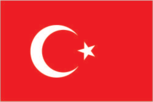
red with a vertical white crescent (the closed portion is toward the hoist side) and white five-pointed star centered just outside the crescent opening
Government type
republican parliamentary democracy
Independence
29 October 1923 (successor state to the Ottoman Empire)
International organization participation
AsDB, BIS, BSEC, CCC, CE, CERN (observer), EAPC, EBRD, ECE, ECO, ESCAP, EU (applicant), FAO, IAEA, IBRD, ICAO, ICC, ICFTU, ICRM, IDA, IDB, IEA, IFAD, IFC, IFRCS, IHO, ILO, IMF, IMO, Inmarsat, Intelsat, Interpol, IOC, IOM (observer), ISO, ITU, NATO, NEA, OAS (observer), OECD, OIC, OPCW, OSCE, PCA, UN, UNCTAD, UNESCO, UNHCR, UNIDO, UNIKOM, UNMIBH, UNMIK, UNOMIG, UNRWA, UPU, WEU (associate), WFTU, WHO, WIPO, WMO, WToO, WTrO
Judicial branch
Constitutional Court, judges appointed by the president; Court of Appeals, judges are elected by the Supreme Council of Judges and Prosecutors
Legal system
derived from various European continental legal systems; accepts compulsory ICJ jurisdiction, with reservations
Legislative branch
- unicameral Grand National Assembly of Turkey or Turkiye Buyuk Millet Meclisi (550 seats; members are elected by popular vote to serve five-year terms)
- election results
- percent of vote by party - NA; seats by party - DSP 136, MHP 130, FP 110, DYP 86, ANAP 88; note - as of 7 March 2000 seating was DSP 136, MHP 127, FP 103, DYP 85, ANAP 88 independents 6, vacancies 5
- elections
- last held 18 April 1999 (next to be held NA 2004)
National holiday
Anniversary of the Declaration of the Republic, 29 October (1923)
Political parties and leaders
- Changing Turkey Party or DEPAR [Gokhan CAPOGLU]; Democracy and Peace Party or DBP ; Democratic Left Party or DSP ; Democratic Party or DP ; Democratic Turkey Party or DTP ; Enlightened Turkey Party or ATP ; Freedom and Solidarity Party or ODP ; Grand Unity Party or BBP [Muhsin YAZICIOGLU]; Labor Party or EP ; Liberal Democratic Party or LDP ; Motherland Party or ANAP ; My Turkey Party or TP ; Nation Party or MP [Aykut EDIBALI]; Nationalist Action Party or MHP ; New Democracy Movement or YDH ; Peace Party or BP [Ali Haydar VEZIROGLU]; People's Democracy Party or HADEP ; Republican People's Party or CHP ; Revolutionary People's Party ; Socialist Power Party or SIP ; True Path Party or DYP ; Virtue Party or FP ; Workers' Party or IP
- note
- Welfare Party or RP was officially outlawed on 22 February 1998
Political pressure groups and leaders
Confederation of Revolutionary Workers Unions or DISK ; Independent Industrialists and Businessmen's Association or MUSIAD ; Moral Rights Workers Union or Hak-Is ; Turkish Industrialists' and Businessmen's Association or TUSIAD ; Turkish Confederation of Employers' Unions or TISK ; Turkish Confederation of Labor or Turk-Is ; Turkish Union of Chambers of Commerce and Commodity Exchanges or TOBB
Suffrage
18 years of age; universal
Economy
Agriculture - products
tobacco, cotton, grain, olives, sugar beets, pulse, citrus; livestock
Budget
- expenditures
- $66.7 billion, including capital expenditures of $3.4 billion (1999)
- revenues
- $45.2 billion
Currency
Turkish lira (TL) = 100 kurus (theoretical)
Debt - external
$104 billion (1999)
Economic aid - recipient
ODA, $195 million (1993)
Economy - overview
Turkey has a dynamic economy that is a complex mix of modern industry and commerce along with traditional village agriculture and crafts. It has a strong and rapidly growing private sector, yet the state still plays a major role in basic industry, banking, transport, and communication. Its most important industry - and largest exporter - is textiles and clothing, which is almost entirely in private hands. The economic situation in recent years has been marked by erratic economic growth and serious imbalances. After a sharp drop in 1994, real GNP averaged 6.5% annual growth in 1995-98; it then fell about 5% in 1999 as Turkey was adversely affected by Russia's economic crisis and two major earthquakes. The already-large public sector fiscal deficit widened in 1999 to perhaps 14% of GDP - due in large part to the huge burden of interest payments which accounted for 42% of central grovernment spending. Despite the implementation in January 1996 of a customs union with the EU, foreign direct investment in the country remains low - less than $1 billion annually - perhaps because potential investors are concerned about economic and political stability. Prospects for the future are brighter - including prospects for foreign investment - because the ECEVIT government is implementing a major economic reform program, including a tighter budget, social security reform, banking reorganization, and greatly accelerated privatization.
Electricity - consumption
118.5 billion kWh (1999)
Electricity - exports
209 million kWh (1999 est.)
Electricity - imports
2.3 billion kWh (1999 est.)
Electricity - production
116.5 billion kWh (1999)
Electricity - production by source
- fossil fuel
- 69.4%
- hydro
- 30.5%
- nuclear
- 0%
- other
- 0.1% (1999 est.)
Exchange rates
Turkish liras (TL) per US$1 - 545,584 (January 2000), 418,783 (1999), 260,724 (1998), 151,865 (1997), 81,405 (1996), 45,845.1 (1995)
Exports
$26 billion (f.o.b., 1999 est.)
Exports - commodities
apparel 28%, foodstuffs 17%, textiles 12%, metal manufactures 9% (1998)
Exports - partners
Germany 21%, US 9%, UK 7%, Italy 6%, France 6% (1999)
Fiscal year
calendar year
GDP
purchasing power parity - $409.4 billion (1999 est.)
GDP - composition by sector
- agriculture
- 18%
- industry
- 29%
- services
- 53% (1998)
GDP - per capita
purchasing power parity - $6,200 (1999 est.)
GDP - real growth rate
-5% (1999 est.)
Household income or consumption by percentage share
lowest 10%: NA% highest 10%: NA%
Imports
$40 billion (c.i.f., 1999 est.)
Imports - commodities
machinery 29%, semi-finished goods 16%, chemicals 14%, transport equipment 11%, fuels 8% (1998)
Imports - partners
Germany 14%, Italy 8%, US 8%, France 8%, Russia 6%, UK 5% (1999)
Industrial production growth rate
-5.2% (1999 est.)
Industries
textiles, food processing, autos, mining (coal, chromite, copper, boron), steel, petroleum, construction, lumber, paper
Inflation rate (consumer prices)
65% (1999 est.)
Labor force
- 23.8 million (April 1999)
- note
- about 1.5 million Turks work abroad (1994)
Labor force - by occupation
agriculture 45.8%, services 33.7%, industry 20.5% (April 1999)
Population below poverty line
NA%
Unemployment rate
7.3% plus underemployment of 6.9% (April 1999 est.)
Communications
Internet Service Providers (ISPs)
24 (1999)
Radio broadcast stations
AM 16, FM 72, shortwave 6 (1998)
Radios
11.3 million (1997)
Telephone system
- undergoing rapid modernization and expansion, especially cellular telephones
- domestic
- additional digital exchanges are permitting a rapid increase in subscribers; the construction of a network of technologically advanced intercity trunk lines, using both fiber-optic cable and digital microwave radio relay is facilitating communication between urban centers; remote areas are reached by a domestic satellite system; the number of subscribers to mobile cellular telephone service is growing rapidly
- international
- international service is provided by three submarine fiber-optic cables in the Mediterranean and Black Seas, linking Turkey with Italy, Greece, Israel, Bulgaria, Romania, and Russia, by 12 Intelsat earth stations, and by 328 mobile satellite terminals in the Inmarsat and Eutelsat systems
Telephones - main lines in use
17.244 million (1998)
Telephones - mobile cellular
3.2 million (1998)
Television broadcast stations
69 (plus 476 low-power repeaters) (1997)
Televisions
20.9 million (1997)
Transportation
Airports
118 (1999 est.)
Airports - with paved runways
- total
- 82 over 3,047 m: 16 2,438 to 3,047 m: 27 1,524 to 2,437 m: 18 914 to 1,523 m: 16 under 914 m: 5 (1999 est.)
Airports - with unpaved runways
- total
- 36 1,524 to 2,437 m: 1 914 to 1,523 m: 9 under 914 m: 26 (1999 est.)
Heliports
2 (1999 est.)
Highways
- paved
- 95,599 km (including 1,726 km of expressways)
- total
- 382,397 km
- unpaved
- 286,798 km (1999 est.)
Merchant marine
- ships by type
- bulk 155, cargo 244, chemical tanker 37, combination bulk 5, combination ore/oil 6, container 20, liquified gas 5, passenger/cargo 1, petroleum tanker 35, refrigerated cargo 3, roll-on/roll-off 22, short-sea passenger 9, specialized tanker 5 (1999 est.)
- total
- 547 ships (1,000 GRT or over) totaling 5,935,173 GRT/9,771,421 DWT
Pipelines
crude oil 1,738 km; petroleum products 2,321 km; natural gas 708 km
Ports and harbors
Gemlik, Hopa, Iskenderun, Istanbul, Izmir, Kocaeli (Izmit), Icel (Mersin), Samsun, Trabzon
Railways
- standard gauge
- 8,607 km 1.435-m gauge (1,524 km electrified) (1999)
- total
- 8,607 km
Waterways
about 1,200 km
Military and Security
Military branches
Land Forces, Navy (includes Naval Air and Naval Infantry), Air Force, Coast Guard, Gendarmerie
Military expenditures - dollar figure
$6.737 billion (FY97)
Military expenditures - percent of GDP
4.3% (FY97)
Military manpower - availability
males age 15-49: 18,523,950 (2000 est.)
Military manpower - fit for military service
males age 15-49: 11,227,922 (2000 est.)
Military manpower - military age
20 years of age
Military manpower - reaching military age annually
- males
- 664,024 (2000 est.)
Transnational Issues
Disputes - international
complex maritime, air, and territorial disputes with Greece in Aegean Sea; Cyprus question with Greece; dispute with downstream riparian states (Syria and Iraq) over water development plans for the Tigris and Euphrates rivers; traditional demands regarding former Armenian lands in Turkey have subsided
Illicit drugs
- key transit route for Southwest Asian heroin to Western Europe and - to a far lesser extent the US - via air, land, and sea routes; major Turkish, Iranian, and other international trafficking organizations operate out of Istanbul; laboratories to convert imported morphine base into heroin are in remote regions of Turkey as well as near Istanbul; government maintains strict controls over areas of legal opium poppy cultivation and output of poppy straw concentrate
- TURKMENISTAN