1996 Edition
CIA World Factbook 1996 (Project Gutenberg)
Introduction
Description
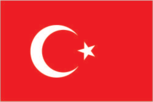
red with a vertical white crescent (the closed portion is toward the hoist side) and white five-pointed star centered just outside the crescent opening
Location
39 00 N, 35 00 E -- Southwestern Asia (that part west of the Bosporus is sometimes included with Europe), bordering the Black Sea, between Bulgaria and Georgia, and bordering the Aegean Sea and the Mediterranean Sea, between Greece and Syria Flag ----
Geography
Area
- comparative area
- slightly larger than Texas
- land area
- 770,760 sq km
- total area
- 780,580 sq km
Climate
temperate; hot, dry summers with mild, wet winters; harsher in interior
Coastline
7,200 km
Environment
- current issues
- water pollution from dumping of chemicals and detergents; air pollution, particularly in urban areas; deforestation
- international agreements
- party to - Air Pollution, Hazardous Wastes, Nuclear Test Ban, Ozone Layer Protection, Ship Pollution, Wetlands, Whaling; signed, but not ratified - Biodiversity, Desertification, Environmental Modification
- natural hazards
- very severe earthquakes, especially in northern Turkey, along an arc extending from the Sea of Marmara to Lake Van
Geographic coordinates
39 00 N, 35 00 E
Geographic note
strategic location controlling the Turkish Straits (Bosporus, Sea of Marmara, Dardanelles) that link Black and Aegean Seas
International disputes
complex maritime, air and territorial disputes with Greece in Aegean Sea; Cyprus question; Hatay question with Syria; dispute with downstream riparians (Syria and Iraq) over water development plans for the Tigris and Euphrates Rivers
Irrigated land
22,200 sq km (1989 est.)
Land boundaries
- border countries
- Armenia 268 km, Azerbaijan 9 km, Bulgaria 240 km, Georgia 252 km, Greece 206 km, Iran 499 km, Iraq 331 km, Syria 822 km
- total
- 2,627 km
Land use
- arable land
- 30%
- forest and woodland
- 26%
- meadows and pastures
- 12%
- other
- 28%
- permanent crops
- 4%
Location
Southwestern Asia (that part west of the Bosporus is sometimes included with Europe), bordering the Black Sea, between Bulgaria and Georgia, and bordering the Aegean Sea and the Mediterranean Sea, between Greece and Syria
Map references
Middle East
Maritime claims
- exclusive economic zone
- in Black Sea only - to the maritime boundary agreed upon with the former USSR
- territorial sea
- 6 nm in the Aegean Sea,; 12 nm in the Black Sea and in the Mediterranean Sea
Natural resources
antimony, coal, chromium, mercury, copper, borate, sulfur, iron ore
Terrain
- mostly mountains; narrow coastal plain; high central plateau (Anatolia)
- highest point
- Mount Ararat 5,166 m
- lowest point
- Mediterranean Sea 0 m
People and Society
Age structure
0-14 years: 32% (male 10,192,195; female 9,836,045) 15-64 years: 62% (male 19,859,717; female 19,187,769) 65 years and over: 6% (male 1,571,451; female 1,837,301) (July 1996 est.)
Birth rate
22.26 births/1,000 population (1996 est.)
Death rate
5.52 deaths/1,000 population (1996 est.)
Ethnic divisions
Turkish 80%, Kurdish 20%
Infant mortality rate
43.2 deaths/1,000 live births (1996 est.)
Languages
Turkish (official), Kurdish, Arabic
Life expectancy at birth
- female
- 74.43 years (1996 est.)
- male
- 69.53 years
- total population
- 71.92 years
Literacy
- age 15 and over can read and write (1995 est.)
- female
- 72.4%
- male
- 91.7%
- total population
- 82.3%
Nationality
- adjective
- Turkish
- noun
- Turk(s)
Net migration rate
0 migrant(s)/1,000 population (1996 est.)
Population
62,484,478 (July 1996 est.)
Population growth rate
1.67% (1996 est.)
Religions
Muslim 99.8% (mostly Sunni), other 0.2% (Christian and Jews)
Sex ratio
- all ages
- 1.02 male(s)/female (1996 est.)
- at birth
- 1.05 male(s)/female
- under 15 years
- 1.04 male(s)/female 15-64 years: 1.04 male(s)/female 65 years and over: 0.86 male(s)/female
Total fertility rate
2.58 children born/woman (1996 est.)
Government
Administrative divisions
- 79 provinces (iller, singular - il); Adana, Adiyaman, Afyon, Agri, Aksaray, Amasya, Ankara, Antalya, Ardahan, Artvin, Aydin, Balikesir, Bartin, Batman, Bayburt, Bilecik, Bingol, Bitlis, Bolu, Burdur, Bursa, Canakkale, Cankiri, Corum, Denizli, Diyarbakir, Edirne, Elazig, Erzincan, Erzurum, Eskisehir, Gazi Antep, Giresun, Gumushane, Hakkari, Hatay, Icel, Iggdir, Isparta, Istanbul, Izmir, Kahraman Maras, Karabuk, Karaman, Kars, Kastamonu, Kayseri, Kilis, Kirikkale, Kirklareli, Kirsehir, Kocaeli, Konya, Kutahya, Malatya, Manisa, Mardin, Mugla, Mus, Nevsehir, Nigde, Ordu, Rize, Sakarya, Samsun, Sanli Urfa, Siirt, Sinop, Sirnak, Sivas, Tekirdag, Tokat, Trabzon, Tunceli, Usak, Van, Yalova, Yozgat, Zonguldak
- note
- Karabuk, Kilis, and Yalova are three new Turkish provinces mentioned in the 24 December 1995 election results
Capital
Ankara
Constitution
7 November 1982
Data code
TU
Diplomatic representation in US
- chancery
- 1714 Massachusetts Avenue NW, Washington, DC 20036
- chief of mission
- Ambassador Nuzhet KANDEMIR
- consulate(s) general
- Chicago, Houston, Los Angeles, and New York
- telephone
- [1] (202) 659-8200
Executive branch
- chief of state
- President Suleyman DEMIREL (since 16 May 1993) was elected for a seven-year term by the National Assembly
- head of government
- Prime Minister Mesut YILMAZ (since 12 March 1996) and Deputy Prime Minister Nahit MENTESE (since 12 March 1996) were appointed by the president
FAX
- [90] (312) 467-0019
- consulate(s)
- Adana
- consulate(s) general
- Istanbul
Flag
red with a vertical white crescent (the closed portion is toward the hoist side) and white five-pointed star centered just outside the crescent opening
Grand National Assembly of Turkey
- (Turkiye Buyuk Millet Meclisi) elections last held 24 December 1995 (next to be held by December 2000); results - RP 21.38%, DYP 19.18%, ANAP 19.65%, DSP 14.64%, CHP 10.71%, independent 0.48%; seats - 550 total) RP 158, DYP 135, ANAP 133, DSP 75, CHP 49
- note
- seats held by various parties are subject to change due to defections, creation of new parties, and ouster or death of sitting deputies; current seats by party are as follows: RP 158, DYP 135, ANAP 126, DSP 75, CHP 49, BBP 7
Independence
29 October 1923 (successor state to the Ottoman Empire)
International organization participation
AsDB, BIS, BSEC, CCC, CE, CERN (observer), EBRD, ECE, ECO, FAO, IAEA, IBRD, ICAO, ICC, ICFTU, ICRM, IDA, IDB, IEA, IFAD, IFC, IFRCS, ILO, IMF, IMO, Inmarsat, Intelsat, Interpol, IOC, IOM (observer), ISO, ITU, NACC, NATO, NEA, OECD, OIC, OSCE, PCA, UN, UNCRO, UNCTAD, UNESCO, UNHCR, UNIDO, UNIKOM, UNOMIG, UNRWA, UPU, WEU (associate), WFTU, WHO, WIPO, WMO, WToO, WTrO
Judicial branch
Constitutional Court, judges appointed by the president; Court of Appeals, judges are elected by the Supreme Council of Judges and Prosecutors
Legal system
derived from various continental legal systems; accepts compulsory ICJ jurisdiction, with reservations
Legislative branch
unicameral
Name of country
- conventional long form
- Republic of Turkey
- conventional short form
- Turkey
- local long form
- Turkiye Cumhuriyeti
- local short form
- Turkiye
National holiday
Anniversary of the Declaration of the Republic, 29 October (1923)
National Security Council
- advisory body to the president and the cabinet
- cabinet
- Council of Ministers was appointed by the president on nomination of the prime minister
Other political or pressure groups
Turkish Confederation of Labor (Turk-Is), Bayram MERAL; Confederation of Revolutionary Workers Unions (DISK), Ridvan BUDAK; Moral Rights Workers Union (Hak-Is), Salim USLU; Turkish Industrialists' and Businessmen's Association (TUSIAD), Halis KOMILI; Turkish Union of Chambers of Commerce and Commodity Exchanges (TOBB), Ali Osman ULUSOY; Turkish Confederation of Employers' Unions (TISK), Refik BAYDUR; Independent Industrialists and Businessmen's Association (MUSIAD), Erol YARAR
Political parties and leaders
True Path Party (DYP), Tansu CILLER; Motherland Party (ANAP), Mesut YILMAZ; Welfare Party (RP), Necmettin ERBAKAN; Democratic Left Party (DSP), Bulent ECEVIT; Nationalist Action Party (MHP), Alparslan TURKES; New Party (YP), Yusuf Bozkurt OZAL; Republican People's Party (CHP), Deniz BAYKAL; Workers' Party (IP), Dogu PERINCEK; Nation Party (MP), Aykut EDIBALI; Democrat Party (DP), Murat UZMAN; Grand Unity Party (BBP), Muhsin YAZICIOGLU; Rebirth Party (YDP), Hasan Celal GUZEL; People's Democracy Party (HADEP), Murat BOZLAK; Main Path Party (ANAYOL), Gurcan BASER; Democratic Target Party (DHP), Abdulkadir Yasar TURK; Liberal Party (LP), Besim TIBUK; New Democracy Movement (YDH), Cem BOYNER; Labor Party (EP), Abdullah Levent TUZER; Democracy and Peace Party (DBP), Refik KARAKOC; Freedom and Solidarity Praty (ODP), Ufuk URAS
Suffrage
18 years of age; universal
Type of government
republican parliamentary democracy
US diplomatic representation
- chief of mission
- Ambassador Marc GROSSMAN
- embassy
- 110 Ataturk Boulevard, Ankara
- mailing address
- PSC 93, Box 5000, APO AE 09823
- telephone
- [90] (312) 468-6110
Economy
Agriculture
tobacco, cotton, grain, olives, sugar beets, pulses, citrus; livestock
Budget
- expenditures
- $35 billion, including capital expenditures of $2.8 billion (1995)
- revenues
- $30.2 billion
Currency
Turkish lira (TL)
Economic aid
- note
- aid for Gulf war efforts from coalition allies (1991), $4.1 billion; aid pledged for Turkish Defense Fund, $2.5 billion
- recipient
- ODA, $195 million (1993)
Economic overview
The Turkish economy consists of a mixture, on the one hand, of modern industry and commerce, and, on the other hand, of time-honored village agriculture and crafts. Since World War II, it has become increasingly integrated into the West European economic arena, for example, as a member of OECD. The economy has improved significantly since the 1994 crisis, when the economy experienced a sharp drop and inflation hit triple digits. The crisis - sparked by the downgrading in January 1994 of Turkey's international credit rating by two US rating agencies - stemmed from years of loose monetary and fiscal policies that had exacerbated inflation and allowed the public debt, money supply, and current account deficit to explode. In April 1994, then Prime Minister CILLER introduced a stabilization package that paved the way for a $950 million IMF standby loan. However, because the government missed key macroeconomic targets in 1995 and the December national election produced months of political wrangling, the IMF put the agreement - and release of remaining funds - on hold. The new center-right minority government that finally has emerged will find it difficult to balance the need for new austerity measures and tough structural reforms with the pressure for continued buoyant growth. Ankara is also likely to face internal opposition to policies it must implement as part of the Turkey-EU customs union agreement - which came into force on 1 January 1996 - because many industries are unfit for EU competition and much-needed revenues will decline with the elimination of import tariffs and surcharges. Meanwhile, Ankara's heavy debt repayment schedule in 1996 makes it necessary for Turkish leaders to bolster the confidence of both domestic and foreign investors.
Electricity
- capacity
- 18,710,000 kW
- consumption per capita
- 1,079 kWh (1993)
- production
- 71 billion kWh
Exchange rates
Turkish liras (TL) per US$1 - 60,502.1 (January 1996), 45,845.1 (1995), 29,608.7 (1994), 10,984.6 (1993), 6,872.4 (1992), 4,171.8 (1991)
Exports
- $20.7 billion (f.o.b., 1995 est.)
- commodities
- textiles and apparel 37%, steel products 12%, fruits and vegetables 11% (1994)
- partners
- Germany 22%, Russia 8%, US 8%, Italy 6% (1994)
External debt
$73.8 billion (1995 est.)
Fiscal year
calendar year
GDP
purchasing power parity - $345.7 billion (1995 est.)
GDP composition by sector
- agriculture
- 15.5%
- industry
- 33.2%
- services
- 51.3% (1994)
GDP per capita
$5,500 (1995 est.)
GDP real growth rate
6.8% (1995 est.)
Illicit drugs
major transit route for Southwest Asian heroin and hashish to Western Europe and the US via air, land, and sea routes; major Turkish, Iranian, and other international trafficking organizations operate out of Istanbul; laboratories to convert imported morphine base into heroin are in remote regions of Turkey as well as near Istanbul; government maintains strict controls over areas of legal opium poppy cultivation and output of poppy straw concentrate
Imports
- $32.6 billion (f.o.b., 1995 est.)
- commodities
- machinery 25%, fuels 17%, raw materials 11%, foodstuffs 5% (1994)
- partners
- Germany 16%, US 10%, Italy 9%, Russia 8% (1994)
Industrial production growth rate
8.8% (1995)
Industries
textiles, food processing, mining (coal, chromite, copper, boron), steel, petroleum, construction, lumber, paper
Inflation rate (consumer prices)
94% (1995)
Labor force
- 20.9 million
- by occupation
- agriculture 46%, services 31%, industry 23%
- note
- about 1.5 million Turks work abroad (1994)
Unemployment rate
10.2% (1995 est.)
Communications
Branches
Land Forces, Navy (includes Naval Air and Naval Infantry), Air Force, Coast Guard, Gendarmerie
Defense expenditures
exchange rate conversion - $6.0 billion, 4% of GDP (1995); note - figures do not include about $7 billion for the government's counterinsurgency effort against the separatist Kurdistan Workers' Party (PKK)
Manpower availability
- males age 15-49
- 16,937,828
- males fit for military service
- 10,312,010
- males reach military age (20) annually
- 637,456 (1996 est.)
Radio broadcast stations
AM 15, FM 94, shortwave 0
Radios
9.4 million (1992 est.)
Telephone system
- fair domestic and international systems
- domestic
- trunk microwave radio relay network; limited open-wire network
- international
- satellite earth stations - 2 Intelsat (Atlantic Ocean), 1 Eutelsat, and 2 Inmarsat (Indian and Atlantic Ocean regions); 1 submarine cable
Telephones
6.89 million (1990 est.)
Television broadcast stations
357
Televisions
10.53 million (1993 est.) Defense
Transportation
Airports
- total
- 104
- with paved runways 1 524 to 2 437 m
- 12
- with paved runways 2 438 to 3 047 m
- 19
- with paved runways 914 to 1 523 m
- 18
- with paved runways over 3 047 m
- 17
- with paved runways under 914 m
- 28
- with unpaved runways 1 524 to 2 437 m
- 2
- with unpaved runways 914 to 1 523 m
- 8 (1995 est.)
Heliports
2 (1995 est.)
Highways
- paved
- 45,683 km (including 862 km of expressways)
- total
- 386,704 km
- unpaved
- 341,021 km (1992 est.)
Merchant marine
- note
- Turkey owns an additional 18 ships (1,000 GRT or over) totaling 247,369 DWT operating under the registries of Malta, Panama, Libya, and Greece (1995 est.)
- ships by type
- bulk 139, cargo 212, chemical tanker 18, combination bulk 7, combination ore/oil 12, container 2, liquefied gas tanker 4, livestock carrier 1, oil tanker 43, passenger-cargo 1, refrigerated cargo 2, roll-on/roll-off cargo 15, short-sea passenger 7, specialized tanker 2
- total
- 465 ships (1,000 GRT or over) totaling 5,509,741 GRT/9,494,434 DWT
Pipelines
crude oil 1,738 km; petroleum products 2,321 km; natural gas 708 km
Ports
Gemlik, Hopa, Iskenderun, Istanbul, Izmir, Izmit, Mersin, Samsun, Trabzon
Railways
- standard gauge
- 10,386 km 1.435-m gauge (1,088 km electrified)
- total
- 10,386 km
Waterways
about 1,200 km