1994 Edition
CIA World Factbook 1994 (Project Gutenberg)
Introduction
Administrative divisions
73 provinces (iller, singular - il); Adana, Adiyaman, Afyon, Agri, Aksaray, Amasya, Ankara, Antalya, Artvin, Aydin, Balikesir, Batman, Bayburt, Bilecik, Bingol, Bitlis, Bolu, Burdur, Bursa, Canakkale, Cankiri, Corum, Denizli, Diyarbakir, Edirne, Elazig, Erzincan, Erzurum, Eskisehir, Gazi Antep, Giresun, Gumushane, Hakkari, Hatay, Icel, Isparta, Istanbul, Izmir, Kahraman Maras, Karaman, Kars, Kastamonu, Kayseri, Kirikkale, Kirklareli, Kirsehir, Kocaeli, Konya, Kutahya, Malatya, Manisa, Mardin, Mugla, Mus, Nevsehir, Nigde, Ordu, Rize, Sakarya, Samsun, Sanli Urfa, Siirt, Sinop, Sirnak, Sivas, Tekirdag, Tokat, Trabzon, Tunceli, Usak, Van, Yozgat, Zonguldak
Agriculture
accounts for 16% of GDP and employs about half of working force; products - tobacco, cotton, grain, olives, sugar beets, pulses, citrus fruit, variety of animal products; self-sufficient in food most years
Airports
total: 113 usable: 105 with permanent-surface runways: 69 with runways over 3,659 m: 3 with runways 2,440-3,659 m: 32 with runways 1,220-2,439 m: 27
Area
total area: 780,580 sq km land area: 770,760 sq km comparative area: slightly larger than Texas
Birth rate
25.98 births/1,000 population (1994 est.)
Branches
Land Forces, Navy (including Naval Air and Naval Infantry), Air Force, Coast Guard, Gendarmerie
Budget
revenues: $36.5 billion expenditures: $47.6 billion, including capital expenditures of $5 billion (1994)
Capital
Ankara
Climate
temperate; hot, dry summers with mild, wet winters; harsher in interior
Coastline
7,200 km
Constitution
7 November 1982
Currency
1 Turkish lira (TL) = 100 kurus
Death rate
5.8 deaths/1,000 population (1994 est.)
Defense expenditures
exchange rate conversion - $14 billion, 5.6% of GDP (1994 est.)
Digraph
TU
Diplomatic representation in US
chief of mission: Ambassador Nuzhet KANDEMIR chancery: 1714 Massachusetts Avenue NW, Washington, DC 20036 telephone: (202) 659-8200 consulate(s) general: Chicago, Houston, Los Angeles, and New York
Economic aid
recipient: US commitments, including Ex-Im (FY70-89), $2.3 billion; Western (non-US) countries, ODA and OOF bilateral commitments (1970-89), $10.1 billion; OPEC bilateral aid (1979-89), $665 million; Communist countries (1970-89), $4.5 billion note: aid for Persian Gulf war efforts from coalition allies (1991), $4.1 billion; aid pledged for Turkish Defense Fund, $2.5 billion
Electricity
capacity: 14,400,000 kW production: 44 billion kWh consumption per capita: 750 kWh (1991)
Environment
current issues: water pollution from dumping of chemicals and detergents; air pollution; deforestation natural hazards: subject to very severe earthquakes, especially in northern Turkey, along an arc extending from the Sea of Marmara to Lake Van international agreements: party to - Air Pollution, Nuclear Test Ban, Ozone Layer Protection, Ship Pollution; signed, but not ratified - Biodiversity, Environmental Modification, Hazardous Wastes,
Ethnic divisions
Turkish 80%, Kurdish 20%
Exchange rates
Turkish liras (TL) per US$1 - 15,196.1 (January 1994), 10,983.3 (1993), 6,872.4 (1992), 4,171.8 (1991), 2,608.6 (1990), 2,121.7 (1989)
Executive branch
chief of state: President Suleyman DEMIREL (since 16 May 1993) head of government: Prime Minister Tansu CILLER (since 5 July 1993)
Exports
$14.9 billion (f.o.b., 1992) commodities: manufactured products 72%, foodstuffs 23%, mining products 4% partners: EC countries 53%, US 6%, Russia 4%, Saudi Arabia 3%
External debt
$59.4 billion (1993)
FAX
[90] (312) 467-0019 consulate(s) general: Istanbul consulate(s): Adana
Fiscal year
calendar year
Flag
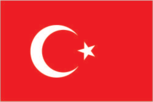
red with a vertical white crescent (the closed portion is toward the hoist side) and white five-pointed star centered just outside the crescent opening
Highways
total: 320,611 km paved: 27,000 km (including 138 km of expressways) unpaved: gravel 18,500 km; earth 275,111 km (1988)
Illicit drugs
major transit route for Southwest Asian heroin and hashish to Western Europe and the US via air, land, and sea routes; major Turkish, Iranian, and other international trafficking organizations operate out of Istanbul; laboratories to convert imported morphine base into heroin are in remote regions of Turkey as well as near Istanbul; government maintains strict controls over areas of legal opium poppy cultivation and output of poppy straw concentrate
Imports
$22.9 billion (c.i.f., 1992) commodities: manufactured products 68%, fuels 17%, foodstuffs 4% partners: EC countries 44%, US 11%, Saudi Arabia 7%, Russia 5%
Independence
29 October 1923 (successor state to the Ottoman Empire)
Industrial production
growth rate 4.3% (1992); accounts for 28% of GDP
Industries
textiles, food processing, mining (coal, chromite, copper, boron minerals), steel, petroleum, construction, lumber, paper
Infant mortality rate
48.8 deaths/1,000 live births (1994 est.)
Inflation rate (consumer prices)
65% (1993)
Inland waterways
about 1,200 km
International disputes
complex maritime and air (but not territorial) disputes with Greece in Aegean Sea; Cyprus question; Hatay question with Syria; ongoing dispute with downstream riparians (Syria and Iraq) over water development plans for the Tigris and Euphrates Rivers
Irrigated land
22,200 sq km (1989 est.)
Judicial branch
Court of Cassation
Labor force
20.8 million by occupation: agriculture 48%, services 32%, industry 20% note: about 1,800,000 Turks work abroad (1993)
Land boundaries
total 2,627 km, Armenia 268 km, Azerbaijan 9 km, Bulgaria 240 km, Georgia 252 km, Greece 206 km, Iran 499 km, Iraq 331 km, Syria 822 km
Land use
arable land: 30% permanent crops: 4% meadows and pastures: 12% forest and woodland: 26% other: 28%
Languages
Turkish (official), Kurdish, Arabic
Legal system
derived from various continental legal systems; accepts compulsory ICJ jurisdiction, with reservations
Legislative branch
unicameral
Life expectancy at birth
total population: 70.94 years male: 68.61 years female: 73.38 years (1994 est.)
Literacy
age 15 and over can read and write (1990 est.) total population: 81% male: 90% female: 71%
Location
Southwestern Asia (that part west of the Bosporus is sometimes included with Europe), bordering the Mediterranean Sea and Black Sea, between Bulgaria and Iran
Manpower availability
males age 15-49 16,112,783; fit for military service 9,828,853; reach military age (20) annually 614,252 (1994 est.)
Map references
Africa, Europe, Middle East, Standard Time Zones of the World
Maritime claims
exclusive economic zone: in Black Sea only - to the maritime boundary agreed upon with the former USSR territorial sea: 6 nm in the Aegean Sea, 12 nm in the Black Sea and in the Mediterranean Sea
Member of
AsDB, BIS, BSEC, CCC, CE, CERN (observer), COCOM, CSCE, EBRD, ECE, ECO, FAO, GATT, IAEA, IBRD, ICAO, ICC, ICFTU, IDA, IDB, IEA, IFAD, IFC, ILO, IMF, IMO, INMARSAT, INTELSAT, INTERPOL, IOC, IOM (observer), ISO, ITU, LORCS, NACC, NATO, NEA, OECD, OIC, PCA, UN, UNCTAD, UNESCO, UNHCR, UNIDO, UNIKOM, UNOSOM, UNRWA, UPU, WEU (associate), WFTU, WHO, WIPO, WMO, WTO
Merchant marine
390 ships (1,000 GRT or over) totaling 4,664,205 GRT/8,163,379 DWT, bulk 103, cargo 195, chemical tanker 10, combination bulk 5, combination ore/oil 12, container 2, liquefied gas 4, livestock carrier 1, oil tanker 41, passenger-cargo 1, refrigerated cargo 2, roll-on/roll-off cargo 5, short-sea passenger 7, specialized tanker 2
Names
conventional long form: Republic of Turkey conventional short form: Turkey local long form: Turkiye Cumhuriyeti local short form: Turkiye
National holiday
Anniversary of the Declaration of the Republic, 29 October (1923)
National product
GDP - purchasing power equivalent - $312.4 billion (1993)
National product per capita
$5,100 (1993)
National product real growth rate
7.3% (1993)
National Security Council
advisory body to the President and the Cabinet cabinet: Council of Ministers; appointed by the president on nomination of the prime minister
Nationality
noun: Turk(s) adjective: Turkish
Natural resources
antimony, coal, chromium, mercury, copper, borate, sulphur, iron ore
Net migration rate
0 migrant(s)/1,000 population (1994 est.)
Note
strategic location controlling the Turkish Straits (Bosporus, Sea of Marmara, Dardanelles) that link Black and Aegean Seas
Other political or pressure groups
Turkish Confederation of Labor (TURK-IS), Bayram MERAL
Overview
In early 1994, after an impressive economic performance through most of the 1980s, Turkey faces its most damaging economic crisis in the last 15 years. Sparked by the downgrading in mid-January of Turkey's international credit rating by two US credit rating agencies, the crisis stems from two years of loose fiscal and monetary policies that have exacerbated inflation and allowed the public debt, money supply, and current account deficit to explode. Under Prime Minister CILLER, Ankara has followed seriously flawed policies that have destroyed public confidence in the government's ability to manage the economy. Inflation is now running at an annual rate of 107% and the public sector deficit is equivalent to 16% of GDP. Turkish firms have been hurt by high interest rates and a dramatic drop in consumer demand. Three Turkish banks have folded and the stock market has fallen 48% since the beginning of the year. Economic growth may drop to between 0% and 2% in 1994, compared to 7.3% in 1993. Moreover, the government is facing a severe cash crunch. In March 1994, the treasury came close to defaulting on a loan, and official foreign currency reserves are equal to less than two months' worth of imports. The unprecedented effort by the Kurdistan Workers' Party (PKK) to raise the economic costs of its insurgency against the Turkish state is adding to Turkey's economic problems. Attacks against the tourism industry have cut tourist revenues, which account for about 3% of GDP, while economic activity in southeastern Turkey, where most of the violence occurs, has dropped considerably. To cope with the economic crisis and instill domestic and international investor confidence in the fragile coalition government, CILLER has asked the IMF to endorse a stabilization package she introduced in early April 1994. Negotiations are underway for a standby agreement, which would give Turkey access to $450 million this year and enable her cash-starved government to return to the foreign capital markets.
Pipelines
crude oil 1,738 km; petroleum products 2,321 km; natural gas 708 km
Political parties and leaders
Correct Way Party (DYP), Tansu CILLER; Motherland Party (ANAP), Mesut YILMAZ; Social Democratic Populist Party (SHP), Murat KARAYALCIN; Welfare Party (RP), Necmettin ERBAKAN; Democratic Left Party (DSP), Bulent ECEVIT; Nationalist Action Party (MHP), Alparslan TURKES; Democracy Party (DEP), Hatip DICLE; Socialist Unity Party (SBP), Sadun AREN; New Party (YP), Yusuf Bozkurt OZAL; Republican People's Party (CHP), Deniz BAYKAL; Labor Party (IP), Dogu PERINCEK; National Party (MP), Aykut EDIBALI; Democrat Party (DP), Aydin MENDERES; Grand Unity Party (BBP), Muhsin YAZICIOGLU; Rebirth Party (YDP), Hasan Celal GUZEL; People's Democracy Party (HADEP), Murat BOZLAK; Main Path Party (ANAYOL), Gurcan BASER; Democratic Target Party, Abdul Kadir Yasar TURK
Population
62,153,898 (July 1994 est.)
Population growth rate
2.02% (1994 est.)
Ports
Iskenderun, Istanbul, Mersin, Izmir
Railroads
8,429 km 1.435-meter gauge (including 795 km electrified)
Religions
Muslim 99.8% (mostly Sunni), other 0.2% (Christian and Jews)
Suffrage
21 years of age; universal
Telecommunications
fair domestic and international systems; trunk radio relay microwave network; limited open wire network; 3,400,000 telephones; broadcast stations - 15 AM; 94 FM; 357 TV; 1 satellite ground station operating in the INTELSAT (2 Atlantic Ocean antennas) and EUTELSAT systems; 1 submarine cable
Terrain
mostly mountains; narrow coastal plain; high central plateau (Anatolia)
Total fertility rate
3.21 children born/woman (1994 est.)
Turkish Grand National Assembly
- (Turkiye Buyuk Millet Meclisi) elections last held 20 October 1991 (next to be held NA October 1996); results - DYP 27.03%, ANAP 24.01%, SHP 20.75%, RP 16.88%, DSP 10.75%, SBP 0.44%, independent 0.14%; seats - (450 total) DYP 178, ANAP 115, SHP 86, RP 40, MCP 19, DSP 7, other 5 note: seats held by various parties are subject to change due to defections, creation of new parties, and ouster or death of sitting deputies;
- present seats by party are as follows
- DYP 178, ANAP 101, SHP 55, RP 39, CHP 18, MHP 13, DEP 13, BBP 7, DSP 3, YP 3, MP 2, independents 10, vacant 8
Type
republican parliamentary democracy
Unemployment rate
12.2% (1993)
US diplomatic representation
chief of mission: Ambassador Richard C. BARKLEY embassy: 110 Ataturk Boulevard, Ankara mailing address: PSC 93, Box 5000, Ankara, or APO AE 09823 telephone: [90] (312) 468-6110 through 6128