1991 Edition
CIA World Factbook 1991 (Project Gutenberg)
Geography
Climate
temperate; hot, dry summers with mild, wet winters; harsher in interior
Coastline
7,200 km
Comparative area
slightly larger than Texas
Disputes
complex maritime and air (but not territorial) disputes with Greece in Aegean Sea; Cyprus question; Hatay question with Syria; ongoing dispute with downstream riparians (Syria and Iraq) over water development plans for the Tigris and Euphrates rivers; Kurdish question among Iran, Iraq, Syria, Turkey, and the USSR
Environment
subject to severe earthquakes, especially along major river valleys in west; air pollution; desertification
Land boundaries
2,715 km total; Bulgaria 240 km, Greece 206 km, Iran 499 km, Iraq 331 km, Syria 822 km, USSR 617 km
Land use
arable land 30%; permanent crops 4%; meadows and pastures 12%; forest and woodland 26%; other 28%; includes irrigated 3%
Maritime claims
Exclusive economic zone: in Black Sea only--to the maritime boundary agreed upon with the USSR; Territorial sea: 6 nm in the Aegean Sea, 12 nm in Black Sea and Mediterranean Sea
Natural resources
antimony, coal, chromium, mercury, copper, borate, sulphur, iron ore
Note
strategic location controlling the Turkish straits (Bosporus, Sea of Marmara, Dardanelles) that link Black and Aegean Seas; Turkey and Norway only NATO members having a land boundary with the USSR
Terrain
mostly mountains; narrow coastal plain; high central plateau (Anatolia)
Total area
780,580 km2; land area: 770,760 km2
People and Society
Birth rate
28 births/1,000 population (1991)
Death rate
6 deaths/1,000 population (1991)
Ethnic divisions
Turkish 80%, Kurdish 17%, other 3% (est.)
Infant mortality rate
54 deaths/1,000 live births (1991)
Labor force
18,800,000; agriculture 56%, services 30%, industry 14%; about 1,000,000 Turks work abroad (1987)
Language
Turkish (official), Kurdish, Arabic
Life expectancy at birth
68 years male, 72 years female (1991)
Literacy
81% (male 90%, female 71%) age 15 and over can read and write (1990 est.)
Nationality
noun--Turk(s); adjective--Turkish
Net migration rate
0 migrants/1,000 population (1991)
Organized labor
10-15% of labor force
Population
58,580,993 (July 1991), growth rate 2.2% (1991)
Religion
Muslim (mostly Sunni) 99.8%, other (Christian and Jews) 0.2%
Total fertility rate
3.6 children born/woman (1991)
Government
Administrative divisions
73 provinces (iller, singular--il); Adana, Adiyaman, Afyon, Agri, Aksaray, Amasya, Ankara, Antalya, Artvin, Aydin, Balikesir, Batman, Bayburt, Bilecik, Bingol, Bitlis, Bolu, Burdur, Bursa, Canakkale, Cankiri, Corum, Denizli, Diyarbakir, Edirne, Elazig, Erzincan, Erzurum, Eskisehir, Gaziantep, Giresun, Gumushane, Hakkari, Hatay, Icel, Isparta, Istanbul, Izmir, Kahraman Maras, Karaman, Kars, Kastamonu, Kayseri, Kirikkale, Kirklareli, Kirsehir, Kocaeli, Konya, Kutahya, Malatya, Manisa, Mardin, Mugla, Mus, Nevsehir, Nigde, Ordu, Rize, Sakarya, Samsun, Siirt, Sinop, Sirnak, Sivas, Tekirdag, Tokat, Trabzon, Tunceli, Urfa, Usak, Van, Yozgat, Zonguldak
Capital
Ankara
Communists
strength and support negligible
Constitution
7 November 1982
Diplomatic representation
Ambassador Nuzhet KANDEMIR; Chancery at 1606 23rd Street NW, Washington DC 20008; telephone (202) 387-3200; there are Turkish Consulates General in Chicago, Houston, Los Angeles, and New York; US--Ambassador Morton ABRAMOWITZ; Embassy at 110 Ataturk Boulevard, Ankara (mailing address is APO New York 09257-0006); telephone [90] (4) 126 54 70; there are US Consulates General in Istanbul and Izmir, and a Consulate in Adana
Elections
Grand National Assembly--last held 29 November 1987 (next to be held November 1992); results--ANAP 36%, SHP 25%, DYP 19%, other 20%; seats--(450 total) ANAP 275, SHP 82, DYP 60, HEP 9, SBP 4, DMP 2, BAP 1, independent 6, vacant 11
Executive branch
president, Presidential Council, prime minister, deputy prime minister, Cabinet
Flag
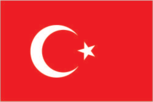
red with a vertical white crescent (the closed portion is toward the hoist side) and white five-pointed star centered just outside the crescent opening
Independence
29 October 1923 (successor state to the Ottoman Empire)
Judicial branch
Court of Cassation
Leaders
Chief of State--President Turgut OZAL (since 9 November 1989); Head of Government--Prime Minister Mesut YILMAZ (since 30 June 1991); Deputy Prime Minister Ekrem PAKDAMIRLI (since 30 June 1991)
Legal system
derived from various continental legal systems; accepts compulsory ICJ jurisdiction, with reservations
Legislative branch
unicameral Grand National Assembly (Buyuk Millet Meclisi)
Long-form name
Republic of Turkey
Member of
AsDB, BIS, CCC, CE, CERN (observer), COCOM, CSCE, EBRD, ECE, FAO, GATT, IAEA, IBRD, ICAO, ICC, ICFTU, IDA, IDB, IEA, IFAD, IFC, ILO, IMF, IMO, INTELSAT, INTERPOL, IOC, IOM (observer), ISO, ITU, LORCS, NATO, NEA, OECD, OIC, PCA, UN, UNCTAD, UNESCO, UNHCR, UNIDO, UNIIMOG, UNRWA, UPU, WHO, WIPO, WMO, WTO
National holiday
Anniversary of the Declaration of the Republic, 29 October (1923)
Political parties and leaders
Motherland Party (ANAP), Mesut YILMAZ; Social Democratic People's Party (SHP), Erdal INONU; Correct Way Party (DYP), Suleyman DEMIREL; People's Labor Party (HEP), Fehmi ISIKLAR; Socialist Unity Party (SBP), leader NA; Democratic Center Party (DMP), Bedrettin DALAN; Great Anatolia Party (BAP), leader NA; Democratic Left Party (DSP), Bulent ECEVIT; Refah Party (RP), Necmettin ERBAKAN; Democratic Center Party (DSP), Bedrettin DALAN; Grand National Party (GNP), leader NA
Suffrage
universal at age 21
Type
republican parliamentary democracy
Economy
Agriculture
accounts for 20% of GDP and employs majority of population; products--tobacco, cotton, grain, olives, sugar beets, pulses, citrus fruit, variety of animal products; self-sufficient in food most years
Budget
revenues $27.6 billion; expenditures $34.4 billion, including capital expenditures of $6.6 billion (1991)
Currency
Turkish lira (plural--liras); 1 Turkish lira (TL) = 100 kurus
Economic aid
US commitments, including Ex-Im (FY70-89), $2.3 billion; Western (non-US) countries, ODA and OOF bilateral commitments (1970-87), $8.6 billion; OPEC bilateral aid (1979-89), $665 million; Communist countries (1970-89), $4.5 billion
Electricity
14,315,000 kW capacity; 41,000 million kWh produced, 720 kWh per capita (1990)
Exchange rates
Turkish liras (TL) per US$1--2,873.9 (December 1990), 2,608.6 (1990), 2,121.7 (1989), 1,422.3 (1988), 857.2 (1987), 674.5 (1986), 522.0 (1985)
Exports
$11.8 billion (f.o.b., 1989); commodities--industrial products 78%, crops and livestock products 20%; partners--FRG 18%, Italy 8%, Iraq 8%, US 8%, UK 5%, France 4%
External debt
$42.8 billion (June 1990)
Fiscal year
calendar year
GDP
$178.0 billion, per capita $3,100; real growth rate 7.6% (1990)
Illicit drugs
one of the world's major suppliers of licit opiate products; government maintains strict controls over areas of opium poppy cultivation and output of poppy straw concentrate
Imports
$16.0 billion (f.o.b., 1989); commodities--crude oil, machinery, transport equipment, metals, pharmaceuticals, dyes, plastics, rubber, mineral fuels, fertilizers, chemicals; partners--FRG 15%, US 11%, Iraq 10%, Italy 7%, France 6%, UK 5%
Industrial production
growth rate 5.9% (1989 est.); accounts for 32% of GDP
Industries
textiles, food processing, mining (coal, chromite, copper, boron minerals), steel, petroleum, construction, lumber, paper
Inflation rate (consumer prices)
60.3% (1990)
Overview
The economic reforms that Turkey launched in 1980 continue to bring an impressive stream of benefits. The economy has grown steadily since the early 1980s, with real growth in per capita GDP increasing more than 6% annually. Agriculture remains the most important economic sector, employing about 55% of the labor force, accounting for almost 20% of GDP, and contributing about 20% to exports. Impressive growth in recent years has not solved all of the economic problems facing Turkey. Inflation and interest rates remain high, and a large budget deficit will continue to provide difficulties for a country undergoing a substantial transformation from a centrally controlled to a free market economy. The government has launched a multimillion-dollar development program in the southeastern region, which includes the building of a dozen dams on the Tigris and Euphrates rivers to generate electric power and irrigate large tracts of farmland. The planned tapping of huge additional quantities of Euphrates water has raised serious concern in the downstream riparian nations of Syria and Iraq.
Unemployment rate
10.4% (1990 est.)
Communications
Airports
115 total, 109 usable; 64 with permanent-surface runways; 3 with runways over 3,659 m; 30 with runways 2,440-3,659 m; 26 with runways 1,220-2,439 m
Civil air
39 major transport aircraft (1990)
Highways
49,615 km total; 26,915 km bituminous; 16,500 km gravel or crushed stone; 4,000 km improved earth; 2,200 km unimproved earth (1985)
Inland waterways
about 1,200 km
Merchant marine
340 ships (1,000 GRT or over) totaling 3,583,720 GRT/6,220,642 DWT; includes 8 short-sea passenger, 1 passenger-cargo, 190 cargo, 1 container, 4 roll-on/roll-off cargo, 3 refrigerated cargo, 1 livestock carrier, 37 petroleum, oils, and lubricants (POL) tanker, 9 chemical tanker, 2 liquefied gas, 7 combination ore/oil, 1 specialized tanker, 72 bulk, 4 combination bulk
Pipelines
1,738 km crude oil; 2,321 km refined products; 708 km natural gas
Ports
Iskenderun, Istanbul, Mersin, Izmir
Railroads
8,401 km 1.435-meter standard gauge; 479 km electrified
Telecommunications
fair domestic and international systems; trunk radio relay network; 3,400,000 telephones; stations--15 AM; 45 (60 repeaters) FM; 67 (504 repeaters) TV; satellite communications ground stations operating in the INTELSAT (2 Atlantic Ocean) and EUTELSAT systems; 1 submarine telephone cable
Military and Security
Branches
Land Forces, Navy (including Naval Air and Naval Infantry), Air Force, Coast Guard, Gendarmerie
Defense expenditures
$5.6 billion, 5% of GDP (1990) _%_
Manpower availability
males 15-49, 14,861,358; 9,083,559 fit for military service; 606,871 reach military age (20) annually