2005 Edition
CIA World Factbook 2005 (Project Gutenberg)
Introduction
Administrative divisions
24 governorates; Ariana (Aryanah), Beja (Bajah), Ben Arous (Bin 'Arus), Bizerte (Banzart), Gabes (Qabis), Gafsa (Qafsah), Jendouba (Jundubah), Kairouan (Al Qayrawan), Kasserine (Al Qasrayn), Kebili (Qibili), Kef (Al Kaf), Mahdia (Al Mahdiyah), Manouba (Manubah), Medenine (Madanin), Monastir (Al Munastir), Nabeul (Nabul), Sfax (Safaqis), Sidi Bou Zid (Sidi Bu Zayd), Siliana (Silyanah), Sousse (Susah), Tataouine (Tatawin), Tozeur (Tawzar), Tunis, Zaghouan (Zaghwan)
Age structure
0-14 years: 25.3% (male 1,316,308/female 1,234,309) 15-64 years: 68.1% (male 3,437,880/female 3,418,591) 65 years and over: 6.6% (male 321,287/female 346,576) (2005 est.)
Agriculture - products
olives, olive oil, grain, dairy products, tomatoes, citrus fruit, beef, sugar beets, dates, almonds
Airports
30 (2004 est.)
Airports - with paved runways
- total
- 14 over 3,047 m: 3 2,438 to 3,047 m: 6 1,524 to 2,437 m: 2 914 to 1,523 m: 3 (2004 est.)
Airports - with unpaved runways
- total
- 16 1,524 to 2,437 m: 2 914 to 1,523 m: 7 under 914 m: 7 (2004 est.) Military Tunisia
Area
- land
- 155,360 sq km
- total
- 163,610 sq km
- water
- 8,250 sq km
Area - comparative
slightly larger than Georgia
Background
Following independence from France in 1956, President Habib BOURGUIBA established a strict one-party state. He dominated the country for 31 years, repressing Islamic fundamentalism and establishing rights for women unmatched by any other Arab nation. In recent years, Tunisia has taken a moderate, non-aligned stance in its foreign relations. Domestically, it has sought to defuse rising pressure for a more open political society. Geography Tunisia
Birth rate
15.5 births/1,000 population (2005 est.)
Budget
- expenditures
- $7.573 billion, including capital expenditures of $1.6 billion (2004 est.)
- revenues
- $6.799 billion
Capital
Tunis
Climate
temperate in north with mild, rainy winters and hot, dry summers; desert in south
Coastline
1,148 km
Constitution
1 June 1959; amended 1988, 2002
Country name
- conventional long form
- Tunisian Republic
- conventional short form
- Tunisia
- local long form
- Al Jumhuriyah at Tunisiyah
- local short form
- Tunis
Currency (code)
Tunisian dinar (TND)
Currency code
TND
Current account balance
$71.85 million (2004 est.)
Death rate
5.09 deaths/1,000 population (2005 est.)
Debt - external
$14.71 billion (2004 est.)
Diplomatic representation from the US
- chief of mission
- Ambassador William J. HUDSON
- embassy
- Zone Nord-Est des Berges du Lac Nord de Tunis, 2045 La Goulette, Tunisia
- FAX
- [216] 71 962-115
- mailing address
- use embassy street address
- telephone
- [216] 71 107-000
Diplomatic representation in the US
- chancery
- 1515 Massachusetts Avenue NW, Washington, DC 20005
- chief of mission
- Ambassador Mohamed Nejib HACHANA
- FAX
- [1] (202) 862-1858
- telephone
- [1] (202) 862-1850
Disputes - international
none This page was last updated on 20 October, 2005 ======================================================================
Distribution of family income - Gini index
41.7 (1995)
Economic aid - recipient
$114.6 million (2002)
Economy - overview
Tunisia has a diverse economy, with important agricultural, mining, energy, tourism, and manufacturing sectors. Governmental control of economic affairs while still heavy has gradually lessened over the past decade with increasing privatization, simplification of the tax structure, and a prudent approach to debt. Progressive social policies also have helped raise living conditions in Tunisia relative to the region. Real growth slowed to a 15-year low of 1.9% in 2002 because of agricultural drought and lackluster tourism. Better rains in 2003 and 2004, however, helped push GDP growth above 5% for these years. Tourism also recovered after the end of combat operations in Iraq. Tunisia is gradually removing barriers to trade with the European Union. Broader privatization, further liberalization of the investment code to increase foreign investment, improvements in government efficiency, and reduction of the trade deficit are among the challenges ahead.
Electricity - consumption
10.05 billion kWh (2002)
Electricity - exports
10 million kWh (2002)
Electricity - imports
90 million kWh (2002)
Electricity - production
10.72 billion kWh (2002)
Electricity - production by source
- fossil fuel
- 99.5%
- hydro
- 0.5%
- nuclear
- 0%
- other
- 0% (2001)
Elevation extremes
- highest point
- Jebel ech Chambi 1,544 m
- lowest point
- Shatt al Gharsah -17 m
Environment - current issues
toxic and hazardous waste disposal is ineffective and poses health risks; water pollution from raw sewage; limited natural fresh water resources; deforestation; overgrazing; soil erosion; desertification
Environment - international agreements
- party to
- Biodiversity, Climate Change, Climate Change-Kyoto Protocol, Desertification, Endangered Species, Environmental Modification, Hazardous Wastes, Law of the Sea, Marine Dumping, Ozone Layer Protection, Ship Pollution, Wetlands signed, but not ratified: Marine Life Conservation
Ethnic groups
Arab 98%, European 1%, Jewish and other 1%
Exchange rates
Tunisian dinars per US dollar - 1.2455 (2004), 1.2885 (2003), 1.4217 (2002), 1.4387 (2001), 1.3707 (2000)
Executive branch
- cabinet
- Council of Ministers appointed by the president
- chief of state
- President Zine El Abidine BEN ALI (since 7 November 1987)
- election results
- President Zine El Abidine BEN ALI reelected for a fourth term; percent of vote - Zine El Abidine BEN ALI 94.5%, Mohamed BOUCHIHA 3.8%, Mohamed Ali HALOUANI 1%
- elections
- president elected by popular vote for a five-year term; election last held 24 October 2004 (next to be held October 2009); prime minister appointed by the president
- head of government
- Prime Minister Mohamed GHANNOUCHI (since 17 November 1999)
Exports
$9.926 billion f.o.b. (2004 est.)
Exports - commodities
textiles, mechanical goods, phosphates and chemicals, agricultural products, hydrocarbons
Exports - partners
France 33.1%, Italy 25.3%, Germany 9.2%, Spain 6.1% (2004)
Fiscal year
calendar year Communications Tunisia
Flag description
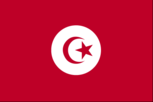
red with a white disk in the center bearing a red crescent nearly encircling a red five-pointed star; the crescent and star are traditional symbols of Islam Economy Tunisia
GDP - composition by sector
- agriculture
- 13.8%
- industry
- 31.8%
- services
- 54.4% (2004 est.)
GDP - per capita
purchasing power parity - $7,100 (2004 est.)
GDP - real growth rate
5.1% (2004 est.)
GDP (purchasing power parity)
$70.88 billion (2004 est.)
Geographic coordinates
34 00 N, 9 00 E
Geography - note
strategic location in central Mediterranean; Malta and Tunisia are discussing the commercial exploitation of the continental shelf between their countries, particularly for oil exploration People Tunisia
Government type
republic
Highways
- paved
- 12,424 km (including 142 km of expressways)
- total
- 18,997 km
- unpaved
- 6,573 km (2001)
HIV/AIDS - adult prevalence rate
less than 0.1% (2005 est.)
HIV/AIDS - deaths
less than 200 (2003 est.)
HIV/AIDS - people living with HIV/AIDS
1,000 (2003 est.)
Household income or consumption by percentage share
lowest 10%: 2.3% highest 10%: 31.8% (1995)
Imports
$11.52 billion f.o.b. (2004 est.)
Imports - commodities
textiles, machinery and equipment, hydrocarbons, chemicals, food
Imports - partners
France 25.1%, Italy 19%, Germany 8.5%, Spain 5.3% (2004)
Independence
20 March 1956 (from France)
Industrial production growth rate
4.4% (2004 est.)
Industries
petroleum, mining (particularly phosphate and iron ore), tourism, textiles, footwear, agribusiness, beverages
Infant mortality rate
- female
- 21.65 deaths/1,000 live births (2005 est.)
- male
- 27.68 deaths/1,000 live births
- total
- 24.77 deaths/1,000 live births
Inflation rate (consumer prices)
4.1% (2004 est.)
International organization participation
ABEDA, ACCT, AfDB, AFESD, AMF, AMU, AU, BSEC (observer), FAO, G-77, IAEA, IBRD, ICAO, ICC, ICFTU, ICRM, IDA, IDB, IFAD, IFC, IFRCS, IHO, ILO, IMF, IMO, Interpol, IOC, IOM, ISO, ITU, LAS, MIGA, MONUC, NAM, OAPEC, OAS (observer), OIC, ONUB, OPCW, OSCE (partner), UN, UNCTAD, UNESCO, UNHCR, UNIDO, UNMEE, UNOCI, UPU, WCO, WFTU, WHO, WIPO, WMO, WToO, WTO
Internet country code
.tn
Internet hosts
281 (2004)
Internet Service Providers (ISPs)
1 (2000)
Internet users
630,000 (2003) Transportation Tunisia
Investment (gross fixed)
24.5% of GDP (2004 est.)
Irrigated land
3,800 sq km (1998 est.)
Judicial branch
Court of Cassation or Cour de Cassation
Labor force
3.55 million note: shortage of skilled labor (2004 est.)
Labor force - by occupation
services 55%, industry 23%, agriculture 22% (1995 est.)
Land boundaries
- border countries
- Algeria 965 km, Libya 459 km
- total
- 1,424 km
Land use
- arable land
- 17.86%
- other
- 68.4% (2001)
- permanent crops
- 13.74%
Languages
Arabic (official and one of the languages of commerce), French (commerce)
Legal system
based on French civil law system and Islamic law; some judicial review of legislative acts in the Supreme Court in joint session
Legislative branch
- unicameral Chamber of Deputies or Majlis al-Nuwaab (189 seats; members elected by popular vote to serve five-year terms)
- election results
- percent of vote by party - NA; seats by party - RCD 152, MDS 14, PUP 11, UDU 7, Al-Tajdid 3, PSL 2
- elections
- last held 24 October 2004 (next to be held October 2009)
Life expectancy at birth
- female
- 76.71 years (2005 est.)
- male
- 73.2 years
- total population
- 74.89 years
Literacy
- definition: age 15 and over can read and write
- female
- 65.3% (2004 est.) Government Tunisia
- male
- 83.4%
- total population
- 74.3%
Location
Northern Africa, bordering the Mediterranean Sea, between Algeria and Libya
Major infectious diseases
- degree of risk
- intermediate
- food or waterborne diseases
- bacterial diarrhea, and hepatitis A
- vectorborne diseases
- may be a significant risk in some locations during the transmission season (typically April through November) (2004)
Manpower available for military service
males age 20-49: 2,441,741 (2005 est.)
Manpower fit for military service
males age 20-49: 2,035,431 (2005 est.)
Manpower reaching military service age annually
- males
- 108,817 (2005 est.)
Map references
Africa
Maritime claims
- contiguous zone
- 24 nm
- territorial sea
- 12 nm
Median age
- female
- 27.82 years (2005 est.)
- male
- 26.78 years
- total
- 27.29 years
Merchant marine
- by type
- bulk carrier 1, cargo 1, chemical tanker 5, passenger/cargo 4, petroleum tanker 1
- registered in other countries
- 3 (2005)
- total
- 12 ships (1,000 GRT or over) 124,733 GRT/122,664 DWT
Military branches
Army, Navy, Air Force (2003)
Military expenditures - dollar figure
$356 million (FY99)
Military expenditures - percent of GDP
1.5% (FY99) Transnational Issues Tunisia
Military service age and obligation
20 years of age for compulsory military service; conscript service obligation - 12 months; 18 years of age for voluntary military service (2004)
National holiday
Independence Day, 20 March (1956)
Nationality
- adjective
- Tunisian
- noun
- Tunisian(s)
Natural gas - consumption
3.83 billion cu m (2001 est.)
Natural gas - exports
0 cu m (2001 est.)
Natural gas - imports
1.58 billion cu m (2001 est.)
Natural gas - production
2.25 billion cu m (2001 est.)
Natural gas - proved reserves
77.16 billion cu m (2004)
Natural hazards
NA
Natural resources
petroleum, phosphates, iron ore, lead, zinc, salt
Net migration rate
-0.54 migrant(s)/1,000 population (2005 est.)
Oil - consumption
87,000 bbl/day (2001 est.)
Oil - exports
NA
Oil - imports
NA
Oil - production
72,580 bbl/day (2001 est.)
Oil - proved reserves
1.7 billion bbl (2004 est.)
Pipelines
gas 3,059 km; oil 1,203 km; refined products 345 km (2004)
Political parties and leaders
Al-Tajdid Movement [Ali HALOUANI]; Constitutional Democratic Rally Party (Rassemblement Constitutionnel Democratique) or RCD [President Zine El Abidine BEN ALI (official ruling party)]; Liberal Social Party or PSL [Mounir BEJI]; Movement of Socialist Democrats or MDS [Ismail BOULAHYA]; Popular Unity Party or PUP [Mohamed BOUCHIHA]; Progressive Democratic Party [Nejib CHEBBI]; Unionist Democratic Union or UDU [Abderrahmane TLILI]
Political pressure groups and leaders
the Islamic fundamentalist party, Al Nahda (Renaissance), is outlawed
Population
10,074,951 (July 2005 est.)
Population below poverty line
7.6% (2001 est.)
Population growth rate
0.99% (2005 est.)
Ports and harbors
Bizerte, Gabes, La Goulette, Skhira
Public debt
59.2% of GDP (2004 est.)
Radio broadcast stations
AM 7, FM 20, shortwave 2 (1998)
Radios
2.06 million (1997)
Railways
- dual gauge
- 10 km 1.435-m and 1.000-m gauges (three rails) (2004)
- narrow gauge
- 1,674 km 1.000-m gauge (65 km electrified)
- standard gauge
- 468 km 1.435-m gauge
- total
- 2,152 km
Religions
Muslim 98%, Christian 1%, Jewish and other 1%
Reserves of foreign exchange and gold
$3.509 billion (2004 est.)
Sex ratio
- at birth
- 1.07 male(s)/female under 15 years: 1.07 male(s)/female 15-64 years: 1.01 male(s)/female 65 years and over: 0.93 male(s)/female
- total population
- 1.02 male(s)/female (2005 est.)
Suffrage
20 years of age; universal
Telephone system
- domestic
- trunk facilities consist of open-wire lines, coaxial cable, and microwave radio relay
- general assessment
- above the African average and continuing to be upgraded; key centers are Sfax, Sousse, Bizerte, and Tunis; Internet access available
- international
- country code - 216; 5 submarine cables; satellite earth stations - 1 Intelsat (Atlantic Ocean) and 1 Arabsat; coaxial cable and microwave radio relay to Algeria and Libya; participant in Medarabtel; two international gateway digital switches
Telephones - main lines in use
1,163,800 (2003)
Telephones - mobile cellular
1,899,900 (2003)
Television broadcast stations
26 (plus 76 repeaters) (1995)
Televisions
920,000 (1997)
Terrain
mountains in north; hot, dry central plain; semiarid south merges into the Sahara
Total fertility rate
1.75 children born/woman (2005 est.)
Unemployment rate
13.8% (2004 est.)