1996 Edition
CIA World Factbook 1996 (Project Gutenberg)
Introduction
Description
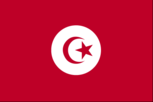
red with a white disk in the center bearing a red crescent nearly encircling a red five-pointed star; the crescent and star are traditional symbols of Islam
Location
34 00 N, 9 00 E -- Northern Africa, bordering the Mediterranean Sea, between Algeria and Libya Flag ----
Geography
Area
- comparative area
- slightly larger than Georgia
- land area
- 155,360 sq km
- total area
- 163,610 sq km
Climate
temperate in north with mild, rainy winters and hot, dry summers; desert in south
Coastline
1,148 km
Environment
- current issues
- toxic and hazardous waste disposal is ineffective and presents human health risks; water pollution from raw sewage; limited natural fresh water resources; deforestation; overgrazing; soil erosion; desertification
- international agreements
- party to - Biodiversity, Climate Change, Desertification, Endangered Species, Environmental Modification, Law of the Sea, Marine Dumping, Nuclear Test Ban, Ozone Layer Protection, Ship Pollution, Wetlands; signed, but not ratified - Hazardous Wastes, Marine Life Conservation
- natural hazards
- NA
Geographic coordinates
34 00 N, 9 00 E
Geographic note
strategic location in central Mediterranean
International disputes
maritime boundary dispute with Libya; land boundary dispute with Algeria settled in 1993; Malta and Tunisia are discussing the commercial exploitation of the continental shelf between their countries, particularly for oil exploration
Irrigated land
2,750 sq km (1989)
Land boundaries
- border countries
- Algeria 965 km, Libya 459 km
- total
- 1,424 km
Land use
- arable land
- 20%
- forest and woodland
- 4%
- meadows and pastures
- 19%
- other
- 47%
- permanent crops
- 10%
Location
Northern Africa, bordering the Mediterranean Sea, between Algeria and Libya
Map references
Africa
Maritime claims
- contiguous zone
- 24 nm
- territorial sea
- 12 nm
Natural resources
petroleum, phosphates, iron ore, lead, zinc, salt
Terrain
- mountains in north; hot, dry central plain; semiarid south merges into the Sahara
- highest point
- Jabal ash Shanabi 1,544 m
- lowest point
- Shatt al Gharsah -17 m
People and Society
Age structure
0-14 years: 34% (male 1,583,636; female 1,489,784) 15-64 years: 61% (male 2,738,013; female 2,719,998) 65 years and over: 5% (male 254,403; female 233,853) (July 1996 est.)
Birth rate
24.03 births/1,000 population (1996 est.)
Death rate
5.18 deaths/1,000 population (1996 est.)
Ethnic divisions
Arab-Berber 98%, European 1%, Jewish less than 1%
Infant mortality rate
35.1 deaths/1,000 live births (1996 est.)
Languages
Arabic (official and one of the languages of commerce), French (commerce)
Life expectancy at birth
- female
- 74.03 years (1996 est.)
- male
- 71.27 years
- total population
- 72.6 years
Literacy
- age 15 and over can read and write (1995 est.)
- female
- 54.6%
- male
- 78.6%
- total population
- 66.7%
Nationality
- adjective
- Tunisian
- noun
- Tunisian(s)
Net migration rate
-0.74 migrant(s)/1,000 population (1996 est.)
Population
9,019,687 (July 1996 est.)
Population growth rate
1.81% (1996 est.)
Religions
Muslim 98%, Christian 1%, Jewish 1%
Sex ratio
- all ages
- 1.03 male(s)/female (1996 est.)
- at birth
- 1.08 male(s)/female
- under 15 years
- 1.06 male(s)/female 15-64 years: 1.01 male(s)/female 65 years and over: 1.09 male(s)/female
Total fertility rate
2.92 children born/woman (1996 est.)
Government
Administrative divisions
23 governorates; Beja, Ben Arous, Bizerte, Gabes, Gafsa, Jendouba, Kairouan, Kasserine, Kebili, L'Ariana, Le Kef, Mahdia, Medenine, Monastir, Nabeul, Sfax, Sidi Bou Zid, Siliana, Sousse, Tataouine, Tozeur, Tunis, Zaghouan
Capital
Tunis
Chamber of Deputies (Majlis al-Nuwaab)
elections last held 20 March 1994 (next to be held NA 1999); results - RCD 97.7%, MDS 1.0%, others 1.3%; seats - (163 total) RCD 144, MDS 10, others 9; note - the government changed the electoral code to guarantee that the opposition won seats
Constitution
1 June 1959; amended 12 July 1988
Data code
TS
Diplomatic representation in US
- chancery
- 1515 Massachusetts Avenue NW, Washington, DC 20005
- chief of mission
- Ambassador Mohamed Azzouz ENNAIFER
- telephone
- [1] (202) 862-1850
Executive branch
- cabinet
- Council of Ministers was appointed by the president
- chief of state
- President Zine El Abidine BEN ALI (since 7 November 1987) was reelected for a five-year term by universal suffrage; election last held 20 March 1994 (next to be held NA 1999); results - President Zine El Abidine BEN ALI was reelected without opposition
- head of government
- Prime Minister Hamed KAROUI (since 26 September 1989) was appointed by the president
FAX
[216] (1) 789-719
Flag
red with a white disk in the center bearing a red crescent nearly encircling a red five-pointed star; the crescent and star are traditional symbols of Islam
Independence
20 March 1956 (from France)
International organization participation
ABEDA, ACCT, AfDB, AFESD, AL, AMF, AMU, BSEC (observer), CCC, ECA, FAO, G-77, IAEA, IBRD, ICAO, ICC, ICFTU, ICRM, IDA, IDB, IFAD, IFC, IFRCS, ILO, IMF, IMO, Intelsat, Interpol, IOC, ISO, ITU, MINURSO, NAM, OAS (observer), OAU, OIC, OSCE (partner), UN, UNAMIR, UNCRO, UNCTAD, UNESCO, UNHCR, UNIDO, UNITAR, UPU, WFTU, WHO, WIPO, WMO, WToO, WTrO
Judicial branch
Court of Cassation (Cour de Cassation)
Legal system
based on French civil law system and Islamic law; some judicial review of legislative acts in the Supreme Court in joint session
Legislative branch
unicameral
Name of country
- conventional long form
- Republic of Tunisia
- conventional short form
- Tunisia
- local long form
- Al Jumhuriyah at Tunisiyah
- local short form
- Tunis
National holiday
National Day, 20 March (1956)
Other political or pressure groups
the Islamic fundamentalist party, An Nahda (Rebirth), is outlawed
Political parties and leaders
Constitutional Democratic Rally Party (RCD), President BEN ALI (official ruling party); Movement of Democratic Socialists (MDS), Mohammed MOUAADA; five other political parties are legal, including the Communist Party
Suffrage
20 years of age; universal
Type of government
republic
US diplomatic representation
- chief of mission
- Ambassador Mary Ann CASEY
- embassy
- 144 Avenue de la Liberte, 1002 Tunis-Belvedere
- mailing address
- use embassy street address
- telephone
- [216] (1) 782-566
Economy
Agriculture
olives, dates, oranges, almonds, grain, sugar beets, grapes; poultry, beef, dairy products
Budget
- expenditures
- $5.5 billion, including capital expenditures to $NA (1993 est.)
- revenues
- $4.3 billion
Currency
1 Tunisian dinar (TD) = 1,000 millimes
Economic aid
- recipient
- ODA, $221 million (1993)
Economic overview
Tunisia has a diverse economy, with important agricultural, mining, energy, tourism, and manufacturing sectors. Detailed governmental control of economic affairs has gradually lessened over the past decade, including increasing privatization of trade and commerce, simplification of the tax structure, and a cautious approach to debt. Real growth has averaged 4.2% in 1991-95, and inflation has been moderate. Growth in tourism and IMF support have been key elements in this solid record. Drought, especially in the south, held back GDP growth in 1995. Further privatization and further improvements in government administrative efficiency are among the challenges for the future.
Electricity
- capacity
- 1,410,000 kW
- consumption per capita
- 595 kWh (1993)
- production
- 5.4 billion kWh
Exchange rates
Tunisian dinars (TD) per US$1 - 0.9635 (January 1996), 0.9458 (1995), 1.0116 (1994), 1.0037 (1993), 0.8844 (1992), 0.9246 (1991)
Exports
- $4.7 billion (f.o.b., 1994)
- commodities
- hydrocarbons, agricultural products, phosphates and chemicals
- partners
- EU countries 75%, Middle East 10%, Algeria 2%, India 2%, US 1%
External debt
$7.7 billion (1993 est.)
Fiscal year
calendar year
GDP
purchasing power parity - $37.1 billion (1994 est.)
GDP composition by sector
- agriculture
- 15%
- industry
- 30%
- services
- 55% (1995 est.)
GDP per capita
$4,250 (1994 est.)
GDP real growth rate
4.4% (1994 est.)
Imports
- $6.6 billion (c.i.f., 1994)
- commodities
- industrial goods and equipment 57%, hydrocarbons 13%, food 12%, consumer goods
- partners
- EU countries 70%, US 5%, Middle East 2%, Japan 2%, Switzerland 1%, Algeria 1%
Industrial production growth rate
5% (1989)
Industries
petroleum, mining (particularly phosphate and iron ore), tourism, textiles, footwear, food, beverages
Inflation rate (consumer prices)
5.5% (1995 est.)
Labor force
- 2.917 million (1993 est.)
- by occupation
- services 55%, industry 23%, agriculture 22% (1995 est.)
- note
- shortage of skilled labor
Unemployment rate
16.2% (1993 est.)
Communications
Branches
Army, Navy, Air Force, paramilitary forces, National Guard
Defense expenditures
exchange rate conversion - $535 million, 2.8% of GDP (1995)
Manpower availability
- males age 15-49
- 2,354,513
- males fit for military service
- 1,349,728
- males reach military age (20) annually
- 91,866 (1996 est.)
Radio broadcast stations
AM 7, FM 8, shortwave 0
Radios
1,693,527 (1991 est.)
Telephone system
- the system is above the African average; key centers are Sfax, Sousse, Bizerte, and Tunis
- domestic
- trunk facilities consist of open-wire lines, coaxial cable, and microwave radio relay
- international
- 5 submarine cables; satellite earth stations - 1 Intelsat (Atlantic Ocean) and 1 Arabsat with back-up control station; coaxial cable and microwave radio relay to Algeria and Libya; participant in Medarabtel
Telephones
233,000 (1987 est.)
Television broadcast stations
19
Televisions
670,000 (1992 est.) Defense
Transportation
Airports
- total
- 29
- with paved runways 1 524 to 2 437 m
- 3
- with paved runways 2 438 to 3 047 m
- 6
- with paved runways 914 to 1 523 m
- 3
- with paved runways over 3 047 m
- 3
- with paved runways under 914 m
- 6
- with unpaved runways 1 524 to 2 437 m
- 2
- with unpaved runways 914 to 1 523 m
- 6 (1995 est.)
Highways
- paved
- 17,510 km (including 52 km of expressways)
- total
- 29,183 km
- unpaved
- 11,673 km (1989 est.)
Merchant marine
- ships by type
- bulk 6, cargo 4, chemical tanker 3, oil tanker 2, roll-on/roll-off cargo 3, short-sea passenger 1 (1995 est.)
- total
- 19 ships (1,000 GRT or over) totaling 125,840 GRT/164,277 DWT
Pipelines
crude oil 797 km; petroleum products 86 km; natural gas 742 km
Ports
Bizerte, Gabes, La Goulette, Sfax, Sousse, Tunis, Zarzis
Railways
- dual gauge
- 10 km 1.000-m and 1.435-m gauges (1993 est.)
- narrow gauge
- 1,758 km 1.000-m gauge
- standard gauge
- 492 km 1.435-m gauge
- total
- 2,260 km