2022 Edition
CIA World Factbook 2022 (factbook.json @ 61dadec0c9c9)
Introduction
Background
From the 11th to the 16th centuries, various ethnic groups settled the Togo region. From the 16th to the 18th centuries, the coastal region became a major trading center for enslaved people, and the surrounding region took on the name of "The Slave Coast." In 1884, Germany declared a region including present-day Togo as a protectorate called Togoland. After World War I, rule over Togo was transferred to France. French Togoland became Togo upon independence in 1960. Gen. Gnassingbe EYADEMA, installed as military ruler in 1967, ruled Togo with a heavy hand for almost four decades. Despite the facade of multi-party elections instituted in the early 1990s, the government was largely dominated by President EYADEMA, whose Rally of the Togolese People (RPT) party has been in power almost continually since 1967 and its successor, the Union for the Republic, maintains a majority of seats in today's legislature. Upon EYADEMA's death in February 2005, the military installed the president's son, Faure GNASSINGBE, and then engineered his formal election two months later. Togo held its first relatively free and fair legislative elections in October 2007. Since then, President GNASSINGBE has started the country along a gradual path to democratic reform. Togo has held multiple presidential and legislative elections, and in 2019 held its first local elections in 32 years. Despite those positive moves, political reconciliation has moved slowly, and the country experiences periodic outbursts of protests by frustrated citizens that have led to violence between security forces and protesters. Constitutional changes in 2019 to institute a runoff system in presidential elections and to establish term limits has done little to reduce the resentment many Togolese feel after more than 50 years of one-family rule. GNASSINGBE became eligible for his current fourth term and one additional fifth term under the new rules. The next presidential election will be in 2025.
Geography
Area
- land
- 54,385 sq km
- total
- 56,785 sq km
- water
- 2,400 sq km
Area - comparative
slightly smaller than West Virginia
Climate
tropical; hot, humid in south; semiarid in north
Coastline
56 km
Elevation
- highest point
- Mont Agou 986 m
- lowest point
- Atlantic Ocean 0 m
- mean elevation
- 236 m
Geographic coordinates
8 00 N, 1 10 E
Geography - note
the country's length allows it to stretch through six distinct geographic regions; climate varies from tropical to savanna
Irrigated land
70 sq km (2012)
Land boundaries
- border countries
- Benin 651 km; Burkina Faso 131 km; Ghana 1,098 km
- total
- 1,880 km
Land use
- agricultural land
- 67.4% (2018 est.)
- agricultural land: arable land
- arable land: 45.2% (2018 est.)
- agricultural land: permanent crops
- permanent crops: 3.8% (2018 est.)
- agricultural land: permanent pasture
- permanent pasture: 18.4% (2018 est.)
- forest
- 4.9% (2018 est.)
- other
- 27.7% (2018 est.)
Location
Western Africa, bordering the Bight of Benin, between Benin and Ghana
Major watersheds (area sq km)
Atlantic Ocean drainage: Volta (410,991 sq km)
Map references
Africa
Maritime claims
- exclusive economic zone
- 200 nm
- territorial sea
- 30 nm; note: the US does not recognize this claim
Natural hazards
hot, dry harmattan wind can reduce visibility in north during winter; periodic droughts
Natural resources
phosphates, limestone, marble, arable land
Population distribution
one of the more densely populated African nations with most of the population residing in rural communities, density is highest in the south on or near the Atlantic coast as shown in this population distribution map
Terrain
gently rolling savanna in north; central hills; southern plateau; low coastal plain with extensive lagoons and marshes
People and Society
Age structure
- 0-14 years
- 39.73% (male 1,716,667/female 1,703,230)
- 15-24 years
- 19.03% (male 817,093/female 820,971)
- 25-54 years
- 33.26% (male 1,423,554/female 1,439,380)
- 55-64 years
- 4.42% (male 179,779/female 200,392)
- 65 years and over
- 3.57% (male 132,304/female 175,074) (2020 est.)
Alcohol consumption per capita
- beer
- 0.78 liters of pure alcohol (2019 est.)
- other alcohols
- 0.33 liters of pure alcohol (2019 est.)
- spirits
- 0.2 liters of pure alcohol (2019 est.)
- total
- 1.4 liters of pure alcohol (2019 est.)
- wine
- 0.09 liters of pure alcohol (2019 est.)
Birth rate
31.86 births/1,000 population (2022 est.)
Child marriage
- men married by age 18
- 2.6% (2017 est.)
- women married by age 15
- 6.4%
- women married by age 18
- 24.8%
Children under the age of 5 years underweight
15.2% (2017)
Contraceptive prevalence rate
23.9% (2017)
Current health expenditure
5.7% of GDP (2019)
Death rate
5.27 deaths/1,000 population (2022 est.)
Demographic profile
Togo’s population is estimated to have grown to four times its size between 1960 and 2010. With nearly 60% of its populace under the age of 25 and a high annual growth rate attributed largely to high fertility, Togo’s population is likely to continue to expand for the foreseeable future. Reducing fertility, boosting job creation, and improving education will be essential to reducing the country’s high poverty rate. In 2008, Togo eliminated primary school enrollment fees, leading to higher enrollment but increased pressure on limited classroom space, teachers, and materials. Togo has a good chance of achieving universal primary education, but educational quality, the underrepresentation of girls, and the low rate of enrollment in secondary and tertiary schools remain concerns.Togo is both a country of emigration and asylum. In the early 1990s, southern Togo suffered from the economic decline of the phosphate sector and ethnic and political repression at the hands of dictator Gnassingbe EYADEMA and his northern, Kabye-dominated administration. The turmoil led 300,000 to 350,000 predominantly southern Togolese to flee to Benin and Ghana, with most not returning home until relative stability was restored in 1997. In 2005, another outflow of 40,000 Togolese to Benin and Ghana occurred when violence broke out between the opposition and security forces over the disputed election of EYADEMA’s son Faure GNASSINGBE to the presidency. About half of the refugees reluctantly returned home in 2006, many still fearing for their safety. Despite ethnic tensions and periods of political unrest, Togo in September 2017 was home to more than 9,600 refugees from Ghana.
Dependency ratios
- elderly dependency ratio
- 5.5
- potential support ratio
- 18.3 (2021 est.)
- total dependency ratio
- 76.5
- youth dependency ratio
- 71
Drinking water source
- improved: rural
- rural: 60.3% of population
- improved: total
- total: 74.6% of population
- improved: urban
- urban: 93.8% of population
- unimproved: rural
- rural: 39.7% of population
- unimproved: total
- total: 25.4% of population (2020 est.)
- unimproved: urban
- urban: 6.2% of population
Education expenditures
4% of GDP (2020 est.)
Ethnic groups
- Adja-Ewe/Mina 42.4%, Kabye/Tem 25.9%, Para-Gourma/Akan 17.1%, Akposso/Akebu 4.1%, Ana-Ife 3.2%, other Togolese 1.7%, foreigners 5.2%, no response 0.4% (2013-14 est.)
- note
- note: Togo has an estimated 37 ethnic groups
HIV/AIDS - adult prevalence rate
1.9% (2021 est.)
Hospital bed density
0.7 beds/1,000 population (2011)
Infant mortality rate
- female
- 36.36 deaths/1,000 live births (2022 est.)
- male
- 45.88 deaths/1,000 live births
- total
- 41.19 deaths/1,000 live births
Languages
French (official, the language of commerce), Ewe and Mina (the two major African languages in the south), Kabye (sometimes spelled Kabiye) and Dagomba (the two major African languages in the north)
Life expectancy at birth
- female
- 74.03 years (2022 est.)
- male
- 68.76 years
- total population
- 71.36 years
Literacy
- definition
- age 15 and over can read and write
- female
- 55.1% (2019)
- male
- 80%
- total population
- 66.5%
Major infectious diseases
- animal contact diseases
- rabies
- degree of risk
- very high (2020)
- food or waterborne diseases
- bacterial and protozoal diarrhea, hepatitis A, and typhoid fever
- respiratory diseases
- meningococcal meningitis
- vectorborne diseases
- malaria, dengue fever, and yellow fever
- water contact diseases
- schistosomiasis
Major urban areas - population
1.982 million LOME (capital) (2023)
Maternal mortality ratio
396 deaths/100,000 live births (2017 est.)
Median age
- female
- 20.3 years (2020 est.)
- male
- 19.7 years
- total
- 20 years
Mother's mean age at first birth
- 25 years (2017 est.)
- note
- note: data represents median age at first birth among women 25-29
Nationality
- adjective
- Togolese
- noun
- Togolese (singular and plural)
Net migration rate
-1.81 migrant(s)/1,000 population (2022 est.)
Obesity - adult prevalence rate
8.4% (2016)
Physicians density
0.08 physicians/1,000 population (2020)
Population
8,492,333 (2022 est.)
Population distribution
one of the more densely populated African nations with most of the population residing in rural communities, density is highest in the south on or near the Atlantic coast as shown in this population distribution map
Population growth rate
2.48% (2022 est.)
Religions
Christian 42.3%, folk religion 36.9%, Muslim 14%, Hindu <1%, Buddhist <1%, Jewish <1%, other <1%, none 6.2% (2020 est.)
Sanitation facility access
- improved: rural
- rural: 18.3% of population
- improved: total
- total: 45.5% of population
- improved: urban
- urban: 81.9% of population
- unimproved: rural
- rural: 81.7% of population
- unimproved: total
- total: 54.5% of population (2020 est.)
- unimproved: urban
- urban: 18.1% of population
School life expectancy (primary to tertiary education)
- female
- 12 years (2017)
- male
- 14 years
- total
- 13 years
Sex ratio
- 0-14 years
- 1.03 male(s)/female
- 15-24 years
- 1 male(s)/female
- 25-54 years
- 0.94 male(s)/female
- 55-64 years
- 0.85 male(s)/female
- 65 years and over
- 0.55 male(s)/female
- at birth
- 1.03 male(s)/female
- total population
- 0.97 male(s)/female (2022 est.)
Tobacco use
- female
- 1.2% (2020 est.)
- male
- 12.3% (2020 est.)
- total
- 6.8% (2020 est.)
Total fertility rate
4.23 children born/woman (2022 est.)
Urbanization
- rate of urbanization
- 3.6% annual rate of change (2020-25 est.)
- urban population
- 44.5% of total population (2023)
Youth unemployment rate (ages 15-24)
- female
- 7.4% (2017 est.)
- male
- 12.3%
- total
- 9.5%
Government
Administrative divisions
5 regions (regions, singular - region); Centrale, Kara, Maritime, Plateaux, Savanes
Capital
- etymology
- Lome comes from "alotime" which in the native Ewe language means "among the alo plants"; alo trees dominated the city's original founding site
- geographic coordinates
- 6 07 N, 1 13 E
- name
- Lome
- time difference
- UTC 0 (5 hours ahead of Washington, DC, during Standard Time)
Citizenship
- citizenship by birth
- no
- citizenship by descent only
- at least one parent must be a citizen of Togo
- dual citizenship recognized
- yes
- residency requirement for naturalization
- 5 years
Constitution
- amendments
- proposed by the president of the republic or supported by at least one fifth of the National Assembly membership; passage requires four-fifths majority vote by the Assembly; a referendum is required if approved by only two-thirds majority of the Assembly or if requested by the president; constitutional articles on the republican and secular form of government cannot be amended; amended 2002, 2007, last in 2019 when the National Assembly unanimously approved a package of amendments, including setting presidential term limits of two 5-year mandates
- history
- several previous; latest adopted 27 September 1992, effective 14 October 1992
Country name
- conventional long form
- Togolese Republic
- conventional short form
- Togo
- etymology
- derived from the Ewe words "to" (river) and "godo" (on the other side) to give the sense of "on the other side of the river"; originally, this designation applied to the town of Togodo (now Togoville) on the northern shore of Lake Togo, but the name was eventually extended to the entire nation
- former
- French Togoland
- local long form
- Republique Togolaise
- local short form
- none
Diplomatic representation from the US
- chief of mission
- Ambassador Elizabeth FITZSIMMONS (since 26 April 2022)
- email address and website
- consularLome@state.govhttps://tg.usembassy.gov/
- embassy
- Boulevard Eyadema, B.P. 852, Lome
- FAX
- [228] 2261-5501
- mailing address
- 2300 Lome Place, Washington, DC 20521-2300
- telephone
- [228] 2261-5470
Diplomatic representation in the US
- chancery
- 2208 Massachusetts Avenue NW, Washington, DC 20008
- chief of mission
- Ambassador Frederic Edem HEGBE (since 24 April 2017)
- email address and website
- embassyoftogo@hotmail.comhttps://embassyoftogousa.com/
- FAX
- [1] (202) 232-3190
- telephone
- [1] (202) 234-4212
Executive branch
- cabinet
- Council of Ministers appointed by the president on the advice of the prime minister
- chief of state
- President Faure GNASSINGBE (since 4 May 2005)
- election results
- Faure GNASSINGBE reelected president; percent of vote - Faure GNASSINGBE (UNIR) 70.8%, Agbeyome KODJO (MPDD) 19.5%, Jean-Pierre FABRE (ANC) 4.7%, other 5% (2020)
- elections/appointments
- president directly elected by simple majority popular vote for a 5-year term (no term limits); election last held on 22 February 2020 (next to be held February 2025); prime minister appointed by the president
- head of government
- Prime Minister Victoire Tomegah DOGBE (since 28 September 2020)
Flag description
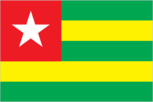
- five equal horizontal bands of green (top and bottom) alternating with yellow; a white five-pointed star on a red square is in the upper hoist-side corner; the five horizontal stripes stand for the five different regions of the country; the red square is meant to express the loyalty and patriotism of the people, green symbolizes hope, fertility, and agriculture, while yellow represents mineral wealth and faith that hard work and strength will bring prosperity; the star symbolizes life, purity, peace, dignity, and Togo's independence
- note
- note: uses the popular Pan-African colors of Ethiopia
Government type
presidential republic
Independence
27 April 1960 (from French-administered UN trusteeship)
International law organization participation
accepts compulsory ICJ jurisdiction with reservations; non-party state to the ICCt
International organization participation
ACP, AfDB, AU, ECOWAS, EITI (compliant country), Entente, FAO, FZ, G-77, IAEA, IBRD, ICAO, ICRM, IDA, IDB, IFAD, IFC, IFRCS, ILO, IMF, IMO, Interpol, IOC, IOM, IPU, ISO (correspondent), ITSO, ITU, ITUC (NGOs), MIGA, MINURSO, MINUSMA, NAM, OIC, OIF, OPCW, PCA, UN, UNAMID, UNCTAD, UNESCO, UNHCR, UNIDO, UNMIL, UNOCI, UNWTO, UPU, WADB (regional), WAEMU, WCO, WFTU (NGOs), WHO, WIPO, WMO, WTO
Judicial branch
- highest court(s)
- Supreme Court or Cour Supreme (organized into criminal and administrative chambers, each with a chamber president and advisors); Constitutional Court (consists of 9 judges, including the court president)
- judge selection and term of office
- Supreme Court president appointed by decree of the president of the republic upon the proposal of the Supreme Council of the Magistracy, a 9-member judicial, advisory, and disciplinary body; other judicial appointments and judge tenure NA; Constitutional Court judges appointed by the National Assembly; judge tenure NA
- subordinate courts
- Court of Assizes (sessions court); Appeal Court; tribunals of first instance (divided into civil, commercial, and correctional chambers; Court of State Security; military tribunal
Legal system
customary law system
Legislative branch
- description
- unicameral National Assembly or Assemblee Nationale (91 seats; members directly elected in multi-seat constituencies by closed, party-list proportional representation vote to serve 5-year terms)
- election results
- percent of vote by coalition/party - NA; seats by party - UNIR 59, UFC 6, NET 3, MPDD 3, other 2, independent 18; composition - men 74, women 17, percent of women 18.7%
- elections
- last held on 20 December 2018 (next to be held in 2023)
National anthem
- lyrics/music
- Alex CASIMIR-DOSSEH
- name
- "Salut a toi, pays de nos aieux" (Hail to Thee, Land of Our Forefathers)
- note
- note: adopted 1960, restored 1992; this anthem was replaced by another during one-party rule between 1979 and 1992
National heritage
- selected World Heritage Site locales
- Koutammakou; the Land of the Batammariba
- total World Heritage Sites
- 1 (cultural)
National holiday
Independence Day, 27 April (1960)
National symbol(s)
lion; national colors: green, yellow, red, white
Political parties and leaders
Action Committee for Renewal or CAR [Dodji APEVON]Alliance of Democrats for Integral Development or ADDI [Tchaboure GOGUE]Democratic Convention of African Peoples or CDPA [Léopold GNININVI]Democratic Forces for the Republic or FDR [Dodji APEVON]National Alliance for Change or ANC [Jean-Pierre FABRE]New Togolese Commitment [Gerry TAAMA]Pan-African National Party or PNP [Tikpi ATCHADAM]Pan-African Patriotic Convergence or CPP [Edem KODJO]Patriotic Movement for Democracy and Development or MPDD [Agbeyome KODJO] Socialist Pact for Renewal or PSR [Abi TCHESSA]The Togolese Party [Nathaniel OLYMPIO]Union of Forces for Change or UFC [N/A]Union for the Republic or UNIR [Faure GNASSINGBE]
Suffrage
18 years of age; universal
Economy
Agricultural products
cassava, maize, yams, sorghum, beans, oil palm fruit, rice, vegetables, cotton, groundnuts
Budget
- expenditures
- 1.203 billion (2017 est.)
- revenues
- 1.023 billion (2017 est.)
Budget surplus (+) or deficit (-)
-3.8% (of GDP) (2017 est.)
Credit ratings
- Moody's rating
- B3 (2019)
- note
- note: The year refers to the year in which the current credit rating was first obtained.
- Standard & Poors rating
- B (2019)
Current account balance
- Current account balance 2016
- -$416 million (2016 est.)
- Current account balance 2017
- -$383 million (2017 est.)
Debt - external
- Debt - external 31 December 2016
- $1.22 billion (31 December 2016 est.)
- Debt - external 31 December 2017
- $1.442 billion (31 December 2017 est.)
Economic overview
Togo has enjoyed a period of steady economic growth fueled by political stability and a concerted effort by the government to modernize the country’s commercial infrastructure, but discontent with President Faure GNASSINGBE has led to a rapid rise in protests, creating downside risks. The country completed an ambitious large-scale infrastructure improvement program, including new principal roads, a new airport terminal, and a new seaport. The economy depends heavily on both commercial and subsistence agriculture, providing employment for around 60% of the labor force. Some basic foodstuffs must still be imported. Cocoa, coffee, and cotton and other agricultural products generate about 20% of export earnings with cotton being the most important cash crop. Togo is among the world's largest producers of phosphate and seeks to develop its carbonate phosphate reserves, which provide more than 20% of export earnings. Supported by the World Bank and the IMF, the government's decade-long effort to implement economic reform measures, encourage foreign investment, and bring revenues in line with expenditures has moved slowly. Togo completed its IMF Extended Credit Facility in 2011 and reached a Heavily Indebted Poor Country debt relief completion point in 2010 at which 95% of the country's debt was forgiven. Togo continues to work with the IMF on structural reforms, and in January 2017, the IMF signed an Extended Credit Facility arrangement consisting of a three-year $238 million loan package. Progress depends on follow through on privatization, increased transparency in government financial operations, progress toward legislative elections, and continued support from foreign donors. Togo’s 2017 economic growth probably remained steady at 5.0%, largely driven by infusions of foreign aid, infrastructure investment in its port and mineral industry, and improvements in the business climate. Foreign direct investment inflows have slowed in recent years.
Exchange rates
- Currency
- Communaute Financiere Africaine francs (XOF) per US dollar -
- Exchange rates 2013
- 494.42 (2013 est.)
- Exchange rates 2014
- 591.45 (2014 est.)
- Exchange rates 2015
- 593.01 (2015 est.)
- Exchange rates 2016
- 593.01 (2016 est.)
- Exchange rates 2017
- 617.4 (2017 est.)
Exports
- Exports 2018
- $1.7 billion (2018 est.) note: data are in current year dollars
- Exports 2019
- $1.67 billion (2019 est.) note: data are in current year dollars
Exports - commodities
refined petroleum, crude petroleum, electricity, calcium phosphates, cotton (2019)
Exports - partners
India 16%, Benin 15%, Burkina Faso 6%, France 6%, Morocco 5% (2019)
Fiscal year
calendar year
GDP - composition, by end use
- exports of goods and services
- 43.1% (2017 est.)
- government consumption
- 11.4% (2017 est.)
- household consumption
- 84.5% (2017 est.)
- imports of goods and services
- -61% (2017 est.)
- investment in fixed capital
- 23.4% (2017 est.)
- investment in inventories
- -1.4% (2017 est.)
GDP - composition, by sector of origin
- agriculture
- 28.8% (2017 est.)
- industry
- 21.8% (2017 est.)
- services
- 49.8% (2017 est.)
GDP (official exchange rate)
$5.232 billion (2018 est.)
Gini Index coefficient - distribution of family income
- Gini Index coefficient - distribution of family income 2015
- 43.1 (2015 est.)
Household income or consumption by percentage share
- highest 10%
- 27.1% (2006)
- lowest 10%
- 3.3%
Imports
- Imports 2018
- $2.33 billion (2018 est.) note: data are in current year dollars
- Imports 2019
- $2.26 billion (2019 est.) note: data are in current year dollars
Imports - commodities
refined petroleum, motorcycles, crude petroleum, rice, broadcasting equipment (2019)
Imports - partners
China 18%, South Korea 13%, India 11%, Belgium 10%, Netherlands 8%, United States 5% (2019)
Industrial production growth rate
5% (2017 est.)
Industries
phosphate mining, agricultural processing, cement, handicrafts, textiles, beverages
Inflation rate (consumer prices)
- Inflation rate (consumer prices) 2017
- -0.9% (2017 est.)
- Inflation rate (consumer prices) 2018
- 0.9% (2018 est.)
- Inflation rate (consumer prices) 2019
- 0.6% (2019 est.)
Labor force
2.595 million (2007 est.)
Labor force - by occupation
- agriculture
- 65%
- industry
- 5%
- services
- 30% (1998 est.)
Population below poverty line
55.1% (2015 est.)
Public debt
- Public debt 2016
- 81.6% of GDP (2016 est.)
- Public debt 2017
- 75.7% of GDP (2017 est.)
Real GDP (purchasing power parity)
- note
- note: data are in 2017 dollars
- Real GDP (purchasing power parity) 2018
- $16.26 billion (2018 est.)
- Real GDP (purchasing power parity) 2019
- $17.15 billion (2019 est.)
- Real GDP (purchasing power parity) 2020
- $17.45 billion (2020 est.)
Real GDP growth rate
- Real GDP growth rate 2015
- 5.7% (2015 est.)
- Real GDP growth rate 2016
- 5.1% (2016 est.)
- Real GDP growth rate 2017
- 4.4% (2017 est.)
Real GDP per capita
- note
- note: data are in 2017 dollars
- Real GDP per capita 2018
- $2,100 (2018 est.)
- Real GDP per capita 2019
- $2,100 (2019 est.)
- Real GDP per capita 2020
- $2,100 (2020 est.)
Reserves of foreign exchange and gold
- Reserves of foreign exchange and gold 31 December 2016
- $42.6 million (31 December 2016 est.)
- Reserves of foreign exchange and gold 31 December 2017
- $77.8 million (31 December 2017 est.)
Taxes and other revenues
21.5% (of GDP) (2017 est.)
Unemployment rate
- Unemployment rate 2016
- 6.9% (2016 est.)
Youth unemployment rate (ages 15-24)
- female
- 7.4% (2017 est.)
- male
- 12.3%
- total
- 9.5%
Energy
Carbon dioxide emissions
- from coal and metallurgical coke
- 706,000 metric tonnes of CO2 (2019 est.)
- from consumed natural gas
- 87,000 metric tonnes of CO2 (2019 est.)
- from petroleum and other liquids
- 1.451 million metric tonnes of CO2 (2019 est.)
- total emissions
- 2.244 million metric tonnes of CO2 (2019 est.)
Coal
- consumption
- 46,000 metric tons (2020 est.)
- exports
- 0 metric tons (2020 est.)
- imports
- 46,000 metric tons (2020 est.)
- production
- 0 metric tons (2020 est.)
- proven reserves
- 0 metric tons (2019 est.)
Electricity
- consumption
- 1,180,140,000 kWh (2019 est.)
- exports
- 118 million kWh (2019 est.)
- imports
- 963 million kWh (2019 est.)
- installed generating capacity
- 210,000 kW (2020 est.)
- transmission/distribution losses
- 210 million kWh (2019 est.)
Electricity access
- electrification - rural areas
- 19% (2019)
- electrification - total population
- 43% (2019)
- electrification - urban areas
- 77% (2019)
Electricity generation sources
- biomass and waste
- 0% of total installed capacity (2020 est.)
- fossil fuels
- 82.2% of total installed capacity (2020 est.)
- geothermal
- 0% of total installed capacity (2020 est.)
- hydroelectricity
- 17.2% of total installed capacity (2020 est.)
- nuclear
- 0% of total installed capacity (2020 est.)
- solar
- 0.6% of total installed capacity (2020 est.)
- tide and wave
- 0% of total installed capacity (2020 est.)
- wind
- 0% of total installed capacity (2020 est.)
Energy consumption per capita
- Total energy consumption per capita 2019
- 4.113 million Btu/person (2019 est.)
Natural gas
- consumption
- 0 cubic meters (2020 est.)
- exports
- 0 cubic meters (2021 est.)
- imports
- 44.797 million cubic meters (2019 est.)
- production
- 0 cubic meters (2021 est.)
- proven reserves
- 0 cubic meters (2021 est.)
Petroleum
- crude oil and lease condensate exports
- 0 bbl/day (2018 est.)
- crude oil and lease condensate imports
- 0 bbl/day (2018 est.)
- crude oil estimated reserves
- 0 barrels (2021 est.)
- refined petroleum consumption
- 10,000 bbl/day (2019 est.)
- total petroleum production
- 0 bbl/day (2021 est.)
Refined petroleum products - exports
0 bbl/day (2015 est.)
Refined petroleum products - imports
13,100 bbl/day (2015 est.)
Refined petroleum products - production
0 bbl/day (2015 est.)
Communications
Broadband - fixed subscriptions
- subscriptions per 100 inhabitants
- 0.6 (2020 est.)
- total
- 52,706 (2020 est.)
Broadcast media
1 state-owned TV station with multiple transmission sites; five private TV stations broadcast locally; cable TV service is available; state-owned radio network with two stations (in Lome and Kara); several dozen private radio stations and a few community radio stations; transmissions of multiple international broadcasters available (2019)
Internet country code
.tg
Internet users
- percent of population
- 24% (2020 est.)
- total
- 1,986,897 (2020 est.)
Telecommunication systems
- domestic
- fixed-line less than 1 per 100 and mobile-cellular nearly 79 telephones per 100 persons with mobile-cellular use predominating (2020)
- general assessment
- system based on a network of microwave radio relay routes supplemented by open-wire lines and a mobile-cellular system; telecoms supply 8% of GDP; 3 mobile operators; 12% of residents have access to the Internet; mobile subscribers and mobile broadband both increasing (2020)
- international
- country code - 228; landing point for the WACS submarine cable, linking countries along the west coast of Africa with each other and with Portugal; satellite earth stations - 1 Intelsat (Atlantic Ocean), 1 Symphonie (2020)
- note
- note: the COVID-19 pandemic continues to have a significant impact on production and supply chains globally; since 2020, some aspects of the telecom sector have experienced a downturn, particularly in mobile device production; progress toward 5G implementation has resumed, as well as upgrades to infrastructure; consumer spending on telecom services has increased due to the surge in demand for capacity and bandwidth; the crucial nature of telecom services as a tool for work and school from home is still evident, and the spike in this area has seen growth opportunities for development of new tools and increased services
Telephones - fixed lines
- subscriptions per 100 inhabitants
- 1 (2020 est.)
- total subscriptions
- 46,499 (2020 est.)
Telephones - mobile cellular
- subscriptions per 100 inhabitants
- 77.2 (2019)
- total subscriptions
- 6,239,180 (2019)
Transportation
Airports
- total
- 8 (2021)
Airports - with paved runways
- 2,438 to 3,047 m
- 2 (2021)
- total
- 2
Airports - with unpaved runways
- 914 to 1,523 m
- 4
- total
- 6
- under 914 m
- 2 (2021)
Civil aircraft registration country code prefix
5V
Merchant marine
- by type
- bulk carrier 1, container ship 9, general cargo 265, oil tanker 56, other 80 (2021)
- total
- 411
National air transport system
- annual freight traffic on registered air carriers
- 10.89 million (2018) mt-km
- annual passenger traffic on registered air carriers
- 566,295 (2018)
- inventory of registered aircraft operated by air carriers
- 8
- number of registered air carriers
- 1 (2020)
Pipelines
62 km gas
Ports and terminals
- major seaport(s)
- Kpeme, Lome
Railways
- narrow gauge
- 568 km (2014) 1.000-m gauge
- total
- 568 km (2014)
Roadways
- paved
- 1,794 km (2018)
- total
- 9,951 km (2018)
- unpaved
- 8,157 km (2018)
- urban
- 1,783 km (2018)
Waterways
50 km (2011) (seasonally navigable by small craft on the Mono River depending on rainfall)
Military and Security
Maritime threats
the International Maritime Bureau reports the territorial and offshore waters in the Niger Delta and Gulf of Guinea remain a very high risk for piracy and armed robbery of ships; in 2021, there were 34 reported incidents of piracy and armed robbery at sea in the Gulf of Guinea region; although a significant decrease from the total number of 81 incidents in 2020, it included the one hijacking and three of five ships fired upon worldwide; while boarding and attempted boarding to steal valuables from ships and crews are the most common types of incidents, almost a third of all incidents involve a hijacking and/or kidnapping; in 2021, 57 crew members were kidnapped in seven separate incidents in the Gulf of Guinea, representing 100% of kidnappings worldwide; Nigerian pirates in particular are well armed and very aggressive, operating as far as 200 nm offshore; the Maritime Administration of the US Department of Transportation has issued a Maritime Advisory (2022-001 - Gulf of Guinea-Piracy/Armed Robbery/Kidnapping for Ransom) effective 4 January 2022, which states in part, "Piracy, armed robbery, and kidnapping for ransom continue to serve as significant threats to US-flagged vessels transiting or operating in the Gulf of Guinea"
Military - note
the first Togolese Army unit was created in 1963, while the Air Force was established in 1964; the Navy was not established until 1976; since its creation, the Togolese military has a history of interfering in the country’s politics with assassinations, coups, influence, and a large military crackdown in 2005 that killed hundreds; over the past decade, it has made some efforts to reform and professionalize, as well as increase its role in UN peacekeeping activities; Togolese police have also been deployed on peacekeeping operations, and Togo maintains a regional peacekeeping training center for military and police in Lome; the Navy and Air Force has increased focus on combating piracy and smuggling in the Gulf of Guinea in June 2022, the Togolese Government declared a state of emergency in its northern border region due to the threat from Jama'at Nasr al-Islam wal Muslimin (JNIM), a coalition of al-Qa'ida-affiliated militant groups based in Mali that also operates in neighboring Burkina Faso; the declaration followed an attack on a Togolese military post in May that killed 8 soldiers and a Togolese military operation launched the same month to boost border security and prevent terrorist infiltrations (2022)
Military and security forces
- Togolese Armed Forces (Forces Armees Togolaise, FAT): Togolese Army (l'Armee de Terre), Togolese Navy (Forces Naval Togolaises), Togolese Air Force (Armee de l’Air), National Gendarmerie (Gendarmerie Nationale Togolaise or GNT) (2022)
- note
- note: the GNT falls under the Ministry of the Armed Forces but also reports to the Ministry of Security and Civil Protection on many matters involving law enforcement and internal security
Military and security service personnel strengths
- approximately 11,000 personnel (6,500 Army; 500 Air and Navy; 3,000 Gendarmerie) (2022)
- note
- note: in January 2022, the Togolese Government announced its intent to boost the size of the FAT to more than 20,000 by 2025
Military deployments
730 (plus about 300 police) Mali (MINUSMA) (May 2022)
Military equipment inventories and acquisitions
the FAT has a small, mixed inventory of mostly older equipment from a variety of countries, including Brazil, China, France, Germany, Russia/former Soviet Union, South Africa, the UK, and the US (2022)
Military expenditures
- Military Expenditures 2017
- 1.9% of GDP (2017 est.) (approximately $130 million)
- Military Expenditures 2018
- 1.9% of GDP (2018 est.) (approximately $140 million)
- Military Expenditures 2019
- 2.6% of GDP (2019 est.) (approximately $190 million)
- Military Expenditures 2020
- 2% of GDP (2020 est.)
- Military Expenditures 2021
- 1.8% of GDP (2021 est.)
Military service age and obligation
18 years of age for military service; 2-year service obligation; no conscription; women have been able to serve since 2007 (2022)
Transnational Issues
Disputes - international
Togo-Benin: in 2001, Benin claimed Togo moved boundary monuments - joint commission continues to resurvey the boundary; Benin’s and Togo’s Adjrala hydroelectric dam project on the Mona River, proposed in the 1990s, commenced in 2017 with funding from a Chinese bank Togo-Burkina Faso: none identified Togo-Ghana: none identified
Illicit drugs
transit hub for Nigerian heroin and cocaine traffickers; money laundering not a significant problem
Refugees and internally displaced persons
- refugees (country of origin)
- 8,391 (Ghana) (2022)
Terrorism
Terrorist group(s)
- Jama’at Nusrat al Islam wal Muslimeen (JNIM)
- note
- note: details about the history, aims, leadership, organization, areas of operation, tactics, targets, weapons, size, and sources of support of the group(s) appear(s) in Appendix-T
Environment
Air pollutants
- carbon dioxide emissions
- 3 megatons (2016 est.)
- methane emissions
- 3.06 megatons (2020 est.)
- particulate matter emissions
- 32.71 micrograms per cubic meter (2016 est.)
Climate
tropical; hot, humid in south; semiarid in north
Environment - current issues
deforestation attributable to slash-and-burn agriculture and the use of wood for fuel; very little rain forest still present and what remains is highly degraded; desertification; water pollution presents health hazards and hinders the fishing industry; air pollution increasing in urban areas
Environment - international agreements
- party to
- Biodiversity, Climate Change, Climate Change-Kyoto Protocol, Climate Change-Paris Agreement, Comprehensive Nuclear Test Ban, Desertification, Endangered Species, Hazardous Wastes, Law of the Sea, Nuclear Test Ban, Ozone Layer Protection, Ship Pollution, Tropical Timber 2006, Wetlands, Whaling
- signed, but not ratified
- none of the selected agreements
Land use
- agricultural land
- 67.4% (2018 est.)
- agricultural land: arable land
- arable land: 45.2% (2018 est.)
- agricultural land: permanent crops
- permanent crops: 3.8% (2018 est.)
- agricultural land: permanent pasture
- permanent pasture: 18.4% (2018 est.)
- forest
- 4.9% (2018 est.)
- other
- 27.7% (2018 est.)
Major infectious diseases
- animal contact diseases
- rabies
- degree of risk
- very high (2020)
- food or waterborne diseases
- bacterial and protozoal diarrhea, hepatitis A, and typhoid fever
- respiratory diseases
- meningococcal meningitis
- vectorborne diseases
- malaria, dengue fever, and yellow fever
- water contact diseases
- schistosomiasis
Major watersheds (area sq km)
Atlantic Ocean drainage: Volta (410,991 sq km)
Revenue from coal
- coal revenues
- 0% of GDP (2018 est.)
Revenue from forest resources
- forest revenues
- 3.96% of GDP (2018 est.)
Total renewable water resources
14.7 billion cubic meters (2017 est.)
Total water withdrawal
- agricultural
- 76 million cubic meters (2017 est.)
- industrial
- 6.3 million cubic meters (2017 est.)
- municipal
- 140.7 million cubic meters (2017 est.)
Urbanization
- rate of urbanization
- 3.6% annual rate of change (2020-25 est.)
- urban population
- 44.5% of total population (2023)
Waste and recycling
- municipal solid waste generated annually
- 1,109,030 tons (2014 est.)
- municipal solid waste recycled annually
- 22,181 tons (2012 est.)
- percent of municipal solid waste recycled
- 2% (2012 est.)