2003 Edition
CIA World Factbook 2003 (Project Gutenberg)
Introduction
Administrative divisions
5 regions (regions, singular - region); De La Kara, Des Plateaux, Des Savanes, Centrale, Maritime
Age structure
0-14 years: 44.5% (male 1,211,252; female 1,203,564) 15-64 years: 53% (male 1,404,763; female 1,473,360) 65 years and over: 2.5% (male 57,535; female 78,825) (2003 est.)
Agriculture - products
coffee, cocoa, cotton, yams, cassava (tapioca), corn, beans, rice, millet, sorghum; livestock; fish
Airports
9 (2002)
Airports - with paved runways
- total
- 2 2,438 to 3,047 m: 2 (2002)
Airports - with unpaved runways
- total
- 7 914 to 1,523 m: 5
- under 914 m
- 2 (2002) Military Togo
Area
- land
- 54,385 sq km
- total
- 56,785 sq km
- water
- 2,400 sq km
Area - comparative
slightly smaller than West Virginia
Background
French Togoland became Togo in 1960. Gen. Gnassingbe EYADEMA, installed as military ruler in 1967, is Africa's longest-serving head of state. Despite the facade of multiparty elections instituted in the early 1990s, the government continues to be dominated by President EYADEMA, whose Rally of the Togolese People (RPT) party has maintained power almost continually since 1967. In addition, Togo has come under fire from international organizations for human rights abuses and is plagued by political unrest. Most bilateral and multilateral aid to Togo remains frozen. Geography Togo
Birth rate
35.23 births/1,000 population (2003 est.)
Budget
- expenditures
- $252 million, including capital expenditures of $NA (1997 est.)
- revenues
- $232 million
Capital
Lome
Climate
tropical; hot, humid in south; semiarid in north
Coastline
56 km
Constitution
multiparty draft constitution approved by High Council of the Republic 1 July 1992; adopted by public referendum 27 September 1992
Country name
- conventional long form
- Togolese Republic
- conventional short form
- Togo
- former
- French Togoland
- local long form
- Republique Togolaise
- local short form
- none
Currency
Communaute Financiere Africaine franc (XOF); note - responsible authority is the Central Bank of the West African States
Currency code
XOF
Death rate
11.51 deaths/1,000 population (2003 est.)
Debt - external
$1.4 billion (2000)
Diplomatic representation from the US
- chief of mission
- Ambassador Gregory ENGLE
- embassy
- Angle Rue Kouenou and Rue 15 Beniglato, Lome
- mailing address
- B. P. 852, Lome
- telephone
- [228] 221 29 91 through 221 29 94
Diplomatic representation in the US
- chief of mission
- Ambassador Akoussoulelou BODJONA
Disputes - international
in 2001 Benin claimed Togo moved boundary monuments - joint commission presently resurveying the boundary
Economic aid - recipient
ODA $80 million (2000 est.)
Economy - overview
This small sub-Saharan economy is heavily dependent on both commercial and subsistence agriculture, which provides employment for 65% of the labor force. Some basic foodstuffs must still be imported. Cocoa, coffee, and cotton generate about 40% of export earnings, with cotton being the most important cash crop. Togo is the world's fourth-largest producer of phosphate, but production fell an estimated 22% in 2002 due to power shortages and the cost of developing new deposits. The government's decade-long effort, supported by the World Bank and the IMF, to implement economic reform measures, encourage foreign investment, and bring revenues in line with expenditures has moved slowly. Progress depends on following through on privatization, increased openness in government financial operations, progress toward legislative elections, and continued support from foreign donors.
Electricity - consumption
614.5 million kWh (2001)
Electricity - exports
0 kWh (2001)
Electricity - imports
520 million kWh; note - electricity supplied by Ghana (2001)
Electricity - production
101.6 million kWh (2001)
Electricity - production by source
- fossil fuel
- 98.7%
- hydro
- 1.3%
- nuclear
- 0%
- other
- 0% (2001)
Elevation extremes
- highest point
- Mont Agou 986 m
- lowest point
- Atlantic Ocean 0 m
Environment - current issues
deforestation attributable to slash-and-burn agriculture and the use of wood for fuel; water pollution presents health hazards and hinders the fishing industry; air pollution increasing in urban areas
Environment - international agreements
- party to
- Biodiversity, Climate Change, Desertification, Endangered Species, Law of the Sea, Nuclear Test Ban, Ozone Layer Protection, Ship Pollution, Tropical Timber 83, Tropical Timber 94, Wetlands
- signed, but not ratified
- none of the selected agreements
Ethnic groups
native African (37 tribes; largest and most important are Ewe, Mina, and Kabre) 99%, European and Syrian-Lebanese less than 1%
Exchange rates
Communaute Financiere Africaine francs (XOF) per US dollar - 696.99 (2002), 733.04 (2001), 711.98 (2000), 615.7 (1999), 589.95 (1998)
Executive branch
- cabinet
- Council of Ministers appointed by the president and the prime minister
- chief of state
- President Gen. Gnassingbe EYADEMA (since 14 April 1967)
- election results
- Gnassingbe EYADEMA reelected president; percent of vote - Gnassingbe EYADEMA 57.2%, Emmanuel Akitani BOB 34.1%, Yawovi AGBOYIBO 5.2%, Maurice Dahuku PERE 2.3%, Edem KODJO 1.0%
- elections
- president elected by popular vote for a five-year term; election last held 1 June 2003 (next to be held NA June 2008); prime minister appointed by the president
- head of government
- Prime Minister Koffi SAMA (since 29 June 2002)
Exports
$449 million f.o.b. (2002)
Exports - commodities
reexports, cotton, phosphates, coffee, cocoa
Exports - partners
Ghana 17.7%, Benin 13.3%, Burkina Faso 8.2%, Philippines 4.9%, Niger 4.1% (2002)
FAX
- [1] (202) 232-3190
- [228] 221 79 52
- chancery
- 2208 Massachusetts Avenue NW, Washington, DC 20008
- telephone
- [1] (202) 234-4212
Fiscal year
calendar year Communications Togo
Flag description
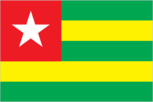
five equal horizontal bands of green (top and bottom) alternating with yellow; there is a white five-pointed star on a red square in the upper hoist-side corner; uses the popular pan-African colors of Ethiopia Economy Togo
GDP
purchasing power parity - $7.594 billion (2002 est.)
GDP - composition by sector
- agriculture
- 42%
- industry
- 21%
- services
- 37% (2001 est.)
GDP - per capita
purchasing power parity - $1,400 (2002 est.)
GDP - real growth rate
2.9% (2002 est.)
Geographic coordinates
8 00 N, 1 10 E
Geography - note
the country's length allows it to stretch through six distinct geographic regions; climate varies from tropical to savanna People Togo
Government type
republic under transition to multiparty democratic rule
Highways
- paved
- 2,376 km
- total
- 7,520 km
- unpaved
- 5,144 km (1999 est.)
HIV/AIDS - adult prevalence rate
6% (2001 est.)
HIV/AIDS - deaths
12,000 (2001 est.)
HIV/AIDS - people living with HIV/AIDS
150,000 (2001 est.)
Household income or consumption by percentage share
- highest 10%
- NA%
- lowest 10%
- NA%
Illicit drugs
transit hub for Nigerian heroin and cocaine traffickers; money laundering not a significant problem This page was last updated on 18 December, 2003
Imports
$561 million f.o.b. (2002)
Imports - commodities
machinery and equipment, foodstuffs, petroleum products
Imports - partners
France 21.3%, China 17%, Netherlands 6.5%, Germany 5.3%, UK 4.8%, Italy 4.4% (2002)
Independence
27 April 1960 (from French-administered UN trusteeship)
Industrial production growth rate
NA%
Industries
phosphate mining, agricultural processing, cement; handicrafts, textiles, beverages
Infant mortality rate
- female
- 60.65 deaths/1,000 live births (2003 est.)
- male
- 76.58 deaths/1,000 live births
- total
- 68.73 deaths/1,000 live births
Inflation rate (consumer prices)
4% (2002 est.)
International organization participation
ACCT, ACP, AfDB, ECA, ECOWAS, Entente, FAO, FZ, G-77, IBRD, ICAO, ICC, ICFTU, ICRM, IDA, IDB, IFAD, IFC, IFRCS, ILO, IMF, IMO, Interpol, IOC, ITU, MIPONUH, NAM, OAU, OIC, OPCW, UN, UNCTAD, UNESCO, UNIDO, UPU, WADB (regional), WAEMU, WCL, WCO, WFTU, WHO, WIPO, WMO, WToO, WTrO
Internet country code
.tg
Internet Service Providers (ISPs)
3 (2001)
Internet users
50,000 (2002) Transportation Togo
Irrigated land
70 sq km (1998 est.)
Judicial branch
Court of Appeal or Cour d'Appel; Supreme Court or Cour Supreme
Labor force
1.74 million (1996)
Labor force - by occupation
agriculture 65%, industry 5%, services 30% (1998 est.)
Land boundaries
- border countries
- Benin 644 km, Burkina Faso 126 km, Ghana 877 km
- total
- 1,647 km
Land use
- arable land
- 41.37%
- other
- 56.79% (1998 est.)
- permanent crops
- 1.84%
Languages
French (official and the language of commerce), Ewe and Mina (the two major African languages in the south), Kabye (sometimes spelled Kabiye) and Dagomba (the two major African languages in the north)
Legal system
French-based court system
Legislative branch
- unicameral National Assembly (81 seats; members are elected by popular vote to serve five-year terms)
- election results
- percent of vote by party - NA%; seats by party - RPT 72, RSD 3, UDPS 2, Juvento 2, MOCEP 1, independents 1
- elections
- last held 27 October 2002 (next NA 2007)
- note
- two opposition parties boycotted the election, the Union of the Forces for Change, and the Action Committee for Renewal
Life expectancy at birth
- female
- 55.45 years (2003 est.)
- male
- 51.47 years
- total population
- 53.43 years
Literacy
- definition
- age 15 and over can read and write
- female
- 46.9% (2003 est.) Government Togo
- male
- 75.4%
- total population
- 60.9%
Location
Western Africa, bordering the Bight of Benin, between Benin and Ghana
Map references
Africa
Maritime claims
- exclusive economic zone
- 200 NM
- territorial sea
- 30 NM
Median age
- female
- 17.7 years (2002)
- male
- 16.9 years
- total
- 17.3 years
Merchant marine
- convenience
- Greece 1 (2002 est.)
- note
- includes a foreign-owned ship registered here as a flag of
- ships by type
- cargo 1, specialized tanker 1
- total
- 2 ships (1,000 GRT or over) 3,918 GRT/3,852 DWT
Military branches
Army, Navy, Air Force, Gendarmerie
Military expenditures - dollar figure
$23.72 million (FY02)
Military expenditures - percent of GDP
1.8% (FY02) Transnational Issues Togo
Military manpower - availability
- males age 15-49
- 1,270,146 (2003 est.)
Military manpower - fit for military service
- males age 15-49
- 666,132 (2003 est.)
National holiday
Independence Day, 27 April (1960)
Nationality
- adjective
- Togolese
- noun
- Togolese (singular and plural)
Natural hazards
hot, dry harmattan wind can reduce visibility in north during winter; periodic droughts
Natural resources
phosphates, limestone, marble, arable land
Net migration rate
0 migrant(s)/1,000 population (2003 est.)
Oil - consumption
10,000 bbl/day (2001 est.)
Oil - exports
NA (2001)
Oil - imports
NA (2001)
Oil - production
0 bbl/day (2001 est.)
Political parties and leaders
- Juvento [Monsilia DJATO]; Movement of the Believers of Peace and Equality or MOCEP [leader NA]; Rally for the Support for Development and Democracy or RSDD [Hanay OLYMPIO]; Rally of the Togolese People or RPT [President Gnassingbe EYADEMA]; Union for Democracy and Social Progress or UDPS [Gagou KOKOU]
- note
- Rally of the Togolese People or RPT, led by President EYADEMA, was the only party until the formation of multiple parties was legalized 12 April 1991
Political pressure groups and leaders
NA
Population
- 5,429,299
- note
- estimates for this country explicitly take into account the effects of excess mortality due to AIDS; this can result in lower life expectancy, higher infant mortality and death rates, lower population and growth rates, and changes in the distribution of population by age and sex than would otherwise be expected (July 2003 est.)
Population below poverty line
32% (1989 est.)
Population growth rate
2.37% (2003 est.)
Ports and harbors
Kpeme, Lome
Radio broadcast stations
AM 2, FM 9, shortwave 4 (1998)
Radios
940,000 (1997)
Railways
- narrow gauge
- 525 km 1.000-m gauge (2002)
- total
- 525 km
Religions
indigenous beliefs 51%, Christian 29%, Muslim 20%
Sex ratio
- at birth
- 1.03 male(s)/female
- total population
- 0.97 male(s)/female (2003 est.)
- under 15 years
- 1.01 male(s)/female 15-64 years: 0.95 male(s)/female 65 years and over: 0.73 male(s)/female
Suffrage
NA years of age; universal adult
Telephone system
- domestic
- microwave radio relay and open-wire lines for conventional system; cellular system has capacity of 10,000 telephones
- general assessment
- fair system based on a network of microwave radio relay routes supplemented by open-wire lines and a mobile cellular system
- international
- satellite earth stations - 1 Intelsat (Atlantic Ocean) and 1 Symphonie
Telephones - main lines in use
25,000 (1997)
Telephones - mobile cellular
2,995 (1997)
Television broadcast stations
3 (plus two repeaters) (1997)
Televisions
73,000 (1997)
Terrain
gently rolling savanna in north; central hills; southern plateau; low coastal plain with extensive lagoons and marshes
Total fertility rate
4.97 children born/woman (2003 est.)
Unemployment rate
NA%
Waterways
50 km (Mono river)